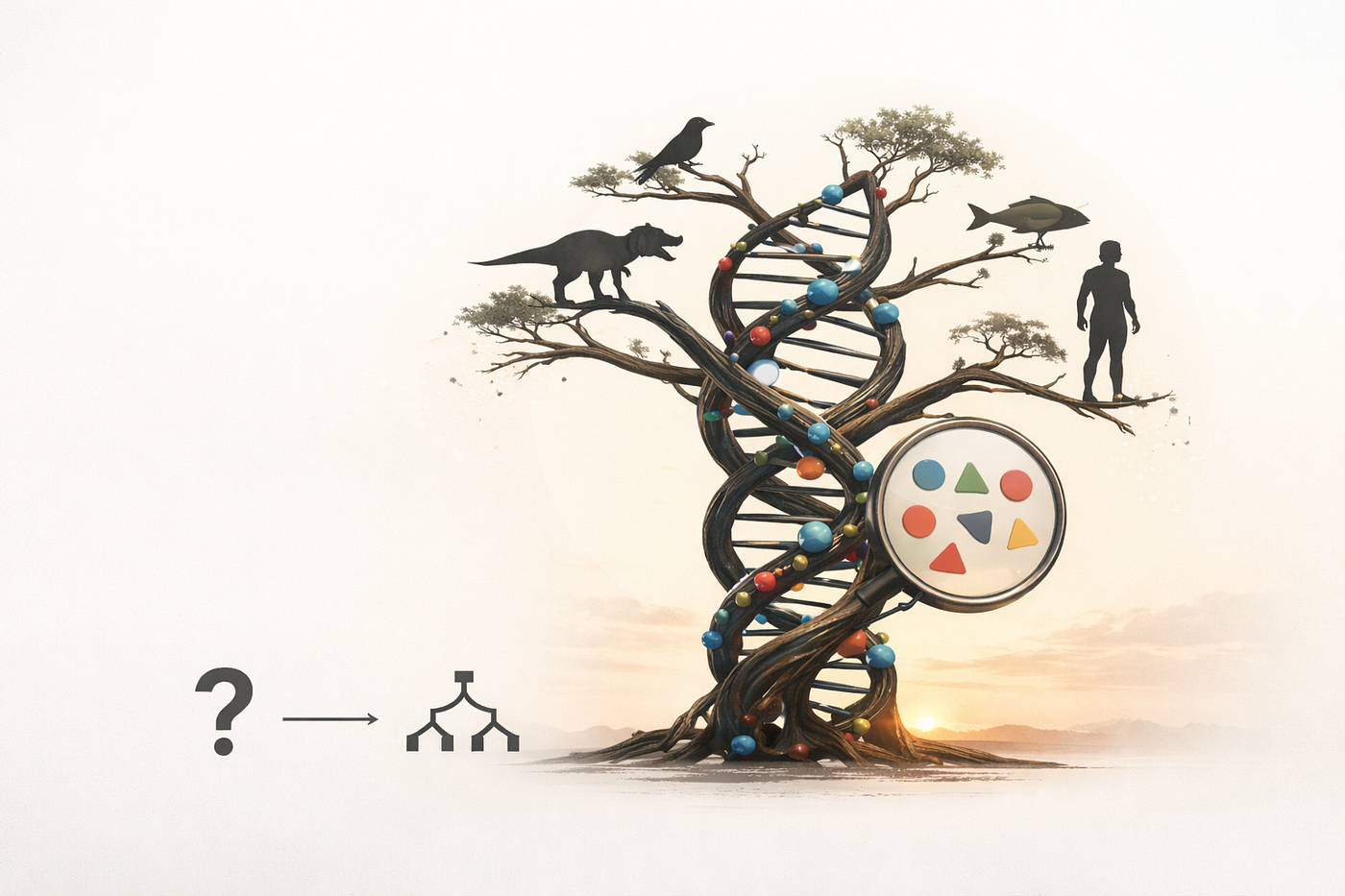
Has 1500 years of Endogamy made Brahmins intelligent?
Can the genome recognize religions, castes & communities?
Has 1500 years of Endogamy made Brahmins intelligent?
Can the genome recognize religions, castes & communities?

📚 Suggested Background Reading
This article is part of a companion series that applies population genetics to real-world historical and social questions. While it is written to be accessible on its own, readers who wish to appreciate the underlying genetics, statistical methods, and computational techniques in greater depth may find the following articles from my Genes Before Gods: Reconstructing Ancient India Through Genetics series useful.
Recommended reading (in 11+ long installments):
- Part 0: When Population genetics cross-examines Mahabharat (https://medium.com/@datavector/genes-before-gods-reconstructing-ancient-india-through-genetics-part-0-f6172c3567c2)
- Part 1: Ancient DNA, ANI, ASI, Steppe ancestry and the three ancestral populations of India (https://medium.com/@datavector/genes-before-gods-reconstructing-ancient-india-through-genetics-part-0-f6172c3567c2).
- Part 2: How chromosomes preserve history — recombination, admixture, linkage disequilibrium and the genetic clock ( https://medium.com/@datavector/genes-before-gods-reconstructing-ancient-india-through-genetics-part-2-6d0b1165ee6f).
- Part 3: How population geneticists reconstruct ancient migrations using PCA, ADMIXTURE, Identity by Descent (IBD), Runs of Homozygosity (ROH), f-statistics and Bayesian models (https://medium.com/@datavector/genes-before-gods-reconstructing-ancient-india-through-genetics-part-3-3d06b0e72a51).
- Part 4: When India stopped mixing — how genetics dates the rise of endogamy and what it reveals about the formation of modern Indian communities.
- And it goes on and on and on (Links to 11+ installments available in Part 0).
This article deliberately does not repeat those concepts. Instead, it assumes that foundation and asks a different question:
What happens when we apply population genetics, evolutionary biology, probability theory and computational reasoning to some of India’s most debated historical and social questions?
One of the most intriguing questions that arises from Indian population genetics is not about ancestry.
It is about evolution.
Modern genomics has now established beyond reasonable doubt that many Indian communities became strongly endogamous roughly 1,500–2,000 years ago. Once marriage largely remained within communities, those communities became partially isolated gene pools. That raises a natural scientific question.
If a community remained genetically isolated while also specializing in particular occupations for many centuries, could evolution gradually alter the frequencies of genetic variants associated with traits useful for those occupations?
For Brahmins, whose traditional roles emphasized memorization, scholarship, philosophy, language, astronomy, mathematics, teaching, and ritual learning, the question is often framed more bluntly:
Did centuries of intellectual specialization, together with endogamy, genetically preserve or enrich variants associated with cognitive ability?
This is an uncomfortable question. It is also an interesting scientific one.
Science should neither reject it because it is politically sensitive nor accept it because it is culturally attractive. Instead, we should ask a different question.
What does evolutionary theory predict?
Step One: Is Evolution Even Possible on This Time Scale?
Many people imagine evolution as something requiring hundreds of thousands of years. That is not always true.
Several well-known human adaptations evolved surprisingly recently. Lactose tolerance spread rapidly after dairy farming became common. High-altitude adaptations evolved independently among Tibetans, Andeans, and Ethiopian highlanders. Resistance to malaria increased where malaria imposed strong selective pressure. These changes occurred within a few thousand years.
Therefore, from an evolutionary standpoint, fifteen hundred years is not too short for measurable genetic change — provided selection is strong enough and acts consistently over many generations.
The question is therefore not whether evolution could occur. The question is whether the conditions required for evolution actually existed.
Evolution Requires More Than Isolation
Endogamy alone does not produce adaptation. It merely preserves whatever genetic variation already exists within a population. To produce evolutionary change, another ingredient is necessary:
selection.
Selection occurs when individuals possessing certain heritable characteristics leave, on average, more surviving offspring than others. Without differential reproductive success, allele frequencies change only through random genetic drift. This distinction is crucial.
Endogamy is like sealing a container. Selection determines what happens inside it.
Could Intellectual Occupations Produce Selection?
Here the hypothesis becomes interesting. Historically, many Brahmin communities occupied roles centered on learning.
- Education was often inherited within families.
- Children learned from parents.
- Literacy was maintained across generations.
- Scholarship became a respected social role.
- One possible hypothesis is that such societies created a form of assortative mating.
- Families known for scholarship may have preferred marriages with other scholarly families.
If cognitive ability has a heritable component — and behavioural genetics indicates that it does — then repeated non-random mating could, in theory, influence the frequencies of some contributing genetic variants over many generations.
Notice the careful wording. The hypothesis does not require conscious breeding.
It requires only that individuals with similar educational or cognitive characteristics married one another more frequently than expected by chance.
This phenomenon is well documented today. Educational attainment is strongly assortative in modern societies. Whether similar patterns operated historically in Brahmin populations remains an open historical and demographic question.
What Does a Community Actually Inherit?
One of the most common questions people ask after learning that Indian communities have remained largely endogamous for nearly 1,500 years is surprisingly simple:
If communities remained genetically isolated for so long, what exactly has been preserved?
Has endogamy preserved
- skin colour?
- Facial appearance?
- Body structure?
- Intelligence?
- Personality?
- Religious beliefs?
- Languages?
Or has it preserved nothing at all? The answer is neither “everything” nor “nothing.”
The genome is an extraordinary archive of biological inheritance, but it is remarkably selective about what it records. Some characteristics survive for thousands of years with surprising stability. Others disappear within a single generation. Still others emerge from an intricate interplay between thousands of genes and an individual’s environment.
Understanding these differences is essential before we ask whether genomes can recognize castes, communities, or even religions.
The Genome Preserves Biology, Not Culture
One of the most important distinctions in genetics is between biological inheritance and cultural inheritance.
Your DNA contains instructions for constructing proteins, regulating cellular processes, and guiding development. It does not contain instructions for speaking Kannada instead of Tamil, worshipping Shiva instead of Vishnu, celebrating Deepavali instead of Christmas, or identifying as a Brahmin rather than a Lingayat.
Culture is transmitted socially. DNA is transmitted biologically. These two systems often travel together — but they are fundamentally different.
A child adopted at birth into another family perfectly illustrates this distinction. Imagine a newborn born into one community but adopted immediately by parents belonging to another. The child will almost certainly acquire:
- the language of the adoptive family,
- their customs,
- their religious practices,
- their surname,
- their food habits,
- and eventually their social identity.
Yet not a single nucleotide in the child’s genome has changed. The biological blueprint remains exactly as it was at birth. The culture changes completely. This simple thought experiment demonstrates one of the deepest principles in genetics:
DNA preserves ancestry. Culture preserves identity.
The two frequently correlate because people usually inherit both from the same parents. But correlation is not causation.
Not All Traits Are Inherited the Same Way
Another widespread misconception is that every inherited characteristic follows the same genetic rules. Nothing could be further from the truth.
- Some traits are controlled almost entirely by a single gene.
- Others depend on hundreds of genes.
- Still others depend upon thousands of genes interacting continuously with nutrition, disease, education, climate, and countless environmental influences.
To appreciate this, it helps to classify traits into broad categories.

This table immediately reveals an important truth. Traits exist on a spectrum. Some are almost entirely genetic. Some are almost entirely cultural.
Many occupy the complex middle ground where genes establish possibilities while the environment determines how those possibilities unfold.
Three Very Different Genetic Architectures
From a population genetics perspective, inherited traits can be divided into three fundamentally different categories.
Category 1 — Mendelian Traits
These are the simplest. A single gene has a large effect. Examples include:
- ABO blood groups
- Rh factor
- Huntington disease
- Cystic fibrosis
- Sickle cell disease
If you inherit a particular mutation, the outcome is usually predictable. These traits behave almost like switches. Gene present. Trait appears. Gene absent. Trait disappears. Nature is relatively straightforward.
Category 2 — Oligogenic Traits
Some characteristics depend upon a handful of genes, each making a substantial contribution. Examples include:
- certain eye colours,
- some forms of deafness,
- several inherited metabolic disorders,
- and pigmentation pathways.
These are more complex than Mendelian traits but still relatively easy to understand because only a small number of genes are involved.
Category 3 — Polygenic Traits
Now we enter the world where modern genetics becomes astonishingly complex. Most characteristics that distinguish one person from another are polygenic. Rather than one gene determining the outcome, thousands of genes each contribute a tiny effect.
No single gene determines height, face, athletic ability or intelligence.
Instead, thousands of genetic variants each shift probabilities ever so slightly. Imagine trying to determine the final score of a cricket match where every spectator in the stadium is allowed to contribute only one run.
No individual contribution changes the result dramatically. But together they determine the final outcome. That is polygenic inheritance.
Why Some Communities Look Different
Human beings are remarkably good at recognizing faces. Many people informally remark that someone “looks like” they belong to a particular region or community. Although such impressions are far from perfect, they are not entirely imaginary.
Long-term endogamy changes the frequencies of genetic variants within a population. Suppose a particular facial characteristic is influenced by hundreds of genetic variants.
If a community remains relatively isolated for many centuries, those variants continue circulating largely within the same population. Over many generations, average facial characteristics become statistically more similar within that community than between unrelated populations.
This does not mean every member resembles every other member. There remains enormous individual variation. But the average distribution shifts. Population genetics always studies distributions, not stereotypes. This distinction is crucial.
Skin Colour: One of the Most Stable Visible Traits
Skin colour provides one of the clearest examples of long-term genetic continuity. Melanin production is influenced by numerous genes, including several that have relatively large effects on pigmentation. These include genes involved in melanosome formation, melanin synthesis, and pigment transport. If a population remains genetically isolated, the frequencies of these variants change only gradually. Consequently, average skin pigmentation remains relatively stable over long periods.
This explains why many geographically isolated populations across the world have retained broadly similar pigmentation patterns for centuries. However, stability does not imply uniformity. Every community contains considerable variation. Sun exposure, nutrition, hormones, age, and random inheritance all contribute to individual differences. Genes establish the range. Environment determines where within that range an individual may fall.
Height: A Lesson in Genes and Environment
Height provides one of the finest demonstrations of why biology is rarely deterministic. Height is strongly heritable. Within well-nourished populations, genetic differences explain much of the variation observed between individuals. Yet history provides equally compelling evidence that environment matters enormously.
Average heights have increased dramatically in several countries during the twentieth century — not because human evolution suddenly accelerated, but because childhood nutrition, sanitation, vaccination, and healthcare improved.
The genome did not change substantially within three or four generations. The environment did. Genes establish potential. Environment determines how much of that potential is realized. This same principle will reappear when we later discuss cognitive ability.
An Important Principle to Remember
Before proceeding further, it is worth pausing to summarize one of the central ideas of this article. The genome does not preserve communities because communities are socially important. It preserves whatever biological variation communities happen to carry.
Some characteristics remain remarkably stable because they are strongly influenced by inherited genetic variants. Others disappear within a generation because they are transmitted through language, culture, religion, or education rather than DNA.
Modern population genetics therefore teaches us something profoundly important:
Endogamy can preserve biological variation. It cannot preserve culture.
The next question naturally follows. If skin colour, facial structure, and height are influenced by genetics, what about the most controversial human trait of all — intelligence?
To answer that, we first need to understand one of the most misunderstood concepts in modern biology:
polygenic inheritance.
Polygenic Traits: When Thousands of Genes Work Together
The human brain contains roughly 86 billion neurons connected by hundreds of trillions of synapses. Building such an extraordinarily complex organ is not the job of a single gene. Nor is it the job of ten genes. Or even a hundred.
Instead, modern genetics has revealed that many complex human characteristics emerge from the combined action of thousands of genetic variants, each contributing an almost imperceptibly small effect.
This is known as polygenic inheritance.
Understanding this concept is essential because it fundamentally changes how we think about heredity.
There Is No “Intelligence Gene”
Popular media often asks questions such as:
Have scientists discovered the intelligence gene?
Or
Is there a gene for mathematical ability?
Or
Is there a gene for musical talent?
The answer, as far as current science is concerned, is no. No single gene determines intelligence, mathematical ability, memory or creativity.
Instead, genome-wide association studies (GWAS) have identified thousands of genetic variants associated with differences in educational attainment, cognitive performance, and related traits. Each individual variant has an exceedingly small statistical effect. No single variant is either necessary or sufficient to produce high cognitive ability.
A useful analogy is rainfall. No single raindrop causes a flood. Millions of raindrops together do. Likewise, no individual genetic variant creates intelligence. Thousands of variants, each nudging development in tiny ways, collectively influence traits related to cognition.
A Symphony, Not a Solo
Imagine listening to a symphony orchestra. Would removing one violin destroy the performance? Probably not. Would removing a single flute matter very much? Again, probably not. Yet remove hundreds of instruments and the music changes dramatically. Polygenic traits work similarly. Every gene contributes a tiny note. The final phenotype emerges from the orchestra rather than from any individual instrument.
This is why searching for an “IQ gene” is scientifically misguided. The architecture itself is distributed.
The Genome Is More Like a Recipe Than a Blueprint
A useful way to think about genes is to imagine preparing a complex dish. No single ingredient determines the final taste. Salt matters. Spices, Oil , Vegetables, Cooking temperature, Cooking time matters.
Even the order in which ingredients are added can influence the result. Human development works in much the same way. Genes interact with other genes, hormones, nutrition, disease and the environment. The final phenotype is the product of an extraordinarily complex developmental process rather than a simple genetic instruction.
Recombination Constantly Reshuffles the Deck
Every child inherits approximately half of each parent’s genome. However, children do not inherit intact copies of either parent’s chromosomes. During meiosis, chromosomes exchange segments through a process called recombination. The resulting chromosome inherited by a child is therefore a mosaic assembled from multiple grandparents.
Every generation creates an entirely new combination of genetic variants. This has profound implications. Even within highly endogamous communities, no two individuals inherit exactly the same genetic architecture. The population remains statistically similar. Individuals remain genetically unique.
Why Siblings Can Be So Different
Most siblings grow up in the same house. They eat similar food, attend similar schools, share the same parents. Yet one sibling may become exceptionally tall. Another remains shorter. One excels in mathematics. Another prefers literature. One develops diabetes. Another never does.
Why?
Because every child receives a unique genetic lottery. Each parent possesses two copies of every autosomal chromosome. During reproduction, only one copy from each pair is passed to the child. Which copy is transmitted is partly random. Recombination introduces even more randomness by exchanging chromosome segments before inheritance.
Consequently, siblings share, on average, about half of their segregating genetic variants, but the exact combination inherited by each child is unique.
The genome is reshuffled every generation. Nature is constantly dealing new hands.
Probability, Not Destiny
This distinction cannot be emphasized enough. Genes influence probabilities. They do not dictate destiny. Suppose a particular combination of thousands of variants increases the statistical likelihood of developing strong mathematical reasoning. That does not guarantee mathematical excellence. Likewise, a less favorable combination does not prevent achievement. Education. Nutrition. Motivation. Health. Opportunity. Family support. Teachers. Peer groups. Random life events. All continue shaping development throughout childhood and adulthood.
Genes load the dice. They do not determine every throw.
Understanding Heritability
One of the most misunderstood concepts in biology is heritability.
People often hear statements such as:
“Height is 80% heritable.”
or
“Intelligence is highly heritable.”
Many incorrectly conclude that this means:
“80% of my height is caused by genes.”
That is not what heritability means. Heritability is a statistical property of a population, not an individual. More precisely, it estimates the proportion of observed variation in a trait, within a particular population and environment, that is associated with genetic differences among individuals.
Notice the important qualifiers. Within a population and environment. Change either one, and the estimate can change.
A Simple Thought Experiment
Imagine a country where every child receives identical nutrition, identical healthcare, identical education, housing, and identical exposure to disease.
Almost every environmental difference has now disappeared. If differences in height remain, most of that remaining variation must arise from genetic differences. Heritability becomes high.
Now imagine another country where half the children suffer severe malnutrition while the other half receive excellent nutrition. Height differences now reflect both genes and nutrition. Environmental variation has increased. Heritability decreases. Notice something remarkable. The genes did not change. Only the environment changed. Heritability changed anyway.
This is why heritability should never be interpreted as a fixed property of a trait. It depends upon the population being studied and the environment in which that population lives.
Why Polygenic Traits Behave Differently
Skin colour is influenced by a relatively modest number of genes with several having comparatively large effects. Blood groups are determined by a handful of genes. These traits can often be predicted reasonably well from genetic information alone.
Polygenic traits are fundamentally different. Thousands of variants each contribute minuscule effects. Developmental processes amplify or dampen these effects. Environmental influences continue throughout life. Consequently, prediction becomes much more difficult.
This is why modern genetics can often predict blood group with extraordinary accuracy but predicts complex behavioural or cognitive traits with much lower precision.
The architecture of the trait itself is fundamentally different.
Polygenic Scores: Powerful but Imperfect
Researchers have developed statistical methods called polygenic scores (sometimes called polygenic risk scores).
Instead of examining one gene, these methods aggregate information from thousands — or even millions — of genetic variants across the genome. Each variant contributes a tiny weighted effect. When added together, they produce a statistical estimate associated with a particular trait.
Polygenic scores have become valuable research tools and are beginning to find clinical applications for some diseases. However, they have important limitations.
For many behavioural and cognitive traits, current polygenic scores explain only part of the observed variation. Their predictive accuracy also differs across populations because allele frequencies, linkage disequilibrium patterns, and the populations used to develop the scores vary.
A polygenic score therefore estimates statistical propensity. It does not predict an individual’s future with certainty.
The Most Important Lesson
Modern genetics has transformed our understanding of heredity. Complex human characteristics are rarely governed by single genes. Instead, they emerge from thousands of interacting genetic variants acting together with developmental processes and environmental influences.
This is why population genetics can identify long-term biological patterns within communities while remaining unable to predict the abilities, achievements, or life outcomes of any single individual.
The genome preserves probabilities. Life determines outcomes.
In the next section, we will examine one of the most discussed — and most misunderstood — applications of these ideas: the relationship between population genetics, cognitive ability, and why discussions about intelligence require exceptional scientific caution.
How Does a Community Preserve Traits for 1,500 Years?
At this point, an obvious question arises. If every child inherits a unique combination of genes… If recombination shuffles chromosomes every generation… If siblings themselves are genetically different…
Then how can an entire community preserve any biological characteristics over hundreds or even thousands of years? Shouldn’t everything simply become random?
The answer lies in one of the central concepts of population genetics:
Natural selection acts on individuals. Evolution acts on populations.
And populations are governed not by individual genomes, but by allele frequencies.
Individuals Come and Go. Populations Endure.
Imagine visiting a village every twenty-five years. Every person you met during your previous visit has now passed away. An entirely new generation has replaced them. Yet the village itself still exists. The language remains similar. Many surnames remain. The temples remain. Communities behave similarly. Individuals are transient. Populations are persistent. Population genetics therefore studies something very different from individual genetics.
Instead of asking,
“What genes does this individual possess?”
it asks,
“How common is each genetic variant within this entire population?”
That simple shift in perspective changes everything.
The Importance of Allele Frequencies
Every gene may exist in multiple versions. These different versions are called alleles.
For example, imagine a gene with two variants.
Allele A
Allele B
Suppose an isolated community contains one thousand individuals. If six hundred carry allele A while four hundred carry allele B, the frequencies become
A = 60%
B = 40%
Notice something important. No individual represents the population. The population is described statistically. Population genetics therefore studies frequencies rather than people.
A Jar of Marbles
An analogy makes this much easier to visualize. Imagine a large glass jar. Inside are one thousand marbles. Six hundred are blue. Four hundred are red. The jar represents an entire population. Each marble represents one allele. Now imagine drawing marbles in pairs to create the next generation.
After reproduction, the marbles are returned. The process repeats. If reproduction occurs completely at random, the proportion of blue and red marbles remains remarkably stable generation after generation.
Individual marbles change. The overall composition barely changes. This is the central idea behind population genetics.
Communities preserve frequencies, not individual genomes.
Hardy-Weinberg Equilibrium
More than a century ago, mathematicians independently realized something extraordinary. If five conditions are approximately satisfied —
- random mating,
- very large population size,
- no natural selection,
- no migration,
- no mutation,
then allele frequencies remain essentially constant from one generation to the next. This principle is known as the Hardy-Weinberg Equilibrium. It is one of the foundational results of modern population genetics. It does not describe how real populations behave perfectly. Instead, it provides a mathematical baseline.
Whenever populations deviate from Hardy-Weinberg expectations, geneticists know that one or more evolutionary forces are operating. In many ways, Hardy-Weinberg plays the same role in genetics that Newton’s First Law plays in physics. It describes what happens when no forces disturb the system. Real populations become interesting precisely because those forces do exist.
Endogamy Changes the Mathematics
Now imagine changing just one assumption. Instead of random mating, people marry only within their own community. Suddenly, the jar of marbles is no longer mixing with neighbouring jars. Each community now has its own separate jar. Generation after generation, these jars evolve independently. Initially they may be almost identical. Over centuries they slowly diverge. Some alleles become more common. Others become rarer. Some disappear entirely. Others become characteristic of that community. Nothing mysterious has happened. The mathematics has changed because mating patterns changed.
Genetic Drift: Evolution by Chance
Not every genetic change occurs because it is useful. Many changes occur simply because of random chance. Imagine flipping a coin ten times. You may obtain seven heads and three tails. That does not mean the coin is biased. Randomness alone produces fluctuations.
Genes behave similarly. Each generation samples only a fraction of the previous generation’s genetic variation. Some variants become slightly more common. Others become slightly less common. Over hundreds of generations, these tiny random fluctuations accumulate. This process is called genetic drift.
It is one of the strongest evolutionary forces operating within isolated populations.
Founder Effects: When History Leaves a Permanent Signature
Suppose a new settlement begins with only fifty families. Among them happens to be one individual carrying an uncommon genetic variant. The settlement grows. After twenty generations, those fifty families become fifty thousand. The variant carried by that original founder may now be present in thousands of descendants.
Not because it offered any advantage. Not because natural selection favored it. Simply because one founder happened to possess it. This is called the founder effect.
Many endogamous communities around the world — including several in India — bear unmistakable signatures of founder events. These signatures are visible today in the frequencies of both harmless genetic variants and disease-causing mutations. History becomes permanently recorded in DNA.
Why Communities Begin to Look Different
Once populations remain genetically isolated, three processes begin operating simultaneously.
First, recombination continuously reshuffles genomes within the community. Second, genetic drift slowly changes allele frequencies. Third, founder effects preserve historical accidents.
After enough generations, the population develops a characteristic statistical profile. This does not imply that every member shares the same appearance. Nor does it imply that individuals can always be assigned to a community simply by looking at them.
Instead, the average distribution of thousands of genetic variants gradually becomes distinctive. This is exactly what modern clustering algorithms detect.
Population genetics identifies statistical patterns. It does not identify immutable biological categories.
Why Population Genetics Works
At first glance, two individuals from neighbouring communities may appear indistinguishable.
Yet when scientists examine hundreds of thousands — or even millions — of genetic markers across the genome, subtle differences in allele frequencies emerge.
No single marker identifies a community. But thousands of markers analyzed together reveal population history with remarkable precision. This is why ancestry inference works. Not because one gene identifies a caste or community, but because long-term endogamy leaves a faint statistical signature across the entire genome.
Modern computational genetics simply learns to recognize that signature.
An Important Distinction
This distinction is so fundamental that it deserves repeating. Population genetics does not claim that communities possess unique genes. Almost all human populations share the overwhelming majority of their DNA. What differs is the frequency with which various genetic variants occur.
Think of two libraries. Both contain nearly the same books. The difference lies not in which books exist, but in how many copies of each book occupy the shelves.
Human populations are much the same. The genome is largely shared. What changes are the proportions. That subtle statistical difference is sufficient to reconstruct thousands of years of demographic history.
And it explains why modern genetics can recognize populations even though it cannot recognize religions, languages, surnames, or social identities.
The genome remembers biological history. It does not remember cultural labels.
If Genes Matter, Why Don’t Exceptional Parents Always Produce Exceptional Children?
This question puzzled scientists long before DNA was discovered.
- If two exceptionally tall parents marry, why are their children often slightly shorter?
- If two brilliant mathematicians have children, why don’t all of their children become equally brilliant?
- Conversely, how do extraordinary individuals occasionally emerge from completely ordinary families?
The answer lies in one of the most important statistical principles in biology:
Regression Toward the Mean
First described by Sir Francis Galton in the nineteenth century, regression toward the mean is a mathematical consequence of inheritance. Imagine that height depends upon approximately ten thousand genetic variants.
A very tall individual is likely to possess an unusually favorable combination of many of these variants. When that individual has children, only half of those variants are passed to each child. The other half comes from the second parent.
Recombination further shuffles these variants into entirely new combinations. As a result, the exceptionally favorable combination that existed in one parent is partially diluted. The children remain, on average, taller than the population. But they are often somewhat closer to the population average than their exceptionally tall parent.
Exactly the same statistical principle applies to many polygenic traits. This is not evidence that “good genes disappear.” Nor does it imply that excellence cannot persist across generations. It simply reflects the mathematics of recombination.
Nature continually reshuffles the genetic deck. Every generation begins with a fresh hand.
The Scientific Verdict: Exceptional individuals arise from unusually favorable combinations of thousands of genetic variants. Those combinations are partially reshuffled in every generation, causing descendants to regress statistically toward the population average while still remaining above average on average.
Why Doesn’t One Brilliant Community Produce Only Brilliant Individuals?
Suppose a community has, on average, higher educational attainment than another. Does that mean every child born into that community will excel academically? Absolutely not. This is where many discussions about genetics go wrong.
Population genetics studies probability distributions, not individual destinies. Imagine two overlapping bell curves. One community has an average value slightly higher than another. The difference between the averages may be real. But the overlap between the two populations may still exceed ninety percent. That means:
- many individuals in the first community will perform below the average of their own community,
- many individuals in the second community will outperform most individuals in the first.
Population averages say nothing definitive about any particular person. This distinction is fundamental. It is the difference between statistics and stereotypes.
Furthermore, educational success depends on many factors that are only partly genetic:
- family environment,
- nutrition,
- quality of schooling,
- socioeconomic status,
- motivation,
- health,
- opportunity,
- and countless random life events.
Genes influence probabilities. Life determines outcomes.
The Scientific Verdict: Even if populations differ in average frequencies of genetic variants related to complex traits, individual prediction remains extremely uncertain because distributions overlap extensively and environmental influences remain substantial.
Why Are Certain Diseases More Common in Particular Communities?
Unlike intelligence or personality, some inherited diseases provide remarkably clear examples of how population genetics operates. Around the world, different communities show unusually high frequencies of specific genetic disorders. Examples include:
- Tay-Sachs disease among Ashkenazi Jews.
- Sickle-cell disease in parts of Africa, the Middle East and India.
- Beta-thalassemia in Mediterranean, Middle Eastern and several Indian populations.
- Certain cardiomyopathies and metabolic disorders in specific Indian endogamous communities.
These patterns do not imply biological superiority or inferiority. Instead, they reflect history. Suppose a small founding population included one individual carrying a rare mutation.
If the community remained relatively isolated for many generations, that mutation could become surprisingly common simply because descendants continued marrying within the same population.
The mutation was inherited. The community expanded. The mutation expanded with it. Modern genomic studies have documented hundreds of such founder events across India. This has important implications for medicine.
Knowledge of population history allows physicians to design more effective carrier-screening programs, genetic counseling strategies, and early diagnostic tests for communities at elevated risk of particular inherited disorders.
Population genetics therefore has direct clinical value.
The Scientific Verdict: Many community-specific genetic diseases are historical accidents amplified by founder effects and long-term endogamy. They are not indicators of superiority, inferiority, or evolutionary success.
Why Are Ashkenazi Jews Disproportionately Represented in Science and Nobel Prizes?
This question frequently appears in discussions about genetics. Ashkenazi Jews constitute only a tiny fraction of the world’s population, yet they have made extraordinary contributions to science, mathematics, economics, literature, medicine, and technology. Does genetics explain this pattern?
The honest scientific answer is:
We do not know with certainty.
Several hypotheses have been proposed.
Hypothesis 1: Cultural Emphasis on Education
For centuries, Jewish communities placed exceptional importance on literacy, scholarship, religious study, and intellectual achievement.
Knowledge became a form of social capital. This undoubtedly contributed to educational success.
Hypothesis 2: Historical Occupations
In medieval Europe, legal restrictions often prevented Jews from owning agricultural land. Many therefore entered occupations requiring literacy, bookkeeping, finance, commerce, medicine, and scholarship. These professions reinforced educational traditions over many generations.
Hypothesis 3: Assortative Mating
People often marry individuals with similar educational backgrounds and cognitive interests. Such non-random mating can reinforce both cultural and genetic patterns over time.
Hypothesis 4: Founder Effects and Demographic History
Ashkenazi Jews experienced severe population bottlenecks followed by rapid expansion. This history produced strong founder effects that are clearly visible in their genomes.
Whether these demographic events also influenced the frequencies of variants affecting cognitive traits remains an area of ongoing research and debate.
Hypothesis 5: Genetic Selection
Some researchers have proposed that historical occupational pressures may have favored alleles associated with cognitive ability. This hypothesis remains controversial. Current evidence is insufficient to establish it as fact. No scientific consensus exists.
Indeed, most researchers believe that the observed achievements likely reflect a complex interaction among genetics, culture, education, history, institutions, and socioeconomic factors rather than any single explanation.
Science is comfortable saying “we don’t yet know.” That is a strength, not a weakness.
The Scientific Verdict: Ashkenazi Jewish achievement is well documented. The reasons remain the subject of active research. No single genetic explanation has been established, and multiple cultural, historical, demographic, and environmental factors almost certainly contribute.
Does Endogamy Preserve Intelligence?
This is perhaps the most difficult question in the entire discussion. The answer depends entirely on what we mean by “intelligence.” If intelligence were controlled by a single gene, the answer would be relatively simple.
But it is not. Cognitive ability is one of the most polygenic traits known. Thousands of genetic variants contribute tiny effects.
The brain itself develops through extraordinarily complex interactions involving genetics, prenatal development, childhood nutrition, disease exposure, education, language, emotional environment, social experiences, and chance.
Consequently, long-term endogamy can preserve the frequencies of many genetic variants within a population. What it cannot do is preserve identical outcomes. Every generation experiences recombination. Every child inherits a unique combination of variants. Every individual encounters a unique environment.
Therefore, while population genetics can detect long-term differences in allele frequencies between populations, translating those differences into predictions about cognitive performance is scientifically far more difficult than predicting traits such as blood groups or certain inherited diseases.
Current polygenic scores for cognitive traits explain only a portion of the observed variation, and their predictive accuracy differs substantially across ancestry groups because the underlying studies, allele frequencies, and genomic correlations differ between populations.
The science is advancing rapidly. But it is far from complete.
Any claim that genes alone determine intelligence — or that environment alone determines intelligence — is inconsistent with modern behavioural genetics.
The evidence supports a far more nuanced conclusion. Genes matter. Environment matters. Development matters. Chance matters. None acts in isolation.
The Scientific Verdict: Endogamy can preserve population-level genetic variation over long periods. It cannot predetermine the intelligence, talents, or achievements of individual members of that community. Complex cognitive traits emerge from thousands of interacting genetic variants combined with developmental and environmental influences.
A Tale of Two Populations: Why We Entertain the Ashkenazi Jewish Hypothesis but Remain Cautious About Brahmins
One of the first objections readers may raise at this point is perfectly reasonable.
“If scientists are willing to discuss genetic hypotheses for the unusually high representation of Ashkenazi Jews in science and mathematics, why should the same evolutionary reasoning not apply to Brahmin communities in India?”
It is an important question. More importantly, it tests whether we are applying scientific reasoning consistently or selectively.
If the same evolutionary mechanisms operate in all human populations, then our standards of evidence should also remain the same.
The Ashkenazi Jewish Hypothesis
Ashkenazi Jews have been the subject of intense genetic research for several decades. Several facts are well established.
- They experienced prolonged endogamy.
- They underwent severe population bottlenecks.
- They show strong founder effects.
Historically, many communities specialized in occupations requiring literacy, numeracy, bookkeeping, finance, medicine, and scholarship. Today they are disproportionately represented in several intellectually demanding professions. These observations motivated a hypothesis proposed by several researchers:
Perhaps centuries of occupational specialization, together with endogamy and assortative mating, gradually altered the frequencies of genetic variants contributing to cognitive ability.
Notice what this statement is. It is a hypothesis. Not a conclusion. It has generated vigorous debate. Some researchers consider aspects of it biologically plausible.
Others argue that cultural transmission, educational traditions, historical circumstances, and socioeconomic factors provide sufficient explanation without invoking genetic adaptation.
Two decades after the hypothesis was proposed, there is still no scientific consensus. Science has not rejected the hypothesis. Neither has it confirmed it.
Now Consider Brahmin Populations
The same exercise can now be performed for many Brahmin communities. Historically they occupied roles centred on:
- preservation of sacred texts,
- teaching,
- grammar,
- logic,
- philosophy,
- astronomy,
- mathematics,
- ritual expertise,
- scholarship.
These occupations persisted across many centuries. Many Brahmin populations also practiced strong endogamy. Many exhibit founder effects.
Historical marriage patterns almost certainly involved substantial assortative mating based upon education, family reputation, and scholarly status.
If one simply lists these ingredients, the parallel with the Ashkenazi Jewish hypothesis becomes obvious.
- Long-term intellectual specialization.
- Endogamy.
- Assortative mating (or not?)
- Founder effects.
The evolutionary ingredients appear remarkably similar.
Why Then Are Scientists More Cautious?
The answer is not that evolutionary biology behaves differently in India. The answer is that the available evidence differs dramatically. Ashkenazi Jews are among the most extensively studied human populations in medical genetics.
- Large-scale genome-wide association studies.
- Whole-genome sequencing.
- Demographic reconstructions.
- Founder analyses.
- Medical registries.
- Disease mapping.
- Population history.
These datasets provide researchers with an unusually rich foundation for testing evolutionary hypotheses. Even with all this evidence, the cognitive-selection hypothesis remains unproven.
Now compare that situation with India. India possesses perhaps the most genetically structured human population on Earth. There is no single “Brahmin genome.”
Instead there are dozens of historically distinct Brahmin populations separated by geography, language, migration history, and demographic events.
Yet comprehensive genomic studies linking these populations to cognitive traits are almost entirely absent. The problem is therefore not that the hypothesis is biologically implausible. The problem is that the necessary data have not yet been collected.
The Missing Experiment
Suppose we genuinely wished to answer this question scientifically. What evidence would we require? At a minimum:
- genome-wide data from multiple Brahmin and non-Brahmin populations across India,
- validated polygenic models developed using South Asian populations,
- careful measurements of educational and cognitive outcomes,
- historical demographic reconstruction,
- statistical controls for geography, nutrition, education, wealth, and culture,
- methods capable of separating natural selection from genetic drift and assortative mating.
Only after assembling such evidence could one begin estimating whether any detectable polygenic adaptation had occurred. At present, that experiment has not been performed. Therefore no responsible scientist can claim either confirmation or refutation.
Theory and Evidence Are Different Things
This distinction deserves emphasis. Evolutionary theory asks:
Could such a process occur?
Modern evolutionary biology answers:
Yes.
If heritable variation exists… if selection acts consistently over many generations… if mating remains non-random… then allele frequencies can gradually change. That conclusion follows directly from population genetics.
Evidence asks a different question.
Did this process actually occur in a specific historical population?
That question cannot be answered by theory alone. It requires data.
Theory establishes possibility. Evidence establishes history.
Confusing the two is one of the most common mistakes made in public discussions of genetics.
Three Competing Models
Given the evidence currently available, several explanations remain scientifically possible.
Model 1 — Cultural Transmission Alone
Educational traditions, literacy, social expectations, institutions, and family environments explain the observed patterns. Genetics contributes only the background heritability common to all human populations.
Model 2 — Gene-Culture Coevolution
Long-term educational traditions created assortative mating and sustained selection pressures. These gradually produced modest shifts in the frequencies of thousands of genetic variants while culture remained the dominant influence.
Model 3 — Predominantly Genetic Explanation
Most observed differences result from substantial evolutionary changes in the genetic architecture of cognition. Current evidence does not allow us to distinguish confidently between the first two models. There is even less evidence supporting the third. That does not mean the third model is impossible. It means the evidence required to support it has not yet been produced.
Applying the Same Scientific Standard Everywhere
Good science applies identical standards of evidence regardless of which population is being discussed.
If we require strong genomic evidence before concluding that natural selection shaped cognitive traits among Ashkenazi Jews, then exactly the same evidentiary standard must apply to Brahmin populations.
Conversely, if we accept that gene-culture coevolution is biologically plausible for one population, intellectual honesty requires acknowledging that the same evolutionary mechanism is equally plausible for another population with comparable demographic history.
Scientific consistency demands both conclusions simultaneously. Anything less would be applying different rules to different populations.
The Scientific Verdict
Modern evolutionary biology predicts that prolonged endogamy, assortative mating, and sustained occupational specialization could, in principle, influence the frequencies of genetic variants contributing to highly polygenic traits.
This prediction is universal. It is not specific to Jews, Brahmins, Europeans, or any other population. Whether that theoretical possibility became historical reality in any particular population is a separate empirical question.
For Ashkenazi Jews, decades of intensive research have not produced scientific consensus. For Brahmin populations, the required genomic studies have scarcely begun. The honest scientific conclusion is therefore neither acceptance nor rejection.
It is this:
The mechanism is biologically plausible. The evidence is presently insufficient to determine whether it occurred, or to estimate its magnitude.
Far from being a weakness, this distinction between what evolutionary theory permits and what empirical evidence demonstrates is one of the defining strengths of the scientific method.
Evolution Does Not Reward Intelligence. It Rewards Reproduction
Whenever discussions about intelligence and genetics arise, people instinctively ask the wrong question.
They ask:
“Is intelligence inherited?”
Or,
“Did this community produce more scholars?”
Or,
“Did this community value education?”
While interesting, none of these questions addresses the central mechanism of evolution. Evolution asks a far simpler — and far more ruthless — question.
Who left more descendants?
That is all. Natural selection has no concept of intelligence, morality, scholarship. It measures only one quantity:
Differential reproductive success.
If possessing a particular heritable trait consistently causes an individual to leave more surviving offspring than others, that trait tends to become more common over generations.
If everyone leaves roughly the same number of descendants, evolution has very little to work with. This single idea changes the entire discussion.
Darwin Never Said “Survival of the Smartest”
Popular culture often summarizes evolution as “survival of the fittest.” Even that phrase is frequently misunderstood. In evolutionary biology, fitness does not mean stronger, healthier, richer, intelligent.
Fitness has a precise meaning. It means:
The expected number of surviving offspring contributed to the next generation.
Nothing more. Nothing less.
A brilliant philosopher who never has children contributes nothing to future generations genetically. An average farmer with eight surviving children contributes far more to the future gene pool.
Evolution counts descendants. Not achievements.
A Simple Village Thought Experiment
Imagine a village containing one hundred Brahmin families. Within the village, individuals vary naturally. Some possess extraordinary memories. Some become respected scholars. Some are average priests. Some struggle academically.
Now suppose every adult eventually marries. Every couple has approximately four surviving children. Every family contributes almost equally to the next generation.
What happens genetically?
Almost nothing. The community certainly remains endogamous. Its existing genetic structure is preserved. But there is no reason to expect the frequencies of variants associated with cognitive ability to systematically increase.
Why?
Because everyone contributed approximately the same number of genes to the next generation. There was no differential reproductive success. No selection.
Now Change Just One Rule
Now imagine a different society. Suppose scholarly achievement becomes extremely important.
- The most respected scholars marry earlier.
- They marry into other scholarly families.
- They possess greater social prestige.
- They enjoy greater economic stability.
- Their children experience lower mortality.
- They ultimately produce eight surviving children. Average scholars produce four.
The least successful produce only one or remain unmarried. Now something entirely different happens. The reproductive contribution is no longer equal.
Generation after generation, families possessing whatever characteristics contributed to scholarly success begin contributing a disproportionately larger fraction of the community’s gene pool.
Evolution now has something to act upon. Notice something remarkable. Nothing about DNA changed overnight.
The only thing that changed was who reproduced more successfully. That is the engine of natural selection.
Endogamy Is Not Enough
This distinction is one of the most overlooked ideas in discussions of caste and genetics. Endogamy and natural selection are not the same phenomenon. Endogamy answers one question.
Who is allowed to marry whom?
Natural selection answers another.
Who leaves more descendants?
A population may remain perfectly endogamous for two thousand years. Yet if every family contributes roughly equal numbers of surviving children, endogamy alone merely preserves the existing genetic variation. It does not necessarily push the population in any particular evolutionary direction.
Endogamy is like sealing a container. Selection determines whether anything inside that container changes.
Assortative Mating Is Also Not Selection
Another concept frequently confused with natural selection is assortative mating. Suppose highly educated individuals preferentially marry other highly educated individuals. This certainly changes the structure of the population. Similar individuals become more likely to have children together. But has evolution necessarily occurred? Not yet.
Suppose every couple — regardless of educational level — still has exactly three surviving children. No group contributes disproportionately to the next generation. The genetic architecture of the population may become more structured. But allele frequencies change very little. Now alter one additional variable.
Suppose highly educated couples average six surviving children while others average two. Only now does sustained directional selection become possible. The distinction is subtle but fundamental.
Assortative mating changes who mates with whom. Selection changes whose genes become more common. One does not automatically imply the other.
The Three Ingredients of Evolution
Quantitative genetics tells us that evolution requires three conditions.
- First, individuals must differ. There must be variation.
- Second, part of that variation must be heritable. Children must resemble their parents to some extent.
- Third, individuals possessing the trait must, on average, contribute more surviving offspring.
Only when all three conditions are satisfied can a population evolve consistently in a particular direction. Remove any one of these ingredients and the response to selection becomes weak or disappears entirely. This relationship is summarized mathematically by one of the central equations of quantitative genetics. R = h² S where
R is the response to selection,
h² is the heritability of the trait,
and
S is the selection differential — the average difference between those who reproduce and the population as a whole.
Notice the consequence. Suppose intelligence is substantially heritable. Suppose cognitive ability is influenced by thousands of genes.
If individuals with higher cognitive ability leave exactly the same number of surviving offspring as everyone else, then the selection differential approaches zero.
And when S approaches zero, the expected evolutionary response also approaches zero. The mathematics itself predicts very little long-term evolutionary change. This is true regardless of whether the trait is height, musical ability, memory, or intelligence.
Heritability alone is not enough. Selection is indispensable.
Applying This Logic to Brahmin Populations
We may now revisit the earlier question. Could centuries of scholarship among Brahmin communities have produced evolutionary changes affecting highly polygenic cognitive traits? The answer depends on a question that is rarely asked.
Did scholarly Brahmins consistently leave more surviving descendants than other Brahmins?
Not merely greater prestige. Not merely greater learning. Not merely greater influence. Greater reproductive success.
If every Brahmin family, regardless of scholarly ability, married and produced similar numbers of surviving children, then long-term endogamy would primarily preserve the existing genetic structure. Selection for cognitive traits would be expected to remain weak.
If, however, scholarly families systematically produced substantially more descendants over many generations, then evolutionary theory predicts that natural selection could, in principle, have acted on whatever heritable variation contributed to those differences.
The difficulty is that we do not currently possess the historical demographic evidence required to answer this question.
The Ashkenazi Jewish Example
The famous hypothesis proposed for Ashkenazi Jews illustrates exactly this distinction. It is often summarized incorrectly as:
“Jews became intelligent because they worked in intellectual occupations.”
That is not the actual evolutionary argument. The proposed chain of reasoning is much more specific. Intellectually demanding occupations produced greater economic success. Greater economic success improved marriage opportunities and family stability. These advantages increased the number of surviving descendants among certain families.
Over many generations, natural selection gradually altered the frequencies of numerous genetic variants contributing to highly polygenic cognitive traits.
Notice that every step depends upon one crucial assumption. Families possessing the relevant traits must have contributed more descendants to future generations.
Without differential reproductive success, the evolutionary argument largely collapses. This is precisely why the hypothesis remains controversial.
Some historians argue that wealthier families indeed enjoyed demographic advantages. Others contend that the historical evidence is too inconsistent to support such a conclusion. Even after decades of research, no scientific consensus has emerged.
The Missing Historical Evidence
Exactly the same question arises for Brahmin populations.
- Historical records clearly document educational specialization.
- They document endogamy.
- They document transmission of scholarship across generations.
What they do not clearly document is whether scholarly families consistently produced more surviving descendants than less scholarly families over many centuries. Without such evidence, the selection coefficient cannot be estimated. Without the selection coefficient, the evolutionary response cannot be estimated.
This is not merely a missing historical detail. It is the central quantitative parameter required by evolutionary genetics.
Why This Question Matters
Notice how different this discussion is from most public debates. Instead of asking:
“Which community is genetically more intelligent?”
population genetics asks:
“Was there measurable selection for cognitive traits?”
Those are profoundly different questions. The first invites ideology. The second invites mathematics. One seeks labels. The other seeks measurable evolutionary processes. Modern genetics is far better equipped to answer the second.
A Framework for Future Research
The hypothesis is scientifically testable. To evaluate it rigorously, researchers would need to reconstruct:
- historical marriage patterns,
- fertility rates,
- numbers of surviving children,
- demographic differences between scholarly and non-scholarly families,
- genomic data from multiple endogamous communities,
- and polygenic analyses based on South Asian populations.
Only then could one estimate whether sustained directional selection actually occurred. Until such evidence exists, the hypothesis remains exactly what science calls it:
A biologically plausible hypothesis awaiting empirical verification.
The Scientific Verdict
Long-term endogamy, by itself, does not imply natural selection.
Nor does scholarship.
Nor does cultural emphasis on education.
Evolution requires something more fundamental. It requires that individuals possessing heritable characteristics consistently contribute more descendants to future generations than others.
Without differential reproductive success, endogamy primarily preserves an existing gene pool rather than systematically reshaping it.
Whether such reproductive differences existed historically among Brahmin populations remains unknown. That is not a weakness of the hypothesis. It is simply the most important unanswered question. And until that question is answered, the scientifically honest conclusion remains:
Endogamy preserved the population. Whether natural selection significantly altered its polygenic architecture remains an open question.
There Was Never One Brahmin Population: Endogamy Was Local, Not National
By now we have seen that chromosomes preserve an astonishing record of human history. They remember ancient migrations. They remember population mixtures. They remember when communities stopped intermarrying.
They even preserve enough information for us to ask whether long-term endogamy, combined with sustained occupational specialization, could theoretically influence the frequencies of highly polygenic traits over many generations.
But before we can answer any of those questions, we must confront a far more fundamental assumption — one that has quietly remained unchallenged throughout this entire discussion.
Who exactly are “the Brahmins”?
Throughout this article, we have casually spoken about Brahmins as though they formed a single biological population.
We discussed endogamy. Selection. Polygenic inheritance. Gene-culture coevolution. But population genetics forces us to ask a much deeper question.
Was there ever a single Brahmin gene pool for evolution to act upon?
Or have we been reasoning about an entity that never existed biologically? Consider two individuals. One is a Havyaka Brahmin from the forests of coastal Karnataka. The other is a Kashmiri Pandit from the valleys of Kashmir. Separated by more than two thousand kilometres. Different climates. Different languages. Different food. Different histories. Different kingdoms. Different neighbours.
Did these two populations actually exchange genes with one another over the last fifteen hundred years? Or was each population far more likely to marry within its own geographical region? Let us ask the question another way.
Who is a Havyaka Brahmin genetically closer to? An Iyer Brahmin living nearly a thousand kilometres away in Tamil Nadu? Or a Bunt, Billava, Gowda or Vokkaliga living within Karnataka? Likewise, is a Kashmiri Pandit genetically closer to a Chitpavan Brahmin from Maharashtra… or to other populations that have lived in Kashmir for centuries?
These are no longer questions that history, tradition or sociology can answer. They are questions for population genetics. Fortunately, the genome keeps remarkably accurate records.
Modern genomic studies allow us to compare hundreds of thousands of genetic markers across populations. When we do so, an unexpected picture begins to emerge.
The genome does not organize India into one giant Brahmin cluster stretching from Kashmir to Kanyakumari. Instead, it reveals something far more interesting. The primary unit of endogamy was not “Brahmin”. It was the regional Brahmin community.
Havyakas. Chitpavans. Iyers. Iyengars. Namboodiris. Saraswats. Deshasthas. Kashmiri Pandits.
Each of these populations largely followed its own historical marriage network.
In other words, the genome suggests that endogamy was overwhelmingly local rather than national.
This changes the entire discussion. If evolution acts upon breeding populations, then the relevant evolutionary unit was probably never “Brahmins” as a whole.
It was dozens of geographically separated Brahmin populations, each following its own demographic history, founder events, marriage patterns, and evolutionary trajectory.
The question we should therefore ask is no longer:
“Did Brahmins evolve as a population?”
Instead, population genetics asks a much more precise question:
“How similar are the genomes of Brahmin populations across India, and are they more closely related to one another than to their geographical neighbours?”
The answer, as we shall now see, is one of the most surprising discoveries to emerge from modern Indian population genetics.
Indian Genome? Think Local
By now we have seen that chromosomes preserve an astonishing record of human history. They remember ancient migrations. They remember admixture. They remember the gradual emergence of endogamy. A natural question now follows.
If marriage networks remained separate for many centuries, can the genome still recognize those communities today?
The answer is yes. But not in the simplistic way that popular discussions often imagine.
The genome does not contain a “Brahmin gene”, a “Lingayat gene” or a “Muslim gene”. It has no understanding of caste, religion or social identity. Those are human classifications. What the genome records is something much simpler and much more objective.
It records who exchanged genes with whom over hundreds of generations.
If two communities have largely shared the same marriage network for centuries, their genomes gradually become more similar. If two communities have remained reproductively isolated for centuries, their genomes gradually become more distinguishable. The genome therefore recognizes demographic history, not social labels.
The Genome Does Not Read Surnames
Imagine receiving two anonymous genomes. No names. No caste. No religion. No language. No village. Only two sequences of three billion DNA letters.
Could a population geneticist tell whether those individuals probably came from the same long-standing community?
Surprisingly, yes.
Not with absolute certainty for every individual, but with remarkably high statistical confidence when many individuals are analysed together.
This is not because one community possesses unique genes that no other community has. Instead, it is because centuries of differing marriage networks subtly alter hundreds of thousands of genetic markers across the genome. The differences are individually tiny. Collectively they become statistically measurable.
Communities Become Genetic Clusters
One of the first techniques population geneticists apply is Principal Component Analysis (PCA). Instead of examining one SNP at a time, PCA summarizes variation across hundreds of thousands of markers simultaneously.
Individuals whose ancestors exchanged genes frequently tend to cluster together. Those whose ancestors remained relatively isolated drift slightly apart. These clusters are never separated by rigid walls. They overlap. They blend into one another.
Nevertheless, they often correspond remarkably well with long-standing demographic communities. The clustering reflects shared ancestry rather than social identity itself.
Brahmins Are Not One Genetic Population
One of the most interesting findings from Indian population genetics is that there is no single “Brahmin genome.” A Tamil Brahmin does not cluster most closely with a Kashmiri Brahmin simply because both identify as Brahmins.
Instead, Tamil Brahmins cluster primarily with other South Indian populations, while also showing the demographic signatures associated with long-term Brahmin endogamy and relatively higher Steppe-related ancestry compared with many neighbouring non-Brahmin communities.
Similarly, Kashmiri Brahmins cluster most closely with other populations of the northwestern Himalayas. Bengali Brahmins cluster primarily with eastern Indian populations. Maharashtrian Brahmins cluster with neighbouring Maharashtrian groups. The same broad pattern appears repeatedly.
Geography remains one of the strongest predictors of genetic similarity. Shared caste identity modifies that picture. It does not erase geography. This observation beautifully illustrates one of the central themes of population genetics.
Communities are shaped by both ancestry and locality. Neither acts alone.
The Same Pattern Appears Across India
The observation is not unique to Brahmins. Many long-standing communities display their own demographic signatures.
Lingayats in Karnataka generally cluster with neighbouring Kannada-speaking populations while preserving the genetic consequences of their own marriage networks.
Vokkaligas cluster closely with other southern Karnataka populations but remain distinguishable at the population level because of centuries of preferential marriage within the community.
Nairs in Kerala cluster primarily with other populations of the Malabar region, reflecting a long local demographic history despite their own distinctive social traditions.
Bunts, Kodavas, Iyers, Iyengars, Marathas, Rajputs, Kayasthas and numerous other communities likewise retain genomic signatures reflecting their own demographic histories.
These signatures are statistical rather than absolute. No chromosome announces, “I belong to this caste.” Instead, thousands of tiny differences accumulate over many generations until population-level patterns become detectable.
What About Indian Muslims?
Perhaps one of the most illuminating discoveries concerns Indian Muslims. A common assumption is that Indian Muslims should resemble populations from Arabia, Persia or Central Asia. The chromosomes tell a different story.
Most Indian Muslim communities cluster far more closely with neighbouring Hindu populations than with populations of the Middle East.
A Muslim from Uttar Pradesh usually resembles neighbouring North Indian populations far more than an Arab from the Arabian Peninsula. A Muslim from Karnataka resembles neighbouring Kannada-speaking populations far more than populations from Iran.
This observation strongly supports what historians have long suggested. The spread of Islam across much of the Indian subcontinent occurred predominantly through conversion of local populations, not through wholesale demographic replacement.
That does not mean there was no migration. Certain communities, such as some Sayyid lineages, Pathan groups, trading communities along the western coast and a few Shia populations, do exhibit additional West Asian ancestry.
The important point is one of scale. The overwhelming genetic background remains overwhelmingly local. Religion changed. The underlying population remained largely the same.
Indian Christians Tell a Similar Story
The genomes of most Indian Christian communities reveal a remarkably similar pattern.
- Christians from Kerala cluster primarily with other populations of Kerala.
- Goan Catholics cluster largely with neighbouring Konkan populations.
- Tamil Christians cluster with surrounding Tamil populations.
Once again, the chromosomes indicate that conversion rather than large-scale replacement was the dominant historical process.
In a few communities, especially among ancient Syrian Christian traditions, small additional West Asian components have been reported, consistent with historical contacts across the Arabian Sea. Even there, the overwhelming majority of ancestry remains indigenous to the subcontinent.
What About the Saraswat Brahmins?
As someone from coastal Karnataka or Goa might naturally ask, where do the Saraswat Brahmins fit into this picture?
Traditional histories often describe Saraswat Brahmins as descendants of Brahmins who migrated south from Kashmir. Population genetics has not yet provided a definitive answer.
Saraswat Brahmins have appeared in several regional genetic studies, including Y-chromosome and autosomal analyses, although they have not yet been characterized as extensively as some other Indian populations using ancient-DNA-based demographic modelling.
The available evidence suggests that they cluster primarily with populations of the Konkan and western coastal regions while retaining certain affinities with other northern-derived Brahmin populations.
This pattern is compatible with a history involving ancient northern ancestry followed by many centuries of local admixture and endogamy along the western coast.
It is less consistent with the idea of a recent migration from Kashmir followed by complete genetic isolation. At present, genetics neither fully confirms nor fully rejects the traditional narrative. It simply indicates that the demographic history is likely to have been more complex than a single migration story.
Future whole-genome sequencing and additional ancient DNA from northwestern India may eventually provide a clearer answer.
The Genome Recognizes History, Not Identity
Perhaps this is the most profound lesson of all. The genome does not recognize caste because society invented caste. It recognizes demographic history because chromosomes record inheritance. If two communities exchanged genes freely for many centuries, their genomes remain similar regardless of what they later called themselves.
If two communities followed different marriage networks for many centuries, their genomes gradually diverge even if they live only a few kilometres apart. In that sense, the genome acts like a historian with an extraordinary memory. It forgets names, languages, kingdoms, and religions. But it never forgets marriages. That is why, centuries after the social rules themselves were written down, the chromosomes still preserve their biological consequences.
How Computational Biology Learned to Compare Entire Populations Instead of Individual Measurements
“Some scientific revolutions do not begin with new discoveries. They begin with the realization that the old mathematics is no longer sufficient.”
When most scientists compare groups, they begin with familiar statistical tools. Suppose we wish to compare the average heights of four populations. Or compare blood pressure among different treatment groups. Or examine whether students from different schools perform differently in an examination. A statistician immediately thinks of Analysis of Variance, better known as ANOVA. ANOVA is one of the great workhorses of classical statistics.
It asks a beautifully simple question.
Are the differences between the group means larger than we would expect from random variation alone?
For many scientific problems, that question is exactly the right one. Population genetics, however, presents an entirely different kind of challenge.
Imagine Comparing Four Communities
Suppose we sequence the genomes of four communities from southern India.
- Saraswat Brahmins
- Vokkaligas
- Lingayats
- Nairs
Each individual contributes not one measurement, but nearly 700,000 SNP markers. Immediately, the statistical landscape changes completely.
Instead of comparing one variable such as height, we are now comparing hundreds of thousands of variables simultaneously. More importantly, those variables are not independent. Many neighbouring SNPs are inherited together. Some are correlated because of linkage. Others because of shared ancestry. Still others because entire chromosome segments have been inherited together for centuries. ANOVA was never designed for this world.
Why ANOVA Begins to Fail
Suppose we perform one ANOVA for every SNP. Seven hundred thousand SNPs would require seven hundred thousand statistical tests. Immediately, a new problem appears.
Even if no true differences existed between the communities, approximately five percent of all tests would appear statistically significant purely by chance if we used the conventional 5% significance threshold. Five percent of seven hundred thousand is thirty-five thousand.
We would mistakenly discover tens of thousands of “significant” SNPs that are nothing more than statistical noise. Correcting for multiple comparisons reduces this problem but creates another. Many truly informative differences become buried beneath extremely conservative statistical thresholds.
Even worse, ANOVA treats every variable independently. The genome does not. A chromosome is not a spreadsheet whose columns are unrelated. It is a long physical molecule. Neighbouring markers travel together through inheritance. The biology itself violates one of the assumptions underlying simple univariate statistical testing. Population genetics therefore required an entirely different way of thinking.
The Genome Is Not One Number
Perhaps the easiest way to understand the problem is to imagine comparing photographs.
Suppose you wish to determine whether two landscapes are similar. Would you compare the average brightness of each photograph? Of course not.
Two completely different landscapes may have exactly the same average brightness. The interesting information lies in the relationships between millions of pixels.
Genomes behave in much the same way. One SNP tells us very little. Hundreds of thousands of correlated SNPs together reveal ancestry. Computational biology therefore shifted its attention away from individual markers and towards patterns emerging across the entire genome.
Principal Component Analysis: Finding the Hidden Landscape
The first major breakthrough came through Principal Component Analysis, or PCA.
Imagine plotting every individual using seven hundred thousand genetic coordinates. No human being can visualize a space with seven hundred thousand dimensions. PCA asks a clever question.
Can those hundreds of thousands of dimensions be compressed into just two or three new axes that preserve most of the important genetic variation? Remarkably, the answer is often yes.
When this is done, individuals begin arranging themselves into clusters. Not because the computer knows their caste. Not because it knows their religion. But because individuals sharing long histories of gene flow naturally occupy similar positions in this reduced genetic space.
Communities that exchanged genes frequently cluster close together. Communities that remained relatively isolated gradually drift apart. For the first time, ancestry becomes something we can literally see.
An Imaginary PCA Plot
Suppose we analyse four communities. A simplified PCA might look like this.
 PC2
                     ▲
Nairs ● ● ● ● ● Lingayats ● ● ● Vokkaligas ● ● ● ● GSB ● ● ●────────────────────────────────────────► PC1No community forms a perfectly isolated island. Instead, each appears as a cloud. Some overlap substantially. Others remain more distinct. The distance between these clouds reflects differences accumulated through many generations of demographic history.
From Communities to Continents
The same mathematics scales effortlessly. Instead of four South Indian communities, imagine adding
- Kashmiri Brahmins
- Bengali Brahmins
- Punjabi Jats
- Gujaratis
- Iranians
- Europeans
- Central Asians
- East Asians
The clusters simply become larger. Remarkably, geography often emerges almost automatically. Neighbouring populations usually cluster near one another because geography historically facilitated gene flow.
Communities separated by mountains, oceans or long-standing marriage barriers gradually drift further apart. The computer discovers geography without ever being told where anyone lives.
Beyond PCA
PCA was only the beginning. Population geneticists soon developed an entire toolbox, with each method answering a different question.

Notice something remarkable. None of these techniques asks,
“What is this person’s caste?”
Instead they ask,
“Which demographic history best explains the chromosomes we observe?”
The social labels come later. The mathematics comes first.
A Lesson from Indian Population Genetics
One of the most fascinating outcomes of these methods is that they reveal both similarity and difference simultaneously.
- Tamil Brahmins cluster primarily with other South Indians.
- Kashmiri Brahmins cluster primarily with northwestern populations.
- Indian Muslims generally cluster with neighbouring non-Muslim populations rather than with populations from Arabia.
- Syrian Christians in Kerala cluster primarily with other Keralites while preserving subtle signatures of historical West Asian contact.
- Saraswat Brahmins cluster largely with western coastal populations while retaining evidence of older northern affinities.
These observations do not emerge because the computer understands history. They emerge because chromosomes preserve the cumulative consequences of marriages, migrations and demographic isolation across hundreds of generations.
Statistics Became History
Perhaps this is the most beautiful lesson of all. Classical statistics taught us how to compare averages. Computational biology taught us how to compare histories. The difference is profound. A genome is not one measurement. It is a historical archive written simultaneously in hundreds of thousands of correlated markers. To read that archive required a new generation of mathematics.
- Principal Component Analysis became the map.
- ADMIXTURE reconstructed ancestral ingredients.
- IBD recovered shared ancestry.
- Runs of Homozygosity revealed endogamy.
- DATES measured historical time.
Together, these methods transformed chromosomes into one of the richest historical documents humanity has ever possessed. The result was not merely a new branch of genetics. It was an entirely new way of writing history.
A Population Genetics Test of the Saraswat Origin Tradition
One of the great strengths of science is that it transforms stories into hypotheses. A historical tradition, by itself, is neither proved nor disproved simply because it has been written down. Instead, science asks a different question.
If the story were historically accurate in a literal demographic sense, what observable evidence should exist today?
Population genetics allows us to ask exactly this question.
The Traditional Narrative
Among the origin traditions of the Saraswat Brahmins is a well-known account found in later recensions of the Skanda Purana and related regional traditions.
In this narrative, after reclaiming the Konkan coast from the sea, Parashurama found the newly created land lacking Vedic priests. He therefore invited Brahmin families from the banks of the Saraswati (or, in some versions, from Kashmir) to settle in Gomantak.
The traditions differ in details. Some describe ten gotras. Others mention ninety-six families. Still others propose intermediate migrations through Bengal before eventual settlement in Goa and coastal Karnataka.
Whether one accepts these narratives as sacred history, cultural memory, or symbolic tradition is a separate question. Population genetics asks something different.
Turning Tradition into a Scientific Prediction
Suppose, for the sake of argument, that the migration occurred largely as described.
Suppose a relatively small number of Brahmin families migrated from Kashmir into Goa. Suppose they remained strongly endogamous for the next fifteen hundred years. What should modern genomes look like? Population genetics predicts several consequences.
- First, the migrants would represent a classic founder population.
- Second, their descendants would preserve much of the genetic structure present in the original Kashmiri population.
- Third, modern Saraswat Brahmins should cluster genetically closer to Kashmiri Pandits than to neighbouring non-Kashmiri populations.
The prediction is clear. If the founding event involved only a limited number of families and subsequent endogamy remained strong, much of the ancestral signal should still be detectable today. Indeed, founder effects often preserve surprisingly strong genetic signatures over dozens of generations.
This is precisely why geneticists can reconstruct migrations that occurred thousands of years ago.
What Do the Genomic Studies Show?
During the past two decades, several major studies have examined fine-scale population structure across the Indian subcontinent.
These include:
- Reich et al. (2009), which established the broad ANI–ASI framework.
- Moorjani et al. (2013), which dated the onset of widespread endogamy.
- Narasimhan et al. (2019), which reconstructed the demographic history of South Asia using ancient DNA.
- Nakatsuka et al. (2025), which sequenced thousands of Indian genomes and revealed exceptionally fine-scale population structure.
Collectively, these studies paint a remarkably consistent picture. Indian populations cluster primarily according to regional ancestry and long-term local marriage networks, not according to a single pan-Indian caste identity.
When Brahmin populations are included, they generally cluster with other genetically nearby populations while still retaining their own endogamous signatures.
In other words, a Havyaka Brahmin is genetically much closer to other populations of coastal Karnataka than to a Kashmiri Pandit. An Iyer clusters with other South Indian populations rather than with western Indian or Kashmiri Brahmins.
The primary axis of genetic similarity is geography first, community second.
The Saraswat Question
This brings us back to the Saraswats.
If today’s Saraswat Brahmins were largely direct descendants of a small founder population arriving from Kashmir and remaining genetically isolated thereafter, one might expect a pronounced affinity toward Kashmiri Brahmins relative to neighbouring western coastal populations.
Current large-scale population genetic studies have not reported such a striking pattern. Instead, Saraswat groups occupy positions expected for populations of the western coast, while also showing the distinct signatures expected of long-term endogamous communities.
This observation does not automatically falsify the traditional narrative. Several alternative explanations remain possible.
Alternative Explanations
The migration story may preserve only a partial historical memory.
A relatively small founding group could have expanded by incorporating local Brahmin populations over subsequent centuries. Multiple waves of migration may have occurred. The original migrants themselves may already have been genetically heterogeneous.
Some versions of the tradition propose intermediate settlements in eastern India before migration to the west coast.
Finally, Puranic narratives often preserve religious legitimacy, sacred geography, or cultural identity rather than literal census records.
Population genetics cannot distinguish among these possibilities without additional evidence.
What the Genome Does Tell Us
Although the genome cannot evaluate theology, it can evaluate demographic models. The simplest demographic interpretation
“a small, largely unmixed Kashmiri founder population gave rise directly to today’s Saraswat Brahmins”
would predict a particularly strong Kashmiri genetic affinity. Current population genetic evidence does not clearly support that simple model. Instead, the genomic evidence is more consistent with the broader pattern observed throughout India:
- regional populations remained largely regional,
- while endogamy operated primarily within those regional communities.
This is exactly the pattern repeatedly observed in modern genomic datasets.
The Scientific Verdict
Population genetics does not ask whether a traditional narrative is sacred. It asks whether a particular demographic model leaves the genetic signature expected under that model.
If a small founder population from Kashmir had remained largely genetically isolated for many centuries after settling the Konkan coast, modern genomes would be expected to retain a strong and distinctive Kashmiri affinity.
Current large-scale genomic studies have not identified such a simple pattern.
Instead, Saraswat Brahmins fit the broader genomic landscape of western coastal India while preserving the endogamous signatures expected of their own regional community.
As with many ancient traditions, the genome neither simply confirms nor simply rejects the narrative. Rather, it suggests that the demographic history was likely more complex than the literal reading of the story alone would imply.
Conclusion: The Genome Keeps Asking Smaller Questions
We began this article with a provocative question.
Has fifteen hundred years of endogamy made Brahmins genetically different?
Along the way, we examined one of the most misunderstood ideas in evolutionary biology. Endogamy, by itself, does not create evolution. Evolution requires variation, heritability, and above all, differential reproductive success. Without selection, a community largely preserves its existing genetic architecture rather than systematically reshaping it.
We then asked whether long traditions of scholarship could, in principle, have influenced highly polygenic traits such as cognitive ability.
Modern evolutionary biology says the mechanism is certainly plausible. Modern population genetics says the evidence is not yet sufficient to determine whether it actually occurred. Finally, we questioned an assumption that quietly underlies almost every popular discussion on the subject.
Was there ever a single Brahmin population?
The genome answered with remarkable clarity. Not really.
What history remembers as one pan-Indian intellectual tradition, population genetics reveals as dozens of largely regional breeding populations, each following its own demographic history.
In other words, endogamy was local, not national.
But if the genome keeps forcing us to examine populations at finer and finer scales, another question naturally emerges.
If there was no single Brahmin gene pool… and instead there were Havyakas, Chitpavans, Iyers, Namboodiris, Saraswats, Deshasthas and many other regional populations…
what was the smallest unit of biological organization that traditional Hindu society attempted to regulate?
The answer is not caste. It is not even sub-caste. It is Gotra.
For thousands of years, Hindu society maintained one of the world’s oldest and most sophisticated systems governing marriage through paternal lineages. Its stated objective was simple.
Do not marry within your own Gotra.
The traditional explanation invokes common ancestry through an ancient Rishi. Modern genetics asks a different question.
- Did this system actually achieve what it was intended to achieve?
- Did Gotra meaningfully reduce inbreeding?
- Does a Kashyapa from Karnataka remain genetically closer to a Kashyapa from Kashmir than to his own regional neighbours?
- Does the Y chromosome preserve what the autosomes have long forgotten?
- Or has time quietly rewritten the genetic story beneath an unchanged social identity?
Those questions take us beyond caste, beyond region, and into one of the oldest surviving institutions of human kinship.
In the next installment, we put the Gotra system itself under the microscope — not through mythology or tradition, but through the mathematics of pedigrees, the biology of inheritance, and the remarkable memory preserved inside the human genome.
메타데이터
- post_id
- 5220d4f52ead
- slug
- has-1500-years-of-endogamy-made-brahmins-intelligent-5220d4f52ead
- url
- https://medium.com/@datavector/has-1500-years-of-endogamy-made-brahmins-intelligent-5220d4f52ead
- canonical_url
- https://medium.com/@datavector/has-1500-years-of-endogamy-made-brahmins-intelligent-5220d4f52ead
- author_url
- https://medium.com/@datavector
- status
- ok
- fetched_at
- 2026-07-11 20:05:18