Illustrating the Bahri Mamluks
An art historical examination of dress in Mamluk Cairo during the Bahri Dynasty (1250–1382 CE / 647–783 AH)
Art History
Illustrating the Bahri Mamluks
An art historical examination of dress in Mamluk Cairo during the Bahri Dynasty (1250–1382 CE / 647–783 AH)

About a year ago, I started work on a new children’s book manuscript where the main character is a craftsman of Khayamiyya — large applique tents used for celebratory occasions. However, whilst the story is purely imaginative, I thought it would be nice for its illustrations to be rooted in history to prevent the perpetuation of stereotypes, as well as perhaps ignite a passion for history and Islamic art history in the next generation. Therefore, when I heard that I needed to conduct a research project to complete my Graduate Certificate of Asian Art through SOAS, London, I jumped at the opportunity to develop a resource and a knowledge base for illustrating the early Mamluk world.
Although it has since been edited and changed, an early draft the story opens like this:
A long time ago in Cairo, when Mamluk sultans ruled the land, the small street of Shari al-Khayamiyya bustled with patrons and merchants, each wanting the best craftsman and lowest price for their magnificent celebratory tents. At the end of the street, in the smallest shop, and with the fewest visitors, worked an elderly tentmaker.
It is from this opening paragraph that the research project took shape. The text gave a definite location for the setting of the illustrations — on Tentmaker Street in Cairo — but the question of how to illustrate the characters and what they were wearing — what was historically accurate or at least feasible — remained. Therefore, I needed to determine the period in which the story was set.
In the manuscript, there are three clues for the historical timeframe. We know from the opening paragraph that it's set in Mamluk Cairo, we know it is around the time of the coronation of a new sultan, and that it must be winter due to an unusual snowfall.
And so, with some research of the different Mamluk sultans, we find the story could be set around the coronation of Sultan an-Nasir Muhammad, who was a sultan in the late Bahri period, coronated three times — each in the wintertime. Therefore, the research question was set as: What would the Tentmaker Wear? An art historical examination of dress in Mamluk Cairo during the Bahri Dynasty (1250–1382 CE).

The geographic area of the Bahri Mamluk Sultanate
With the parameter of Mamluk Cairo in the Bahri dynasty in place, I looked at primary sources from the region shaded grey in the map above. As I was doing this research for illustration development, the most important primary sources were illustrated manuscripts and written chronicles from the time. From this research, I aimed to develop guidelines for the dress of the following characters:
- The Sultan
- The Emir
- Patrons and merchants in the bazaar (including women outside of the home)
- Children
- Craftsmen (including the tentmaker)
Let’s start with the Sultan.
The Sultan
The Sultan is perhaps the easiest, as in the Vienna Maqamat manuscript there is a frontispiece that is most likely depicting Sultan an-Nasir himself being coronated. This painting therefore has the added benefit of helping to determine how much of a correlation there is between the illustrated manuscripts and the actual dress of the period as described in the chronicles.

Having installed the Abbasid caliphate in Cairo after the destruction of Baghdad to legitimise the Mamluk sultanate, the Mamluks also inherited the Abbasid’s emblematic colour, black. Black therefore became the colour of both the caliph’s and the sultan’s investiture robes, just as we see on the Vienna Maqamat frontispiece.
Therefore, we can be confident that there is some accuracy in the miniature paintings. In the written sources, for example, chroniclers describe the outfit of the coronation. Whilst in the Vienna Maqamat, the new sultan wears a white turban, chronicles report that al-Mansur Abu Bakr, the son of al-Nasir Muhammad wore a black khil’a over a green farajiyya cloak, along with a black turban wound round a cap made from a fragment of the Ka’aba curtain.
In the painting, the Sultan is likely wearing a red kalawta cap wrapped around with gauze, an overcloak called a ‘qaba’ islimi, with a tatari cloak underneath and a metal belt. Each of these clothing practices were introduced by al-Nasir Muhammad’s father Al-Mansur Qalawun, and the colour of the kalawta was changed from yellow to red by Sultan Al-Ashraf Khalil.

However, we can also see that Mamluk illustrations follow precedents set by previous miniature painters, as well as thematic compositions used throughout the Islamic lands. For example, comparing the Mamluk frontispiece on the right to Abbasid examples on the left [shown above], we can see that coronation scenes are depicted using very similar compositions despite being painted in different periods and geographies.
We also know that illustrations did not always follow the trends of Mamluk society. On the completion of the Hajj pilgrimage, Sultan an-Nasir Muhammad shaved his hair — a necessary ritual on completion of Hajj. On his return, he made shaved hair a general rule for his soldiers, thus making it a fashion in Cairo amongst the elite, and marking a drastic change from the long hair that had been worn previously, particularly as shaved hair was seen in Mamluk circles as an expression of mourning. However, miniature paintings continued to show figures with long hair, and were unaffected by this change in Cairene taste.

Not everyone dressed like the Sultan during his coronation, however. Indeed, apart from during his investiture, the Sultan did not dress differently from the highest-ranking emirs. Even al-Nasir Muhammad, who promoted a culture of opulence in his court, preferred to dress unpretentiously in an ordinary cotton garment and a plain silver belt. However, we know that in Mamluk Cairo dress was very important. It defined many layers of identity, from gender to religion, someone’s rank, to where they came from, to their profession.
Therefore, let’s have a look next at the ranks below the Sultan, starting with the Mamluk emirs.
The Emir
There is one piece of clothing that would have marked an emir’s importance, his power and his honour: the khil’a, or robe of honour. These honorific robes were distributed at the end of all solemn events attended by the Sultan, such as hunting excursions, tournaments and games, and with the receiving of guests and dignitaries from the provinces or from abroad. Whilst orthodox Islam forbids men from wearing silk, this has not always been followed, and silks were used as a tool to propagate power and rule, with symbols of power and colours specific to the ruler. Therefore, whilst the clergy and other pious individuals followed these guidelines, others — arguably the majority of high society — ignored this religious ruling.

The colours of these khil’a robes were exquisite: violet silk with a brocaded tiraaz, robes in olive green and red and worked with gold and lined with the pelt of stoats, red and green velvet with brocaded tiraaz. Tiraaz were mainly applied to the upper sleeves, although outstanding robes for top emirs may have additional bands. There was also variation in how elaborately decorated the tiraaz bands were, with the tiraaz for the highest ranks being brocaded or embroidered with gold and silver threads, sometimes with pearls and gems added.
The distribution of khil’a also reinforced social hierarchies, with the status of the receiver indicated by the design, fabric, and colour of the garment, and the amount and quality of the tiraaz. The highest-ranking emirs would receive silk over-cloaks with collars of brocade and sable that had been imported from Russia, Mongolia and China, lined with squirrel fur. The top-ranking emirs would have robes made of red double silk satin, either imported from Byzantium or made in the Byzantine style. Red and multicoloured fabrics were of the highest rank. Underneath these red overcoats, the top emirs would wear a cloak of yellow Byzantium silk, whilst on their heads the kalawta would be gold-brocaded and adorned with fittings of gold, with a turban wrapped in a gauze of fine Alexandrian muslin. For the very top emirs even this gauze was silk. Belts for the upper echelons were gold or silver, sometimes encrusted with pearls, emeralds and other gems. Status was also shown through the design of the sleeves, with higher status shown by longer and more ample sleeves.
Further down the ranks were robes made from tard wahsh, whose name suggests that this fabric was patterned with motifs of animals. This style of fabric is often described as having inscriptions, hunting motifs and gold brocade.
Other robes further down the ranks were made of a two-coloured chenille fabric called ‘kamkha’, which was lined with the fur of squirrels and beavers, woven with gold and silver. Emirs of this rank would wear gauze belts without a clasp or gems, which along with the gauze used to wrap their kalawta would be patterned in green and golden-yellow colours. Green colours were used for the middle-ranking emirs.
Further down the rank was a robe made from a mixture of cotton and silk, lined with squirrel and beaver fur. Their kalawta would have little gilding. The gauze of the turban and belt would be patterned with green and yellow jakhas — thought to be a ribbon-work of cartouches.
Lower in rank, the cloaks became monochrome, worn over green or blue cloaks, and as the rank decreased the amount of fur used in the garment also decreased. Lower-ranking emirs would receive blue silk over cloaks with a broad brocaded tiraaz, as blue was the lowest rank of fabric.
Unfortunately, no complete garment of outfit survives from the Mamluk era, and whilst we do have fragments of cottons, linens and silks from the period, it is uncertain whether these were used for clothing, interior decoration or for other uses.

However, examining these textile fragments in comparison to miniature paintings, we see that there is a correlation in styles, such that whilst the illustrations are not exact representations, they create a stylistic shorthand that may have been understood by viewers contemporary to the period in which they were made. For example, floral patterns may have been shorthand for Chinese silks, such as the examples in the image above that were both found in Fustat — old Cairo. We know that there were diplomatic and commercial relations with the Ilkhanids in Persia and the Yuan in China, resulting in the adoption of Chinese motifs into Islamic art. The motif on the pink garment is a motif that is commonly used on illustrated garments, and there are several different textile patterns that this may relate to.

For example, the motif may refer to a complex pattern such as the one found on the textile fragment shown above, which contains winding floral vines surrounding stylised lilies and medallions with Arabic inscriptions.

The motif may otherwise represent fabric such as this Seljuk robe from Central Asia, which is also shown in a similar garment construction to those painted.

Alternatively, the motif may be referencing a continuing visual culture that has been present throughout the south-west Asia/north African region, passed down from craftsman to craftsman and creating a visual language with a continuous thread passing through the Abbasid, Fatimid, Seljuk, Ilkhanid and Mamluk periods. This explains the similarities between Mamluk book illustration, and the illustrations on Seljuk mina’i ceramics.

However, there are examples where close parallels may be drawn between preserved textile fragments and manuscript illustrations. For example, the hexagon and lozenge design on two of these garments echoes the design of this textile fragment.

Looking at this miniature painting, the brightly coloured rumi motifs on the garment in this frontispiece from the sulwan al-muta’ fi ‘udwan al-atba mirror the colours used in this tiraaz fragment from the eleventh century. Likewise, and perhaps remarkably so, the pattern of the garment in the central figure is near-identical to the Gujarati textile fragment found near Fustat, both dating to the Bahri Mamluk period.
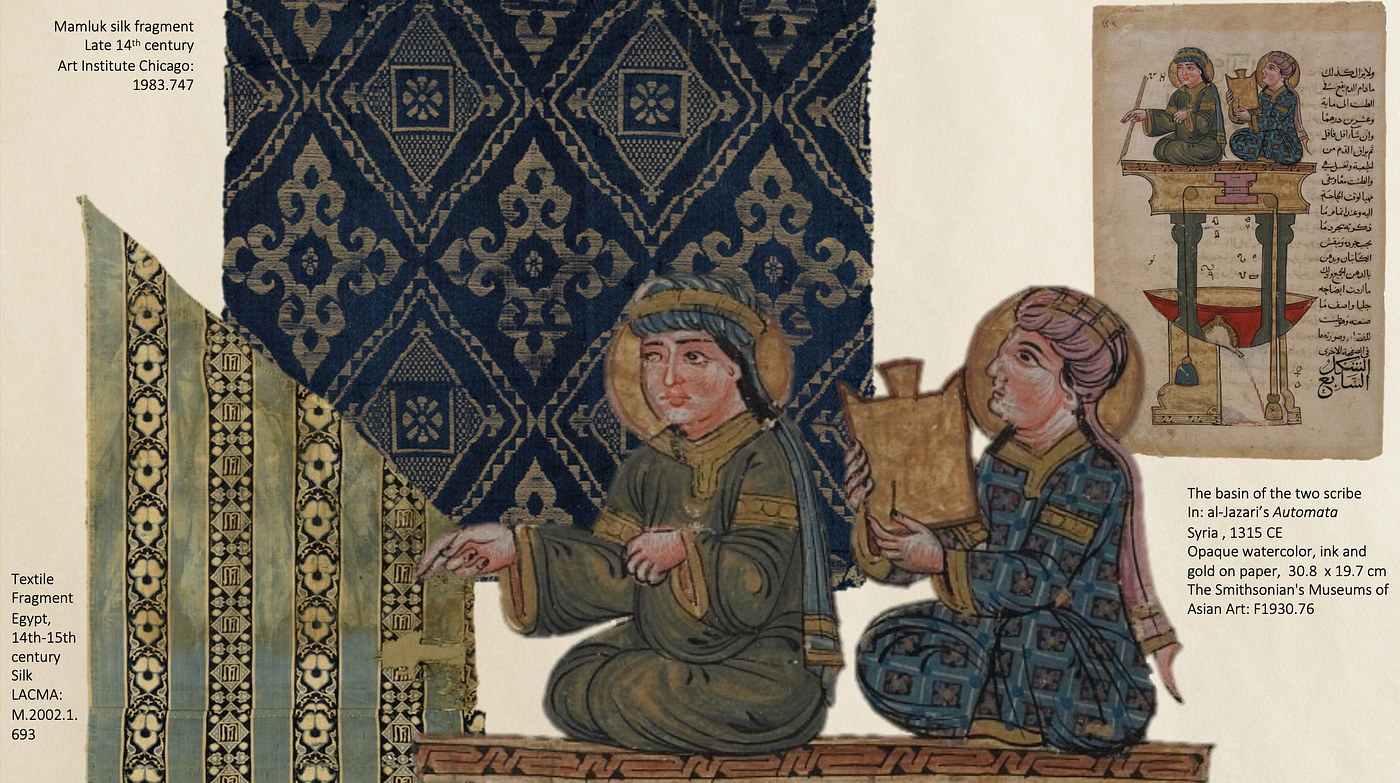
In addition, the diamond pattern on the righthand garment is reminiscent of this Mamluk textile fragment, whilst the colouring of the garment on the left is similar to this textile fragment from fourteenth to fifteenth century Egypt.

Here too, correlations can be drawn between the figure depicted on top of this water raising, storing and serving device and the two textile fragments shown alongside it. You can see that these square patterns with lozenge borders is a common theme in both manuscript illustration and in textile design.

Even the spiralling rumi designs that are highly reminiscent of manuscript illumination patterns may in fact be shorthand for real fabric styles that were in circulation at the time. Take, for example, the Mamluk period textile fragment shown above, and compare it to the Mamluk illustration from the Kalila and Dimna.

Reinforcing this idea, all the textile fragments shown in the image above have elements of rumi patterns that the book illustration may be representing. Considering that there are potential textile sources for the patterns depicted on the painted garments, one could postulate that this rather odd pattern on the blue and olive garments may also be representative. One could therefore propose that these patterns are not representing a particular patterned fabric, but rather a type of fabric itself: jacquard and damask silks.

Therefore, these abstract but repetitive patterns would represent not only the drape of the fabric but also the sheen as it reflects the light. One could argue, after all that the fabric of the two angels gives an effect very similar to the silk damask textile fragment shown to the left.

Whilst the literature describes clothing using many names, it is somewhat difficult without images to differentiate them and is somewhat like describing the differences between a shirt and a blouse in modern fashion to the unititiated. Therefore, it’s difficult to find the difference between salari and tatari cloaks. But it seems safe to say that Mamluk clothing consists of underwear comprising a qamis — shirt — and sirwaal — trousers — with a long-sleeved robe on top, with another cloak on top with either long or short sleeves.
For instance, the Qaba tatari was a Mongol-style cloak, that was introduced by Sultan Qalawun (r. 1279–1290), has a diagonal fastening on one side of the waist, characteristic of Eastern dress, and it seems that these eventually became known as salari.
Clothing also differed with the seasons, with white garments made from lighter fabrics used for summer with white boots, whilst in winter garments were made from wool or silk with fur with boots made from yellow or red leather that reached to the knee.

Headwear was incredibly important for the Mamluks, and the loss of one’s headdress was seen as shameful and used to express one’s own shame and repentance. Pulling off someone’s headdress was to humiliate them.
After his return from pilgrimage, al-Nasir Muhammad introduced the kalawta nasiriyya to his emirs and his military, which consisted of a small cap wrapped in gauze with the tip pointed upwards, unlike the turbans of civilians. It is important to note that here the depiction varies from reality that the introduction of the kalawta nasiriyya came after the ruling of having short hair, and so the headwear would not have been worn over long hair as is often shown in manuscript illustrations.
Underneath the wrapped gauze, the kalawta may have looked like the caps shown above, which are some of the few surviving caps from the Mamluk period. The navy-blue hat contains the inscription “Glory to our lord Sultan al-Malik al-Nasir”, and so is dated to the period we are looking at. The two similar caps at the top also have the word “al-sultan” woven into the fabric.

The sharbush, however, was used much earlier than the kalawta nasiriyya, and was reserved for highly solemn occasions, such as for the investiture of governors. The sharbush was a three-pointed crown, and was exclusive to the highest-ranking emirs.
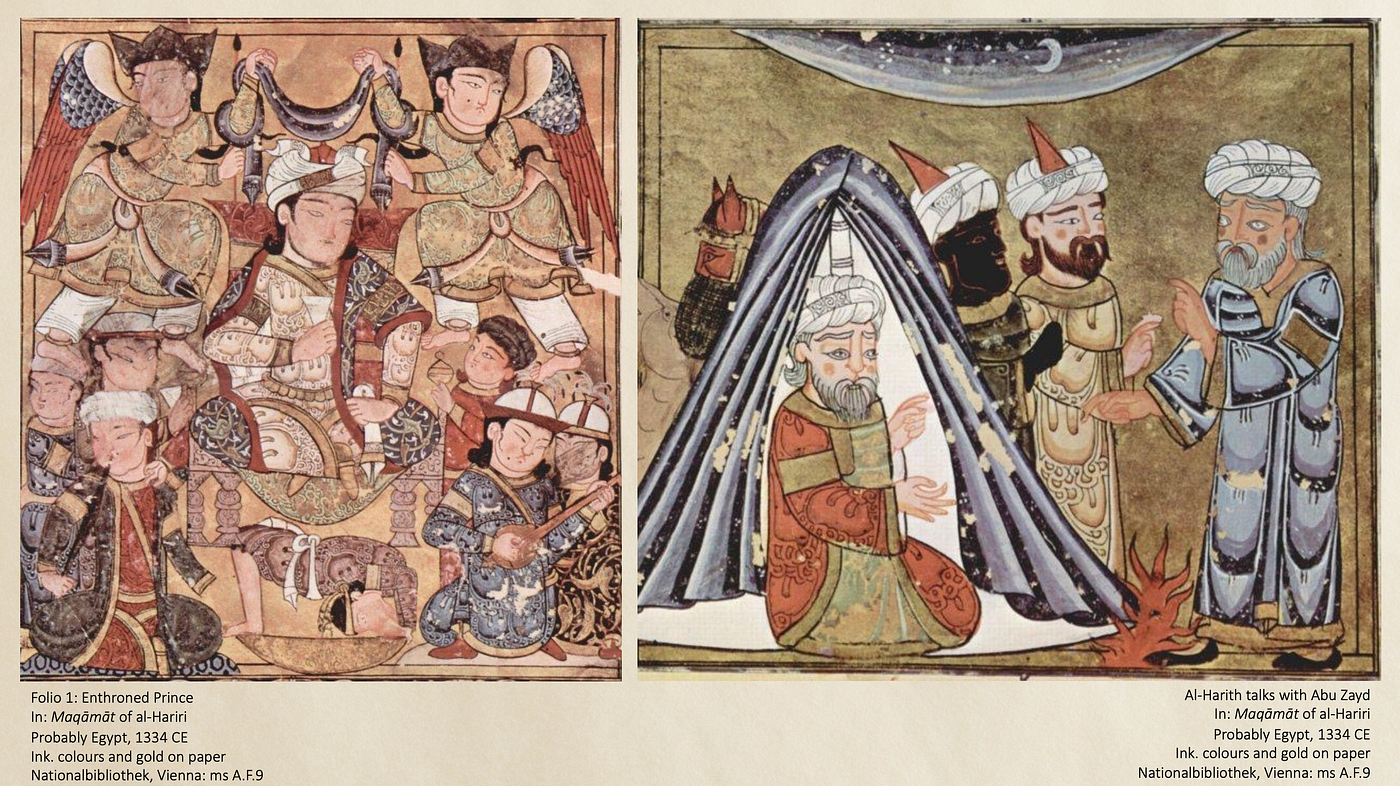
An important point however on Mamluk society is that whilst the Sultan and the emirs would be of Turkic origin — having been brought into Egypt as slaves at an early age — the native Cairene population was not.
These racial differences, as well as the differences in the attire between a court setting and the non-Mamluk population, are depicted in the Vienna Maqamat. In the image from the Vienna Maqamat on the right we see that the figures have non-Asian facial features with a variety of skin tones, whereas in the court scene on the left, the figures are all drawn with Turkic features — showing the Kipchak steppe heritage of the Bahri Mamluks. This may have been an artistic representation of the Bahri Mamluk’s eastern origins and their fascination with the Mongols rather than their actual physical appearance, as there are records of Kipchaks with fair skin and blonde hair — vastly different to their portrayal in Mamluk illustrations.
And so, on this note, let’s turn to look at the dress of the civilian, non-Mamluk population of Cairo.
Patrons and Merchants
Whilst the articles of clothing did not differ much between the Mamluk ruling class and the indigenous population, the fabrics did. For example, the highest-ranking civilian dignitaries of the judicial and administrative establishment were honoured with khil’a made of white-coloured chenille ‘kamkha’ fabric. The robes of honour given to civilians consisted of an over-cloak lined with fur, with a green cloak underneath, but did not reach the quality of the highest emirs. The tiraaz band, for example, was embroidered in plain silk rather than gold brocade, and the turban was wound from Damietta linen, not fine silk.

Whilst the military and the emirs would have short, upward-pointed tips to their wrapped turbans, the civilian elite wore their turbans with long tails called dawa’ib. These long tips were either wrapped around the neck, or hung down between the shoulders, sometimes to as low as their saddles. The lower ranks had the tails of their turbans hanging only to their shoulders, rather than to their lower backs.
Just as with the emirs and military, hierarchy was designated through clothing, and the fabric used depended on status and wealth: silk satin was used by the elite, whereas a shawl may be used by the lower ranks instead.

The merchants, due to Cairo’s position at the heart of international trade, could be extremely wealthy — particularly those involved with the spice and slave trades.
The clothing of the merchant elite was opulent, sometimes even with a double tiraaz marking their distinction. Alongside the sirwal, farajiyya and turban worn by other civilians, merchants would often also wear a dagger. Those lower down in hierarchy, however, had cloaks without fur, and even further down the cloak came without an accompanying shawl. The lower the rank, the less refined the fabric used and the less fancy the garment.
The middle classes mainly wore the same thing as the elite civilians, with the differences again lying in the quality of the fabric used. An over-cloak called a farajiyya was worn, which was a long cloak with big sleeves. The farajiyya had an opening at the shoulders rather than at the front, and men of higher status were reported to have “windcatcher sleeves”, although it is not very clear what these were. Sometimes the farajiyya had buttons down the front. Only the Mamluks wore belts of metal, and the indigenous population instead wrapped cloth around their waist, which could be used as a mat for praying when out and about.

Due to their position within the religious establishment, high-ranking judges and preachers wore robes made from wool without embroidery. The farajiyya over-cloak was white, and the jubba worn underneath was green and had an opening at the back.
Religious dignitaries wore an honorific shawl above their head or shoulders, called a tarha. After the 13th century, the turban, or imaamah, became a distinguishing headgear for religions and non-military statesmen, and increased in size over time until it looked like a small tower. The preachers in the mosques wore black gowns.
Following the third righteous caliph ‘Umar’s regulations that non-Muslims should be recognisable, regulations were implemented on the non-Muslims in society. In Mamluk Egypt, the main legislation was regarding the colour of turbans: blue turbans were reserved for Christians, and Jews wore yellow turbans. However, the number of records describing how these regulations had to be enforced demonstrates that they also tended to be neglected and ignored.
In Mamluk society, colours carried great importance, with writings on the interpretations of dreams giving us clues on their meanings. Yellow farajiyya, for example, predicted illness. A green or white qaba’ was auspicious whilst yellow predicted illness and blue predicted disaster. Red could mean power or frivolity, but generally carried auspicious meanings.
The age of the garment in the dream also carried meaning. An old qaba’ signalled oncoming sorrow, a new one indicated success and happiness, and a silk qaba’ foreshadowed honour and prestige.
Whilst black silk in real life was reserved for the caliph and Sultan, in dreams, it was interpreted as a bad omen. In addition, whilst yellow traditionally had negative connotations within dream interpretation, it was also the emblematic colour for the Mamluks, and was displayed on silk banners and on other insignia. In illustrated manuscripts, however — just as in life — colours did not necessarily continue to carry these meanings, and colours were likely just determined on an aesthetic basis.
Women
Just as for men, the basic underwear was sirwal and a shirt. The sirwal were tied around the waist with a ribbon, and wealthy ladies attached a gem or pearl to the tip of this ribbon. For the wealthy, the sirwal were made from silk adorned with gold, reaching down to the ankles. The shirt, or jalabiyya, reached down to either the knees or down to the floor. Women wore slippers or boots made from coloured leather.

The women wore a headdress called isaaba, which was a band tied around the forehead to hold the veil, and this is commonly depicted in illustrated manuscripts. The isaaba could be plain, embroidered, or bejewelled, depending on their wealth and status.
The fasadiyya was a scarf used to cover women’s hair that was made of floral-patterned Iraqi silk and bordered by misri brocaded silk.

Contrary to religious edict, women were generally present on the street: for work, shopping, and to meet friends. Cairene women in Mamluk Egypt enjoyed considerable freedom. However, in public, women would generally have been covered with a large wrap called an izaar covering the entire body, and so beauty, wealth and status were displayed on the visible parts of their clothes, such as the hems of their dresses and sirwal. The izaar was a large wrap that covered the body and was tied under the arm, and could be made from expensive material such as gold-brocaded silk. The colour of the izaar was dependent on the faith of the wearer: white for Muslims, blue for Christians, yellow for Jews, and red for Samaritans.

Despite illustrations suggesting otherwise, veiling of the face was almost ubiquitous for women in Mamluk society, and even Mamluk female slaves seem to have covered their faces, despite being exempt from these Islamic rulings.
There were three types of face veils. The women of the upper class wore veils of black net over their eyes and covering their entire face, allowing them to see through without being seen themselves. Alternatively, women wore a veil of black net with two holes for eyes, or a face veil in white or black covering the face up to the eyes.

Gold and silver anklets and bracelets were another sign of wealth and status, which were engraved with words. Henna was another method of beautification and is depicted in several manuscript illustrations.
Children
There unfortunately seems to be no written information on children’s dress in the Mamluk period, but from miniature paintings it appears that boys dressed the same as adults.

From the chronicles, we know that orphan boys would receive a maluuta — a simple garment similar to the jubba — a shirt, sirwal, a cap, clogs, and sometimes an over-cloak.
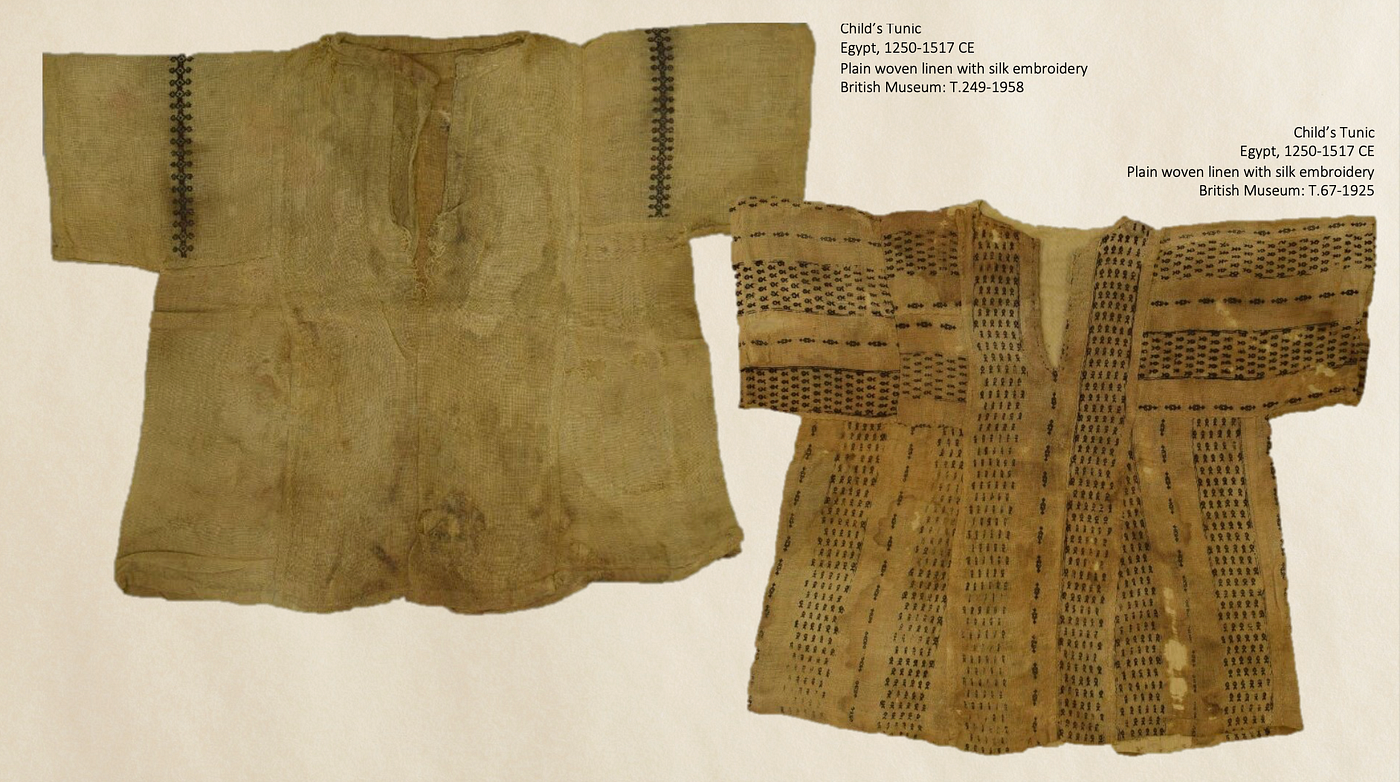
Some of the few surviving garments from the Mamluk period are children’s tunics, such as the deep red or purple tunic in the collection of the British Museum (T.66–1925), the two yellow tunics patterned with silk embroidery shown above, and a sirwal and jacket set in the collection of the Victoria and Albert Museum (763–1898 and 778–1898).
Girls wore caps instead of veils, but there is little other information and no apparent illustrations.
With the exploration of the supporting cast complete, let’s turn to the craftsmen.
Craftsmen and the Tentmaker
Although there is little in the chronicles about the garments of the poorer classes, they most likely dressed the same as the middle class, with the fabric quality according to their financial means. Regardless of social rank, the qamis and sirwal were the basic dress garments, but the poorer the person, the more frugal their attire.
When at work, craftsmen wore a blue coarse shirt, and in book illustrations from the fourteenth century, these are often portrayed as short with bare legs — or sometimes sirwal — underneath.

A poor man in the fourteenth century, such as a poor tentmaker, would only have worn sirwal, a shirt, a turban, and a woolen mantle or wrap (iba’a)

A mandeel, or a kerchief, was used by all social groups, and occupied a prominent place in Mamluk outfits. The Italian traveller Simone Sigoli’s account in 1384 described how all men held a scarf or kerchief in their hands or over their shoulders. For commoners, the mandeel was a multi-use item and was used as a towel, napkin, tablecloth, bag, or as a scarf.

Cotton, linen and wool were used across all classes, but in the Bahri period a coarse wool imported from Europe called jukh was also used for clothing, and a white linen or cotton was used for their turban. Instead of boots, they wore wide trousers and red slippers that left the heel uncovered — similar to the style still found in Middle Eastern and Maghrebi souks.
Social mobility in Mamluk society was demonstrated by the change of attire, and so, with successful completion of the coronation tent, the tentmaker would likely have been gifted a khil’a (of low rank) in gratitude of his service. Documents report that on completion of al-Nasir Muhammad’s palace in 1314, a total of 2,500 robes were distributed to the craftsmen involved in its construction, with the supervisors awarded robes of silk. The wearing of this khil’a signifies increased importance in Mamluk society.
Whilst this overview of dress in the Bahri Mamluk dynasty is not exhaustive, it gives an overview and a starting point for illustrating the period without relying on tropes and stereotypes. I hope it provides an informative resource.
Sources and Readings
Behrens-Abouseif, Doris. Dress and Dress Code in Medieval Cairo: A Mamluk Obsession. Brill, 2023.
Fathy, Hebatullah, and Boussy Zidan. “Judges’ Costumes During the ‘Abbasid and the Mamluk Eras Based on the Archaeological Manuscripts.” International Journal of Heritage, Tourism and Hospitality 11, no. 3 (2017): 50–66.
Fuess, Albrecht. “Sultans with Horns: The Political Significance of Headgear in the Mamluk Empire.” Mamlūk Studies Review 12 (2008): 71–94.
Mayer, L. A. Mamluk Costume. Geneva, 1952.
Stowasser, Karl. “Manners and Customs at the Mamluk Court.” Muqarnas 2 (1984): 13–20.
Taghizadeh Borujeni, Robabeh, Abbas Bozorgmehr, and Zahra Akbarzade Niaki. “The Manifestation of the Political Tendencies of the Mamluk Sovereigns on Fabric Designs.” Islamic Art Studies 18, no. 43 (2021): 94–108.
메타데이터
- post_id
- 524fd666db3f
- slug
- illustrating-the-bahri-mamluks-524fd666db3f
- url
- https://medium.com/@rosalindnoor/illustrating-the-bahri-mamluks-524fd666db3f
- canonical_url
- https://medium.com/@rosalindnoor/illustrating-the-bahri-mamluks-524fd666db3f
- author_url
- https://medium.com/@rosalindnoor
- status
- ok
- fetched_at
- 2026-07-23 13:25:52