From Jim Crow to Nazi Germany to Now: The Dangerous Logic Behind Anti-Trans Laws
Bathroom Bans, Book Burnings, and the Return of Global Fascism
From Jim Crow to Nazi Germany to Now: The Dangerous Logic Behind Anti-Trans Laws
Bathroom Bans, Book Burnings, and the Return of Global Fascism
Abstract
This essay argues that contemporary political and legal attacks on transgender people in the United States exhibit structural parallels with historical forms of segregation and authoritarian exclusion, including Jim Crow racial separation and early fascist gender policing. It combines lived experience with historical and scholarly analysis to contend that mechanisms of exclusion and bodily control are not isolated phenomena but predictable patterns of social exclusion. Experts in genocide studies have warned that these dynamics may constitute the early stages of genocidal process, marked by dehumanisation and systemic marginalisation — and that recognising these patterns early is vital for effective resistance.
Introduction: Situated Knowledge and Urgency
Transgender people are often dismissed as “biased” when we point to societal dangers. Yet those targeted by exclusionary policies are, in many cases, the earliest to perceive their escalation. I speak here not only from formal knowledge but from lived experience — raised within Christian institutions that were at times compassionate and at times confining, permitted to transition through moral discernment in a Catholic school, and later drawn into Islam by deep textual engagement with the Qur’ān as an ethical and unifying framework. This positionality does not replace analysis; it alerts it to mechanisms that formal institutions often ignore until it is too late.
II. Fascism and Genocide as Processes, Not End States
Authoritarian and fascist systems do not begin with camps or mass murder — they begin with moral panic, scapegoating, and ideological construction of enemies. Genocide scholars today argue that targeting groups defined by non-traditional gender identities reflects early warning signs of genocidal process — not merely as metaphor but as structural pattern recognition. According to experts, current political rhetoric and policy actions against transgender and nonbinary Americans could signal a broad assault on the very existence of a gender group.
This framing aligns with Gregory Stanton’s “stages of genocide”, a model scholars use to identify predictable escalations from classification and discrimination to dehumanisation and elimination.
III. Historical Precedent: Nazi Gender Policing
Historical fascism did not confine its control to political opponents alone; it extended into bodies and identities. In 1933, the Nazis stormed and destroyed the Berlin Institute of Sexual Science — an internationally renowned pioneer in research on sexuality and gender diversity — and publicly burned its archives alongside works deemed “degenerate.” Though trans and queer scholarship was not central to political power at the time, the Nazis viewed gender variance itself as a threat to their rigid ideological order, eliminating knowledge and institutions that challenged their enforced binaries.
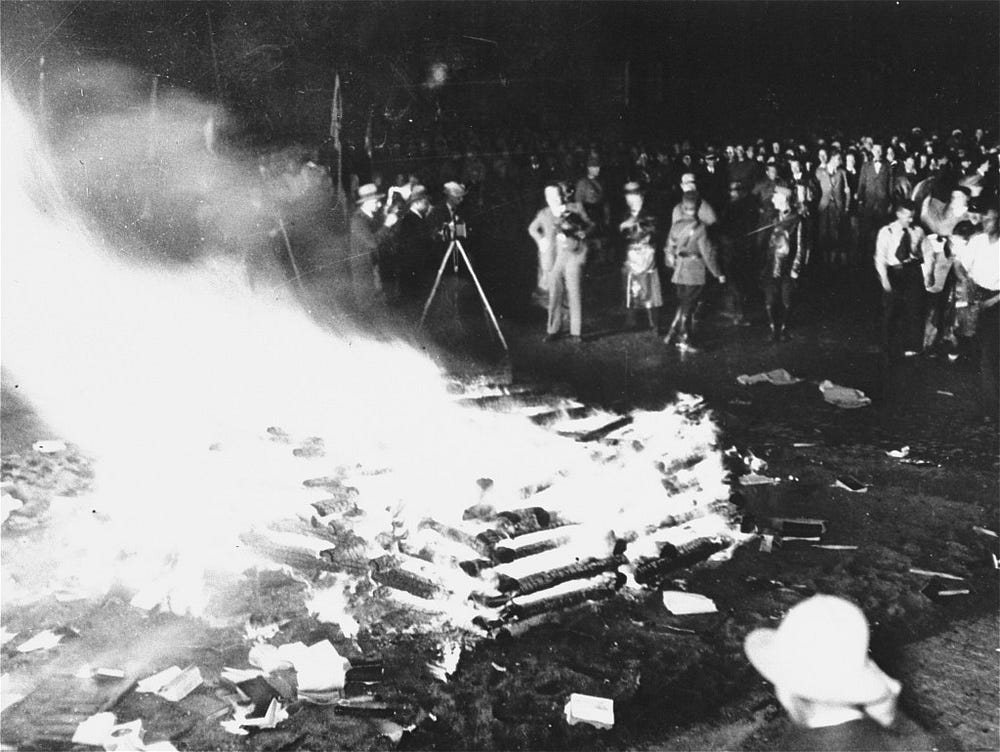
Public burning of “un-German” books in the Opernplatz (Opera Square). Berlin, Germany, May 10, 1933. — source: Holocaust Encyclopaedia, all rights reserved.
This early assault on both bodies and the languages that structure their recognition demonstrates that authoritarian violence often precedes mass execution with symbolic erasure and knowledge destruction. As
IV. “Gender Ideology” as Contemporary Enemy
Today’s political rhetoric mirrors past narratives of ideological contamination. The term “gender ideology,” widely used by conservative movements, functions like the Nazi-era construct of “cultural Bolshevism”: a conspiracy framing nonconforming identities and progressive movements as a corrosive threat to civilisation itself. Public figures and lawmakers invoke these terms not only to oppose specific policies but to cast entire identities as existential enemies of a purported social order.
This is a transition from policy disagreement to ontological rejection — a hallmark of processes that precede violence.
V. Bathrooms, Surveillance, and Bodily Policing
Public restrooms are not trivial: they are sites of necessity, intimacy, and social participation. Control over who may use which restroom is not simply a matter of architecture; it is a mechanism of exclusion and surveillance.
Debates over restroom access have evolved from abstract policy battles into practical enforcement mechanisms that empower police, guards, and lawmakers to regulate bodily presence in public space. Bathroom bills that insist on “protecting women” often do so by requiring verification of biological sex or by allowing non-state actors to police bodies — a logic that, once normalised, is not far from the surveillance and enforcement practices seen under historical segregation.
“Texas Department of Public Safety officers guard the women’s bathroom and ask some individuals to show ID to enter at the Capitol in Austin on Dec. 6, 2025. Members of 6W Project protested the newly enacted Senate Bill 8 “bathroom bill” by checking what the enforcement measures to enter the bathroom would be at the Capitol. SB 8, also known as the Texas Women’s Privacy Act, is aimed at restricting transgender people’s access to certain restrooms in the state, and went into effect on Dec. 4, 2025. Salgu Wissmath for The Texas Tribune” — source linked below, all rights reserved.
VI. Segregation Logic: Jim Crow as Structural Parallel
The comparison to Jim Crow is not rhetoric: it is mechanistic homology. Jim Crow laws in the United States codified racial segregation across every aspect of public life, including restrooms, under the doctrine of “separate but equal” that was upheld by Plessy v. Ferguson (1896).
Public facilities were marked with “White Only” and “Colored” signs to enforce racial hierarchy; bathrooms became symbolic and functional spaces of exclusion. This system was justified as “protective,” but its real logic was one of removal from civic life — a logic repeated in arguments for segregated gendered spaces today.
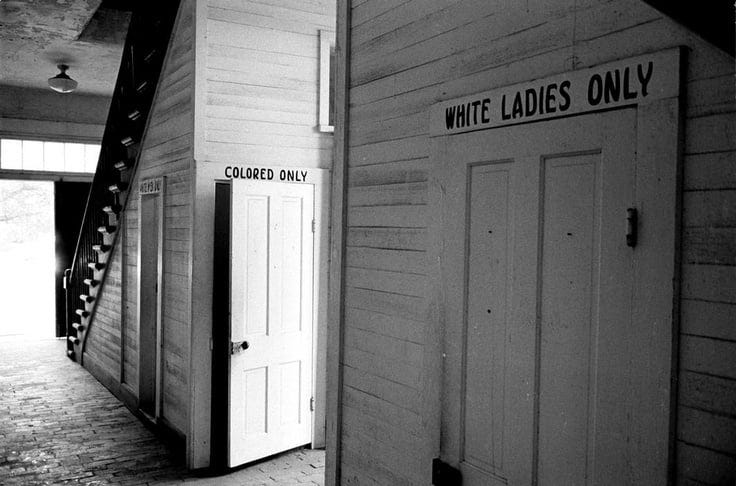
Bob Adelman, Louisiana. Clinton. 1964. Segregated bathrooms in the city courthouse. Photo: © Bob Adelman/Magnum Photos — All Rights Reserved.
To insist that any group “can have their own space” and therefore suffers no harm reproduces the core justification of segregation: that separation is sufficient. But history shows this is false; separation is a tool of dehumanisation and material inequality.
VII. Religion, Authority, and Resistance
Religion is often weaponised by power, but the problem lies not in faith itself but in its instrumentalisation. My own journey — from Christian formation to Qur’ānic engagement — shows that scriptural and contemplative traditions can offer ethical resistance to state idolatry and coercive hierarchies.
Authoritarian movements often co-opt religious language (e.g., “natural law”) to absolve themselves of ethical accountability and to sanctify exclusionary policies. A theological perspective that insists on human dignity, accountability, and internal coherence, whether articulated in Islamic theology, Christian ethics, or other traditions, resists such capture.
VIII. Conclusion: Naming Patterns Before It Is Too Late
Institutions are designed to act after consensus; those targeted by exclusionary processes are often the first to recognise patterns of danger. The comparison to Jim Crow and early fascist strategies is not hyperbolic, but methodological: it reveals structural similarities in mechanisms of exclusion and control.
Gender policing is not an isolated cultural skirmish; it is part of a continuum of social processes that restrict access to public life, assign bodies to categories designed to marginalise, and normalise surveillance. Recognising these patterns now is not alarmism — it is early intervention.
History shows us that once segregation and dehumanisation become acceptable language, violence is the next step. Naming these processes before they solidify is the first line of defence.
This argument is also applicable wherever such policies emerge and we must be vigilant against them.
References
Early Warning, Fascism, and Genocidal Process
- Important Context. *Experts Warn the U.S. Is in the Early Stages of Genocide.*
- Stanton, Gregory H. The Ten Stages of Genocide. Genocide Watch.
- Trans Genocide Watch. *Patterns of Anti-Trans Violence and Political Escalation.*
Contemporary Anti-Trans Rhetoric and Policy
- Transitics. *Republicans Pivot Anti-Trans Rhetoric From “Protecting Kids” to “Protecting Women.”*
- Time Magazine. *How Bathroom Bills Became the Front Line of the Culture Wars.*
- American Civil Liberties Union (ACLU). *Transgender Federal Worker Challenges Trump’s Federal Bathroom Ban.*
- The Texas Tribune. *Enforcement of Texas’ “bathroom bill” draws challenges as colleges, cities implement new policis.*
Nazi Germany, Gender Policing, and Book Burnings
- Holocaust Memorial Day Trust. *6 May 1933: Looting of the Institute of Sexology.*
- United States Holocaust Memorial Museum. *Magnus Hirschfeld.*
- University of Washington Tacoma. *Gender, Ideology, and Control in Nazi Germany* (Undergraduate Thesis).
Segregation, Jim Crow, and Public Infrastructure
- United States Supreme Court. Plessy v. Ferguson, 163 U.S. 537 (1896).
- Artnet. *Art Student’s Segregated Bathrooms Create Furor at SUNY Buffalo*
- National Archives. “Colored Women’s Washroom” Sign (Jim Crow Era).
메타데이터
- post_id
- 5281961cecae
- slug
- from-jim-crow-to-nazi-germany-to-now-the-dangerous-logic-behind-anti-trans-laws-5281961cecae
- url
- https://medium.com/@vhcapps/from-jim-crow-to-nazi-germany-to-now-the-dangerous-logic-behind-anti-trans-laws-5281961cecae
- canonical_url
- https://medium.com/@vhcapps/from-jim-crow-to-nazi-germany-to-now-the-dangerous-logic-behind-anti-trans-laws-5281961cecae
- author_url
- https://medium.com/@vhcapps
- status
- ok
- fetched_at
- 2026-07-13 14:59:43



