Wastewater Surveillance: An Early Warning System for Infectious Disease
Disclosure: I wrote this article and used AI as a “professional editor” to refine and shorten overly long or complicated sentences.
Wastewater Surveillance: An Early Warning System for Infectious Disease
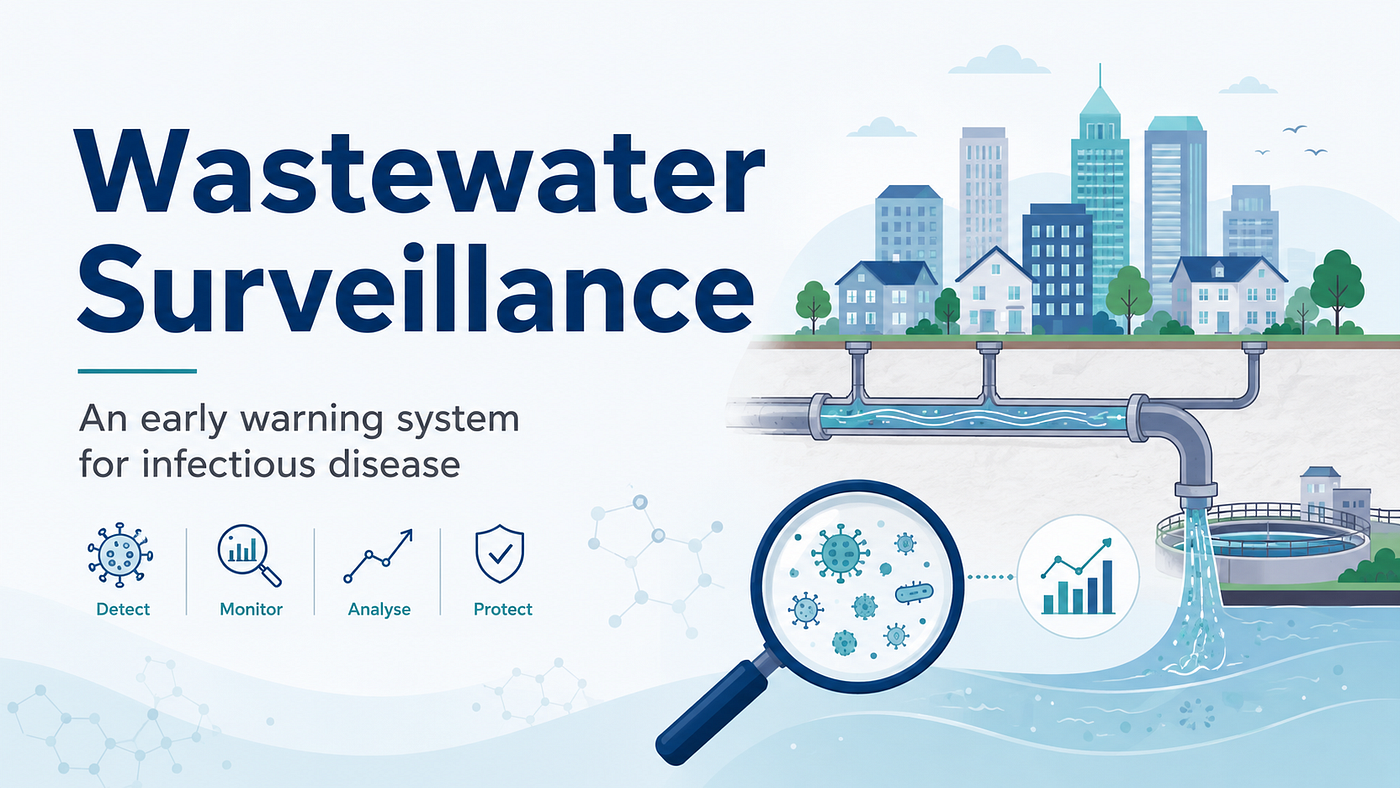
Image generated with the assistance of AI.
Disclosure: I wrote this article and used AI as a “professional editor” to refine and shorten overly long or complicated sentences.
.
Back in the late 2000s, Google launched a project called Google Flu Trends. The idea was straightforward: people search for symptoms like “fever” and “sore throat” before they see a doctor, so search activity should be an early signal of flu spreading in a community. The original program was eventually discontinued after concerns about accuracy, but it demonstrated something important: people often leave early digital traces of illness before traditional surveillance systems detect a rise in cases. With the rise of **wearables**, digital surveillance may become a powerful tool again in the future.
Traditional infectious disease surveillance, by contrast, relies on patient testing, one patient at a time, one result at a time, often with delayed reporting. It provides important value, but methods that can detect rising pathogen activity even before hospitals or clinics see a major rise in patients are especially valuable. Early detection can guide public health action before the situation becomes harder to contain.
In the meantime, public health officials already have a powerful tool in hand: wastewater surveillance. You might have heard of wastewater-based epidemiology in connection with COVID-19, but SARS-CoV-2 wasn’t the start and is certainly not the end. In fact, researchers and public health agencies have explored wastewater as a way to measure chemical exposures, pharmaceuticals, and drug-use patterns across communities for years. In Europe, wastewater analysis has been used to compare drug-use patterns across many cities, including weekly fluctuations in substances such as cocaine metabolites and MDMA.
Similar approaches are also being explored in North America. For example, San Francisco began testing wastewater for fentanyl, xylazine, methamphetamine, amphetamine, cocaine, and related metabolites, as well as naloxone and its metabolite.
So, how does wastewater surveillance work when it is used to monitor infectious diseases?
As with my other articles, this overview is intentionally simplified. The underlying science, public health interpretation, and technical limitations are complex, but the core idea is easy to understand: wastewater can act as an early warning system.
.
How Wastewater Testing Works
Instead of testing one person at a time, wastewater surveillance analyzes sewage from a community. That may sound unusual at first, but it is actually a powerful public health tool. People infected with certain viruses or bacteria can shed biological material into wastewater through stool, urine, saliva, mucus, or other bodily fluids. Importantly, this can happen even when people have mild symptoms, or no symptoms at all.
A wastewater sample is usually collected from untreated sewage entering a wastewater treatment facility. The sample is then processed in a laboratory to look for specific biological markers of infection, most commonly genetic material such as DNA or RNA from pathogens.
The testing itself is conceptually similar to many molecular diagnostic tests used to test an individual patient. The key difference is the sample source.
A clinical PCR test may ask: “Does this person have the virus?”
A wastewater test asks: “Can we detect the virus, and is it increasing or decreasing in this community?”
Wastewater testing is not usually used to diagnose an individual patient. Instead, it helps monitor disease trends at the population level. In this way, wastewater testing can provide a community-level snapshot of infectious disease activity, often before many people seek medical care or get tested individually.
COVID-19 brought wastewater surveillance into broader public awareness. During the pandemic, many people infected with SARS-CoV-2 shed viral RNA into wastewater. By measuring that RNA over time, public health officials could track whether viral activity was rising or falling in a community.
This became especially valuable when individual testing behavior changed. Early in the pandemic, many people got tested through clinics or public testing sites, which reported the results. Later, more people used at-home tests, or did not test at all anymore, and many infections were never officially reported. As a result, traditional case counts became less reliable as a measure of total community spread. Wastewater helped fill part of that gap.
The CDC currently uses wastewater monitoring to track respiratory viruses such as SARS-CoV-2, influenza A, and RSV at community, state, regional, and national levels.
.
What Are the Bottlenecks of Wastewater Surveillance?
Wastewater surveillance is powerful, but it has limitations.
Detection sensitivity is one of the main challenges. Wastewater is exactly what the name suggests: a very large amount of water mixed with a relatively small amount of biological material. Every toilet flush, shower, sink, and industrial or environmental input adds volume. The pathogen signal, by contrast, may be present only in tiny amounts.
In other words, the target is extremely diluted, and highly sensitive detection methods are required.
Usually, testing methods that can specifically amplify the target are best suited, such as **polymerase chain reaction (PCR)**. PCR is a technology that can amplify nucleic acid from just a few molecules to billions, and it is extremely sensitive in detecting even trace amounts.
This is why wastewater surveillance for infectious diseases usually relies on nucleic-acid detection, such as PCR-based methods. Depending on the pathogen, the target may be DNA or RNA. For example, SARS-CoV-2, influenza, and RSV are RNA viruses, so wastewater testing looks for viral RNA. Other pathogens or antimicrobial-resistance markers may be detected through DNA.
Even then, timing matters. If only one person in a community is infected, wastewater testing will often not detect that signal. There may not be enough pathogen material in the total wastewater volume, and the sample may not be collected at the same time that the person is actively shedding the pathogen.
This example highlights an important point: wastewater surveillance is often most useful for identifying broader community trends. It can help show whether a pathogen signal is appearing, increasing, decreasing, or spreading geographically.
However, interpreting those trends can be complicated by the timing of sampling and by the wastewater system itself. In combined sewer systems, rainwater can enter the same pipes as household wastewater. Heavy rainfall can dilute pathogen signals, increase flow rates, and make direct comparisons between sampling days more difficult.
There are also privacy and communication challenges.
Because wastewater data is collected at the community level, it is less personal than individual clinical testing. However, if testing is performed at very small scales, such as a single building, hospital, dormitory, or correctional facility, privacy concerns become more important.
Communication also matters. A rising wastewater signal does not automatically mean panic. It means public health officials should pay attention, compare the signal with other data, and decide whether additional testing, communication, or intervention is needed.
.
Beyond COVID-19: Flu, RSV, Mpox, Polio, and More
Other infectious diseases can also be monitored through wastewater or environmental surveillance. The World Health Organization notes that wastewater and environmental surveillance has long been used in the polio eradication program and more recently during the COVID-19 pandemic. WHO guidance now highlights it as a tool for tracking a much broader set of pathogens, including mpox virus, cholera, and typhoid, in addition to the respiratory viruses already mentioned.
Some infections are difficult to track because not everyone gets tested. Others may spread silently before obvious outbreaks occur. Wastewater surveillance can help detect signals earlier, identify geographic hotspots, and monitor whether disease activity is rising or falling.
Wastewater surveillance does not replace clinical testing. Individual diagnostic tests remain essential for confirming whether a specific person is infected and for guiding medical care. Wastewater surveillance adds a different kind of information: it helps public health officials see what may be happening across a community.
Wastewater testing represents a shift in how we think about public health monitoring.
Traditional infectious disease surveillance often depends on individual people interacting with the healthcare system. Someone becomes sick, seeks care, gets tested, and the result is reported. That approach remains essential, especially for diagnosis and treatment.
But it misses infections that are mild, asymptomatic, untested, or unreported.
Wastewater surveillance adds another layer. It allows public health officials to monitor disease activity in the background, at a population level, without requiring every infected person to be individually tested. It does not replace clinical testing, but it can help reveal signals that traditional surveillance may miss.
And in infectious disease, earlier signals can make all the difference.
.
If you’d like to keep reading:
Subscribe to my newsletter on **Substack** (free, email delivery)
If you’d like to follow my work professionally (and read articles there as well):
Connect with me on **LinkedIn**
If you find this writing useful and want to support independent science communication:
You can support my work on **Patreon** (optional)
메타데이터
- post_id
- 528f189dcd0b
- slug
- wastewater-surveillance-an-early-warning-system-for-infectious-disease-528f189dcd0b
- url
- https://medium.com/@scienceworthknowing/wastewater-surveillance-an-early-warning-system-for-infectious-disease-528f189dcd0b
- canonical_url
- https://medium.com/@scienceworthknowing/wastewater-surveillance-an-early-warning-system-for-infectious-disease-528f189dcd0b
- author_url
- https://medium.com/@scienceworthknowing
- status
- ok
- fetched_at
- 2026-06-09 15:37:30