The Ultimate HAVING vs WHERE SQL Cheat Sheet
WHERE starts the race, HAVING finishes it
The Ultimate HAVING vs WHERE SQL Cheat Sheet
WHERE starts the race, HAVING finishes it
If you’ve been working with SQL for a while, you’ve likely come across HAVING and WHERE clauses. They both seem to filter data but they work in different stages of the query process. Understanding when to use HAVING vs WHERE can make your queries more efficient and accurate.
1. Understanding WHERE Clause
The WHERE clause filters rows before any grouping or aggregation happens.
Syntax:
SELECT column1, column2
FROM table_name
WHERE condition;
Key Points:
- Works on raw rows before aggregation.
- Can be used with
=,<,>,LIKE,IN, etc. - Cannot directly filter aggregate functions (like
SUM(),AVG()).
Example — Filtering Orders Before Grouping:
Imagine we have an orders table:
order_id | customer_id | amount | order_date
1        | 101         | 150    | 2025-08-01
2        | 102         | 80     | 2025-08-02
3        | 101         | 200    | 2025-08-03
4        | 103         | 50     | 2025-08-04
Query:
SELECT *
FROM orders
WHERE amount > 100;
Output:
order_id | customer_id | amount | order_date
1        | 101         | 150    | 2025-08-01
3        | 101         | 200    | 2025-08-03
2. Understanding HAVING Clause
The HAVING clause filters data after grouping and aggregation are applied.
Syntax:
SELECT column1, AGG_FUNC(column2)
FROM table_name
GROUP BY column1
HAVING condition;
Key Points:
- Works after
GROUP BY. - Designed for filtering aggregate results (
SUM(),COUNT(),AVG()). - Cannot be used before grouping — use
WHEREfor that.
Example — Filtering Customers by Total Order Amount:
order_id | customer_id | amount | order_date
1        | 101         | 150    | 2025-08-01
2        | 102         | 80     | 2025-08-02
3        | 101         | 200    | 2025-08-03
4        | 103         | 50     | 2025-08-04
Query:
SELECT customer_id, SUM(amount) AS total_spent
FROM orders
GROUP BY customer_id
HAVING SUM(amount) > 200;
Output:
customer_id | total_spent
101         | 350
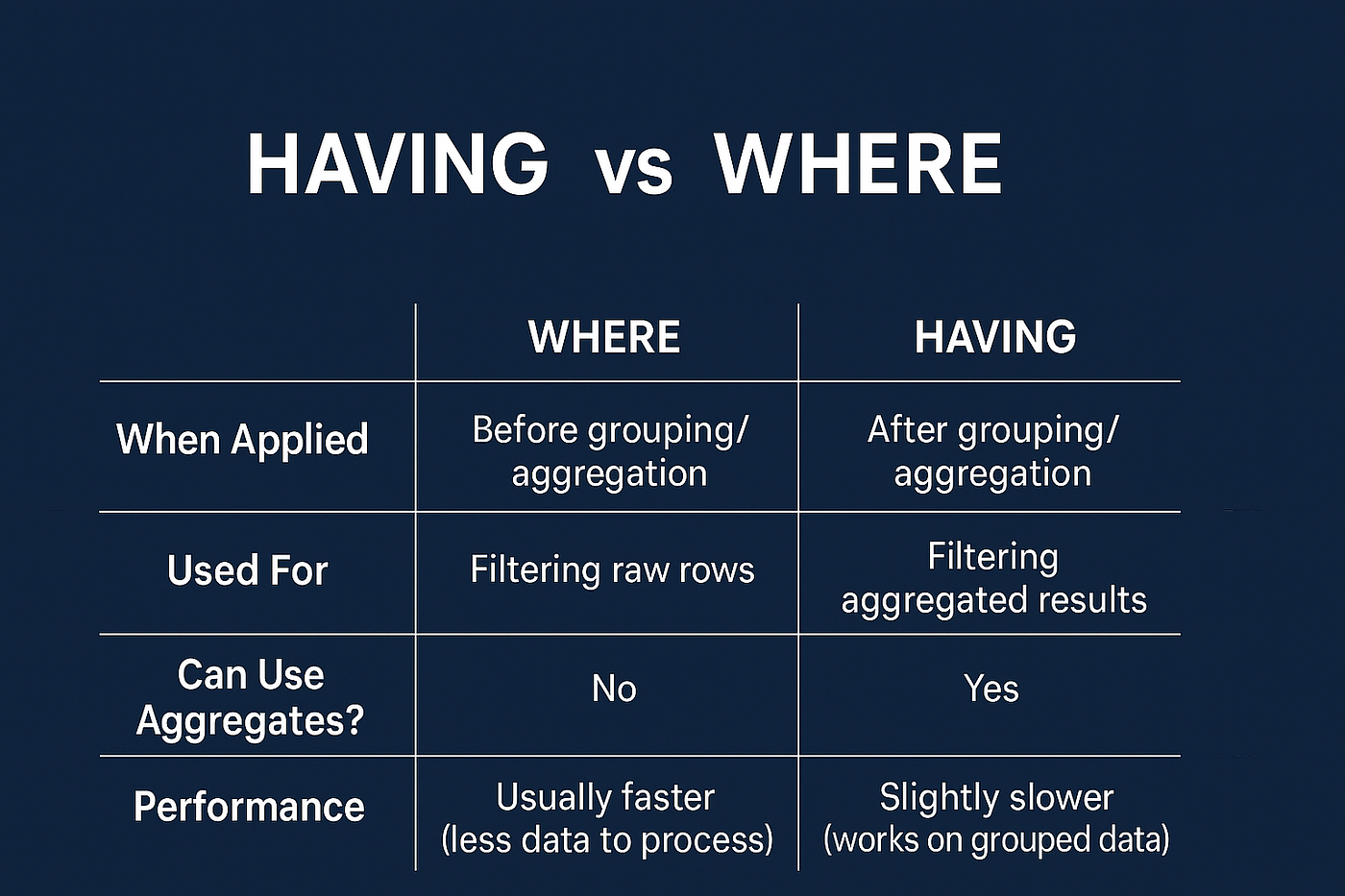
3. WHERE vs HAVING — Key Differences
Feature                 WHERE                               HAVING
----------------------  ----------------------------------  ----------------------------------
When Applied            Before grouping/aggregation         After grouping/aggregation
Used For                Filtering raw rows                  Filtering aggregated results
Can Use Aggregates?     No                                  Yes
Performance             Usually faster (less data to process) Slightly slower (works on grouped data)
4. Real-World Problem Example
Scenario: A sales manager wants to:
- Exclude all orders below $100.
- See only customers who have spent more than $500 in total.
Query:
SELECT customer_id, SUM(amount) AS total_spent
FROM orders
WHERE amount > 100
GROUP BY customer_id
HAVING SUM(amount) > 500;
Explanation:
WHERE amount > 100→ filters raw orders first.HAVING SUM(amount) > 500→ filters aggregated totals.
Input Table:
order_id | customer_id | amount | order_date
1        | 101         | 150    | 2025-08-01
2        | 102         | 80     | 2025-08-02
3        | 101         | 200    | 2025-08-03
4        | 101         | 300    | 2025-08-05
5        | 104         | 600    | 2025-08-06
Output Table:
customer_id | total_spent
101         | 650
104         | 600
SQL #SQLTips #DataAnalysis #WHEREClause #HAVINGClause #DatabaseQueries #LearnSQL #SQLForBeginners #DataFiltering #SQLBestPractices
메타데이터
- post_id
- 52cefbb2c2b8
- slug
- the-ultimate-having-vs-where-sql-cheat-sheet-52cefbb2c2b8
- url
- https://medium.com/@thecodestudio/the-ultimate-having-vs-where-sql-cheat-sheet-52cefbb2c2b8
- canonical_url
- https://medium.com/@thecodestudio/the-ultimate-having-vs-where-sql-cheat-sheet-52cefbb2c2b8
- author_url
- https://medium.com/@thecodestudio
- status
- ok
- fetched_at
- 2026-07-26 08:23:31