Article 3 of 4 : The Missing Middle: Why India’s Steel Decarbonization needs a category of…
What sits between the large capital bets and the generic solutions & why it is the most underutilized opportunity in Indian steel
Article 3 of 4 : The Missing Middle: Why India’s Steel Decarbonization needs a category of Innovation that doesn’t exist yet
What sits between the large capital bets and the generic solutions & why it is the most underutilized opportunity in Indian steel
The most valuable conversations I have had this year have been with people closest to the problem, navigating the gap between a credible decarbonization strategy and the operational reality of delivering it, shift by shift, plant by plant.
This is a 4-part series on what I believe is the most important & most overlooked opportunity in India’s industrial decarbonization agenda, starting with steel.
Every article in this series is written with one conviction that India has the opportunity to build a genuinely competitive low-carbon steel industry, not just a compliant one. And that the path to get there is clearer, faster & more accessible than most roadmaps suggest. The missing middle is not a gap to lament. It is an opportunity to build.
I would also welcome perspectives from anyone working at this intersection-whether in operations, sustainability, digital, strategy, innovation or materials.
Explore the full series here: (Summary, Article-1,Article-2,Article-4)
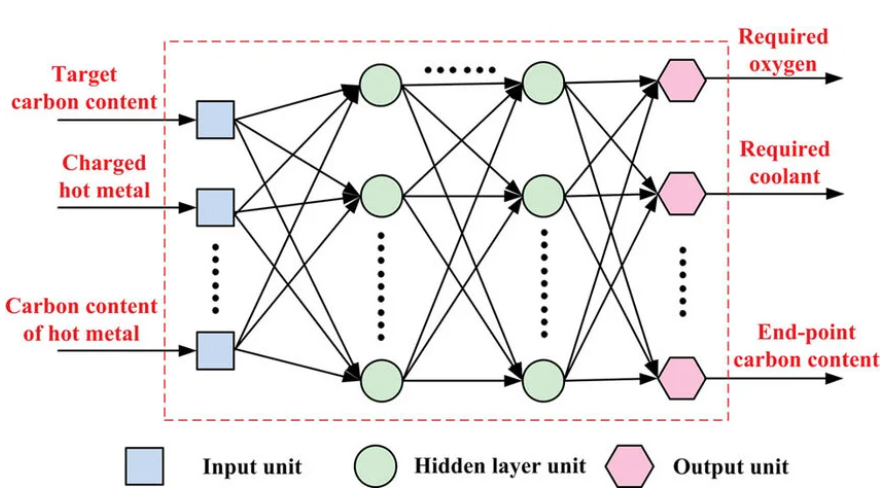
Source : Research Gate (BP neural network for BOF end-point carbon prediction)
In the previous article, I described three decarbonization pathways running simultaneously in India’s steel sector — green hydrogen, large-scale renewable energy, DRI-EAF transition & four quick wins that should run in parallel. All three pathways are strategically correct. All four quick wins are available today.
Here is what I deliberately left out of that article. The most consequential gap in India’s steel decarbonization is not in the strategy. It is not in the capital. It is not even in the data, most major steel companies have already built the data infrastructure.
The gap is in a specific category of innovation that sits between the large capital programs and the generic technology solutions that surround them. I call it the missing middle.
Section 1: The Missing middle defined
Every modern Indian steel plant running an Industry 4.0 program has accumulated years of operational data — DCS historians, energy meters, quality logs, environmental monitors. This data contains a precise record of every inefficiency in the plant. Every heat that consumed more energy than necessary. Every shift where process parameters drifted from optimal.
The data is there. What is missing is the domain-specific intelligence that reads it in real time and tells the operator what to do differently — right now, this shift to reduce energy per ton and carbon intensity simultaneously.
But the missing middle is not only about software or data intelligence. It is a broader category of innovation that spans three distinct tiers each with a different capital requirement, timeline & impact profile. And the defining characteristic of all three tiers is the same: domain-specific, deployable on existing infrastructure & delivering measurable outcomes in 12 months.
Section 2: Three tiers of the missing middle
The opportunities described below are illustrative, not exhaustive. The missing middle in Indian steel decarbonization is wider than any single article can map — spanning process stages, technology domains & material categories that are still being defined. The ventures that matter most may be the ones that do not yet have a name.
Tier 1: Process and Operational Intelligence (zero capex, 6–12 months, immediate ROI)
Domain-specific advisory systems running on existing plant data. No new hardware. No capital expenditure on process assets. The five opportunities described in the previous article — BF-BOF process optimization, DRI shaft advisory, coal blend optimization for coke ovens, carbon intelligence & renewable dispatch, all sit here.
The critical word is domain specific. A system that does not know what metallization rate is, why it matters for DRI shaft efficiency, how changes in reducing gas composition cascade through to Scope 1 emission intensity, that system cannot help. That knowledge is earned through deployment in a real steel plant, with real shift data, validated against real operational outcomes. It is not in a textbook and it is not transferable from a horizontal technology platform.
Tier 2: Enabling Technology for the Big Bets (low capex, 12–24 months, strategic impact)
These are the innovations that make the large capital programs perform to their designed potential. Green hydrogen integration into DRI is a large capital bet, but the electrolyzer membrane technology that determines whether the hydrogen plant is economically viable is a Tier 2 innovation.
Carbon intelligence platforms that verify Scope 1/2/3 in real time, track progress against CCTS benchmarks & generate product-level carbon certificates for EU CBAM compliance — these make the decarbonization investment commercially valuable, not just environmentally meaningful.
A sinter digital twin with a thermal camera and permeability sensor that delivers 10% production improvement and 8% coke reduction in live deployments, that is a Tier 2 innovation running on existing sinter strand infrastructure.
Tier 2 innovations do not replace the large capital bets. They make those bets viable, measurable & commercially valuable, which is what transforms a capital investment into a competitive advantage.
Tier 3: Industrial Circularity & Advanced Materials (medium investment, 24+ months, downstream value)
This is the tier that most steel decarbonization discussions miss entirely & it is the one with the longest-duration compounding effect.
Critical mineral recovery from steel waste (the mine hiding in plain sight) Every ton of steel produced generates approximately 100–150 kg of slag as a byproduct India produces over 20 million tons of steel slag annually. Most of it goes to road construction and cement clinker at minimal value. What almost no Indian steel company is doing systematically is recovering the critical minerals locked inside it especially Vanadium
The light-weighting contest(steel’s next competitive frontier) India’s auto OEMs are under CAFE norm pressure to reduce vehicle weight by 2027. The contest is between Advanced High-Strength Steel, which India’s largest steel companies are actively developing & high-performance composites, which offer superior weight reduction in specific applications where AHSS reaches its limits. The steel companies that win are not the ones defending conventional steel. They are the ones evolving their material solutions to serve customers’ light-weighting, safety & embodied carbon requirements simultaneously. The ones that do not will cede applications to alternative materials, one specification at a time.
Section 3: The Compounding Logic — Why All Three Tiers Together
The missing middle is not a choice between three tiers. It is a portfolio. Companies that pursue all three simultaneously rather than sequencing them , build compounding advantages that are difficult for competitors to replicate.
Tier 1 quick wins generate verified carbon data and financial savings. Tier 2 enabling technology makes the large capital bets perform and generates the product-level carbon certificates that make low-carbon steel commercially valuable. Tier 3 materials innovations extend the decarbonization story downstream and open new markets. Each tier feeds the others.
A steel company that deploys all three simultaneously in 2025–2026 will arrive at 2030 with verified emission reduction credentials, a commercial green steel product range, a circular economy story backed by certified data & cost structures that reflect efficiency gains compounded over five years. A company that waits for the big bets to commission before pursuing the middle tiers will arrive at 2030 with a hydrogen plant and a CCTS liability.
Section 4: Why Existing Players Don’t Fill the Missing Middle
Large industrial automation vendors Emerson, Aveva, Siemens are excellent at process control infrastructure. They are not in the business of building carbon-optimized decision intelligence on top of that infrastructure & they move at infrastructure timelines, not startup timelines.
Generic technology companies have technical capability but lack the steel domain depth to know which process parameters matter in a DRI shaft versus an EAF versus a coke oven. They lack the sustainability expertise to connect process decisions to carbon accounting outcomes and CCTS compliance.
Management consulting firms produce roadmaps and recommendations. The implementation gap between a decarbonization strategy and a deployed, verified process advisory system is precisely where consulting value disappears.
Generic startup accelerators bring energy but not domain depth. A startup without operational knowledge of DCS historians, metallurgical process parameters & CCTS compliance cannot build the right solution regardless of its technical capability.
What the missing middle requires is a specific combination: deep industrial process domain knowledge, operational intelligence capability, carbon accounting expertise, advanced materials access & the ability to deploy within a plant environment quickly in 6–12 months, not 5 years. This combination does not exist in any single existing vendor category. It has to be built at their intersection.
That is what the next article is about.
We at NOW is actively looking to co-create with industrial companies in steel/metals, cement, chemicals & other hard-to-abate sectors. We are a DeepTech venture studio & we co-found industrial decarbonization ventures alongside companies like yours.
We bring capital, domain expertise, a venture building playbook & access to frontier technology/IP across process intelligence, advanced materials & industrial waste recovery. You bring the mandate, the operational data & the platform to pilot. Based on what we find together, you choose to partner, invest or acquire. No obligation until the numbers speak.
The best co-creation partnerships start with a problem, not a pitch. If you are a sustainability, operations, digital, or strategy leader in an industrial company — whether you are already executing your decarbonization program or building the case for it and you believe there is more value to unlock on the journey, we would like that conversation.
→ Tell us about your industrial innovation/decarbonization challenge & we will be in touch [**Link**]
Explore the full series here: (Summary, Article-1,Article-2,Article-4)
메타데이터
- post_id
- 52dec356ea1b
- slug
- article-3-of-4-the-missing-middle-why-indias-steel-decarbonization-needs-a-category-of-52dec356ea1b
- url
- https://medium.com/@pradeepvrush/article-3-of-4-the-missing-middle-why-indias-steel-decarbonization-needs-a-category-of-52dec356ea1b
- canonical_url
- https://medium.com/@pradeepvrush/article-3-of-4-the-missing-middle-why-indias-steel-decarbonization-needs-a-category-of-52dec356ea1b
- author_url
- https://medium.com/@pradeepvrush
- status
- ok
- fetched_at
- 2026-07-28 19:19:40