Gemini vs. GPT-4: Which AI Giant Reigns Supreme?
A Comprehensive Comparison of Model Architectures, Use Cases, Future Trends, and Practical Tips
Gemini vs. GPT-4: Which AI Giant Reigns Supreme?
A Comprehensive Comparison of Model Architectures, Use Cases, Future Trends, and Practical Tips
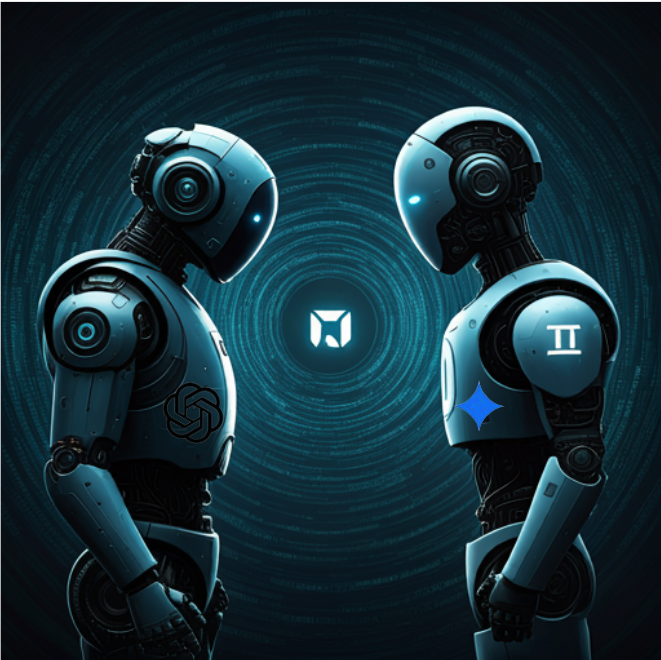
In the fast-paced world of artificial intelligence, choosing the right AI platform is key to creating successful applications. OpenAI’s GPT-4 and Google’s Gemini are two advanced AI models that offer powerful capabilities in natural language processing, multimodal support, and deep contextual understanding. This article provides a comprehensive comparison of these AI giants, covering their technical foundations, performance, use cases, ethical considerations, and future trends. With practical examples, developer tips, and visual aids, this guide will help you decide which API best fits your project’s needs.

This table provides a quick overview of the key differences between GPT-4 and Gemini, helping readers identify the most suitable model for their unique project requirements.
Enhanced Technical Comparisons
Model Architectures: GPT-4 vs. Gemini
- GPT-4: OpenAI’s GPT-4 uses a transformer-based architecture with extensive layers and attention heads, optimized for complex language tasks. Known for versatility, GPT-4 is ideal for applications requiring natural language understanding, content creation, and programming support.
- Gemini: Google’s Gemini API leverages Google’s advanced AI infrastructure, integrating resources from Google’s knowledge graph and search capabilities. Although specific architectural details are proprietary, Gemini is optimized for contextually rich responses and multimodal capabilities, making it powerful for applications needing integrated text, image, or video support.
Training Data:
- GPT-4: Trained on diverse datasets, including licensed and publicly available data, GPT-4 excels across various domains.
- Gemini: With access to Google’s knowledge graph and public datasets, Gemini provides contextually accurate and relevant responses for search and research-oriented applications.
Performance Benchmarks
Quantitative Comparisons:
- Both models excel in tasks like text generation, translation, and code completion. GPT-4 generally outperforms in creative language tasks and complex coding, while Gemini is optimized for search accuracy and fact-based responses.
Qualitative Analysis:
- GPT-4: Known for its coherence and fluency in language generation, GPT-4 excels in creative writing and content-heavy applications.
- Gemini: With Google’s knowledge graph integration, Gemini provides context-rich, accurate responses, ideal for search-based applications and fact-focused tasks.
Market Presence and User Experience
Both ChatGPT and Gemini have achieved notable traction. ChatGPT’s early release has built a robust user base, while Google Gemini, with its tight integration into Google’s suite (e.g., Search, Assistant, Workspace), is positioned for rapid market growth.
Personal Experience with Google Gemini
As a Google Cloud user, I have found Google Gemini to be a powerful tool, especially for:
- Contextual Understanding: Gemini excels in summarizing documents and delivering precise answers to complex questions.
- Multimodal Capabilities: Its ability to handle text, code, and images makes it highly versatile.
- Seamless Integration: The integration with Google Cloud simplifies implementation, streamlining workflow optimization.
Practical Real-World Examples
Concrete use cases illustrate how each model can be applied effectively:
OpenAI API (GPT-4)
- Chatbot Development: Create conversational chatbots for customer service, capable of understanding nuanced queries and responding naturally.
- Content Generation: Develop marketing content, such as social media posts and product descriptions, leveraging GPT-4’s robust language abilities.
- Scientific Analysis: Summarize scientific papers, extract insights, and generate research proposals, aiding researchers in synthesizing large volumes of data.
Google Gemini API
- Customer Insights: Analyze customer feedback to extract actionable insights, providing businesses with a deeper understanding of user preferences.
- Multimodal Applications: Integrate text and image data for applications in e-commerce (e.g., visual search) or healthcare (e.g., image-based diagnostics).
- Search Enhancement: Create advanced search tools with accurate, context-aware responses, ideal for knowledge bases or academic research platforms.
Ethical Considerations
The ethical implications of using AI in applications are significant, particularly around bias, fairness, and misinformation.
Bias and Fairness: Both models are trained on large datasets, which may contain inherent biases. OpenAI and Google are continuously working to address these biases, but developers should remain vigilant, especially in sensitive applications where fairness is crucial.
Misinformation and Harmful Content: AI-generated content has the potential to mislead if not properly monitored. Both OpenAI and Google provide moderation tools, but developers should apply additional checks, especially in applications where factual accuracy is critical. Ensuring responsible AI development is essential to minimize potential harm.
Advanced Use Cases
Scientific Research
- Drug Discovery: AI models like GPT-4 and Gemini can accelerate drug discovery by predicting molecular interactions and analyzing biomedical data.
- Climate Modeling: AI enhances climate models, helping scientists predict and mitigate future climate challenges through complex environmental data processing.
Creative Industries
- Content Creation: Both GPT-4 and Gemini can generate creative outputs such as poetry, stories, and music, making them invaluable tools for media and entertainment.
- Game Development: Use AI to generate procedural content, develop characters, and craft dynamic storytelling experiences, enhancing interactivity and immersion.
Education and Training
- Personalized Learning: Adapt educational content to individual learning styles, creating a more personalized, engaging experience.
- Intelligent Tutoring Systems: AI-powered tutoring systems offer customized feedback, interactive exercises, and guidance, making learning more accessible and effective.
Future Trends and Implications
Advancements in Multimodal AI
As multimodal capabilities advance, AI models that process text, images, and audio seamlessly are becoming the new standard. Google’s Gemini is already optimized for such tasks, making it particularly suited for industries like e-commerce, healthcare, and media.
Reinforcement Learning
The integration of reinforcement learning into generative AI promises even more adaptive responses based on feedback, enhancing decision-making in autonomous systems, robotics, and personalized services.
Economic and Social Impact
The rise of AI automation will reshape industries, creating new job roles while automating routine tasks. Understanding AI’s broader economic impact, from job creation to shifting skill requirements, will help businesses and policymakers prepare for a future where AI coexists with human labor.
Developer Tips for Optimizing API Usage
Practical guidance can help developers get the most out of these APIs:
- Prompt Engineering: Crafting effective prompts is essential for accurate results. Provide specific, context-rich prompts to improve model response relevance.
- Fine-Tuning: Fine-tune both APIs for domain-specific applications, such as customer support or specialized technical support.
- Optimizing API Usage: Monitor token usage, set rate limits, and implement error handling to optimize cost-effectiveness and ensure smooth operations.
- Troubleshooting: Familiarize yourself with common API issues, such as rate limits and response errors, and implement error-handling protocols to prevent disruptions.
Visual Enhancements for Engagement
To enhance reader engagement and understanding, consider adding these visual aids:
- Infographics: Use infographics to break down complex comparisons, such as architectural differences or performance benchmarks.
- Code Snippets: Provide syntax-highlighted code snippets to demonstrate real API calls, such as creating chatbots or generating summaries.
- Interactive Elements: Engage readers with interactive quizzes or code playgrounds, enabling them to try API calls and enhance learning.
SEO Optimization
- Keyword Research: Target relevant keywords like “AI APIs,” “GPT-4 vs. Gemini,” and “OpenAI vs. Google” to attract readers interested in generative AI.
- Meta Tags: Use optimized titles, descriptions, and headers to improve search visibility and attract targeted readers.
- Internal and External Linking: Link to additional resources, such as OpenAI and Google documentation, as well as related articles, to improve SEO and provide extra value for readers.
Community Engagement
Encouraging engagement fosters a community around your content. Invite readers to share thoughts, ask questions, and offer their own experiences with these APIs. Actively responding to comments can increase visibility and build a loyal following.
Strong Conclusion and Call to Action
Both OpenAI’s GPT-4 and Google’s Gemini are transformative AI platforms, each offering unique strengths. OpenAI’s versatility and compatibility across platforms make it a top choice for varied applications, while Google Gemini excels in multimodal and search-driven applications, especially within the Google Cloud ecosystem.
When selecting an API, consider your tech stack, data requirements, and budget. Experiment with fine-tuning options, leverage prompt engineering, and explore each API’s potential to maximize their impact on your projects. As AI technology advances, staying informed will help you adapt and make the most of these innovations.
By applying these insights and practical tips, this article equips developers, AI enthusiasts, and industry professionals with the knowledge to harness the full power of GPT-4 and Gemini, elevating their projects to new heights.
About the Author
Dr. Veera B Dasari, a Google Cloud Champion and Subject Matter Expert (SME), is the CEO and Chief Architect at Lotus Cloud, where he leads innovations in AI, cloud technology, and modern architecture. With extensive experience in AI-driven projects, Dr. Dasari specializes in practical applications of generative AI models, from natural language processing to multimodal capabilities.
As the author of this in-depth guide on OpenAI’s GPT-4 and Google’s Gemini, Dr. Dasari brings valuable insights to developers, tech professionals, and AI enthusiasts. His work with Lotus Cloud empowers clients to leverage advanced AI tools to drive innovation, streamline operations, and enhance user experiences. Passionate about knowledge sharing, Dr. Dasari frequently contributes articles and resources, helping readers stay informed and equipped to navigate the latest advancements in AI and cloud technology.
메타데이터
- post_id
- 52e9386d2bfd
- slug
- gemini-vs-gpt-4-which-ai-giant-reigns-supreme-52e9386d2bfd
- url
- https://medium.com/@drdasari/gemini-vs-gpt-4-which-ai-giant-reigns-supreme-52e9386d2bfd
- canonical_url
- https://medium.com/@drdasari/gemini-vs-gpt-4-which-ai-giant-reigns-supreme-52e9386d2bfd
- author_url
- https://medium.com/@drdasari
- status
- ok
- fetched_at
- 2026-08-06 17:37:03





