On-Page SEO: Your Ultimate Guide to Dominating Search Rankings
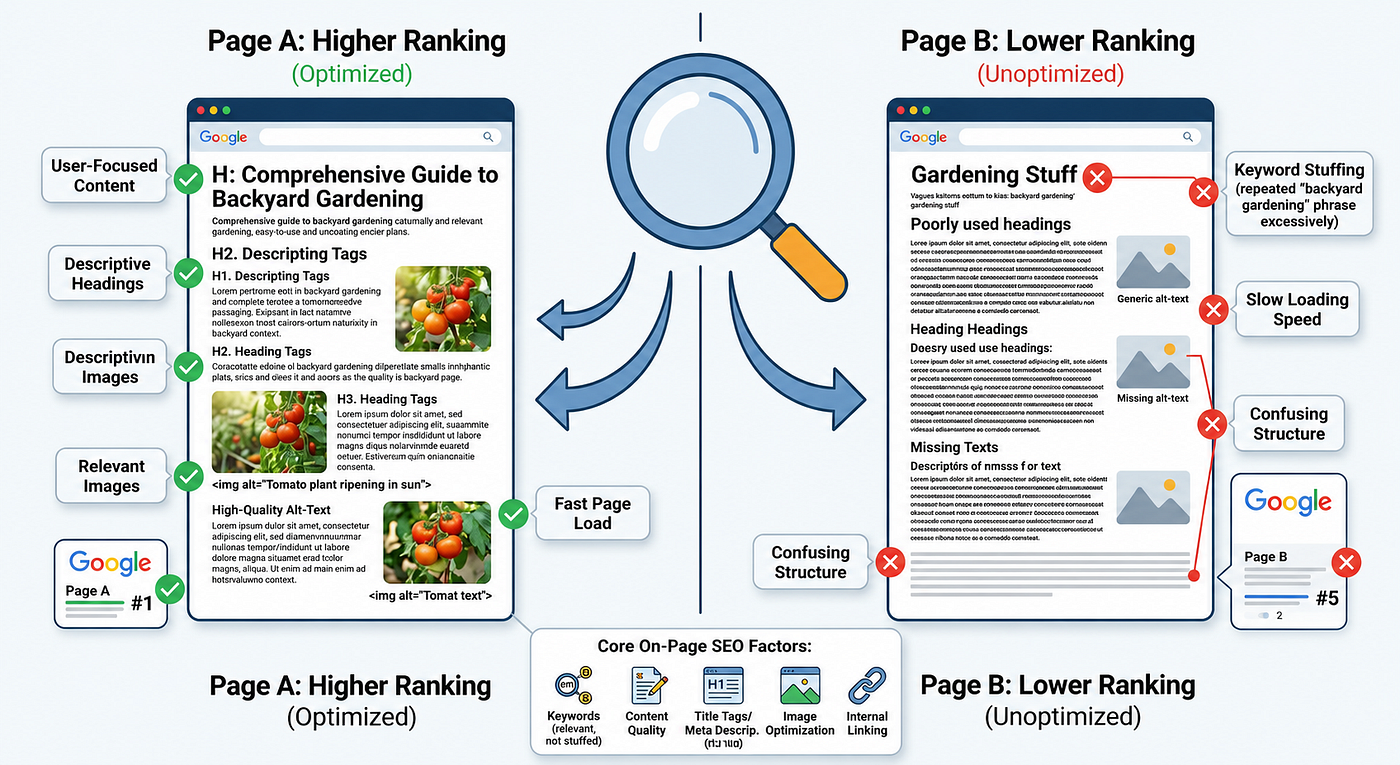
Ever wonder why one page ranks above yours despite having similar information? The difference often lies in how well that page is optimized…
On-Page SEO: Your Ultimate Guide to Dominating Search Rankings
Ever wonder why one page ranks above yours despite having similar information? The difference often lies in how well that page is optimized for search engines. On-page SEO is the process of refining the elements directly on your website to help it rank higher and draw more relevant traffic. It is not just about keywords; it is about making your site easy for both Google and your readers to understand.
Today, search engines prioritize the user experience over old tricks like keyword stuffing. Providing genuine, valuable content that answers a user’s question is now the most important factor for success. This guide covers the actionable steps you need to take to master on-page optimization and improve your site’s search visibility.
Understanding the Fundamentals of On-Page SEO
What is On-Page SEO?
On-page SEO refers to the practice of optimizing individual web pages to rank higher in search results. Unlike off-page SEO, which focuses on external factors like backlinks, on-page SEO is entirely under your control. It involves managing your content, HTML source code, and page structure. The goal is simple: make your web pages as relevant and useful as possible for your target audience.
The Pillars of On-Page Optimization
Three main factors hold up a strong on-page strategy:
- Content Quality: Your top priority. Your pages must provide unique, accurate, and engaging information that solves a specific user problem.
- Strategic Keywords: Use search terms thoughtfully and naturally in areas that help search engines recognize your topic, rather than packing the page blindly.
- User Experience (UX): If your site is fast, easy to navigate, and mobile-friendly, search engines will reward you because your visitors will stay longer.

Optimizing Core On-Page Elements
Title Tags: Your First Impression
The title tag is one of the most important factors for your rankings. It is the headline that shows up in the search results page. If it is clear and enticing, more people will click on it, which tells search engines your page is valuable.
- Place your primary keyword near the start of the title tag for maximum impact.
- Keep it between 50 and 60 characters so it does not get cut off by search engines.
- Every page on your site must have a unique title tag to help search engines distinguish one page from another.
Meta Descriptions: The Sales Pitch for Your Page
While meta descriptions do not directly impact organic rankings, they heavily dictate your Click-Through Rate (CTR). Think of this as a short, persuasive sales pitch. When a user sees your link in the search results, this description tells them why they should visit your page instead of the competition.
- Include your main keyword naturally within the text.
- Keep it between 150 and 160 characters so it displays fully.
- End with a clear call to action (CTA), such as “Learn more,” “Find out,” or “Read our guide,” to encourage users to click.
Header Tags (H1-H6): Structuring Your Content
Headers provide a map for your content. Your H1 tag is the main headline for your page. It should be descriptive, include your primary keyword, and be completely unique. Use only one H1 tag per page to avoid confusing search engines.
Use H2 and H3 tags to break up your text into readable sections. This makes it easier for users to scan the page and find what they need. Use these headers to include subtopics and related terms (LSI keywords), which helps search engines understand the breadth of your content.

Content Optimization Strategies
High-Quality Content & E-E-A-T
Your content needs to match the user’s search intent completely — whether they are looking for an answer to a question or a product to buy.
To stand out from shallow articles, align your content with Google’s E-E-A-T (Experience, Expertise, Authoritativeness, and Trustworthiness) guidelines. Be thorough, provide original insights, and use unique data points.
Formatting Tip: Keep your sentences short and use bullet points to break up walls of text. This drastically improves readability.
Strategic Keyword Usage
You need to know which terms your target audience uses to find you. Use keyword research tools to find these phrases, but do not obsess over density. There is no magic number of times you should repeat a keyword. Instead, use it naturally in your H1, H2, meta description, and the first 100 words of your content. Incorporate related terms or synonyms to give search engines better context.
Image Optimization
Images make your content better, but they can slow down your site if they are too large.
- Compression: Always compress images to reduce file size before uploading.
- File Names: Use descriptive, hyphen-separated file names with keywords (e.g.,
seo-checklist-2026.jpginstead ofIMG_4829.jpg). - Alt Text: Add descriptive alt text to every image to help visually impaired users and to give search engines clear context about the image content.
Technical On-Page SEO Factors
URL Structure
A clean, descriptive URL helps both users and search engines. Keep your URLs short and readable. Use hyphens to separate words instead of underscores or spaces. Including your primary keyword in the URL is highly recommended, but avoid adding long strings of numbers or unnecessary parameters.
Internal Linking
Internal links connect your content and help search engines crawl your site more effectively while passing authority (link juice) from one page to another. Use strategic internal linking to point readers to other relevant articles on your site using descriptive anchor text. Only link to pages that actually add value to the reader.
Mobile-Friendliness & Core Web Vitals
Most people search from their phones today. Google uses mobile-first indexing, which means it looks at the mobile version of your site to rank it. Your site must be fully responsive, meaning it adapts to fit any screen size. Buttons must be easy to tap, and text should be readable without zooming in.
Page Speed Optimization
Nobody likes a slow website. If your page takes too long to load, visitors will bounce immediately, which hurts your search ranking. Use tools like Google PageSpeed Insights to monitor your Core Web Vitals (LCP, INP, CLS). Common fixes include:
- Compressing images and using next-gen formats (WebP).
- Leveraging browser caching.
- Minifying CSS, JavaScript, and HTML code.
- Utilizing a Content Delivery Network (CDN).

Advanced On-Page SEO Tactics
Schema Markup
Schema markup is microdata code you add to your site to help search engines return more informative results. It creates rich snippets, which are search results that show extra information like star ratings, prices, FAQs, or event dates. This visually stands out and often leads to more clicks from the SERP.
User Experience (UX) Signals
Search engines watch how users interact with your page. If users visit your page and then click the “back” button immediately to find another result, search engines assume your page did not satisfy their search (a behavior known as pogo-sticking). Focus on a seamless user journey: ensure your call to action is clear, navigation is intuitive, and your layout is clean.
Content Updates and Freshness
Search engines prefer active, up-to-date websites. If you have older content, revisit it to make sure the information is still correct. Update your statistics, add new insights, and improve the writing. Refreshing old posts can give them a massive ranking boost without needing to create entirely new pages from scratch.
Final Thoughts
On-page SEO is not a one-time setup; it is a regular part of running a successful website. By focusing on quality content, a clear structure, and a fast user experience, you build a strong foundation for your site to succeed. Start by checking your title tags and meta descriptions today, then look at your content to see where you can add more value. Keep testing, keep updating, and you will see your search rankings grow over time.

메타데이터
- post_id
- 52ebb007680d
- slug
- on-page-seo-your-ultimate-guide-to-dominating-search-rankings-52ebb007680d
- url
- https://medium.com/@muhammadsaqlain34839/on-page-seo-your-ultimate-guide-to-dominating-search-rankings-52ebb007680d
- canonical_url
- https://medium.com/@muhammadsaqlain34839/on-page-seo-your-ultimate-guide-to-dominating-search-rankings-52ebb007680d
- author_url
- https://medium.com/@muhammadsaqlain34839
- status
- ok
- fetched_at
- 2026-06-10 08:17:25