The Monolithic Illusion: Why ⚛️Cosmos IBC and Modularity Will Quietly Liquidate the Competition
Table of Contents
The Monolithic Illusion: Why ⚛️Cosmos IBC and Modularity Will Quietly Liquidate the Competition

Table of Contents
1. Introduction: The Fragmentation Crisis and the Interoperability Mirage
2. Deep Dive into IBC: The Gold Standard of Trust-Minimized Communication
3. The Omni-Asset Superpower: Beyond Coins to Multi-Standard NFTs
4. The Synergy of Modularity and Interoperability
5. The Engineering Evolution: Overcoming Challenges and Mitigating Risks
6. A Critical Critique: Brilliant Technology, Failed Marketing
7. Conclusion: The Definitive Endgame for Web3
1. Introduction: The Fragmentation Crisis and the Interoperability Mirage
The blockchain industry has long suffered from a fundamental paradox: individual networks thrive on isolation to maintain security, yet the broader Web3 ecosystem demands seamless connectivity. Early solutions resorted to cross-chain bridges (cross-chain bridges) — centralized or multi-sig intermediaries that quickly became the primary targets for multi-million-dollar exploits.
While many contemporary projects claim to solve interoperability (interoperability), they often rely on trusted third parties, shared security bottlenecks, or rigid architectural constraints. The Cosmos ecosystem offers a radically different paradigm. By combining the Inter-Blockchain Communication (IBC) protocol with a deeply **modular architecture** (modular architecture), Cosmos does not just bridge blockchains; it weaves them into a decentralized, sovereign internet of blockchains (Internet of Blockchains).
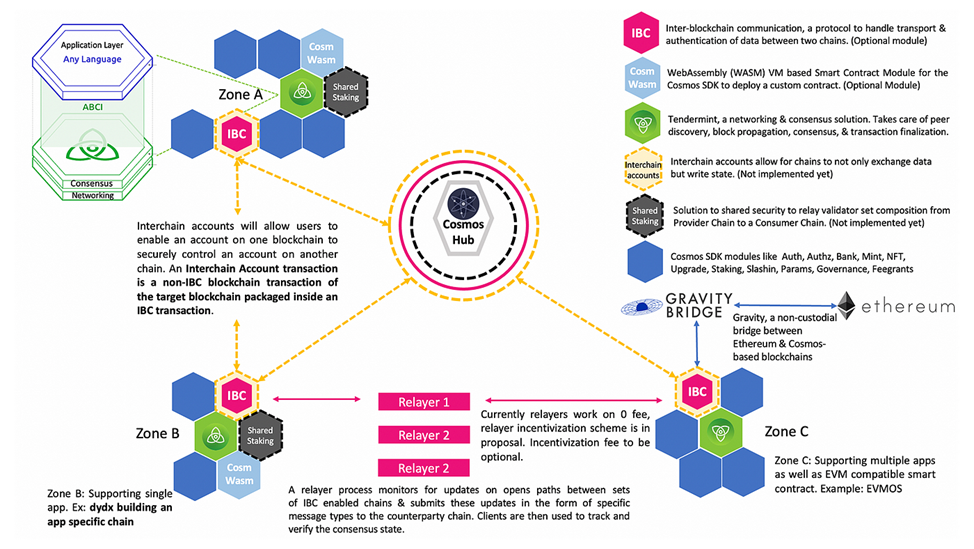
Interoperability
2. IBC (Inter-Blockchain-Communication) :The Gold Standard of Trust-Minimized Communication
At the heart of the Cosmos ecosystem lies the Inter-Blockchain Communication (IBC) protocol. Unlike traditional bridges that rely on wrapped tokens (wrapped tokens) and external validators, IBC establishes a direct, trust-minimized link between independent blockchains.
Architecture and Mechanics
IBC operates on a two-layer transport and application framework:
· Transport Layer (TAO — Transport, Authentication, and Ordering): This layer handles the establishing of secure communication paths. It relies on **light clients (light clients) and [relayers](https://cosmos.network)** (relayers).
Light Clients: Chain A runs a light client (a stripped-down version of the consensus state) of Chain B within its own state, and vice versa. This allows Chain A to cryptographically verify that a specific transaction actually occurred on Chain B without needing to trust an intermediary.
Relayers: These are off-chain processes responsible for physically carrying packets (packets) of data across the network. Crucially, relayers are completely permissionless; because light clients verify the data, a malicious relayer can only delay a message, never forge one.
· Application Layer: This defines how the data packets are interpreted. The application layer handles much more than just simple native token transfers.
IBC (Inter-Blockchain-Communication)
3. The Omni-Asset Superpower: Beyond Coins to Multi-Standard NFTs
A major misconception is that cross-chain communication is restricted to fungible tokens (fungible tokens). IBC completely shatters this limitation via ICS-721 (Interchain Non-Fungible Tokens).
Through IBC, an NFT is not merely “wrapped” or mirrored; its data structure, metadata, and unique cryptographic identity are preserved as it natively migrates across completely different sovereign blockchains. Whether an asset is a standard fungible token, an ERC-20 equivalent, an ERC-721/ERC-1155 NFT, or an ecosystem-specific exotic asset standard, IBC treats the data as a blank canvas. If a module exists to interpret the standard on the destination chain, the asset can move freely. This enables cross-chain gaming items, decentralized identities, and fractionalized real-world assets (RWAs) to roam the entire interchain seamlessly.

The Omni-Asset Superpower: Beyond Coins to Multi-Standard NFTs
4. The Synergy of Modularity and Interoperability
The true genius of Cosmos lies in how its interoperability layer interacts with its modular design framework.
The Cosmos SDK and Tendermint/CometBFT
Traditionally, building a blockchain required coding everything from scratch: the networking layer, the consensus engine, and the application logic. Cosmos decoupled these layers:
· CometBFT (formerly Tendermint): Handles the Networking and Consensus layers.
· Cosmos SDK: A modular framework that allows developers to plug-in pre-built application layers (modules) like auth, bank, staking, and crucially, the IBC module.
Modularity During Interoperability
In a modular paradigm, a blockchain’s functions are split into execution (execution), settlement (settlement), data availability (data availability), and consensus (consensus).
When a modular chain communicates via IBC, it doesn’t just send static assets; it can compose modules across layers dynamically. For example, a modular rollup built using Celestia for data availability and the Cosmos SDK for execution can use IBC to dynamically interact with an application-specific chain (AppChain) on Cosmos.
This enables **Interchain Accounts (ICA)**: a smart contract on Chain A can natively register an account on Chain B and execute modules (like voting in governance or liquid staking) on Chain B as if it were happening locally. This is modular interoperability at its peak — functional composition without sacrificing sovereignty.
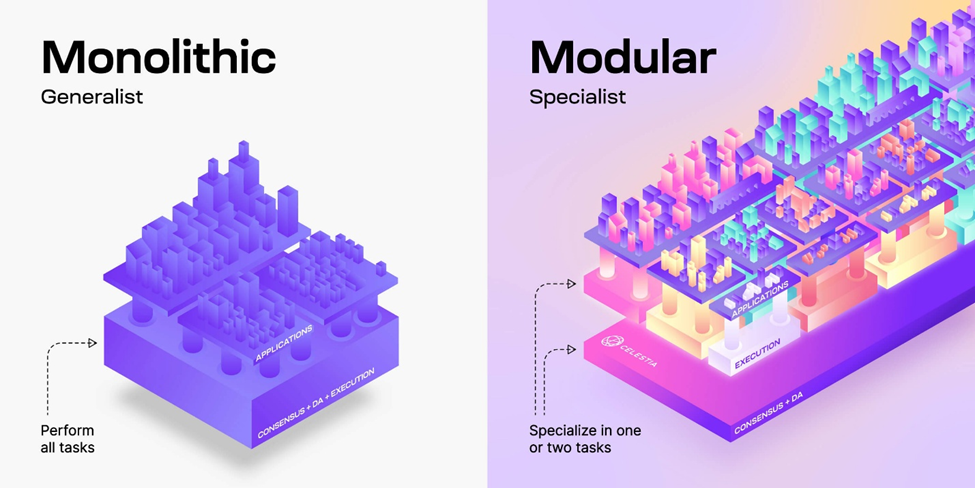
Modular Blockchain on cosmos ecosystem ( Celestia )
The Competitive Edge: IBC vs. Other Interoperability Protocols

5. The Engineering Evolution: Overcoming Challenges and Mitigating Risks
The Cosmos architecture is not a static conceptual paper; it is a living ecosystem that showcases immense developer dynamism (developer dynamism). Over the years, core engineers have systematically identified vulnerabilities, systemic bottlenecks, and economic imbalances, rolling out production-grade upgrades to solve them.
Resolved Legacy Bottlenecks (The History of Dynamic Fixes)
· The Monolithic Upgrade Hardship: Early Cosmos chains suffered from severe downtime during upgrades. If a single module needed patching, the entire state transition engine had to halt.
o The Fix: The implementation of Cosmos SDK Upgrades (CosmWasm integration and Upgrade Modules) allowed chains to execute live, automated state migrations at specific block heights without breaking consensus.
· The Single-Chain Fee Isolation: Initially, cross-chain actions required users to manually hold gas tokens for every single chain they touched. A user bridging from Chain A to Chain B could get their funds stuck on Chain B if they did not possess Chain B’s native token to pay for the execution.
o The Fix: Fee Middleware (ICS-29) and Interchain Accounts (ICA) evolved to allow “forwarding channels,” enabling a user to pay fees on the source chain while the protocol handles target chain gas abstraction behind the scenes.
Present Architectural Challenges and Mitigation Frameworks
· The Relayer Economics Vulnerability: Relayers must spend real capital (gas fees) on destination chains to submit IBC data packets. Without compensation, the network risked relayer strikes, leading to frozen cross-chain operations.
o Mitigation: The development of On-Chain Incentivization Modules. Users now attach an explicit “bounty” to their IBC packets, creating a highly competitive, decentralized marketplace where relayers are guaranteed profitability based on network demand.
· Asymmetric Security Risks (The Poison Token Attack): In Cosmos, each chain maintains its own validator set. If a malicious actor compromises a small AppChain with weak economic security (e.g., $1M market cap), they could print infinite counterfeit tokens on that chain and route them via IBC into a multi-billion-dollar hub like Osmosis, draining legitimate liquidity pools.
o Mitigation:
A. **Interchain Security (ICS) / Replicated Security:** Consumer chains can now forfeit their independent validator sets and “rent” the massive economic security of the Cosmos Hub ($ATOM), ensuring institutional-grade protection from day one.
B. IBC Rate Limiting: Hubs have implemented stateful circuit breakers (circuit breakers) that restrict the total volume of an asset entering or leaving a chain within a specific window, containing the damage of an exploit instantly.
· Liquidity and State Fragmentation: The explosion of sovereign AppChains natively fragments liquidity, making the user experience (user experience) clunky compared to monolithic environments.
o Mitigation: Packet Forwarding Middleware (PFM) and multi-hop routing allow complex, multi-chain asset transfers to execute in a single atomic-like user click, paving the way for complete chain abstraction (chain abstraction).
6. A Critical Critique: Brilliant Technology, Failed Marketing
Let’s be completely honest: if Solana possessed the modular flexibility, trustless interoperability, and sovereign architectural layers of Cosmos, it would have already permanently dethroned Ethereum and captured Bitcoin’s spot at the apex of global market cap. Solana has the hype, the culture, and the explosive retail attention, but its rigid, monolithic design creates a systemic single point of failure. Cosmos has the opposite problem: it possesses arguably the most advanced engineering infrastructure in Web3, while suffering from a glaring internal crisis: a profound failure in community building (community building) and retail marketing (retail marketing). The ecosystem is trapped in a classic engineer’s trap — building a masterpiece but forgetting how to sell it to the masses.
The Marketing and User Promotion Crisis
Cosmos has consistently failed to market its breakthroughs to everyday retail users. While competing ecosystems capture massive cultural mindshare by turning minor network iterations into massive public relations campaigns, Cosmos remains largely invisible to the average trader.
· The Rebranding Black Hole: The transition of core tech names (e.g., Tendermint rebranding to Ignite, then portions splitting into CometBFT) creates deep cognitive fatigue and confusion for outside investors and non-technical builders.
· The Inability to Capture Value: The native token of the Cosmos Hub ($ATOM) was historically decoupled from the success of the AppChains built using the SDK. Chains like Binance Coin (BNB), Terra (LUNA), and dYdX extracted trillions in value from Cosmos technology without returning direct accrual to ATOM holders. The core foundation failed to market ATOM as the “index play” of interoperability early enough.
The Community Disconnection
The Cosmos developer community is highly academic and decentralized, which, paradoxically, has alienated the broader Web3 community.
· Governance Toxicity: Cosmos Hub governance has historically been plagued by highly publicized, toxic political infighting (e.g., the fork splits and intense validator drama). This dramatic infighting overshadows technical milestones and frightens institutional capital.
· Lack of Narrative Control: While other ecosystems cultivate highly cohesive, fanatical communities (e.g., the Solana “Bears/Sols” or Ethereum “Maxis”), Cosmos community members are fragmented across separate AppChains. There is no unified, aggressive narrative promoting Cosmos IBC as the ultimate endgame. It has essentially outsourced its PR to individual projects, resulting in an echo chamber of brilliant developers talking to other brilliant developers, completely disconnected from retail liquidity inflows.
7. Conclusion: The Definitive Endgame for Web3
Many interoperability solutions operate on an imperial model — forcing chains to bow to a master hub or rely on vulnerable external notary systems. Cosmos rejects this. By pioneering an environment where blockchains are modularly constructed yet standardly connected via IBC, it offers the only logically sound model for global Web3 expansion.
The developer layer has proven its exceptional adaptability by systematically transforming previous bugs into structural pillars. However, for Cosmos to claim true dominance, its ecosystem must bridge the gap between architectural brilliance and market communication. If the community can match its developer dynamism with an equally aggressive and unified retail narrative, the Cosmos architecture will remain the definitive blueprint for the decentralized internet.

==================================================
ABOUT THE AUTHOR & METADATA
==================================================
✍️ Author: [sulli0ne]
🔗 Profile: [ https://x.com/sulli0ne]
X Post: [ https://x.com/sulli0ne/status/2056040398095544381 ]
📅 Published Date: May 2026
🏷️ Category: Web3 Infrastructure / Blockchain Modularity / Blockchain Interop
— — — — — — — — — — — — — — — — — — — — — — — — —
Disclaimer:
This article is for informational and educational purposes only and does not constitute financial, investment, or legal advice. Blockchain technologies and digital assets involve significant risks. Always conduct your own research (DYOR) before making any investment decisions.
==================================================
메타데이터
- post_id
- 52fda2e4bcbd
- slug
- the-monolithic-illusion-why-️cosmos-ibc-and-modularity-will-quietly-liquidate-the-competition-52fda2e4bcbd
- url
- https://medium.com/@jp.sullione/the-monolithic-illusion-why-%EF%B8%8Fcosmos-ibc-and-modularity-will-quietly-liquidate-the-competition-52fda2e4bcbd
- canonical_url
- https://medium.com/@jp.sullione/the-monolithic-illusion-why-%EF%B8%8Fcosmos-ibc-and-modularity-will-quietly-liquidate-the-competition-52fda2e4bcbd
- author_url
- https://medium.com/@jp.sullione
- status
- ok
- fetched_at
- 2026-06-09 15:37:30