What Happens to Business Contracts During a CVL?
When a company enters a Creditors’ Voluntary Liquidation (CVL), its financial position has reached a point where it can no longer continue…
What Happens to Business Contracts During a CVL?
When a company enters a Creditors’ Voluntary Liquidation (CVL), its financial position has reached a point where it can no longer continue trading. This naturally raises questions about what happens to existing business contracts, including agreements with suppliers, customers, landlords, and service providers.
Understanding how contracts are treated during a CVL can help directors prepare for the process and manage expectations.
Do Business Contracts Automatically End?
In most cases, business contracts do not automatically terminate the moment a company enters liquidation. However, the appointment of a liquidator significantly changes how those contracts are handled.
Many commercial contracts include insolvency clauses, which allow the other party to terminate the agreement if the company enters liquidation. This means that once a CVL begins, suppliers or service providers may choose to end their contracts immediately.
Role of the Liquidator
Once appointed, the Insolvency Practitioner (IP) acting as liquidator takes control of the company’s affairs. One of their responsibilities is to review all existing contracts and decide how to deal with them in the best interests of creditors.
The liquidator may choose to:
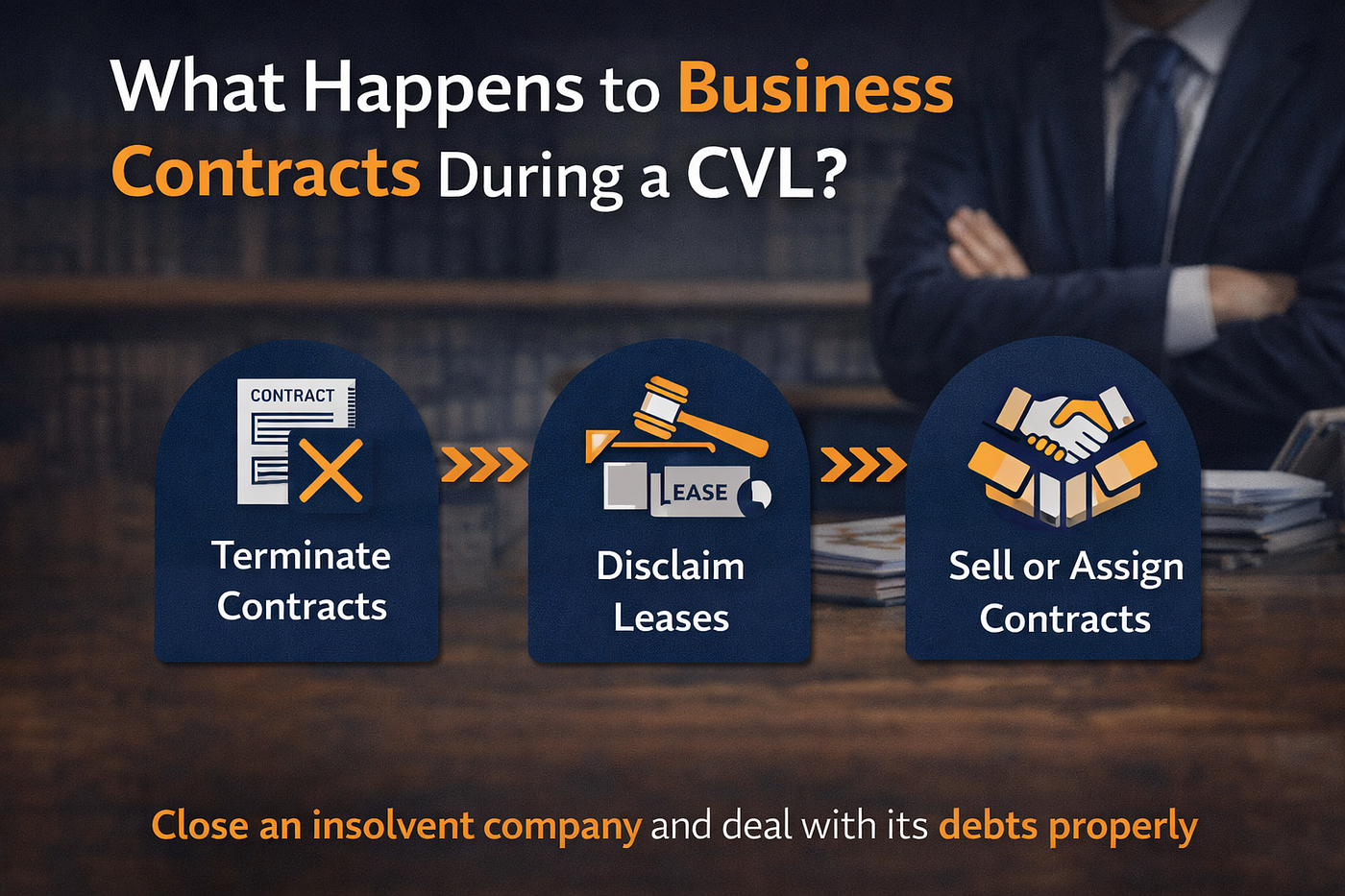
Terminate contracts that are no longer beneficial or are causing further financial loss Allow certain contracts to continue temporarily if they help preserve or realise value Negotiate with counterparties where appropriate
Their primary goal is to avoid increasing liabilities while maximising returns for creditors.
Ongoing Contracts and Trading
In most CVLs, the company stops trading shortly after liquidation begins. As a result, ongoing contracts for services, supply, or trading activities are typically brought to an end.
However, there are limited situations where short-term trading may continue if it helps achieve a better outcome for creditors, such as completing work to increase the value of assets. In these cases, the liquidator will manage any necessary contractual arrangements.
What About Customer Contracts?
Contracts with customers, particularly those involving future delivery of goods or services, are often affected. If the company can no longer fulfil its obligations, these contracts are likely to be terminated.
Customers who have paid in advance but have not received goods or services may become unsecured creditors in the liquidation. They can submit a claim for the amount owed, although repayment depends on the availability of funds.
Supplier and Lease Agreements
Supplier contracts are usually terminated once the company stops trading, especially if payments are outstanding. Suppliers may also take steps to recover goods under retention of title clauses, where applicable.
Lease agreements for business premises are another key consideration. The liquidator will assess whether the lease should be disclaimed. In many cases, leases are formally disclaimed, meaning the company is released from future obligations under the contract. The landlord may then submit a claim as a creditor for any losses.
Can Contracts Be Transferred or Sold?
In some cases, contracts may hold value and can be assigned or sold to another party. This is more common where the contract is commercially beneficial and transferable. Any proceeds from such arrangements are used to repay creditors.
Final Thoughts
During a Creditors’ Voluntary Liquidation, business contracts are carefully reviewed and managed by the liquidator to ensure the best possible outcome for creditors. While many contracts are terminated, some may be continued, disclaimed, or even sold depending on their value.
**Simple Liquidation** is a trading name of Leading Business Services Limited, supporting directors through structured liquidation processes led by licensed Insolvency Practitioners. Understanding how contracts are handled in a CVL can help directors approach the process with greater clarity and confidence.
메타데이터
- post_id
- 530070933f29
- slug
- what-happens-to-business-contracts-during-a-cvl-530070933f29
- url
- https://medium.com/@simpleliquidationinuk/what-happens-to-business-contracts-during-a-cvl-530070933f29
- canonical_url
- https://medium.com/@simpleliquidationinuk/what-happens-to-business-contracts-during-a-cvl-530070933f29
- author_url
- https://medium.com/@simpleliquidationinuk
- status
- ok
- fetched_at
- 2026-07-13 06:23:13