Why Are the South China Sea’s Resources Strategic for Different Actors?
✍️ Apolítik0 → ← PGT
Why Are the South China Sea’s Resources Strategic for Different Actors?
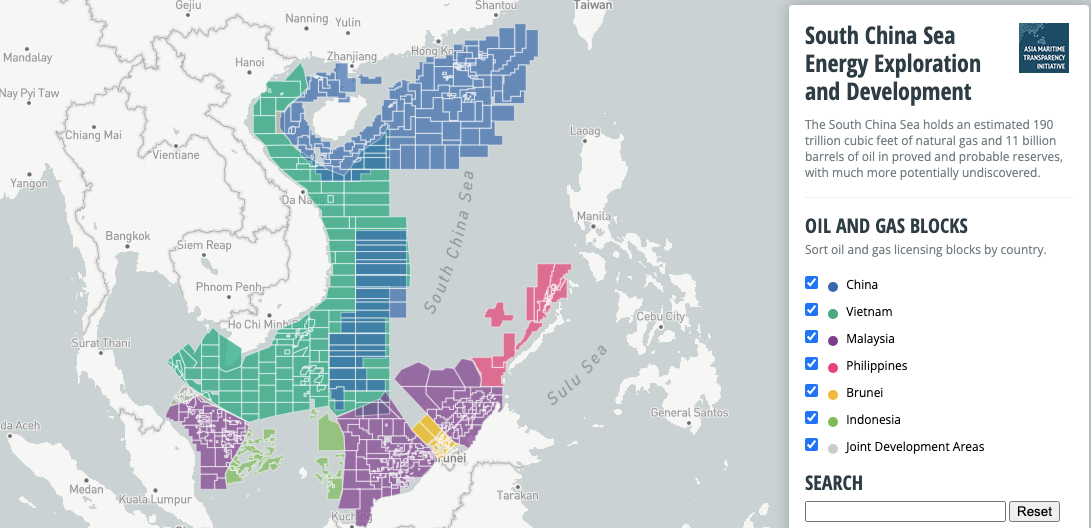
Oil and gas exploration and development blocks within the South China Sea Strategic Node. The spatial distribution of energy exploration areas illustrates how natural resources shape national priorities, maritime claims, and strategic competition among regional actors. Source: Asia Maritime Transparency Initiative (AMTI), CSIS.
✍️ Apolítik0 → ← PGT
∞ → ← ∞
Strategic Node: South China Sea
ERE Axis: Resources
∞
The resources of the South China Sea do not hold the same strategic meaning for every actor. Although hydrocarbons, fisheries, and other marine resources are located within the same maritime space, each state evaluates them according to its energy needs, economic priorities, security objectives, and national capabilities. Their strategic importance lies not only in their availability, but in the way they influence present-day decisions and shape long-term strategies.
For the principal claimants -China, the Philippines, Vietnam, Malaysia, Brunei, and Taiwan- these resources represent a combination of energy security, economic development, sovereign rights, and control over maritime areas considered essential to their national interests. The prospect of accessing and protecting these resources influences investment policies, maritime presence, and long-term capability development.
Other regional actors, such as Indonesia, also regard these resources as strategically significant because of their connection to the protection of the Exclusive Economic Zone around the Natuna Islands, the security of national fisheries and energy reserves, and the stability of the broader Southeast Asian maritime environment.
For extra-regional actors -including the United States, Japan, Australia, India, and several European partners- the primary interest is not the direct exploitation of these resources, but the preservation of a stable maritime environment that supports regional security, uninterrupted trade, and a balanced Indo-Pacific. In this context, resources become strategically important because they influence the behavior of states and contribute to the overall stability of the strategic system.
These different perspectives demonstrate that the same resources can generate different strategic priorities. Their significance extends beyond their economic value, reflecting their capacity to shape decisions, strengthen capabilities, and influence how states pursue and protect their interests within the strategic node.
Strategic Event
The continued strengthening of national capabilities and policies aimed at securing future access to, protection of, and sustainable use of the South China Sea’s natural resources.
Observable Indicator
Expansion of energy infrastructure, increased exploration activities, enhanced maritime capabilities, cooperation agreements, and initiatives designed to secure sustainable access to the strategic node’s natural resources.
Observable Variable
Strategic Preparation
Definition
The process through which actors progressively develop political, institutional, technological, logistical, or operational capabilities to respond to a strategic environment and strengthen their position for future scenarios.
Operational Status
Consolidating.
Systemic Observation
The strategic significance of resources varies according to the interests, capabilities, and objectives of each actor. These different perceptions drive strategic preparation and help explain why the South China Sea remains one of the Indo-Pacific’s most sensitive strategic nodes.
∞ → El equilibrio decide ← ∞
∞ ⟷ ∞
메타데이터
- post_id
- 5337025ac48f
- slug
- why-are-the-south-china-seas-resources-strategic-for-different-actors-5337025ac48f
- url
- https://medium.com/tgp-strategic-notes/why-are-the-south-china-seas-resources-strategic-for-different-actors-5337025ac48f
- canonical_url
- https://medium.com/tgp-strategic-notes/why-are-the-south-china-seas-resources-strategic-for-different-actors-5337025ac48f
- author_url
- https://medium.com/@apolitik0
- status
- ok
- fetched_at
- 2026-07-19 19:02:42