Express vs Koa: Understanding the Differences Between Frameworks
Introduction
Express vs Koa: Understanding the Differences Between Frameworks
Introduction
Before we get started: What exactly is a framework? According to Codeacademy,
A framework is a structure that you can build software on. It serves as a foundation, so you’re not starting entirely from scratch.
In other words, a framework provides pre-written code, tools, and conventions that help developers build applications more efficiently.
Normally, frameworks are associated to specific tasks and programming languages. The use of reliable frameworks can save time, reduce errors, and build more clean and secure code.
In our case the focus is on Express and Koa, two back-end web frameworks built for Node.js. Both are designed to simplify the process of creating a web server, handling routing, managing middleware, and responding to HTTP requests.
Express.JS
Express.js is a “Fast, unopinionated, minimalist web framework for Node.js”. It was designed to simplify the process of building server-side applications by providing a lightweight structure for handling HTTP requests, routing, and middleware.
Starting a server using Express can be as simple as the example below:
const express = require('express')
const app = express()
const port = 3000

app.get('/', (req, res) => {
  res.send('Hello World!')
})

app.listen(port, () => {
  console.log(`Example app listening on port ${port}`)
})
This basic setup defines a single route (/) and starts a server that listens on port 3000. From this simple foundation, developers can build scalable web applications and APIs with greater control and flexibility.
Koa.JS
According to the official website,
Koa is a new web framework designed by the team behind Express, which aims to be a smaller, more expressive, and more robust foundation for web applications and APIs. By leveraging async functions, Koa allows you to ditch callbacks and greatly increase error-handling.
Unlike Express, Koa does not include any middleware by default, giving developers complete control over which components to add. This minimalist, modular design encourages cleaner and more maintainable code.
Here’s an example of how simple it is to start a basic Koa server:
const Koa = require('koa');
const app = new Koa();

app.use(async ctx => {
  ctx.body = 'Hello World';
});

app.listen(3000);
This setup creates a server that responds with “Hello World” to all incoming requests, demonstrating how Koa uses middleware functions and async syntax to handle requests.
Comparisons between Express and Koa
Syntax & Learning Curve
Express uses a more straightforward syntax that developers may find easier to learn. It follows a more traditional structure and includes built-in routing and middleware tools.
Koa, on the other hand, embraces modern JavaScript by using async/await and a middleware system based entirely on Promises. While this results in cleaner and more readable code in the long run, it comes with a steeper learning curve, especially for beginners who aren’t yet comfortable with asynchronous programming.
Middleware System
Express comes with a rich set of built-in middleware functions and has a huge ecosystem of third-party middleware available via npm.
Unlike Express, Koa doesn’t include any built-in features or middleware. Instead, developers are expected to install and configure routing, templating, rendering, and so on. This design results in a highly customizable development experience, which is particularly appreciated by more experienced developers who want control over their application’s architecture.
Performance
Because of its small codebase (no built in middleware) and native support for Promises, Koa is extremely lightweight, allowing for better performance and more efficient execution when properly configured. However, in real-world applications, the difference is usually minimal unless you’re operating at massive scale.
That said, both frameworks are capable of handling high-performance web servers.
Popularity, Community & Ecosystem
Express is one of the most used Node.js frameworks. It benefits from a large user base, extensive documentation, tutorials, and community support.
The graph below shows Express was downloaded approximately 36 times more than Koa over the past year.
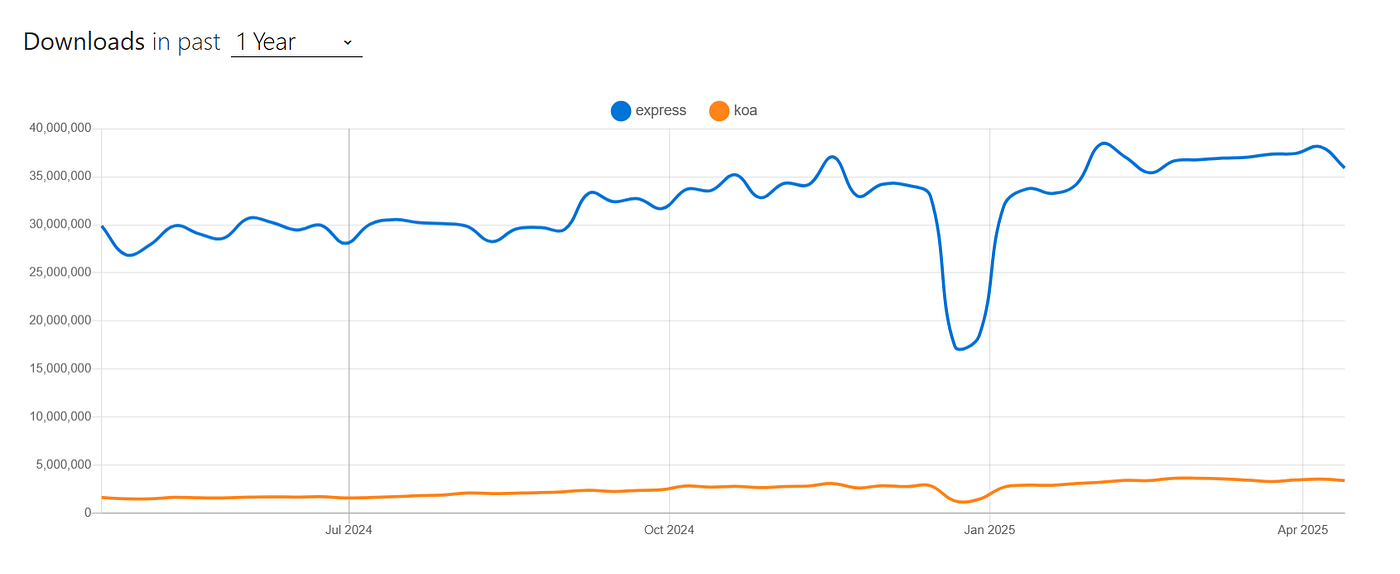
Number of downloads in the past year: Express vs Koa
Despite being newer and more minimal than Express, Koa has been growing steadily (currently about 3 million downloads per week), and it has a smaller but passionate community.
How to choose between Express and Koa?
When deciding between Express and Koa, I believe the choice depends on the project’s requirements and the team’s experience level.
Below are some factors to consider when selecting between the two:
Express
Better for less experienced developers: Due to its simplicity, extensive documentation, and large community, Express is often “easier” for developers who are just starting with Node.js or web development.
Fast to Set Up: If you’re working on a project with a tight deadline or need to quickly prototype a web app, Express provides a straightforward setup and a lot of built-in functionality to handle common use cases like routing, templating, and middleware.
Projects and Teams: Express is best suited for small to medium-sized projects, RESTful APIs, and applications where the priority is speed and simplicity.
Koa
Ideal for Experienced Developers: Koa is more flexible and minimalistic, requiring developers to manually set up components like routing and middleware. This makes it more suitable for developers who want to have complete control over their server architecture.
Modern Projects and better error handling: Koa is ideal for projects that demand customizability and modern features like async/await. It’s a great choice for teams focused on building highly scalable applications or APIs where performance is critical. Koa also works well for larger or more complex projects where you need better control over how the server behaves.
Conclusion
As a developer, knowing how to compare frameworks is essential because it helps you choose the right tool for the job. Each framework has its own pros and cons, and understanding these differences allows you to make informed decisions based on the specific needs of your project. While both Express and Koa offer powerful capabilities for building web servers, they differ significantly in their structures and design approaches.
Choosing between them is not a matter of personal preference — it’s about selecting the right tool that best aligns with your project’s goals, complexity, and team experience.
References:
메타데이터
- post_id
- 534b144d5fce
- slug
- express-vs-koa-understanding-the-differences-between-frameworks-534b144d5fce
- url
- https://medium.com/@tayrinesoares/express-vs-koa-understanding-the-differences-between-frameworks-534b144d5fce
- canonical_url
- https://medium.com/@tayrinesoares/express-vs-koa-understanding-the-differences-between-frameworks-534b144d5fce
- author_url
- https://medium.com/@tayrinesoares
- status
- ok
- fetched_at
- 2026-07-20 02:17:25