The Great Digital Retreat
How young people from Brooklyn to Beijing are walking away from the internet, and what they’re finding instead
RECLAIMING THE SELF
The Great Digital Retreat
How young people from Brooklyn to Beijing are walking away from the internet, and what they’re finding instead
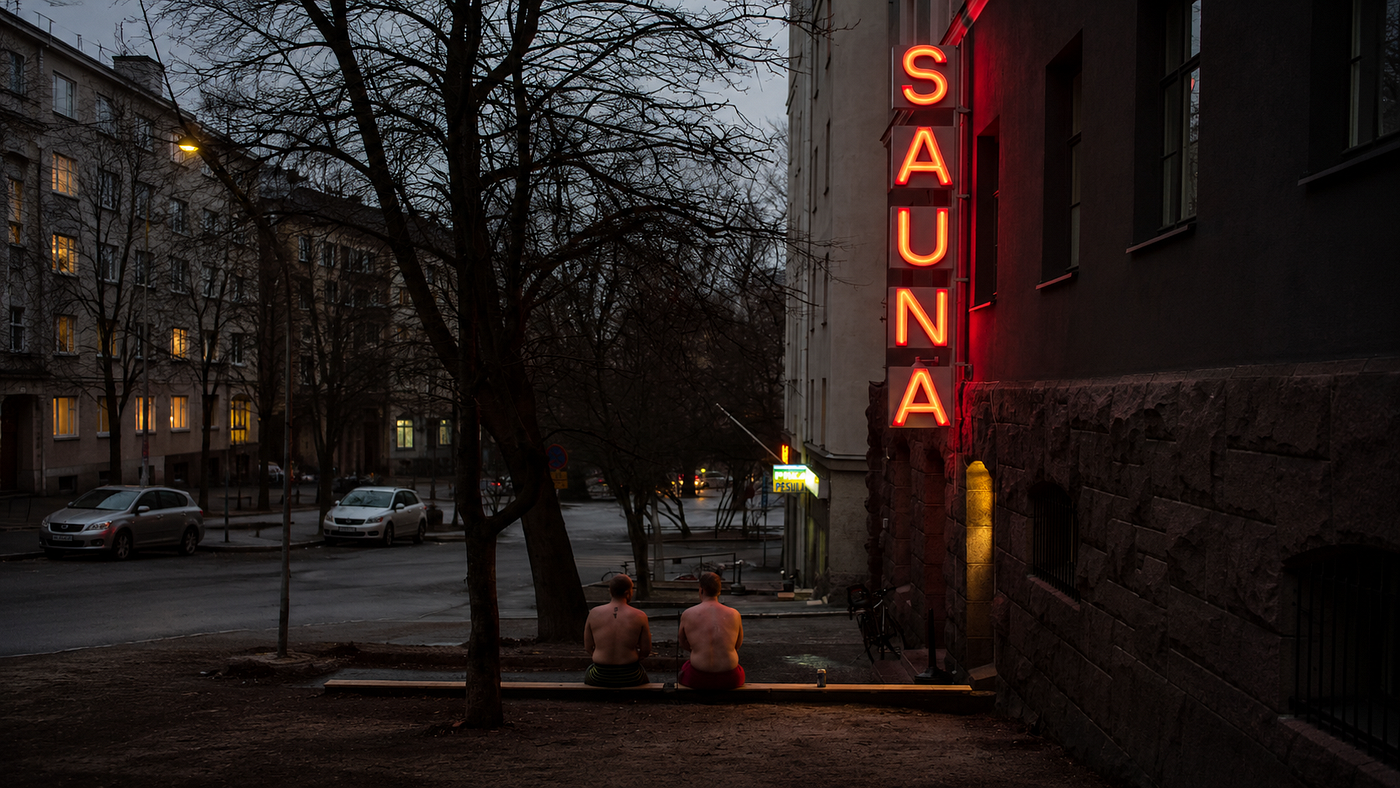
Photo by George Pisarevsky on Unsplash
My friend invited me on a “color walk” last week.
The rules are simple. Pick a color before leaving the house. Spend an hour photographing anything you see in that shade. At the end, you have a little gallery.
It sounds almost childish. But what struck me wasn’t the activity. It was what it replaced.
An hour without my phone. An hour actually looking.
I noticed my neighbor’s dog wearing a yellow vest. I found an alley behind my building covered in jacaranda blooms I’d walked past a thousand times without seeing.
I asked her where she’d heard about this.
“I saw it on TikTok,” she said.
We both noticed the irony.
We’re living inside systems designed to capture us.
Algorithms. Infinite scroll. Frictionless checkout. Every element is engineered to keep you engaged, consuming, addicted. (I’ve written about this mechanism before in *We Escaped the Tribe and Became Industrial Prey*.)
But the designers missed something fundamental. As Hegel wrote in *Science of Logic*:
“Contradiction is the root of all movement and vitality; it is only in so far as something has a contradiction within it that it moves, has an urge and activity.”
The harder you compress a spring, the stronger it rebounds.
Between 2021 and 2024, reports suggest smartphone usage among 18-to-24-year-olds has begun to decline, while interest in flip phones has surged. Google searches for “no-buy challenge” hit an all-time high, up 40% year-over-year.
A rebellion is quietly spreading.
And it’s being led by the generation that grew up with smartphones in their hands.
Three Signs of the Shift
Since the beginning of 2025, I’ve listened to over 200 hours of podcasts. But what I noticed wasn’t just my own behavior — it was what my friends started sharing with me. Not 30-second clips, not viral moments. But two-hour, three-hour deep-dive conversations.
We’d forgotten you could think about one thing for that long.
The data confirms this isn’t just personal. On YouTube, video essays — long-form analysis ranging from 25 minutes to over an hour — have become massively popular, accumulating hundreds of millions of views.
In China, the pattern is remarkably similar. On podcast platforms, episodes under 15 minutes account for only 4.4% of listening time. Episodes over an hour make up nearly 40%. On Bilibili (with an average user age of 25), long-form content has experienced rapid growth, with the platform reporting significant increases in viewership for videos exceeding 30 minutes.
Research shows that constant information switching produces what scholars call “social media fatigue” — systemic exhaustion from keeping the brain’s reward system in permanent overdrive.
Long-form content offers something different. Not frictionless. Not optimized for instant gratification. Deep enough that you have to choose to pay attention.
It returns control.
The second sign is physical.
In New York, a group of high school students meets every Sunday. No phones allowed. They call themselves the Luddite Club — named after the 1811 textile workers who smashed industrial looms.
These teenagers paint. Sing. Dance. Write. They invest themselves fully in physical reality.
The sentiment runs deeper than you’d expect. In China, similar movements are growing. On Xiaohongshu (Little Red Book), hashtags for “breaking phone addiction” and “digital detox methods” have accumulated over 230 million views.[1] Globally, Pinterest searches for “digital detox vision boards” increased 273%.
A 2024 Harris Poll found that 21% of Gen Z wish smartphones had never been invented. Nearly half wish TikTok (47%), Snapchat (43%), or X (50%) had never existed.
Not “I want to use my phone less.”
But “I wish it had never been invented.”
The third sign appears in how young people spend money.
Hannah, a 27-year-old living in New York, participated in a six-month no-shopping challenge. Her spending dropped 60%. She paid off her credit card debt.
But as she told reporters, the real shift was internal:
“I stopped using shopping as a way to release stress. I realized I was buying things to avoid certain feelings.”
According to fintech company Chime, millions of Americans participated in some form of no-buy challenge in 2024. The Wall Street Journal called it “the one thing ordinary people feel they can fully control in a volatile economy.”
The rebellion takes many forms. In China, researchers studying online communities found that 81% of consumption-related groups focused on reduced consumption, from pragmatic frugality to deconstructing marketing rhetoric.
And then there’s Xiaohongshu — Little Red Book. It’s China’s Instagram meets Pinterest, a platform explicitly designed to seed consumer desire. Yet hashtags for rational consumption and minimalist living have accumulated over 8 billion views.
Even on platforms built as consumption engines, anti-consumption movements are thriving.
Photo by Sevak Khachatoorian on Unsplash
What They’re Really Rejecting
Young people have seen through the mechanics.
Algorithms and consumer culture operate on the same principle: immediate feedback, dopamine release, sustained craving. Once this loop starts, it’s autopilot. It takes control of your behavior. Traps you in addiction, emptiness, stronger addiction.
Stanford psychiatrist Dr. Anna Lembke writes in *Dopamine Nation* that addiction is the hijacking of the brain’s reward system. Withdrawal isn’t deprivation. It’s about rebuilding the capacity for delayed gratification.
Research supports this pattern. A randomized experiment by economists Hunt Allcott, Luca Braghieri, and colleagues found that participants who deactivated Facebook for four weeks experienced measurably higher life satisfaction and lower depression levels. Other studies on temporary social media breaks report similar improvements in well-being and reduced anxiety.
This isn’t about saving money or quitting your phone.
It’s about reclaiming yourself from a life designed by systems.
Social media platforms use algorithms to control what you see. You’re no longer selecting information. You’re processing what they choose to show you.
Gen Z is rebuilding their own pathways.
On Neocities, there are now 1.5 million personal websites built with HTML. Young people are using flip phones with only basic functions. Downloading books from open-source platforms. Building personal sites with raw code.
These behaviors look like nostalgia. But they’re answers to a question: Who decides what I see?
As Cal Newport writes in *Digital Minimalism*:
“Technology is intrinsically neither good nor bad. The key is using it to support your deeply held values, rather than letting it use you.”
What was once a fringe idea is now a daily practice.
After the pandemic, loneliness became the baseline.
U.S. CDC data shows that among 18-to-24-year-olds, 57% report persistent sadness and indicators of severe loneliness — up 22 percentage points from 2019. In China, a 2024 social trends report found that young adults have an average of just 2 close friends. 24% said they have no one they can talk to openly, describing themselves as “lone wolves.”
This era provided the densest communication tools in history. Yet it produced one of the loneliest generations. Likes, comments, DMs — they’re substitutes. They can’t fill the void.
Young people are voting with their feet. In 2024, attendance at large concerts grew 84%. Among music festival attendees, 18-to-24-year-olds accounted for 36% — far higher than other age groups. Gen Z audiences now drive the majority of growth in live music events.
They’re done with digital substitutes. They’re hungry for the collision and belonging that happens when humans occupy the same space.
Echoes and Hope
This kind of resistance is not new.
Rebellion rarely stops the flood. But it changes its direction.
Between 1811 and 1816, English textile workers launched **the Luddite movement**, smashing industrial looms to resist devalued labor. The government violently suppressed them. The movement didn’t stop industrialization. But it laid the groundwork for labor rights and lasting critiques of technological alienation.
In the late 19th century, William Morris and John Ruskin led **the Arts and Crafts movement **against mass production’s dehumanization. They didn’t stop factories. But they birthed modern design ethics and a DIY culture that persists today — preserving a space for humanity when machines threatened to crush it.
In the 1960s and 70s, **the counterculture movement** didn’t overthrow capitalism. But it profoundly changed culture, pushing through environmental legislation and embedding sustainability into mainstream consciousness.
Today’s rebellion is already forcing tech companies to add screen time features. It’s spawning a digital wellness industry. It’s driving global privacy legislation.
Of course, resistance is quickly absorbed by the market. Flip phones are marketed as trendy accessories. Wired headphones have become a vintage fashion. Even rebellion against consumerism is packaged and sold back to us.
The capitalist system is remarkably adept at co-opting its own critics.
But even as the market commodifies the movement, the underlying desire remains real.
The hunger for autonomy. For presence. For lives not mapped by algorithms.
My friend and I still do our activities. Sometimes, color walks. Sometimes we wander through the wet market. Sometimes we just sit in the park downstairs and talk for hours.
We’re not performing a digital detox for Instagram. We’re trying to survive. We don’t have a perfect solution to defeat the systems built around us. The screens will remain. The platforms will adapt.
But across the globe — from Brooklyn to Beijing — young people are making a quiet choice.
To look up. To be present. To occupy the same physical space.
To live lives that are messy and uncertain, but real.
The system can calculate our screen time. It can manipulate dopamine release. It can predict what we’ll buy.
But it cannot extinguish humanity’s hunger for autonomy.
And in that choice, however small, lies hope.
Further reading on RECLAIMING THE SELF
References
[1] Xiaohongshu (Little Red Book) platform hashtag data, 2026.
메타데이터
- post_id
- 5356969ae3c0
- slug
- the-great-digital-retreat-5356969ae3c0
- url
- https://medium.com/southern-winds/the-great-digital-retreat-5356969ae3c0
- canonical_url
- https://medium.com/southern-winds/the-great-digital-retreat-5356969ae3c0
- author_url
- https://medium.com/@jmresearch2026
- status
- ok
- fetched_at
- 2026-06-23 17:05:31