It’s “No Mow May.” But does not mowing your lawn really help bees?
How native flowers, less pesticides, and habitats offer real hope for struggling bees.
It’s “No Mow May.” But does not mowing your lawn really help bees?
How native flowers, less pesticides, and habitats offer real hope for struggling bees.

Honey bees are not native to the U.S., but are needed to pollinate many of our crops. Credit: Ted Erski from Pixabay
This week I was excited to write a story about native bees for a local newsroom, WKTV Journal in Grand Rapids, Michigan. It’s a subject I’ve been wanting to tackle for a while — the interplay between honey bees, which are not native to the U.S., and native bees, and how they work together to pollinate our crops and plants.
Honey bees have gotten a bad rap lately because of evidence they can compete with native bees. But, as usual, the story’s complicated, and a lot depends on location, context and the density of bee hives in relation to the abundance of flowers.
The WKTV Journal story can be found here. Since it had to adhere to a limited word count, I could expand on some key details in the version below.
Many homeowners have stopped mowing their lawns in May to help bees and other pollinators. It’s part of an international initiative dubbed ‘No Mow May.’
But now experts say the practice may be overrated.
“There’s no strong evidence that No Mow May really benefits wild bees,” said Logan Rowe, conservation associate with the Michigan Natural Features Inventory, told me. “There are many other ways that will have a greater impact on native bee populations and communities.”
Besides the familiar honey bee, which was imported from Europe and is not native to the U.S., Michigan boasts around 470 native bee species. Worldwide there are more than 20,000 species, with around 3,600 native to North America and 2,100 to Europe.
Some have been declining recently, with potentially dire consequences for agriculture and natural communities, which depend on the insects for pollination.
Many bees are declining
Rowe specializes in rare insects, including the several wild bees that are dwindling or have disappeared altogether. But exactly how many of the Michigan’s native bees are in trouble is not clear, he said.
“We have two species that are state endangered, legally protected. Those are the rusty patched bumble bee and the American bumble bee,” Rowe said.
But there’s evidence other native bees aren’t doing well, either, including the four other bumble bees that are designated as “species in greatest need of conservation” in the state.
“Habitat loss is probably the biggest threat, but it operates in many different ways,” Rowe said. For example, converting natural areas to agriculture leads to more exposure to harmful pesticides.
Additionally, honey bees can compete with native bees for resources. “There’s evidence that shows that if a plant species is dominated by honey bees, you’ll get less native bees visiting that plant,” Rowe said. Honey bees can also transmit harmful pathogens.
“We have an agricultural system that is reliant on honey bees. That doesn’t mean native bees don’t contribute,” Rowe said. “There’s plenty of research that will show that supporting native bees within agricultural landscapes leads to increased crop production.”
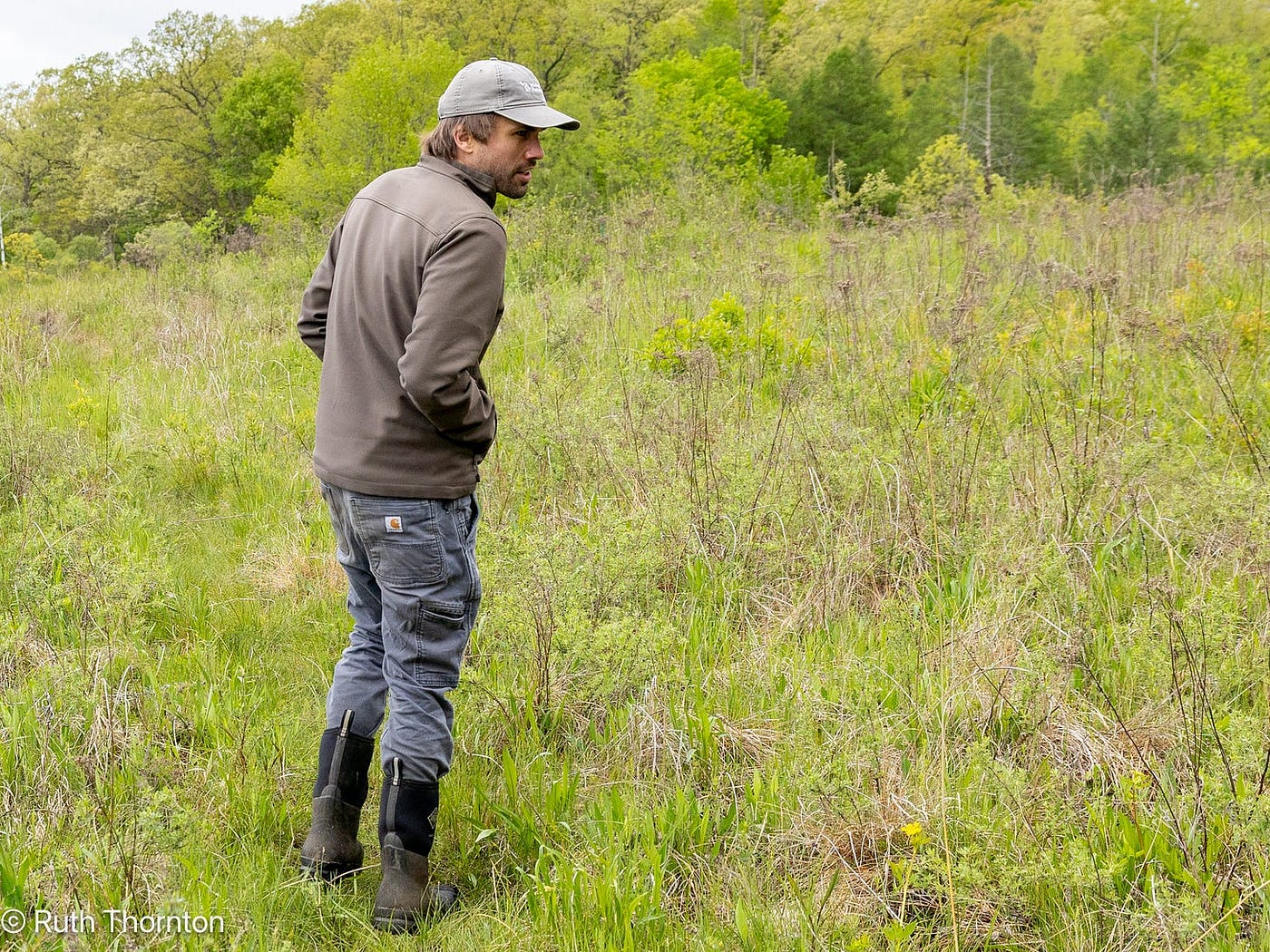
Logan Rowe, conservation associate with the Michigan Natural Features Inventory, surveys for rare insects. Credit: Ruth Thornton.
Honey bees have different concerns than wild bees
But, Rowe said, the concerns around honey bees differ from those around native bees. “Honey bees are managed livestock, essentially. They’re not native bees, so it’s a different type of worry — it’s more of a management concern, as opposed to a species loss concern, because we’re not going to lose honey bees as a species.”
Rufus Isaacs, a professor at Michigan State University, told me that “there are clear signals that some bee species have declined in some areas, and honey bee numbers have gone through some tough times as well.”
Isaacs is an extension specialist at MSU, and part of his job is to support berry farmers in the state and help them manage insects. “Sometimes it’s pest insects, but often we’re also interested in managing the beneficial insects. And, of course, bees fall in that category,” Isaacs said.
Because much agriculture is dependent on bees, what’s causing their decline needs to be better understood, he said.
“We talk about the ‘four Ps,’” he explained — poor nutrition, or a lack of access to flowering plants, pesticides, pathogens and parasites. “Bees are dealing with a lot of these challenges in combined ways as well, and that can make it hard to understand how those are all interacting.”
While maintaining healthy honey bee populations is essential for agriculture, so is keeping native bees healthy.
For example, Rowe said, “having both honey bees and native bees in a blueberry field in southwest Michigan is going to produce a better crop than either on its own.”
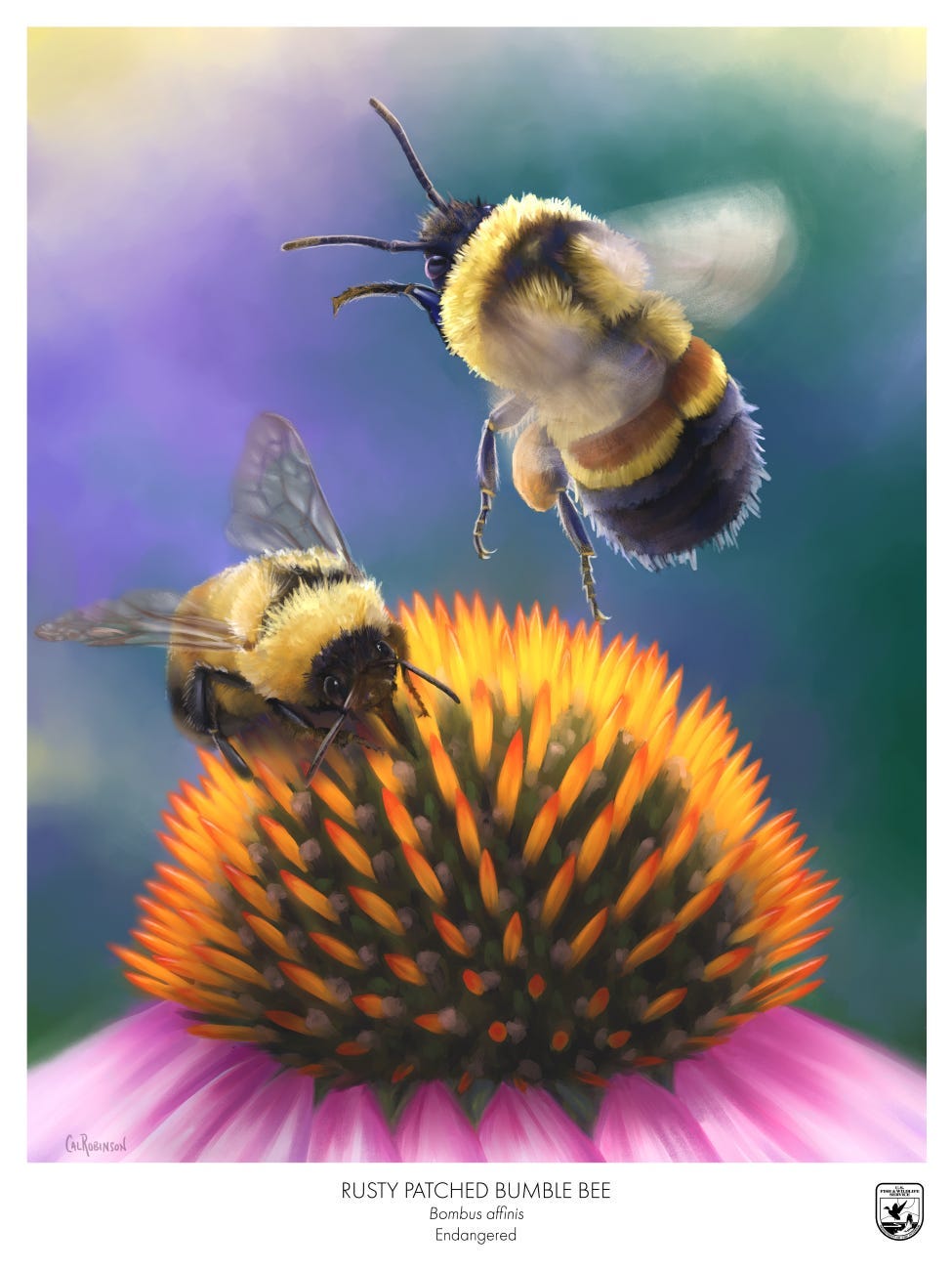
Rusty patched bumble bees are listed as federally endangered in the U.S. Credit: Cal Robinson/USFWS. Public Domain.
Michigan’s fruit crops largely depend on bees
Most of Michigan’s fruit crops are dependent on bee pollination — including blueberries, apples, cherries and cranberries — as are most vegetable crops, and some nuts, Isaacs said.
On the larger commercial berry farms, the “farmers need very large numbers of insects to move the pollen among millions [of flowers] that are only going to be open for a couple of days,” he added.
Much of that is accomplished through the large numbers of honey bees farmers bring in seasonally to pollinate their crops. That’s why commercial bee keepers, who move their hives from farm to farm, are so important.
But, Isaacs said, wild bees are more efficient pollinators, especially for crops that are native to the U.S. While honey bees need to visit those flowers multiple times to fully pollinate them, it often just takes one visit by a wild bee.
There’s evidence that “well-pollinated” plants produce sweeter crops that also have a better shelf life in the grocery store.
“That’s why farmers are spending money on bringing in honey bees, planting conservation plantings and doing whatever they can around the farm to enhance the level of pollination,” — including from native bees, Isaacs said.
“Blueberries and cranberries are two good examples where their whole reproductive system is adapted for pollination by bumble bees, and the bumble bees that are in this region do a great job of pollinating those crops,” Isaacs said.
Native bees are also more tolerant of the Midwest climate. While honey bees don’t want to fly when it’s cool or windy, wild bees are adapted to these conditions.
Native bees are efficient pollinators for native crops, like blueberries in Michigan. Photo by Joshua Woroniecki on Unsplash
Another factor affecting wild bees is climate change, Isaacs said. “Just how the climate is changing quickly, and in ways sort of unpredictable.” For example, when flowers come out early in an unseasonable warming spell, but then freeze again, they become unavailable for bees.
“That’s something that I think is also affecting wild bees,” Isaacs said. “There are some signals where certain species are retreating north and are not as common in the southern part of the state. Maybe the climate is not as suitable for them as it used to be.”
Losing bees and their pollination services could have dire consequences for people, Rowe said. “If we lose wild bees, we could see collapses of our natural communities, and we have no idea what that would mean for the natural areas in the state.”
Bumble Bee Atlas community science project
Rowe said bumble bees are a good place to start if people are interested in learning more about wild bees.
“Bumble bees are charismatic and fuzzy, and people like them,” he said.
They’re also easier to identify than other bees. That’s part of the reason the Michigan Natural Features Inventory and Michigan State University Extension launched the Michigan Bumble Bee Atlas, a community science project in which volunteers look for bumble bees and record any sightings.
Similarly, many U.S. areas participate in a Bumble Bee Atlas coordinated by the Xerces Society and partners.
How to support bees
If you want to help native bees, Rowe recommends planting native flowers and grasses. “There’s a lot of nesting that can happen in the stems of grasses, in the clumps on the ground.”
While ‘No Mow May’ is a start, “there’s only so much that you can get out of a lawn full of dandelions and other flowering weeds,” he said.
Instead of parking your lawn mower for one month out of the year, people should consider supporting native pollinators year-round.
For example, Isaacs encourages growing a “mullet garden” — tidy in the front, (wildlife) party in the back — where the front yard, where neighbors walk past, is nicely maintained.
“Then in the back garden that my neighbors can’t see is where I have the nesting habitat. I’ve got some piles of logs, and some areas that are just like old branches and places that are undisturbed,” he said. That provides wild bees with areas to nest.
Also, “the more diversity of flowering plants you have out there, the more different kinds of bees you’ll have,” Isaacs said. Planting flowers that bloom throughout the growing season ensures bees have a continuous supply of food, since different bees are active at different times of year.
It’s best to limit the application of pesticides, which can harm beneficial insects.
But if you decide that you do need to use pesticides, “spraying at night is one way that you can minimize direct exposure to pollinators, but also think about not spraying anything that’s blooming,” Isaacs said. Products are available that are selective and only kill the target insects.
Urban areas with many bee hives can cause competition between honey bees and native bees for the limited number of flowers available. Isaacs cautioned that many hobbyist bee keepers underestimate the complexity of keeping their hives healthy and free of pathogens and parasites.
“If you’re really trying to ‘save the bees,’ I don’t think you do that by putting a honey bee hive in your backyard,” Isaacs said. “The best thing you can do is plant flowers, create habitat for them, enjoy all the different kinds of bees that will come if you create a little patch of that in your garden.”
What you can do, and useful links
For those in Michigan, if you’re interested in helping bees, you can join the Michigan Bumble Bee Atlas as a volunteer — community members of all backgrounds and skill levels are encouraged to participate. Check the website for more information.
For other U.S. states, check the Bumble Bee Atlas to see if your state has a community science program.
Worldwide, you can take photos of bees (or any animal or plant) and submit them to iNaturalist to help document occurrences. More information can be found at iNaturalist.org.
Useful links:
- Royal Horticultural Society: Mullet gardening
- Xerces Society: Wild bee conservation
- Xerces Society: U.S. Bumble Bee Atlas
- *Pollinator Partnership*
- U.S. Regional pollinator friendly planting guides
- *Pollinator Friendly Alliance*
- *iNaturalist*
- *Beginner’s guide to common native bees, by Utah State University*
- *American Beekeping Federation*
- *Michigan Pollinator Initiative*
- *Michigan Bumble Bee Atlas*
- *Michigan Beekeepers Association*
- *Common bees of Michigan*
Related stories:
메타데이터
- post_id
- 5384ca1f9f85
- slug
- its-no-mow-may-but-does-not-mowing-your-lawn-really-help-bees-5384ca1f9f85
- url
- https://medium.com/the-new-climate/its-no-mow-may-but-does-not-mowing-your-lawn-really-help-bees-5384ca1f9f85
- canonical_url
- https://medium.com/the-new-climate/its-no-mow-may-but-does-not-mowing-your-lawn-really-help-bees-5384ca1f9f85
- author_url
- https://medium.com/@rthornton28
- status
- ok
- fetched_at
- 2026-06-09 15:37:30