The Data Engineer’s Survival Guide: 7 Real-World Challenges and How to Actually Fix Them
From silent pipeline failures to ballooning cloud bills — battle-tested solutions for the problems no tutorial warns you about.
The Data Engineer’s Survival Guide: 7 Real-World Challenges and How to Actually Fix Them
From silent pipeline failures to ballooning cloud bills — battle-tested solutions for the problems no tutorial warns you about.
Data engineering looks clean on the whiteboard. You draw arrows between boxes — source → transform → sink — and the audience nods. Then production happens.
Pipelines fail silently at 3 AM. A schema change upstream wipes out a downstream dashboard. Cloud costs spike 40% with no obvious culprit. Data quality issues surface two weeks after the fact, after a business decision has already been made on bad numbers.
This guide is for engineers in the middle of that reality. Not the idealized version. The one where you’re debugging a Spark job on a Friday afternoon and the stakeholders are already asking for the report.
Here are seven of the most common challenges data engineers face — and the alternatives and patterns that actually help.
Challenge 1: Brittle ETL Pipelines That Break on Schema Changes
The Problem
You’ve built a pipeline ingesting data from a third-party API or an upstream team’s database. It works perfectly — until the source quietly adds a column, renames a field, or changes a data type. Your pipeline throws a generic KeyError or silently drops rows. You find out from an angry Slack message, not a monitoring alert.
Schema drift is one of the most underestimated sources of pipeline failure. Most pipelines are written assuming the world is static. It isn’t.
The Fix: Schema Evolution + Contract-First Design
Short-term: Use schema validation libraries at ingestion time. Tools like Great Expectations or Pydantic let you define what you expect from incoming data and fail loudly (with context) when reality diverges.
from pydantic import BaseModel, ValidationError
from typing import Optional

class OrderEvent(BaseModel):
    order_id: str
    customer_id: str
    amount: float
    currency: str = "USD"          # default handles new optional fields
    discount_code: Optional[str]   # nullable without breaking the pipeline
def ingest_order(raw: dict) -> OrderEvent:
    try:
        return OrderEvent(**raw)
    except ValidationError as e:
        # Dead-letter queue, not silent failure
        send_to_dlq(raw, error=str(e))
Long-term: Adopt a data contract approach. Treat the schema as an API contract between teams, versioned and documented. Tools like Soda, Data Contract CLI, or even a simple JSON Schema file in your repo can enforce this.
For cloud pipelines on AWS: Use AWS Glue Schema Registry to centrally manage and version schemas for Kafka and Kinesis streams. It enforces compatibility modes (BACKWARD, FORWARD, FULL) so breaking changes get caught before they hit your consumers.
Challenge 2: Silent Pipeline Failures and Zero Observability
The Problem
Your Airflow DAG shows green checkmarks. But no data landed in the destination table. Or 50,000 rows were inserted when 500,000 were expected. The pipeline ran — it just didn’t do anything useful. And you won’t know until someone downstream complains.
Silent failures are worse than crashes. A crash pages you. A silent failure lets bad data quietly poison your analytics.
The Fix: Observability-First Pipeline Design
Think of pipeline observability in three layers:
1. Execution metrics — Did the job run? Did it finish? How long did it take? Use your orchestrator’s built-in alerting (Airflow SLAs, Prefect automations) and emit custom metrics to CloudWatch, Datadog, or Prometheus.
2. Data volume checks — Did the right amount of data move? Add row count assertions as a post-load step. If you loaded fewer than 80% of yesterday’s volume, alert before anyone else does.
# Airflow task: post-load volume check
def validate_row_count(**context):
    today_count = get_row_count(table="orders", date=context["ds"])
    yesterday_count = get_row_count(table="orders", date=context["yesterday_ds"])

    if yesterday_count > 0:
        ratio = today_count / yesterday_count
        if ratio < 0.8 or ratio > 1.5:
            raise ValueError(
                f"Anomalous row count: today={today_count}, yesterday={yesterday_count}, ratio={ratio:.2f}"
            )
3. Data quality checks — Is the data correct? Null rates, uniqueness constraints, referential integrity. This is where tools like dbt tests, Great Expectations, or Monte Carlo shine.
Alternative for smaller teams: Elementary is an open-source dbt package that adds data observability on top of your existing dbt models with minimal setup — anomaly detection, test result history, and Slack alerts out of the box.
Challenge 3: ELT vs. ETL — Picking the Wrong Pattern for Your Scale
The Problem
Many teams start with ETL (transform before load) because it feels safer — cleaner data in the warehouse. But as data volumes grow and business requirements change faster than transform logic can keep up, the transformation layer becomes a bottleneck. Changing business logic means touching the pipeline, reprocessing historical data, and praying nothing breaks downstream.
Conversely, teams that jump straight to ELT (load raw, transform in the warehouse) sometimes end up with a data swamp — raw tables no one trusts and transformation sprawl across a dozen ad-hoc SQL scripts.
The Fix: Match the Pattern to the Use Case
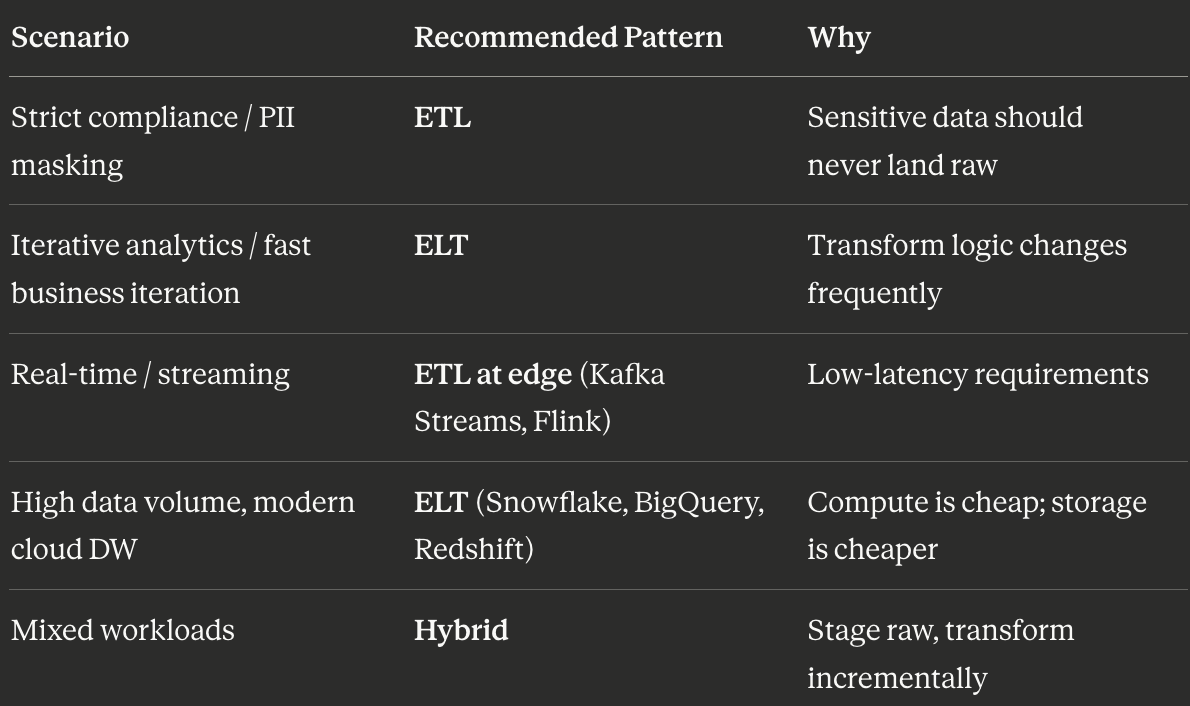
The modern default for most teams is ELT + dbt. Load raw data into a staging layer, then use dbt to model it incrementally. Your transformation logic lives in version-controlled SQL, tested and documented, with lineage tracked automatically.
-- dbt incremental model: only processes new records
{{ config(materialized='incremental', unique_key='order_id') }}

SELECT
    order_id,
    customer_id,
    amount,
    currency,
    COALESCE(discount_code, 'NONE') AS discount_code,
    loaded_at
FROM {{ source('raw', 'orders') }}
{% if is_incremental() %}
    WHERE loaded_at > (SELECT MAX(loaded_at) FROM {{ this }})
{% endif %}
Challenge 4: Cloud Cost Sprawl — The Bill That Keeps Growing
The Problem
You migrated to the cloud for scalability and flexibility. Six months later, the data team’s AWS bill has tripled and nobody can tell you exactly why. Scan costs on S3, always-on Redshift clusters, Glue job overruns, Kinesis shard underutilization — the charges are real but invisible until month-end.
Cloud infrastructure for data is particularly susceptible to cost creep because storage and compute feel “free” until they aren’t.
The Fix: FinOps Habits for Data Engineers
1. Partition your data storage aggressively. Unpartitioned S3 tables are a query tax. Partition by year/month/day (or higher cardinality if your queries filter on it). Athena, Glue, and Spark all benefit dramatically from partition pruning.
s3://your-bucket/orders/year=2024/month=11/day=15/part-00000.parquet2. Right-size your compute. Use Spot Instances for batch Spark/EMR jobs — they can cut compute costs 60–90%. For Glue, use G.1X workers for most jobs; only scale up for memory-intensive workloads. Set job timeouts to prevent runaway jobs from burning budget silently.
3. Use Redshift/Snowflake auto-suspend. If you’re on Redshift Serverless or Snowflake, configure auto-suspend aggressively (5–10 minutes idle). An idle warehouse sitting overnight costs real money.
4. Implement cost tagging from day one. Tag every resource with team, project, environment. Without tags, cost attribution is archaeology. Use AWS Cost Explorer or a tool like Infracost in CI to flag cost-impacting infrastructure changes before they merge.
5. Monitor with budgets and anomaly alerts. AWS Cost Anomaly Detection can alert you within hours of a spend spike — not at the end of the month. Set it up. It’s free.
Challenge 5: Data Quality Issues Discovered Too Late
The Problem
A data analyst discovers that a key metric has been wrong for the past two weeks because a JOIN was producing duplicates. Or a NULL snuck into a customer_id column. By the time anyone notices, a business decision has been made, a quarterly report has been published, and trust in the data platform has taken a hit.
Data quality failures aren’t just technical problems — they’re trust problems. And trust, once lost, is slow to rebuild.
The Fix: Shift Data Quality Left
1. Validate at ingestion, not at consumption. Don’t rely on analysts to find issues. Catch them the moment data enters your system. Use schema validation (see Challenge 1) and add source-level quality checks in your ingestion layer.
2. Implement dbt tests as non-negotiable. Every model should have at minimum:
not_nullon primary keysuniqueon primary keysaccepted_valueson status/type enumsrelationshipsfor foreign keys
# schema.yml
models:
  - name: orders
    columns:
      - name: order_id
        tests:
          - not_null
          - unique
      - name: status
        tests:
          - accepted_values:
              values: ['pending', 'processing', 'shipped', 'cancelled']
      - name: customer_id
        tests:
          - relationships:
              to: ref('customers')
              field: customer_id
3. Add statistical anomaly detection for subtle drift. Hard rules (not_null, unique) catch obvious failures. For subtle drift — a metric dropping 10%, a new value appearing in a column — use anomaly detection. Monte Carlo, Bigeye, and the open-source Elementary all offer this.
4. Build a data quality SLA dashboard. Make quality visible. A simple dashboard showing test pass rates, freshness metrics, and row count trends gives stakeholders visibility and gives your team accountability.
Challenge 6: Scaling Pipelines for ML Workloads
The Problem
Batch ETL pipelines and ML feature pipelines have fundamentally different requirements. A reporting pipeline that runs once a day is forgiving of inefficiency. A feature pipeline that feeds a real-time model — or that needs to backfill two years of training data on demand — is not. Data engineers who build ML pipelines using standard batch ETL patterns often hit walls around point-in-time correctness, feature reuse, and training/serving skew.
The Fix: Design for ML-Specific Requirements
1. Separate the feature store from the data warehouse. Your analytics warehouse is optimized for aggregate queries. ML features need low-latency point lookups, time-travel semantics, and reuse across multiple models. Consider a feature store like Feast or Tecton for teams with serious ML workloads.
2. Build time-aware pipelines. ML models are particularly sensitive to data leakage — accidentally using data from the future to predict the past. Use event timestamps, not processing timestamps, when joining features.
# Wrong: uses processing time (leaks future data into training)
df.join(features_df, on="customer_id")

# Right: point-in-time correct join
df.join(
    features_df,
    on=["customer_id"],
    how="asof",                      # join to most recent feature row <= event_timestamp
    left_on="event_timestamp",
    right_on="feature_timestamp"
)
3. Design for backfill from day one. Parameterize date ranges. Never hardcode WHERE date = TODAY(). Your pipeline should be able to reprocess any historical window with a single parameter change.
4. Track data lineage end-to-end. For regulated industries (healthcare, finance), you need to know which training data produced which model version. Tools like OpenLineage and Marquez integrate with Airflow and Spark to capture this automatically.
Challenge 7: The Monolith Pipeline — One DAG to Rule Them All
The Problem
It starts reasonably: one Airflow DAG that ingests, transforms, and loads everything. Then new requirements get added. And more. Six months later you have a 200-task DAG where tasks have implicit dependencies nobody documented, a failure in task 15 blocks 40 downstream tasks, and nobody is confident about what safe to change.
Monolith pipelines are the data engineering equivalent of a monolith codebase — they work until they don’t, and then they’re very hard to fix.
The Fix: Modular, Decoupled Pipeline Design
1. Apply the Single Responsibility Principle to DAGs. Each DAG should do one thing: ingest from one source, or transform one domain, or load one destination. A DAG that does all three for all sources is a liability.
2. Use dataset-driven scheduling (Airflow 2.4+). Instead of hard-coding cross-DAG dependencies with ExternalTaskSensor (brittle, timing-sensitive), use Airflow Datasets to trigger downstream DAGs when upstream data is ready.
from airflow.datasets import Dataset

orders_dataset = Dataset("s3://your-bucket/processed/orders/")
# Upstream DAG produces the dataset
with DAG("ingest_orders", schedule="@daily") as dag:
    load_task = PythonOperator(
        task_id="load_orders",
        python_callable=load_orders,
        outlets=[orders_dataset]   # marks dataset as updated on completion
    )
# Downstream DAG is triggered when dataset is updated
with DAG("transform_orders", schedule=[orders_dataset]) as dag:
    ...
3. Treat your pipelines as software.
- Version control everything (DAGs, SQL, configs)
- Code review pipeline changes the same way you’d review application code
- Write unit tests for transform functions
- Use CI/CD to deploy DAG changes, not manual file uploads
4. Consider event-driven alternatives for real-time needs. If your use case demands near-real-time processing, Airflow (a batch scheduler) may be the wrong tool entirely. AWS EventBridge + Lambda, or Apache Kafka + Flink, are better fits for event-driven architectures.
Putting It All Together
None of these challenges exist in isolation. Schema drift causes silent failures. Silent failures degrade data quality. Bad data quality erodes trust in the platform. An unmaintainable monolith DAG makes all of these harder to fix.
The common thread across all seven fixes is this: treat data pipelines with the same engineering discipline as production software. Validate early, monitor continuously, design for change, and make failures loud rather than quiet.
The engineers who build reliable data platforms aren’t the ones who avoid these problems — they’re the ones who’ve hit them hard enough to build proper defenses.
Quick Reference: Challenge → Fix
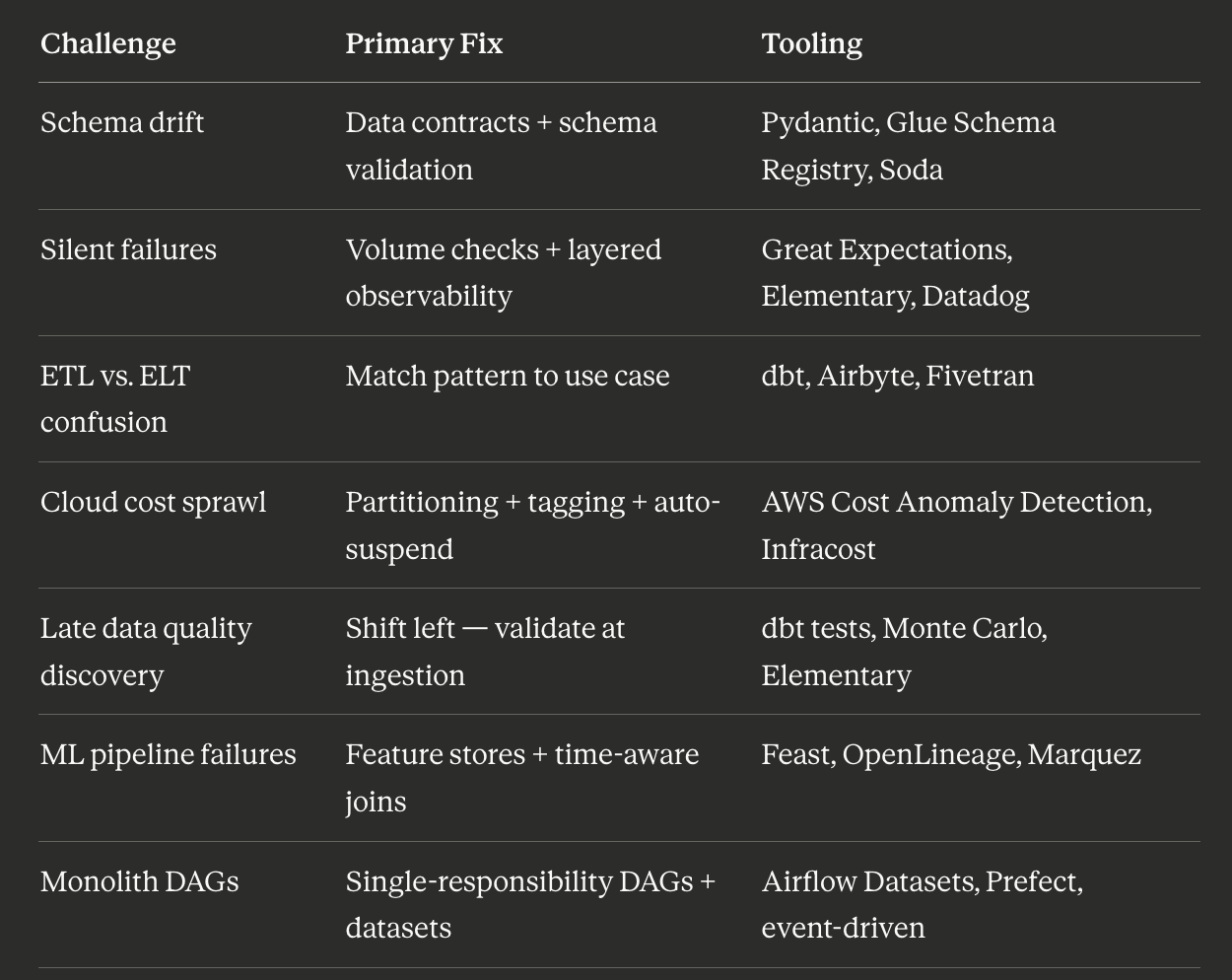
If you’ve been in the trenches with any of these, drop a comment — I’d love to hear how your team solved it. And if you’re currently dealing with one of these, the answers are out there. You just have to know what you’re looking for.
메타데이터
- post_id
- 5394989190b4
- slug
- the-data-engineers-survival-guide-7-real-world-challenges-and-how-to-actually-fix-them-5394989190b4
- url
- https://medium.com/@dineshdevisetti2000/the-data-engineers-survival-guide-7-real-world-challenges-and-how-to-actually-fix-them-5394989190b4
- canonical_url
- https://medium.com/@dineshdevisetti2000/the-data-engineers-survival-guide-7-real-world-challenges-and-how-to-actually-fix-them-5394989190b4
- author_url
- https://medium.com/@dineshdevisetti2000
- status
- ok
- fetched_at
- 2026-06-09 15:37:30