🥳🎉3️⃣Triple Helix Data Framework For Successful Implementation of End-to-End AI & Data Strategies…
Why Your AI & Data Strategies and Initiatives Keep Failing and the AI & Modern Data Meta Framework Built to Fix It
🥳🎉3️⃣Triple Helix Data Framework For Successful Implementation of End-to-End AI & Data Strategies And Measurable ROI & Business Impact by David Kabii Version 1.0 Release🚀
Why Your AI & Data Strategies and Initiatives Keep Failing and the AI & Modern Data Meta Framework Built to Fix It
The structural problem nobody is talking about
Every enterprise data programme I’ve consulted on shares the same failure signature. Here’s the framework I built to address it, and sharing the whitepaper here next. There’s a diagnosis I’ve made more times than I can count, in boardrooms from Nairobi to London ( virtually, for now, but still.. ).
The organisation has invested seriously in data. There are pipelines, dashboards, a data science team, and probably a Head of Data or a CDO. The tooling is modern: dbt, Airflow, BigQuery or Snowflake, some version of a BI platform. The budget line is real. The intentions are genuine.
Yet the CEO still cross-references the official dashboard against a spreadsheet before any meeting. The Head of Finance quietly maintains her own numbers. The ML model deployed six months ago hasn’t been looked at since its launch presentation. The analytics team is buried in data validation requests instead of doing analysis.
The failure is not accidental. It is structural.
Most data organisations have built their capability as three adjacent but disconnected disciplines:
• 𝗔 𝗱𝗮𝘁𝗮 𝗲𝗻𝗴𝗶𝗻𝗲𝗲𝗿𝗶𝗻𝗴 𝘁𝗲𝗮𝗺 that owns the pipelines, measured on uptime and delivery speed • 𝗔𝗻 𝗮𝗻𝗮𝗹𝘆𝘁𝗶𝗰𝘀 𝘁𝗲𝗮𝗺 producing reports and insights, measured on report and dashboard delivery speed and ticket closure • 𝗔𝗜 𝗮𝗻𝗱 𝗱𝗮𝘁𝗮 𝘀𝗰𝗶𝗲𝗻𝗰𝗲 𝘁𝗲𝗮𝗺𝘀 training models, measured on notebook accuracy metrics
Each strand is competent in isolation. Together, they pull in different directions, producing data nobody fully trusts, insights that contradict each other, and AI models that degrade silently because nobody is watching their training data.
The result is an organisation that has data but does not think with it.
I built the Triple Helix Data & AI Framework as a direct response to this structural problem.
The metaphor is not decorative
The framework borrows its name from molecular biology deliberately.
In chemistry, a triple helix is a nucleic acid structure where three strands coil around a common axis, each maintaining its own identity while being stabilised by the others. Remove one strand and the structure collapses. It cannot form without all three.
The integrity of the whole depends on the integration of the parts.
It also gives rise to emergent behaviours that none of the disciplines could hope to accomplish on their own.
This is structurally precise, not decorative. Each data discipline is distinct, with different practitioners, different rhythms, different success metrics. But they need to be wound together around a shared axis of infrastructure and organisational contract. Their integration produces something qualitatively different from the sum of their parts.
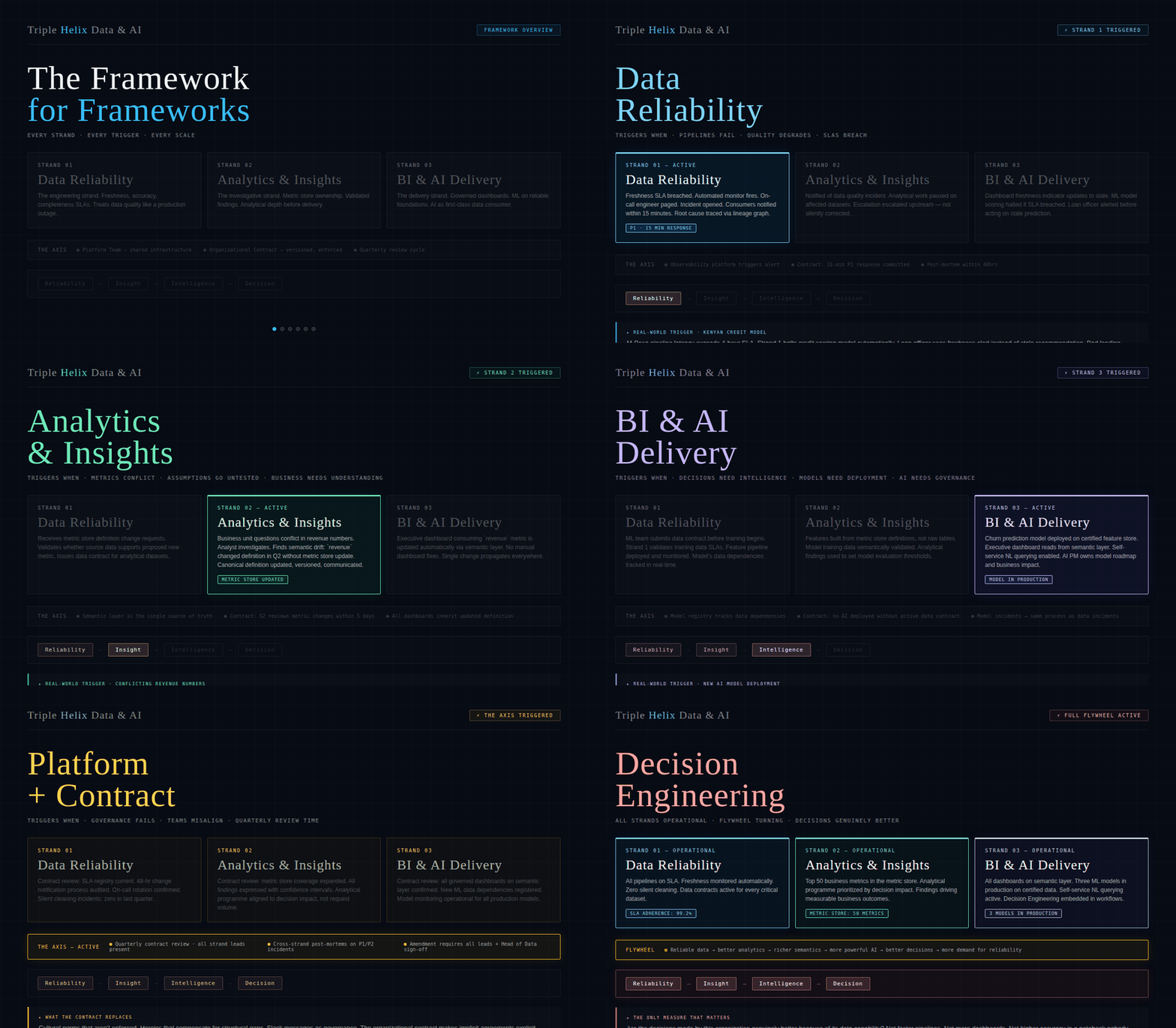
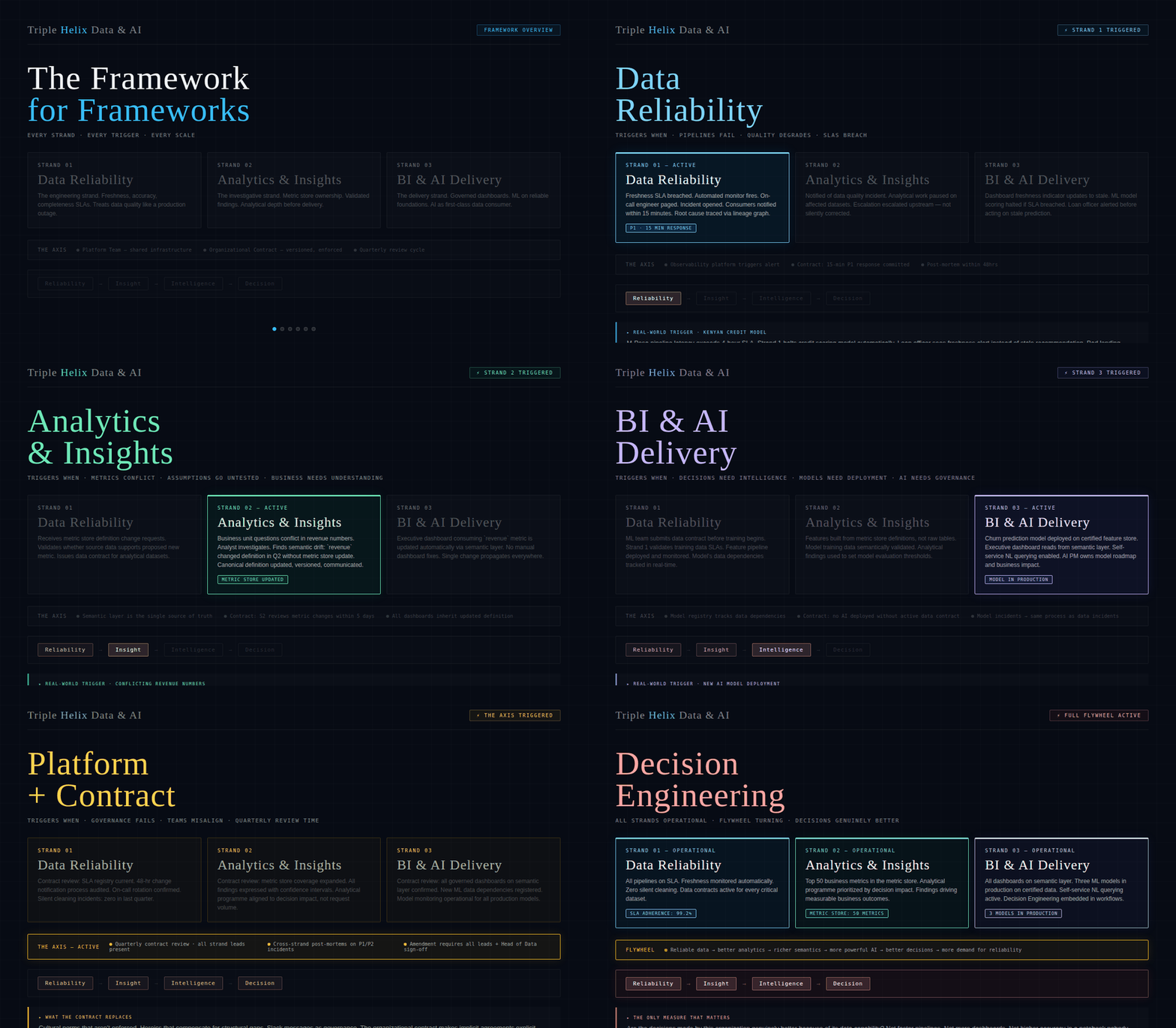
The three strands are:
Strand 1: Data Reliability: The engineering strand.
Its mandate is precise and simple: a reliable data system is one whose consumers can make decisions from it without first needing to verify it.
This strand thinks like Site Reliability Engineering applied to data systems. It owns freshness SLAs, data contracts, observability platforms, and incident management. When a pipeline breaks, this strand has an on-call rotation, posts to an incident channel, and runs a post-mortem within 48 hours. Exactly like production software. Because reliable data is production software.
Strand 2: Analytics & Insights: The investigative strand. Its mandate is not reporting, which is the delivery of pre-agreed metrics on a cadence. Analytics & Insights is the discipline of generating understanding that was not previously available: answering questions not yet asked, challenging unchecked assumptions, surfacing patterns that change how the organisation understands itself.
This strand owns the metric store with every key business metric defined once in code and versioned too, and the semantic layer with business logic encoded in a single canonical location, not repeated in every dashboard.
Strand 3: BI & Artificial Intelligence: The delivery strand.
BI and AI belong in the same strand because they share the same upstream dependencies and the same downstream purpose: enabling a decision.
A BI dashboard showing last quarter’s churn rate and an ML model predicting next quarter’s differ in temporal direction, not structural kind. Both are decision-support systems. Both usually fail the same way; not because technology broke, but because the data was wrong or the business definition was ambiguous.
The Triple Helix Data Organizational Contract: What Makes the Difference
The three strands coil around a shared axis: the platform infrastructure handled by the Data Platform Team and the Organizational Contract.
The contract is the part most frameworks miss entirely.
Most AI& data strategies, initiatives, and products have implicit agreements between their teams. Everyone knows roughly that data engineers build pipelines and analysts consume them. But implicit agreements produce implicit failures; the kind where a schema change breaks seventeen dashboards because nobody told the analytics team, or where an AI model starts producing confidently wrong predictions because upstream data silently drifted and nobody was watching.
The Triple Helix Organizational Contract makes these agreements explicit, versioned, and enforced through tooling.
It looks like this:
Each turn of the flywheel compounds the gains ofprevious one. This is the difference between an organisation that has data infrastructure and one that is data-enabled, learns continuously, and is decision engineering ready.
The flywheel only activates when all three strands are functioning. Excellent data reliability without an analytical function gives you trustworthy pipelines and no insight. Excellent analytics on unreliable data means you spend most of your time validating, not analysing. Sophisticated AI models with no data governance means your models degrade silently. Only the integrated model produces the compounding effect and desired business objectives.
Why AI Keeps Failing and Fixing It
The most important insight in the framework is about AI’s role as a consumer, not just a tool.
Most AI deployments treat the data layer as pre-solved. The data team provides the data; the AI team builds the models. What could go wrong?
Everything, as it turns out.
An AI model is the most demanding consumer of the data reliability layer that most organisations have ever built. It requires: [here list]
- Feature freshness SLAs it can rely on — because stale features produce stale predictions
- Training data that has been quality-checked and contracted — because a data quality issue in training becomes a bias issue in production
- Continuous drift monitoring — because concept drift and data drift are invisible until the model is already confindently producing wrong answers.
In East Africa specifically, I’ve seen this pattern repeatedly. A Kenyan fintech with an impressive credit scoring model, but payment processing provider data arriving with variable latency nobody has ever contracted [here] for. The model scores on stale transaction histories. Nobody knows, because nobody is watching. Loan approvals that should be declined sail through; loan applications that should be approved get flagged. Trust in the model collapses within a quarter.
The fix is not a better model. The fix is Strand 1 — build the reliability foundation before you build the model, every time.
The Triple Helix rule: build Strand 1 before AI investment. AI quality is bounded by data quality.
Decision Engineering: the reason the framework exists
Every component of the Triple Helix framework points toward a single destination: Decision Engineering.
Decision Engineering is the discipline of deliberately designing how decisions are made — ensuring that the right information reaches the right decision-maker, at the right level of confidence, in the right format, at the right time — and that the outcomes of decisions are measured and fed back to improve future decisions.
It is not a data engineering concept. It is a strategy concept.
The Decision Intelligence Stack has five layers:
- Layer 1: Reliable Data — the foundation. Without this, nothing above is valid.
- Layer 2: Intelligence — patterns detected in reliable data: ML output, statistical analysis.
- Layer 3: Insight — the interpretation of patterns as business meaning.
- Layer 4: Recommendation — the suggested action, explainable and contestable.
- Layer 5: Decision — the human or automated choice, with outcome measured and feedback loop closed.
Each layer is only as good as the layer below it. A brilliant recommendation built on unreliable data is a confident wrong answer.
The Triple Helix is the infrastructure that makes Decision Engineering possible. Without it, Decision Engineering remains an aspiration. With it, it becomes a systematic capability.
The East Africa advantage
I built this framework with Kenyan and East African organisations in mind, and I want to say something directly: the leapfrog opportunity here is real.
European and North American enterprises carry enormous legacy technical debt — mainframes, on-premise data warehouses, decades of shadow spreadsheets baked into operational processes. They have to migrate to cloud-native architectures while keeping existing systems running.
East African organisations building now can start on the cloud-native architecture from day one. No migration cost. No legacy constraint. A mobile-first data generation environment that produces richer transaction data than most OECD markets (M-Pesa transaction histories are, for credit and insurance ML applications, among the richest signal sources available anywhere). Regulatory environment (Kenya Data Protection Act 2019, CBK guidelines) that is more flexible than GDPR for innovation, while still requiring governance discipline.
The organisations in Kenya and across East Africa that build on the Triple Helix architecture now — before accumulating their own legacy debt — can reach decision-engineering maturity faster than comparable organisations in developed markets.
This is a genuine competitive window. It will not stay open indefinitely.
For enterprises that already have systems in place, the Triple Helix framework does not expect you to change much except the alignment of the teams. This enables building of reliable data and AI eco-systems and products with what already exists. At the same time, we enable enterprises to become truly decision-driven enterprises and decision engineering ready. For those seeking to adopt and/or comply with certain data frameworks or standards like TOGAF, DMBOK, medallion, GDPR, HIPAA etc, the triple helix data framework will get you there too while delivering ROI simultaneously as it happens.
I shall be providing code walktrhoughs and much more, watch this space:

How to start
The answer is almost always Strand 1. Sophisticated analytics on unreliable data produces sophisticated wrong answers. Build the foundation first.
For an early-stage team (3–5 people):
- Collapse Strand 1 and Strand 2 into a single analytics engineer hire — dbt + SQL covers 80% of both strands at this scale
- Get one pipeline monitored for freshness with an actual alert
- Define one business metric, officially, in code
- Get one dashboard that the marketing director trusts
That is enough for 90 days. The rest follows.
For the CDO at a scale-up who’s lost data trust:
- Run a metric definition workshop — get the five most-contested metrics defined, in code, agreed
- Implement data contracts for the five most-consumed datasets
- Establish an on-call rotation for Strand 1
For the AI-first organisation whose models are degrading:
- Stop new AI development for 60 days
- Map every model’s training data to its source pipelines
- Implement freshness monitoring and contracts for all model training data
- Build the feature store on the new reliability foundation
- Redeploy with data quality gates that halt retraining on stale data
What’s in the Triple Helix Data Framework
The Triple Helix Data & AI Framework v1.0 is a 15,000+ word living reference document covering:
- The Triple Helix Data Model and Teams Model in full
- 18 chapters across four layers: Executive Summary, Framework Reference, Maturity Model, Implementation
- The Organisational Contract in operational detail, including YAML data contract structure
- SLA framework by tier (freshness, accuracy, completeness, incident SLA)
- Maturity Model with 150-point assessment scorecard
- Implementation roadmap (4 phases, 18+ months)
- Five case patterns: early-stage, scale-up, enterprise reorganisation, AI-first, county government
- Layer 3 practitioner guides for each strand
- Framework stacking tables: DMBOK, Data Mesh, Data Fabric, TOGAF, MLOps, Modern Data Stack
- Regulatory reference: Kenya DPA 2019, CBK guidelines, GDPR, AfCFTA
- Salary benchmarks for Nairobi, 2026
- Starter stack for East Africa ($700–2,000/month)
- Role profiles for 11 data team roles
It is tool-agnostic. It prescribes patterns, contracts, and operating models — not vendors or products.
The organisations that win the next decade will not be those with the most data. They will be those whose data makes their decisions genuinely, measurably better.
That is what the Triple Helix framework exists to build.
Read on the full Helix data framework at https://triplehelixdata.org**)

David Kabii, Creator of the Triple Helix AI & Data Framework
David Kabii is the founder and author of the Triple Helix Data & AI Framework. He is an independent data and AI consultant based in Nairobi, Kenya, with prior senior roles in software engineering, data engineering, data science, technical writing, and AI & modern data strategist. He consults across the EMEA region on data strategy, AI readiness, and decision engineering.
Follow on Medium @david.kabii https://medium.com/@david.kabii
Triple Helix Data Framework Home: triplehelixdata.org | https://triplehelixdata.org*)
Tags: Data Engineering, AI Strategy, Data Science, Decision Engineering, Kenya Tech, East Africa, CDO, Data Strategy, Machine Learning, Data Governance
메타데이터
- post_id
- 53aa2ed1356b
- slug
- 3️⃣triple-helix-data-framework-for-successful-implementation-of-end-to-end-ai-data-strategies-53aa2ed1356b
- url
- https://medium.com/@david.kabii/3%EF%B8%8F%E2%83%A3triple-helix-data-framework-for-successful-implementation-of-end-to-end-ai-data-strategies-53aa2ed1356b
- canonical_url
- https://medium.com/@david.kabii/3%EF%B8%8F%E2%83%A3triple-helix-data-framework-for-successful-implementation-of-end-to-end-ai-data-strategies-53aa2ed1356b
- author_url
- https://medium.com/@david.kabii
- status
- ok
- fetched_at
- 2026-08-12 19:20:28