The Attorney-Client Privilege: Why AI Vendors Require Enforceable Oversight
A Policy Proposal for Safe and Accountable AI Use in Law Firms: Guidance for Legal Practitioners, Firm Leadership, and Regulators
The Attorney-Client Privilege: Why AI Vendors Require Enforceable Oversight
A Policy Proposal for Safe and Accountable AI Use in Law Firms: Guidance for Legal Practitioners, Firm Leadership, and Regulators

Image sourced from https://daanishbhatti.medium.com
Executive Summary
Law firms increasingly rely on third-party AI vendors to improve efficiency and reduce costs. However, this reliance creates serious risks to the attorney-client privilege. If confidential information is disclosed to a vendor, even unintentionally, that privilege can be permanently lost. Despite this risk, there is currently no federal policy governing AI vendor use in legal practice. Firms rely only on broad ethical duties and vendor promises, which are not legally binding and set no enforceable data protection standards. State rules also vary, making accountability difficult when breaches cross jurisdictions. Without a clear regulatory framework for vendor-related risks, the chance of breaching the attorney-client privilege becomes unacceptably high. To address this, legal regulators and bar authorities should establish a uniform set of rules for third-party AI vendor use in law, with clear security requirements and accountability for breaches. Scholars and policymakers have proposed several approaches to closing this gap, including external oversight, internal governance within law firms, and vendor reforms. Of these, external oversight provides the strongest foundation as it shifts AI governance in law from a trust-based model to a compliance-based one, where privilege protection is grounded in explicit and enforceable standards. In practice, this would require a third-party oversight system that conducts audits on vendor data handling, mandates regular reporting, and maintains a certification registry to identify vendors that meet confidentiality protection standards.
Why Law Firms Are Adopting AI in the First Place: To Work Faster, Smarter, and Cheaper
Law firms use AI to improve efficiency, reduce costs, and stay competitive as clients expect faster and more affordable services. In areas such as document review, contract checking, and legal research, empirical studies on AI in legal practice show that these tools reduce administrative workload and speed up the review of large document sets, allowing lawyers to spend more time on strategy and client advice (Zahra, 2025).
To meet these goals, law firms rely on different types of AI tools, each serving a specific function. One major category is predictive analytics, which helps firms estimate the likely outcomes of cases based on past data. Beyond prediction, AI is also used in contract review and document management to make due diligence and discovery faster and more organized. In more specialized areas, some firms use AI assistants for arbitration support, compliance monitoring, and litigation analysis. Building on these functions, generative AI systems such as ChatGPT or legal-focused platforms like Harvey help with drafting tasks by creating briefs, summarizing laws, and analyzing case decisions (Khatniuk et al., 2023). Together, these tools help lawyers to complete their work more efficiently, at a lower cost, and with greater accuracy than traditional methods.
Third-Party AI Vendors: The New Normal in Legal Practice
While AI adoption is not yet consistent across the legal industry, it continues to grow steadily. Surveys indicate that approximately 30 percent of law firms in the United States use some form of AI (Ambrogi, 2025). Much of this growth is driven by larger firms, with nearly half of those with 500 or more lawyers reporting AI use in the 2024 American Bar Association (ABA) Tech Survey. In contrast, adoption among smaller firms has been slower, with fewer than 20 percent of solo practitioners using AI in their work (Provow, 2024).
Among law firms that have adopted AI, roughly 80 percent rely on third-party platforms, while only 20 percent use in-house systems (Ambrogi, 2025). This reliance on external vendors persists even in firms with internally developed AI tools, as Axiom reports that 83 percent of employees in those firms still use third-party products that were not built or owned by their organizations (Provow, 2024). This trend exists because, while in-house AI systems provide firms with full control over their data and allow for better customization and confidentiality, developing and maintaining such systems requires substantial budgets, technical expertise, and continuous updates that many firms cannot afford (Tye, 2024). As a result, most continue to rely on third-party AI. However, in doing so, they overlook a serious issue, which is that these systems provide far weaker protection for confidential information than many assume.
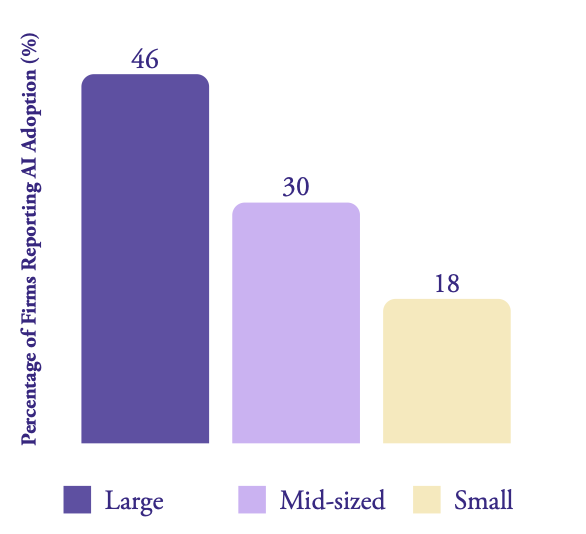
Fig. 1 2025 Al Adoption by Law Firm Size (Ambrogi, 2025)
At first, it may seem that the chances of an AI vendor exposing or misusing client data are low. This perception exists because enterprise-grade AI vendors that market directly to law firms do take steps to protect confidentiality. They often encrypt data in transit and at rest, prohibit model training on client inputs, and implement limited data retention policies (Davis, 2020). For example, Dentons’ partnership with Microsoft includes a rule that client data will not be used to train the underlying AI models and must be deleted after thirty days (Tye, 2024). Additionally, some vendors also obtain internationally recognized certifications, such as ISO 27001, which require documented security procedures and structured data protection frameworks (Coveo’s, 2023). However, these measures are voluntary business choices rather than legal obligations, meaning vendors can change or withdraw them at any time. This creates a false sense of security, as lawyers may assume that vendor safeguards are reliable even though no binding rules ensure these protections will remain consistent or enforceable.
This misplaced trust directly puts the attorney-client privilege at risk, as the privilege is lost whenever confidential information is shared with a third party (Needham, 2025). When lawyers enter sensitive details into an external AI system, they no longer control how the data is handled and cannot verify whether it is retained, copied, or accessed internally. Some may attempt to reduce this risk by anonymizing client information, but this approach is rarely sufficient, as specific fact patterns can still reveal a client’s identity. In such cases, any storage or logging of that information may be treated as disclosure and result in privilege loss. The risk increases with general-purpose AI tools, such as the free version of ChatGPT, which may retain user inputs for training and does not guarantee confidentiality (Needham, 2025). It becomes even more serious when data is stored across borders and accessed by vendors who are not bound by local confidentiality obligations (Davis, 2020). If a breach occurs, lawyers, not AI vendors, would bear full professional responsibility for violating client confidentiality, even though they have little control over how the vendor manages the data.
More importantly, the attorney-client privilege cannot be fixed or restored once it is breached. Because the privilege is a legal protection that keeps private communications out of court, even a single disclosure can expose sensitive facts, legal strategies, or client statements during legal proceedings. The loss of privilege not only destroys an individual case but also threatens the integrity of the entire legal system. If clients cannot trust that their information will remain private, they may hesitate to share important details with their lawyers, which directly weakens a lawyer’s ability to provide effective representation.
“A distinct and also vital ethical duty that lawyers will have to manage is to insure that the use of AI solutions does not pose a risk to the general duty to preserve client confidence and to maintain and preserve the attorney-client privilege” (Davis, 2020).
In short, once a client’s confidential information enters an AI vendor’s system, privilege can be broken in ways lawyers cannot control. On top of that, because of the irreversible nature of privilege loss, the stakes for adopting AI in legal practice become exceptionally high, making it urgent for the industry to adopt practical regulation for protection.
The Policy Gap: No Clear Rules for AI Use in Law Firms
Nevertheless, despite the serious risk of AI data breaches, there is currently no single federal policy that regulates how law firms use AI vendors. Instead, guidance comes solely from professional ethics rules and state bar associations. The most relevant rule is the ABA Model Rule 1.6, which was adopted in 2012 and requires lawyers to take “reasonable efforts” to protect client confidentiality (Davis, 2020). A few state bars, including those in California, New Jersey, and Pennsylvania, have issued opinions reminding lawyers that if they use AI, they should still meet their professional duties, including staying competent in the technology they use, protecting client confidentiality, and independently verifying the accuracy of any AI-generated work (Tye, 2024). Additionally, some courts now require lawyers to disclose AI use in court filings, and some firms have developed internal review policies to verify the accuracy of AI outputs and safeguard sensitive client data (Needham, 2025). However, these measures are mostly advisory rather than legally binding. Broad ethics rules, such as the duty to take “reasonable efforts,” were created more than a decade ago and were never designed to address AI-specific risks like data storage or model training practices (Tye, 2024). As a result, they do not apply to AI vendors and fail to regulate how sensitive client information is stored, retained, or reused once it enters these systems.
In addition to being unenforceable, these standards are also inconsistent across jurisdictions. Because lawyer regulation in the United States is traditionally handled at the state level, the system remains fragmented (Needham, 2025). Some states have issued guidance, while others have not, which leads to significant gaps and inconsistencies (Davis, 2020). This patchwork of rules presents major challenges for law firms operating across multiple jurisdictions, as each state may have different or even conflicting standards. When a breach involves parties across states, whether it is the law firm, the client, or the AI vendor, existing rules may not apply and fail to hold anyone accountable. As a result, the responsibility for managing AI-related risks, once again, falls entirely on lawyers, exposing them to serious confidentiality risks.

Fig. 2 State AI Bills Enacted Since 2003 (Zahra, 2025)
Closing the Gap: Practical Solutions for Governing AI in Law
To prevent the permanent loss of the attorney-client privilege, the need for stronger regulations for the use of AI vendors has become urgent. Legal regulators and bar authorities should establish explicit, enforceable, and uniform rules to ensure security, accountability, and ethical compliance. To address this gap, scholars and policymakers have proposed several approaches, including third-party committee oversight, internal governance within law firms, and vendor-level reforms.
1. Reforms Within Law Firms: Building Ethical and Secure AI Practices
The first solution is for law firms themselves to take greater responsibility for the use of AI. Since lawyers already carry a non-delegable duty to protect client information, improving internal governance and risk management becomes essential.
Lejniece (2025) proposes that law firms should assign the responsibility of internal AI governance to a senior partner or governance officer who oversees compliance and implementation. By placing this responsibility at the leadership level, firms would signal to their clients that AI governance is a core part of professional ethics. Regular risk assessments, employee training, and clear documentation of AI use would further support this structure by keeping oversight visible and ongoing rather than reactive.
To reinforce this internal structure, O’Grady and O’Grady (2025) suggest the use of built-in ethics monitoring tools. They propose AI “ethics agents,” which are software systems that operate within a firm internally and act as continuous digital ethics advisors. These “agents” would provide real-time prompts, reminders, and accountability checks that help lawyers apply ethical duties in their workflow and avoid misuse when using AI tools.
Ideally, this internal governance model allows law firms to actively prevent confidentiality breaches before confidential information reaches an external vendor. By assigning oversight to senior leadership and integrating monitoring tools into daily workflows, the firm positions AI risk prevention as a core ethical duty rather than a technical add-on. Additionally, regular assessments and documentation make data handling traceable and accountable. In doing so, AI oversight shifts from a one-time compliance checklist to a visible, routine ethical practice.
However, this approach also has several limitations. First, building internal governance programs and installing monitoring systems would require significant financial, administrative, and technical resources. Larger firms may have the capacity to develop such structures, but smaller firms and solo practitioners may not be able to afford them. As a result, this solution may leave the smaller firms vulnerable. More importantly, internal governance is still a form of self-regulation. Even with strong internal policies, once data is sent to an AI vendor, firms could still lose control of the confidentiality, and clients receive no additional legal protection unless vendors themselves are bound by enforceable rules.
2. Improvements by AI Vendors: Designing for Confidentiality and Compliance
Another proposed solution focuses on changes that AI vendors could make. Since vendors control the systems that process sensitive legal data, their design choices and ethical standards directly determine whether the attorney–client privilege is protected or put at risk.
Turksen et al. (2024) argue that vendors should adopt ethics-by-design and explainability frameworks to make AI behavior more transparent. Explainability tools allow lawyers to see how an AI model generates outputs and whether it stores, transfers, or retains sensitive information. When law firms can clearly trace how data is handled, they are better at detecting and addressing confidentiality risks before a breach occurs.
Drawing from the United Nations’ Ruggie Principles, Frostestad (2024) builds on this model by recommending that AI vendors incorporate international human rights and social responsibility standards in their development. This approach requires vendors to treat confidentiality, fairness, and accountability as core obligations. Under this framework, vendors need to conduct human rights impact assessments and establish internal ethics boards to monitor compliance.
This approach allows vendors to include transparency directly into the system and treat privilege protection as a core obligation. In return, law firms gain stronger assurance that sensitive information is not retained or misused. In addition, explainability tools allow law firms to verify compliance instead of relying solely on vendor assurances. As a result, this prevents risky data practices at the technological level and lowers the chance of privilege loss before it can occur.
Nevertheless, this solution still depends on voluntary cooperation. Vendors are not bound by legal regulations to be held liable for privilege loss, so there is no guarantee they will maintain these safeguards over time. Without enforceable obligations or external audits, ethics-by-design remains an expensive choice rather than a requirement, and law firms still have no legal protection if a vendor breach occurs.
3. Third-Party Oversight: Audits, Certification Registries, and Enforceability
The last solution is to create a comprehensive oversight system that holds both vendors and law firms accountable. This involves establishing an external review committee, implementing mandatory audits, and maintaining a certification registry to ensure that AI vendors used in legal practice meet minimum standards for privilege protection.
Turksen et al. (2024) suggest that the legal industry should adopt an external compliance framework for AI use, similar to the one used in the financial sector. In banking, institutions are required by regulatory bodies to maintain audit trails, report risks, and go through independent reviews to verify compliance with anti-money laundering and consumer protection standards. A comparable system in law could be led by the ABA in coordination with state bar associations and independent technical auditors. Law firms and AI vendors would regularly report how they protect confidentiality and allow third-party auditors to verify compliance with privilege and security requirements.
Within this framework, Needham (2025) proposes that regulators, such as the ABA, and independent technical experts should directly evaluate AI vendors and maintain a public list of certified providers that meet confidentiality requirements. This certification system would function similarly to the Leadership in Energy and Environmental Design (LEED) program used in environmental regulation, where companies voluntarily meet defined benchmarks to earn public trust. By applying a similar certification registry model to AI, law firms could rely on verified vendors without needing to do research on AI vendors themselves.
This oversight model introduces both enforceability and transparency into regulating the use of AI vendors. Instead of relying on voluntary vendor promises or vague ethical duties, law firms would operate under a structured system with clear standards that can be audited and enforced. This changes the governance of AI from a trust-based model to a compliance-based one, preventing vendors from secretly changing their data policies and ensuring that law firms are not left to manage risks on their own. By centralizing verification through certification and audits, responsibility shifts from lawyers to an accountable oversight system. This creates real legal consequences for noncompliance and ensures that confidentiality standards are applied consistently across the industry.
While this solution offers strong protection, there are several challenges to enforcing it in practice. Establishing and maintaining a national oversight system would require significant administrative spending by regulators, law firms, and AI vendors for audits, reporting, and compliance. These costs are the true price of using AI responsibly, not an optional burden. AI only seems inexpensive when firms ignore the expense of preventing privilege loss and monitoring data practices. However, once essential oversight is included, the real cost of AI in legal practice comes into focus, including the price of regular audits, vendor evaluations, updated security reviews, and the staffing needed to manage ongoing reporting, similar to environmental rules that require companies to factor pollution and cleanup into the cost of doing business. Beyond cost, coordinating across state bar jurisdictions poses a major timing challenge. Aligning standards nationwide would require cooperation among multiple regulatory authorities and could take months, if not years, to complete, while AI is developing far faster than regulatory processes. As a result, certification criteria could quickly become outdated.
Recommendation: Third-Party Oversight as the Most Effective Solution
Among the three approaches, external oversight offers the strongest protection for attorney-client privilege because it introduces enforceable standards, creates shared accountability between vendors and law firms, and replaces trust-based AI adoption with a regulated system. To implement this, legal regulators and bar authorities should:
• Establish a third-party audit and reporting system, such as by the ABA, that evaluates AI vendors on how they collect, store, and process legal data, with a focus on privilege protection and confidentiality.
• Create a certification registry of approved AI vendors that meet minimum standards for data security and privilege protection, allowing firms to rely on them without conducting their own technical audits.
• Require law firms to either use certified vendors or provide documented due diligence showing an equivalent level of protection before adopting any third-party AI system.
• Mandate periodic data handling disclosures from both vendors and participating law firms to maintain certification status and ensure that confidentiality safeguards remain active over time.
• Develop enforcement mechanisms, such as suspension from the registry, public decertification, or professional penalties for firms that knowingly use non-compliant systems or fail to report breaches.
By implementing these steps, regulators would move the legal industry from voluntary ethics statements to enforceable protection standards. This oversight framework would prevent privilege loss before it occurs and create an accountability structure that applies to both firms and vendors.
References
Ambrogi, B. (2025, March 7). Aba Tech Survey Finds Growing Adoption of AI in Legal Practice, With Efficiency Gains as Primary Driver. LawSites. https://www.lawnext.com/2025/03/aba-tech-survey-finds-growing-adoption-of-ai-in-legal-practice-with-efficiency-gains-as-primary-driver.html
Coveo’s AI platform Earns Coveted ISO 27001 Certification: Setting the Standard for Security and Trust. Coveo Solutions Inc. (2023, June 28). https://ir.coveo.com/en/news-events/press-releases/detail/335/coveos-ai-platform-earns-coveted-iso-27001-certification
Davis, A. E. (2020). The Future of Law Firms (and Lawyers) in the Age of Artificial Intelligence. Revista Direito GV, 16(1), Article 201945. https://doi.org/10.1590/2317-6172201945
Frostestad, H. L. (2024). AI Regulation in a ChatGPT Era: Cross-border Cooperation and Hope in a Sudden Storm. Indiana Journal of Global Legal Studies, 32(1), 1–38. https://doi.org/10.2979/gls.00001
Khatniuk, N., Shestakovska, T., Rovnyi, V., Pobiianska, N., & Surzhyk, Y. (2023). Legal Principles and Features of Artificial Intelligence Use in the Provision of Legal Services. Journal of Law and Sustainable Development, 11(5), e1173. https://doi.org/10.55908/sdgs.v11i5.1173
Lejniece, A. (2025). Good Governance Principles for Law Firms Using Artificial Intelligence. Transforming Arbitration. Exploring the Impact of AI, Blockchain, Metaverse and Web3, 179–215. https://doi.org/10.54195/fmvv7173_ch10
Needham, C. A. (2025). Regulation of The Use of Generative Artificial Intelligence Tools in The Delivery of Legal Services: Verification and Accountability. Washington University Journal of Law and Policy, 77(1), 184.
O’Grady, C. G., & O’Grady, C. S. (2025). Agentic Workflows in the Practice of Law AI Agents as Ethics Counsel. The Georgetown Journal of Legal Ethics, 38(2), 247.
Provow, K. (2024, November 20). AI in Legal Departments: Promise Meets Reality in 2024. On-Demand Legal Talent, Lawyers, & Legal Services Provider. https://www.axiomlaw.com/blog/ai-in-legal-departments-promise-meets-reality#:~:text=November%202024,and%20legal%20research%20(37%25).
Turksen, U., Benson, V., & Adamyk, B. (2024). Legal implications of automated suspicious transaction monitoring: enhancing integrity of AI. Journal of Banking Regulation, 25(4), 359–377. https://doi.org/10.1057/s41261-024-00233-2
Tye, J. C. (2024). Exploring the Intersections of Privacy and Generative AI: Dive into Attorney-Client Privilege and ChatGPT. Jurimetrics (Chicago, Ill.), 64(3), 309–340.
Zahra, Y. (2025). Regulating AI in Legal Practice: Challenges and Opportunities. Journal of Computer Science Application and Engineering (JOSAPEN), 3(1), 10–15. https://doi.org/10.70356/josapen.v3i1.47
메타데이터
- post_id
- 53b3bcdc5a65
- slug
- the-attorney-client-privilege-why-ai-vendors-require-enforceable-oversight-53b3bcdc5a65
- url
- https://medium.com/writ340econfall2025/the-attorney-client-privilege-why-ai-vendors-require-enforceable-oversight-53b3bcdc5a65
- canonical_url
- https://medium.com/writ340econfall2025/the-attorney-client-privilege-why-ai-vendors-require-enforceable-oversight-53b3bcdc5a65
- author_url
- https://medium.com/@rheasong
- status
- ok
- fetched_at
- 2026-07-08 11:08:33






