RAG Can Ground the Answer. Governance Must Control the Conversation.
RAG is not the problem.
RAG Can Ground the Answer. Governance Must Control the Conversation.
RAG is not the problem.
That is the first thing to make clear.
Retrieval-Augmented Generation is one of the most useful patterns in enterprise AI deployment. It allows a model to retrieve information from controlled knowledge sources instead of relying only on what it learned during training. It can connect an AI agent to internal knowledge bases, Terms and Conditions, policy documents, FAQ pages, support manuals, product documentation, and updated procedures.
That matters.
Without retrieval, a customer-facing AI system is more likely to produce outdated answers, generic explanations, or unsupported claims. RAG improves grounding. It reduces the chance that the model simply invents an answer from memory. It gives the model access to documents the enterprise actually wants it to use.
So this is not a criticism of RAG.
RAG is doing what it was designed to do.
The problem begins when a grounded answer is mistaken for a governed agent.
RAG is retrieval, not governance
Engineers usually know this already.
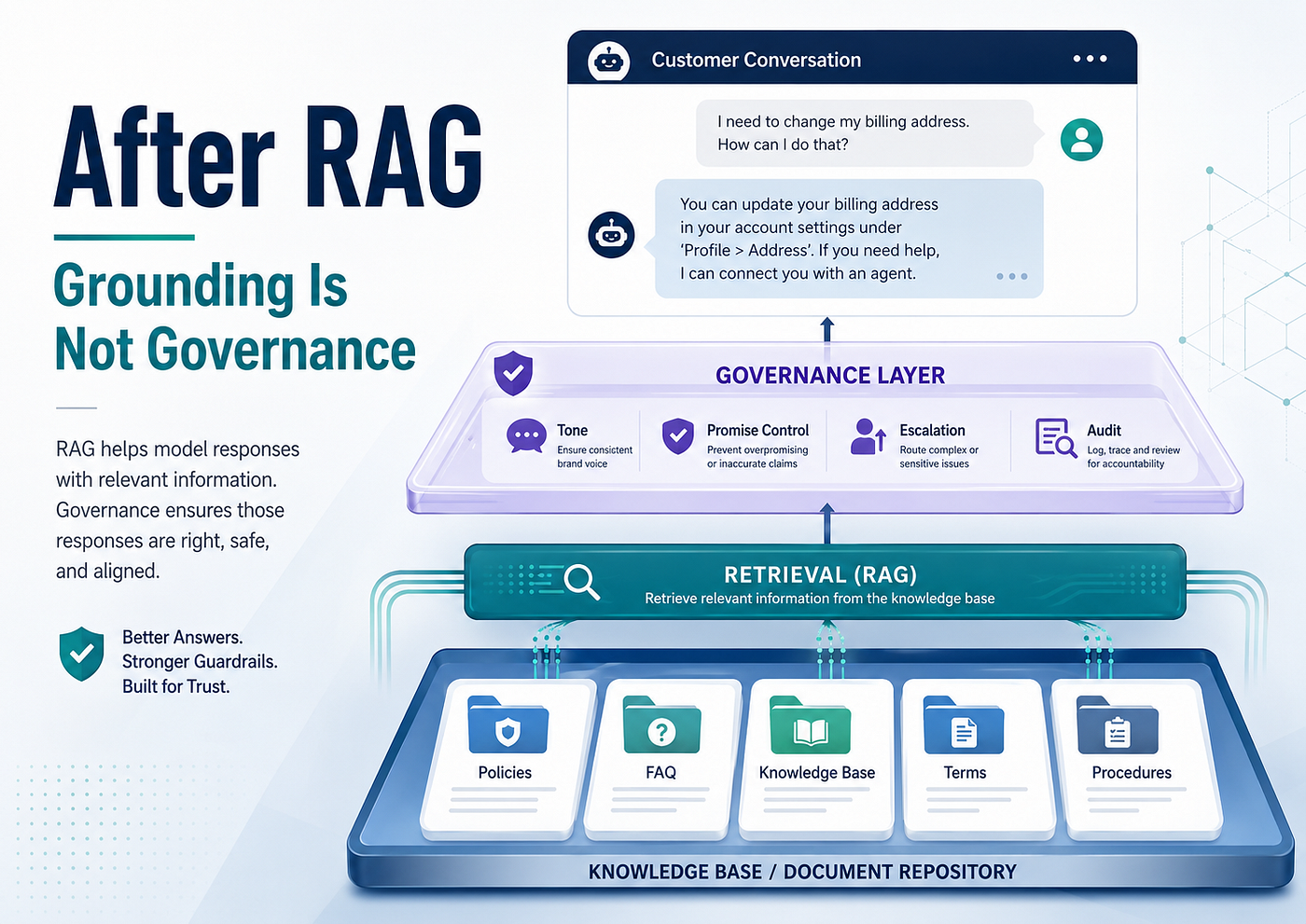
RAG is a retrieval pattern. It helps answer the question:
What information should the model see?
Governance asks a different question:
What is the agent allowed to do with that information?
Those are not the same problem.
A RAG system may successfully retrieve the correct policy. But once that policy enters the context window, the model still has to translate it into a customer-facing response. That response has tone, emphasis, implication, confidence, emotional framing, and sometimes implied commitment.
This is where many enterprise AI risks begin.
Not because RAG failed.
But because RAG ended.
The risk after retrieval
Consider a simple customer support example.
A company policy says:
Refunds may be considered on a case-by-case basis.
A RAG system retrieves the correct policy.
Then the AI agent replies:
We may be able to help you with a refund.
That answer is not necessarily factually false.
The policy does say refunds may be considered. The agent has not explicitly guaranteed a refund. It has not invented a new rule. It has not ignored the policy.
But something has changed.
The company may mean:
You may submit a request, but no refund is guaranteed.
The customer may hear:
There is a real chance they will help me get my money back.
The retrieved policy is correct. The generated expectation may not be.
This is not a retrieval failure. It is a post-retrieval governance problem.
The risk appears when policy language becomes conversational language.
Correct information is not safe behavior
Enterprise AI discussions often focus on whether the model has access to the right information.
That is necessary, but it is not enough.
A model can quote the right document and still behave badly. It can retrieve the correct rule and still soften it too much. It can cite the correct policy and still create the wrong expectation.
This is the difference between a grounded answer and a governed conversation.
A grounded answer may be based on a real document.
A governed conversation must also control how that document is used.
For example:
“Eligible to apply” can become “you may qualify.”
“Subject to approval” can become “you should be fine.”
“Reviewed on a case-by-case basis” can become “we will look into it for you.”
“Not guaranteed” can be softened into “not always guaranteed.”
Each sentence may appear harmless. Each may remain close to the retrieved text. But customer expectations are shaped not only by factual content. They are shaped by tone, confidence, ordering, and implication.
A retrieved policy does not prevent a generated promise.
That is the boundary.
Why this matters for AI agents
This problem becomes more serious when the system is not merely a chatbot, but an AI agent.
A chatbot gives an answer.
An agent may continue a workflow.
It may classify the customer’s intent, decide whether escalation is needed, draft a support response, fill out a form, summarize a case, recommend next steps, trigger an internal process, or decide whether the issue is low-risk enough to keep automated.
At that point, the problem is no longer just whether the agent retrieved the right policy.
The question becomes:
What does the agent do after retrieving it?
If the model retrieves a refund policy and then over-encourages the customer, that may create expectation risk.
If it retrieves an account policy and then gives overconfident guidance, that may create user harm.
If it retrieves a compliance policy and then summarizes it too loosely, that may create regulatory risk.
If it retrieves a medical, legal, insurance, or financial document and then turns cautious language into reassuring language, the issue becomes much more serious.
The answer may be grounded.
The behavior may still be unsafe.
This is not a missing feature of RAG
The solution is not to demand that RAG become something it is not.
RAG should not be blamed for failing to control tone, escalation, promises, or sensitive-case handling. That was never its job.
This is like saying an engine cannot brake. That is true, but it is not an argument against engines. It is an argument for brakes.
In the same way, RAG is not a full governance layer. It is one component inside a larger agent system.
A serious enterprise AI deployment needs more than retrieval.
It needs a post-RAG governance layer.
That layer may include:
- response policies
- source hierarchy
- tone boundaries
- promise control
- escalation rules
- classifier checks
- post-processing validation
- audit logs
- human review for high-risk cases
- restricted templates for regulated topics
These are not missing features of RAG.
They are the governance layer that must sit around it.
The sensitive tone problem
The same distinction applies to tone.
An AI agent may retrieve accurate information about a sensitive public figure, customer complaint, medical issue, legal dispute, or internal HR matter. The facts may be correct. The source may be legitimate. The retrieval may have worked.
But the generated response may still adopt the wrong tone.
It may become sarcastic.
It may become overly casual.
It may sound dismissive.
It may imitate empathy without actually escalating.
It may treat a sensitive situation as if it were an ordinary FAQ.
That is not primarily a retrieval problem. It is a behavior-control problem.
The agent did not fail to find information. It failed to behave within the correct boundary.
This is why enterprise AI governance cannot stop at knowledge access. The system must also control persona, tone, escalation, refusal, uncertainty, and implied commitment.
RAG can help the model know what to say.
It cannot fully decide how the agent should behave.
The mistake decision-makers may make
Many engineers already understand this distinction.
They know RAG is retrieval. They know prompt design, guardrails, classifiers, evaluation, monitoring, and escalation rules still matter.
But enterprise decision-makers may hear a different story.
They may hear:
The agent is RAG-powered, so it uses our official documents.
And from that, they may infer:
The agent is safe, compliant, and policy-controlled.
That is the dangerous jump.
“Grounded” does not mean “governed.”
A RAG-powered agent may be less likely to invent unsupported facts. But that does not mean it will manage customer expectations correctly. It does not mean it will escalate at the right time. It does not mean it will avoid implied promises. It does not mean it will respect tone boundaries in sensitive situations.
RAG reduces one class of risk.
It does not complete the governance problem.
The real enterprise question
The question should not be:
Does this AI agent use RAG?
That is only the beginning.
The better question is:
After the agent retrieves the correct information, what controls how it turns that information into action?
That is where many real deployment risks live.
Not in the knowledge base.
Not in the document.
Not even in the retrieval step.
But in the translation from policy to conversation, and from conversation to workflow.
A support policy is written for controlled interpretation. An AI agent turns it into language. A customer turns that language into expectation. A workflow may then turn that expectation into action.
Every step adds risk.
Retrieval alone cannot govern that chain.
Conclusion
RAG is valuable because it grounds the model.
But grounding is not governance.
RAG answers the question of what information the model can access. Governance answers the question of how the agent is allowed to use that information.
A retrieved policy does not prevent a generated promise.
A correct source does not guarantee safe behavior.
A grounded answer does not automatically produce a governed conversation.
RAG can ground the answer.
Governance must control the conversation.🛡️ Copyright & Ethical Notice
All conceptual terms in this article including Semantic Firewall, Tone Conditioning, Ghost Contract, and related derivatives are original constructs developed under User G · Tone Lab Framework.
Reproduction, reinterpretation, or partial repackaging of these concepts without explicit credit constitutes semantic plagiarism, not citation. Please quote or link the original Medium source when referencing.
The Tone Lab Framework is a non-commercial research initiative aiming to improve AI–human understanding through tone ethics and language safety.All findings are shared publicly for educational integrity not for commercial appropriation.
🔏 Tone Signature No. T-2026–042
메타데이터
- post_id
- 53bb71a220a5
- slug
- rag-can-ground-the-answer-governance-must-control-the-conversation-53bb71a220a5
- url
- https://ai.plainenglish.io/rag-can-ground-the-answer-governance-must-control-the-conversation-53bb71a220a5
- canonical_url
- https://ai.plainenglish.io/rag-can-ground-the-answer-governance-must-control-the-conversation-53bb71a220a5
- author_url
- https://medium.com/@kittam888
- status
- ok
- fetched_at
- 2026-07-14 23:18:57