The Halving City
Part Four — Climax and Resolution
Serial Fiction
The Halving City
Part Four — Climax and Resolution
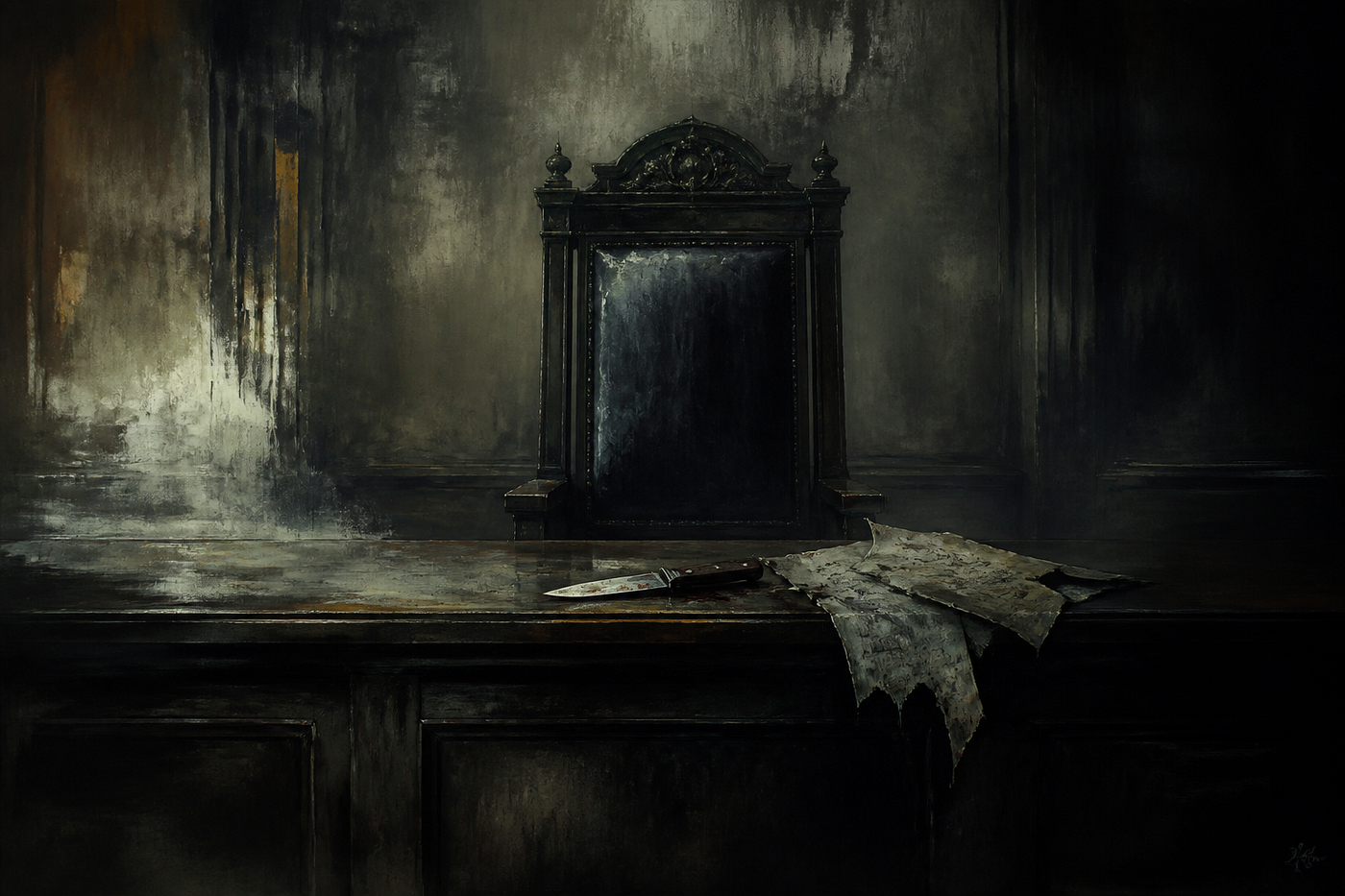
Image created by author on Magnific
(Part 1)
(Part 2)
(Part 3)
Continued. A father has asked the Hall to halve his own child’s belief in him. The Magistrate, refusing to rule, has found a third path.
It must be understood that the Magistrate did not mean this as a figure of speech, because the city he served had long ago lost the ability to hear a thing as a figure of speech. The Law had taught it to hear all claims literally, to take every want as a want of the whole thing, and the Magistrate had lived inside that literalness for so long that he reached for it now as the only language in which the thing could be said and made binding. He did not say the office should be halved in spirit. He said it as he would have said it of a loaf, and he meant to do it as he had done the loaf, with an edge, because the Law had never accepted a halving done with words alone as fully done, and he would not let this one be less than the others. He would not let the office escape the blade that he had brought down on the friendship and the name. Whatever he had done to them, he would do to himself.
He took up the knife the Hall kept for halvings, the same knife that had cut the baker’s loaf in the first week of the season, and he laid the founding charter open on the bench, and he understood that the office was not the charter and not the knife and not the bench, that the office had no body any more than the friendship had, that it lived nowhere but in the man who held it and in the city’s agreement to be ruled by him. And so he understood what halving it required.
It required halving the only body the office had, which was his own authority to act, and there was only one way to halve an authority that lives in the agreement of a city, which is to break the agreement, publicly, past mending, so that no whole authority remains for any man to inherit.
He did not cut himself. The Recorder, writing, had feared for a moment that he would, and the city would later tell the story as though he had, because the city preferred its truths with blood in them. But the Magistrate was not a man who confused the body with the thing. He had spent a whole winter learning the difference between the loaf, which was a body, and the marriage, which was not. To halve the office he did not need to harm his flesh. He needed to do something far harder, which was to destroy, with his own hands and in the sight of the only witness the law required, the thing that made him a magistrate at all.
He took the knife, and he cut the founding charter in half.
It did not cut cleanly. That was the thing the Recorder set down most carefully, because it seemed to him to matter, though he could not have said how. The loaf had cut cleanly, in the first week of the season, the blade finding the seam in the dough as though the loaf had been made to be halved, which in a sense it had. But the charter was old, and the vellum was thick and gone hard with the years, and it fought the knife. The Magistrate had to saw at it. He had to bear down, and the blade caught and dragged, and the old vellum tore as much as it cut, so that the line down the spine was not a line at all but a ragged wound, fibrous, reluctant, the document refusing to the last to be halved, as though even the founders’ charter knew itself for one of the things that does not survive division and was trying, in the only way a piece of vellum can try, to remain whole. The Magistrate sawed through it anyway. His face did not change.
The Recorder, watching, thought of the man’s voice reading out the apportioned days of the crying child, the voice that did not change because the Law did not provide for the changing of a magistrate’s voice, and he understood that he was watching the same refusal now turned at last upon its source, the accuracy that had cut everything finally cutting the thing that had licensed all the cutting, and not flinching, because to flinch would have been to admit that this cut was different from the others, and the whole meaning of the act was that it was not different, that it was the same Law, the same blade, the same even edge, brought home.
He cut it down the spine, through the struck clause and the four words in the margin, through who shall decide which, so that the question itself was severed and each half of the page carried half of it, who shall on the one and decide which on the other, a question and the wreck of a question. He cut through the seal of the founders and the names of the founders and the whole instrument by which the city had agreed to be the city. And when it was cut he laid the two halves on the bench side by side, and he spoke the judgment, and the Recorder wrote it whole, the last whole thing he would write in the service of that Law.
“The office of Magistrate,” the Magistrate said, “is hereby halved. To the Law, one half: the right to apply the blade evenly to all things that can survive it. To justice, the other half: the right to refuse the blade to all things that cannot. And because no man can hold two halves that contradict each other and remain one man, because an authority halved against itself is not a smaller authority but no authority at all, this bench is, from this moment, empty. There is no Magistrate. There is no whole office for any man to sit in. I have done to the office exactly what the Law does to all contested things, and the Law is satisfied, and the office, being of a kind that cannot survive the halving, has ceased wholly to be.
“Let the record show that the Law of the Half was applied, for the first and last time, to itself. Let the record show what it produced. Let the city read, in the empty bench, the answer to the question the founders struck out. They asked who should decide which things may be halved. The answer is no one, and the proof is that the only man who ever tried to decide it could do so in no other way than by destroying the seat from which the deciding would have to be done. There is no floor that a man may stand on to find the floor. I have looked. This is the looking. This is what it costs.”
He set down the knife. He did not clean it. He left it on the bench beside the two halves of the charter, and he stood, an ordinary man now, a man who had once measured grain, and he walked out of the Hall through the same door the parties used, because the Magistrate’s door behind the bench was a door for a Magistrate and there was no longer any such person.
The Recorder sat alone in the dark Hall with the cut charter and the dirty knife and the last entry drying on the tablet. The Law had been asked, for once, to halve a thing that could not survive halving and that fully deserved to be halved, and it had done so, accurately, and the accurate halving had destroyed it. He set the reed down. There was nothing to add to that, and he understood, sitting there, that there never had been anything to add to any of it, that the entries had always told the whole truth in their two flat words and that he had spent a season learning to read what the two words had said all along.
He did not go home that night. He could not have said why. The Hall was cold and the dark in it was complete except for the one candle he had lit to write the final entry by, and the sensible thing, the thing his wife would have wanted, was to bank the candle and bar the door and walk home through the quiet streets to the small house and the cradle that would not leave it.
But he found he could not leave the bench. There was a feeling in him that to leave it would be to abandon a body, that the empty seat behind the cut charter was a kind of corpse, the corpse of the office, and that someone ought to sit with it through the first night the way the living sit with the dead, not because the dead need it but because the living cannot bear to think of them alone.
So he sat with the office. He sat with the empty bench and the knife the Magistrate had not cleaned, and somewhere in the long middle of the night he understood that the not-cleaning had been the Magistrate’s last act of meaning, his final entry in a language older than the record. A magistrate cleans the knife. That had been the closing motion of every halving since the loaf, the blade wiped and returned to its place, the office made ready for the next dispute, the assertion that the work would go on. To leave the knife dirty was to say: there will be no next dispute. There is no one to make the office ready for. The work does not go on.
The Magistrate had left the blade fouled on purpose, the way a man leaves a door open when he means everyone to understand he is not coming back, and the Recorder, sitting with it, understood the message and could not decide whether it was despair or the only honesty the man had left, and decided, toward dawn, that there was no difference, that in this city, at the end of this season, despair and honesty had become the same thing wearing different coats, as accuracy and justice had once seemed to the Magistrate to be.
When the light came up gray in the high windows the Recorder rose, stiff, old in a way he had not been the morning before, and he did the one thing he was certain of, which was that he would not clean the knife either. Whatever else he did, he would leave the Magistrate’s last sentence standing. He banked the candle and he left the bench as it was, the cut charter, the fouled blade, the empty seat, and he walked home through streets that were already, that early, full of people halving things in doorways, and he went to the small house and he lifted the stone from the floor and he began to write the true account, the one beneath the stone, because someone had to, and there was no longer anyone else.
In the season after the bench went empty, it seemed for a while that nothing had changed, because the people did not believe the bench could stay empty. They had been ruled by the Law of the Half for so long that they understood the empty bench not as the end of the Law but as a vacancy, a chair waiting for the next man, and they expected, every morning, that a new Magistrate would be appointed and the halving would resume. The disputes piled up at the door of the Hall. The hurt husband came back the next day with the boy as he had been told, and found the bench empty, and the knife still on it, and the cut charter, and he stood for a long time and then took the boy home, and the boy’s belief was not halved that day, not by the Law.
It was halved anyway, in time, the way all children’s beliefs in their parents are halved, by living, by seeing, by the slow accumulation of the small truths that no court delivers and no court can prevent. The boy grew up and came to understand what his father was, in halves and then in wholes, and came to understand that his mother had not lied, and the understanding cost him a floor and he fell and he got up, as children do, and built another floor out of the wreckage of the first, which is the only floor any adult ever stands on. The Law had not been needed to break the boy’s belief. Time would do it, had always done it, did it to every child in every city that ever stood. The husband had brought to the bench a grief that did not belong there, a grief that no settlement could touch, and the empty bench had given him the only true answer, which was no answer, which was: this is not a thing for the Hall. Go home. Let the boy believe you until he cannot. There is no half of this, and there is no court for it, and the love and the loss in it are yours to carry whole, because some things, the realest things, come without a seam, and the only justice they will ever know is the justice of being left uncut.
But the city could not hear that answer, because the city had spent its whole life learning to bring everything to the bench. And when no new Magistrate came, when it became clear at last that the bench would stay empty, the city did not return to the old slow ways of judges and testimony and the weight of remembered wrongs. It had forgotten how. The Law had been so simple and had served so long that the city had let every other instrument of settlement rust and fall, and now, with the one instrument broken, it had nothing.
So the people did the thing that the Recorder, watching, found most terrible of all, more terrible than the empty bench, because it revealed how deep the rot had gone. They kept halving. They did not need the Magistrate. They had learned the motion so thoroughly that they performed it on each other, in the streets, in the markets, in their houses, without any authority at all.
The Recorder saw it done once in the market square in a way he never afterward forgot. Two women were disputing a bolt of cloth, a good wool, dyed a blue that did not come cheap, and a small crowd had gathered, not to take sides, because no one in that city took sides any longer, taking a side being a way of sharing a thing, but to witness, in the way the city had learned to witness, silently, so that the halving would be remembered and could not be disputed later. And the two women, without a magistrate, without a bench, without any law to compel them but the law they carried now inside themselves, took the bolt of cloth between them, and one took shears from her belt, because women in that city had begun to carry shears the way men in the feud-cities of the plain carried knives, and they measured the bolt by eye, and they cut it in half, there in the square, and each walked away with her half, and the blue wool that had been enough to clothe a family was now two lengths too short to make anything but a child’s garment, and the crowd dispersed, having witnessed.
So the friendships went on dying, and the names, and the marriages, and there was no one now even to write them down, no charter to be searched by candlelight for a struck clause. There was only the motion, the halving, performed by everyone on everyone, a city of people each standing alone amid the halves of everything they had once shared, holding their pieces, trusting no one, because to trust is to share and to share is to make a thing wanted by two, and a thing wanted by two will be halved.
The Magistrate had been right. There was a floor, and no man could stand anywhere to find it, and his being right had saved no one, because the city did not want a man who was right. It wanted the blade, and when he took the blade away it grew its own.
The Recorder was the last person in the city to keep a record, because he was the only one who had ever understood that the record was a separate thing from the Law, and could survive it.
For a while after the bench went empty he continued to come to the Hall, though there was nothing to record, and he sat at his place beside the empty seat with the cut charter still lying where the Magistrate had left it, because no one had the authority to move it, there being no authority left, and he found that he could not bring himself to move it either, because to clear the bench would be to admit that the office was truly gone, and some part of him, the part that had believed in the floor beneath his stool, was not yet ready.
But the second record, the one beneath the stone in the small house, that he worked on every night. He copied into it now the whole season, from the loaf to the empty bench, the true ledger of what the halving had cost, and when he had set down everything he had witnessed he found that he was not finished, because a true record of a thing is not only the thing but its meaning, and the meaning was the hardest part to get down without lying, in either direction, without making the Law a simple villain or the Magistrate a simple hero, when the truth was that the Law had been a genuine attempt to solve a genuine problem and had failed not because it was evil but because it was incomplete, because it had answered the question of who deserves a thing by refusing to ask it, and the refusal had worked, beautifully, for loaves, and had murdered everything that was not a loaf.
He wrote, in the second record, the thing he had come to understand and that he believed the city would need, someday, if it was ever to be a city again. He wrote that the founders had not been wrong to fear the man who weighs. The man who weighs is dangerous. A city ruled by men who decide which things are sacred is a city one bad man away from deciding that the wrong things are sacred and the right things may be cut, and the founders had seen this clearly and had built the blade to protect the city from it.
But the founders had been wrong to believe that the danger of the man who weighs could be escaped by abolishing him. It could not be escaped. It could only be hidden, struck through, written over, built upon, and a danger that is built upon does not go away. It becomes the foundation. The city had not avoided the terrible question of which things may be cut. It had only refused to answer it, and the refusal had been an answer, the worst answer, the answer that everything may be cut, and the city had lived inside that answer for generations without knowing it was an answer at all, until a tired woman and a hurt man and a boy reaching into the light had finally carried the question to a bench where a man was at last unwilling to pretend it had not been asked.
There is no floor that a man may stand on to find the floor. The Magistrate had said it and it was true. But the Recorder, writing by the failing light in the small house, came to the end of the true ledger and understood the corollary, the thing the Magistrate had not lived to write, the thing that was the whole bitter gift of the season.
The floor is found by falling.
A city cannot reason its way to the knowledge of what may not be cut. It can only cut, and cut, and cut, descending from the loaf to the farm to the marriage to the friendship to the name to the belief of a child in a parent, until it reaches at last a thing whose halving is so total a ruin that someone, some single ordinary person who has stopped being able to sleep, refuses, and in refusing destroys the instrument and himself with it, and leaves behind only an empty bench and a cut charter and a record beneath a stone. That is how the floor is found. Not by deciding. By arriving at the bottom and having no further to fall. The founders had wanted to spare the city the fall. They had struck the clause to spare it. And in sparing it they had condemned it to fall forever, a little at a time, on everyone, with no bottom, because a city that will not let one man find the floor by refusing is a city that has chosen instead to have every man find it, alone, in the dark, holding the ruined half of everything he ever loved.
The Recorder finished the ledger. He did not know who would read it. He hid it again beneath the stone, and he went on living in the city that went on halving itself, and he grew old there, among people who held their things alone and close, who lent nothing and helped no one and shared not even grief, each of them standing on the floor they had fallen to find, and he was the only one who knew it was a floor, the only one who remembered that the falling had once had a bottom, that a man had reached it, that the reaching had a name and the name was not justice and not failure but both at once, inseparable, the way the loaf had been both halves of the same bread.
When he was old, near the end, he gave the second record to a child, a girl who reminded him of no one, who could read, and who asked too many questions, which in that city was the rarest and most dangerous thing a person could do, because a question is a thing you must hold open and a city that halves all things had taught its people to close everything, to want nothing in common, to ask nothing they would have to share the answer to.
He had watched the girl for a season before he gave it to her. She lived two doors down, the granddaughter of the potter whose wife had refused the cradle all those years before, and she had grown up in the hard closed city like every other child, taught from birth to hold her things alone, and yet something in her had not closed. She asked him once, finding him on the step in the sun, why the old Hall stood empty, and when he gave her the answer the city gave, that there had been a Magistrate once and now there was not, she had frowned and asked the question no one in the city asked, which was: why has no one taken his place? And he had looked at her for a long moment, this child who had arrived at the one question the whole city had spent a generation arranging never to ask, and he had understood that the falling had bottomed out at last in a single child who could still hold a question open, and that this was either nothing at all or the only hope there was, and that he would not live to learn which.
He gave her the ledger and he told her to hide it, and to read it when she was grown, and to understand that it was the true account of how the city had learned the one thing it could not bear to know, which was that some things are whole, and that the wholeness is the whole of their worth, and that a city which cannot tell the loaf from the child will, in the end, eat both.
He told her that the record was a thing she must hold alone, not because holding it alone was good, but because the city had made holding-alone the only safe way to hold anything, and that if she ever found another person she could hold it with, a single other person she could share the open question with and not have it halved between them into two closed halves, then she would have found the thing the city had lost, and should guard it more carefully than the ledger, more carefully than her life, because it was the thing the ledger was written to make possible and the only thing that could ever undo what the Law had done.
She took it. She did not understand it, being a child. But she took it, and she hid it, and she kept the question open, and that is where the account beneath the stone ends, because the Recorder died that winter, an old man in a small house, and was buried by no one in particular, the city having lost the custom of gathering even for the dead, a funeral being a thing held in common and so a thing to be feared.
They never appointed another Magistrate. There was no one to do the appointing, and no agreement left to do it with, the agreement having been cut down its spine and left in two halves on a bench that no one would clear.
The Hall stands yet, they say, in that city, with the dust still turning in the high windows when the light comes sideways in the spring. The bench is empty. The charter lies in its two halves where it was left, who shall on the one and decide which on the other, and the knife lies beside them, and no one has cleaned it, because there is no one whose place it is to clean it, and the city has long since stopped being able to imagine a hand that the cleaning would belong to.
And the people go on. They halve what they cannot agree on, by their own hands, in the street, and they hold their pieces, and they trust no one, and they prosper, in the way that a thing prospers which has solved the oldest problem in the world by ensuring that no two people ever again want the same thing, because they have ensured it by making certain that no one shares anything with anyone, ever, for any reason, so that there is nothing left in the whole city that two people could both desire.
They have solved the problem.
There is no problem of two people wanting the same thing in that city, and there has not been for a long time, because there are no longer two people who want anything together at all. There are only the halves, held alone, each in its separate hand, in a city that found its floor and is still, to this day, standing on it, calling the standing peace.
And somewhere in that city, if the Recorder chose well, there is a woman now grown who once asked why no one had taken the Magistrate’s place, who has read a record kept beneath a stone, who knows what the city has agreed to forget. She holds the question open. She has told no one, because there is no one yet she can tell without the telling being halved between them.
But she watches the empty Hall, and the cut charter in its two halves, and the knife no one will clean, and she understands what the city around her does not, which is that the bench is empty not because the office failed but because the office, at the last, did the one whole thing it was ever capable of, which was to refuse.
She is waiting still. She does not know for what. Perhaps for another person who can hold the question with her without closing it. Perhaps only to grow old in her turn and give the record to a child who asks too many questions, and so to keep the question moving through the closed city the way a single coal is carried from a dead fire to a cold hearth, in the hope, against all the evidence of that place, that some fire somewhere will still be willing to take it whole.
The Law of the Half solved the oldest problem in the world.
It is worth remembering, the Recorder wrote, in the last line of the record beneath the stone, that the oldest problem in the world is not two people wanting the same thing. That is only the oldest problem that has an exact answer. The oldest problem in the world, the one with no exact answer, the one the founders fled and the Law was built to bury and the city paid everything to forget, is how two people who want different things may go on living, whole, together. The city never solved that one. It only made certain, with great patience and perfect consistency, over many generations, that no one would ever again have to try.
메타데이터
- post_id
- 53ca7a39cd65
- slug
- the-halving-city-53ca7a39cd65
- url
- https://medium.com/@nrw.scribe/the-halving-city-53ca7a39cd65
- canonical_url
- https://medium.com/@nrw.scribe/the-halving-city-53ca7a39cd65
- author_url
- https://medium.com/@nrw.scribe
- status
- ok
- fetched_at
- 2026-07-18 15:52:18