Advanced Test Tube Baby Treatment for Couples in Lajpat Nagar
Let me start with a simple truth. Infertility is not a reflection of your worth. It is a medical condition, like diabetes or high blood…
Advanced Test Tube Baby Treatment for Couples in Lajpat Nagar
Test Tube Baby Treatment
Let me start with a simple truth. Infertility is not a reflection of your worth. It is a medical condition, like diabetes or high blood pressure. And like those conditions, it has treatments that work. One of the most effective is what people commonly call “test tube baby” treatment. The medical term is IVF in vitro fertilisation.
If you have been trying to conceive and the road seems longer than you expected, you are not alone. In Lajpat Nagar, couples now have access to advanced fertility care that matches the best in the world. Let me walk you through what IVF actually involves, who it helps, and how to navigate your choices.
What Does “Test Tube Baby” Actually Mean?
The term sounds dramatic, but the process is straightforward. IVF means fertilisation happens outside your body. Your eggs are collected from your ovaries. They are combined with your partner’s sperm in a specialised lab. The fertilised egg (now called an embryo) grows for three to six days. Then one or two healthy embryos are placed back into your uterus.
That is it. There is no test tube anymore — it is a small plastic dish. The baby develops inside your uterus just like any other pregnancy. IVF does not create a different kind of child. It just helps the first meeting between egg and sperm happen in a lab instead of inside your body.
Who Needs IVF Treatment?
IVF is not the first step for everyone. Most couples start with simpler treatments like ovulation induction pills or intrauterine insemination (IUI). But IVF becomes necessary in several situations.
Blocked fallopian tubes are a common reason. If your tubes are damaged, the egg and sperm cannot meet naturally. IVF bypasses the tubes completely. Severe male factor infertility — very low sperm count or poor movement — is another reason. IVF with ICSI (where a single sperm is injected directly into an egg) can overcome this. Endometriosis, unexplained infertility after years of trying, or ovulation disorders that do not respond to simpler treatments are also indications.
If you are over 38, IVF is often recommended sooner. Age affects egg quality, and waiting too long reduces success rates.
The IVF Process: What Actually Happens
Let me break this down so you know exactly what to expect. There is a lot of frightening information out there. The reality is much more manageable.
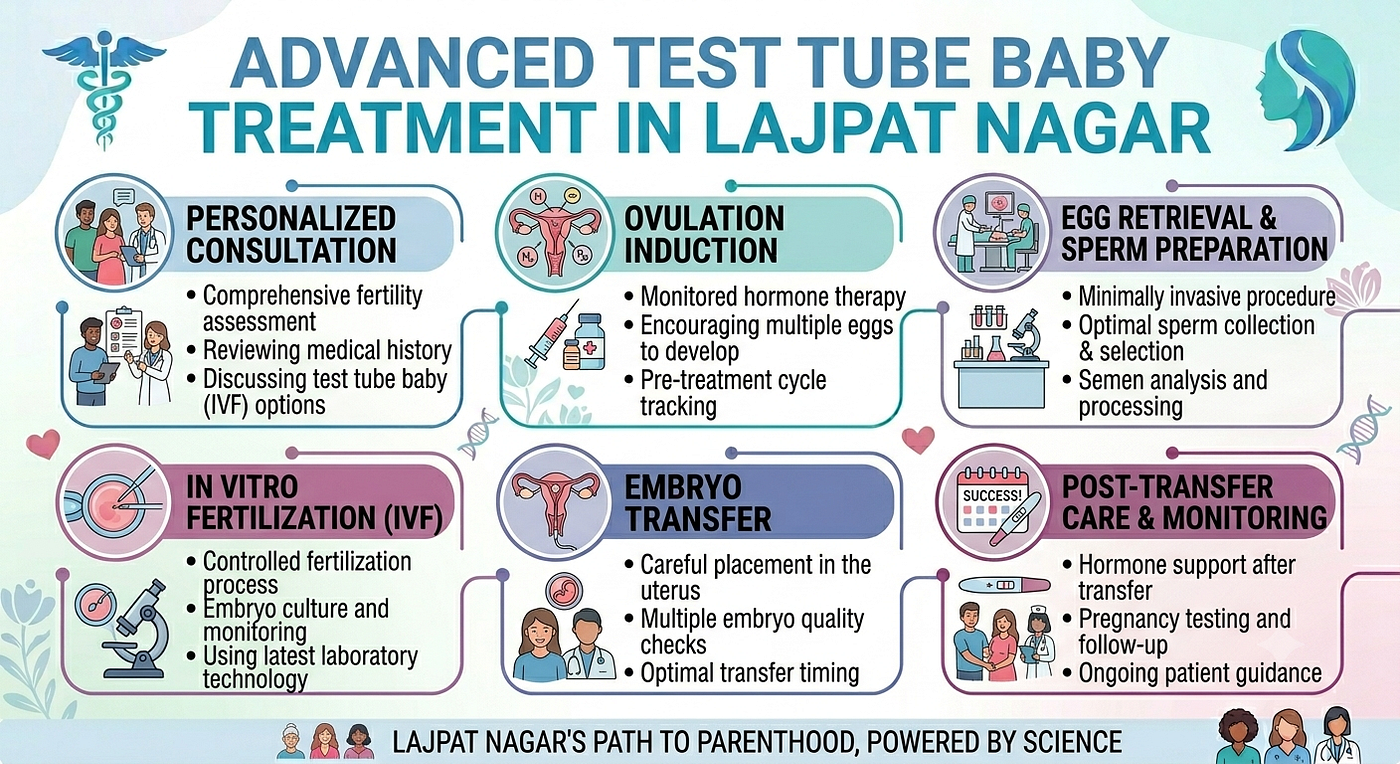
First, an initial consultation. Your doctor reviews your history, orders blood tests, does an ultrasound, and checks a semen analysis. This creates a plan tailored to you.
Next, ovarian stimulation. For about eight to twelve days, you give yourself daily hormone injections. These encourage your ovaries to produce multiple eggs. You will have frequent ultrasounds and blood tests to monitor your response. The needles are very fine. Most women say they are not as bad as they feared.
Then, egg retrieval. This is a minor procedure under light sedation. You will be asleep or very drowsy. A thin needle passes through the vagina into each ovary to collect the eggs. It takes about 15 to 20 minutes. You go home the same day.
After that, fertilisation. In the lab, your eggs are combined with your partner’s sperm. If male factor is an issue, the embryologist may perform ICSI injecting a single sperm into each mature egg.
Next, embryo development. The fertilised eggs are monitored for three to six days. The embryologist looks for healthy, growing embryos. Extra embryos can be frozen for future cycles.
Then, embryo transfer. This is simple and painless — like a Pap smear. A thin, soft catheter passes through your cervix, and the embryo is placed into your uterus. No sedation needed. It takes five minutes.
Finally, the two‑week wait. You wait about 14 days, then take a pregnancy test to see if the embryo implanted.
Success Rates: What You Can Realistically Expect
I want to be honest. IVF does not guarantee a baby. Success rates depend heavily on the woman’s age, the cause of infertility, and the quality of the lab and embryologist.
For women under 35, a single IVF cycle has a success rate of roughly 50 to 60 per cent. For women aged 35 to 37, it drops to about 40 to 50 per cent. For ages 38 to 40, it is around 30 to 40 per cent. Over 40, it is 15 to 25 per cent per cycle.
These are averages. Your personal chances depend on your situation. A good doctor will never promise a baby, but they will give you realistic expectations.
What IVF Costs in Lajpat Nagar
Money matters. A standard IVF cycle in Lajpat Nagar typically costs between ₹1,00,000 and ₹1,80,000. This usually includes consultations, blood tests, ultrasounds, egg retrieval, lab work, and the embryo transfer. Medications add another ₹30,000 to ₹70,000. If you need ICSI, add ₹20,000 to ₹40,000. Freezing and storing extra embryos costs extra.
Do not choose a clinic based only on price. The cheapest option is not always the best. Embryology quality is the single biggest predictor of success. Ask who runs the lab. Ask about their experience. Ask about live birth rates, not just pregnancy rates.
What to Look for in a Fertility Clinic
Not all clinics are the same. Look for transparency — clear pricing upfront, including medication costs. Openly shared success rates. If they refuse or give vague answers, walk away.
Embryology expertise matters as much as the doctor. Ask about qualifications, experience, and how many cycles they do per year. High volume usually means better outcomes.
Comprehensive care matters too. Good clinics offer counselling, nutrition advice, and emotional support. IVF is hard on your mind, not just your body. You deserve support for both.
If you are considering **IVF Treatment in lajpat nagar**, look for centres that offer everything under one roof — diagnostics, lab, retrieval, transfer, and freezing. Running between locations adds stress you do not need.
When to Consider Donor Eggs or Sperm
Sometimes, your own eggs or your partner’s sperm are not likely to lead to a successful pregnancy. Poor egg quality, very low ovarian reserve, or severe male factor are reasons to consider donors. It is a hard decision, but for many couples, it is the path to parenthood.
Donor programmes in Lajpat Nagar are well‑regulated. Donors are screened for infections and genetic conditions. You can often choose based on physical characteristics, blood group, and education.
Final Thoughts
Choosing IVF is not admitting defeat. It is using the tools that modern science has put within your reach. Lajpat Nagar has become a hub for advanced fertility care because it offers skilled specialists, modern labs, and accessible costs.
If you are searching for **Infertility Treatment in Lajpat Nagar New Delhi**, take the first step. Do your research. Ask questions. Visit a few clinics. Do not lose hope. Fertility medicine has come further than most people realise. Your story may be closer to its happy ending than you think. You just need to take that first step.
메타데이터
- post_id
- 53cc7cf5bf2c
- slug
- advanced-test-tube-baby-treatment-for-couples-in-lajpat-nagar-53cc7cf5bf2c
- url
- https://medium.com/@dramritaseo/advanced-test-tube-baby-treatment-for-couples-in-lajpat-nagar-53cc7cf5bf2c
- canonical_url
- https://medium.com/@dramritaseo/advanced-test-tube-baby-treatment-for-couples-in-lajpat-nagar-53cc7cf5bf2c
- author_url
- https://medium.com/@dramritaseo
- status
- ok
- fetched_at
- 2026-06-22 19:40:15