A Practical Guide to Selecting SMT Pogo Pins for Your Surface Mount Application
Modern electronic devices are becoming smaller, smarter, and more powerful. As PCB designs become increasingly compact, engineers need…
A Practical Guide to Selecting SMT Pogo Pins for Your Surface Mount Application
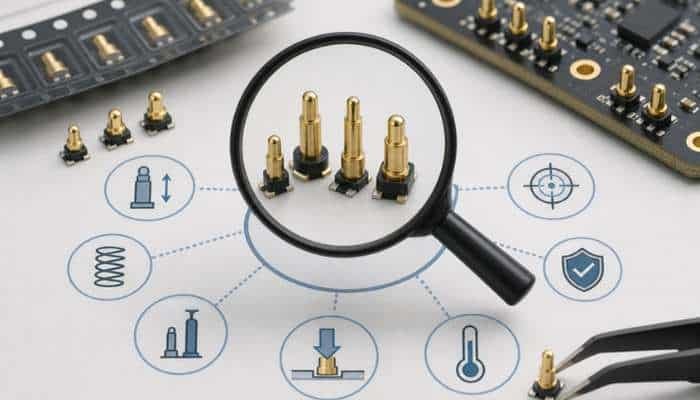
Modern electronic devices are becoming smaller, smarter, and more powerful. As PCB designs become increasingly compact, engineers need reliable connection solutions that can deliver consistent performance while saving valuable board space. A Practical Guide to Selecting SMT Pogo Pins for Your Surface Mount Application explains the key factors engineers should consider when choosing spring-loaded connectors for modern electronic designs.
SMT pogo pins have become an essential component in applications where reliable electrical contact, compact design, and repeated connection cycles are required. From wearable devices and charging systems to industrial electronics and testing equipment, these connectors provide a flexible alternative to traditional plugs and sockets.
What Are SMT Pogo Pins?
SMT pogo pins are surface-mounted spring connectors that attach directly to PCB pads using standard reflow soldering processes. They contain a spring mechanism that allows the pin to compress and maintain consistent contact pressure between two surfaces.
Unlike conventional connectors, pogo pins do not require a physical locking mechanism. Their spring-loaded design allows them to handle slight alignment variations while maintaining stable electrical connections.
This makes them ideal for products where space, reliability, and durability are critical.
Common Applications of SMT Pogo Pins
Before selecting a pogo pin, engineers must understand the specific application requirements. Different uses require different electrical and mechanical characteristics.
Charging Interfaces
Many compact devices use SMT pogo pins for charging connections. Wireless earbuds, smartwatches, fitness trackers, and medical wearables rely on these connectors because they provide a small and reliable charging interface without requiring bulky ports.
Board-to-Board Connections
In compact electronic systems, multiple PCBs often need to communicate inside a sealed enclosure. SMT pogo pins provide a reliable connection while allowing small differences in alignment caused by manufacturing tolerances.
Testing and Programming
Manufacturers also use pogo pins in production testing and programming fixtures. They allow temporary electrical connections for testing, firmware updates, and quality checks without adding permanent connectors to the final product.
Important Factors When Selecting SMT Pogo Pins
Choosing the correct pogo pin requires careful evaluation of electrical, mechanical, and environmental factors.
1. Current Rating and Electrical Performance
Current capacity is one of the most important specifications. Signal-based applications usually require lower current ratings, while power and charging applications need pogo pins designed to handle higher loads.
Engineers should also consider contact resistance. Lower resistance helps reduce heat generation, improves signal stability, and ensures efficient electrical performance.
2. Size and PCB Compatibility
The physical dimensions of the pogo pin must match the available PCB space.
Smaller pogo pins are useful for compact electronics because they require less board area. However, larger pins typically provide stronger mechanical performance and higher current capacity.
Working travel is another important measurement. The pin must maintain contact throughout the full movement range without becoming fully compressed or losing spring pressure.
3. Spring Force and Durability
Spring force determines how well the pogo pin maintains contact during operation. A properly selected spring force helps prevent connection failures caused by vibration, movement, and temperature changes.
Too little force can cause unstable connections, while excessive force may damage PCB contact pads or create unnecessary mechanical stress.
Engineers should choose a spring force that balances reliable contact with long-term component durability.
4. Plating and Material Quality
The plating material directly affects conductivity, corrosion resistance, and product lifespan.
Gold plating is widely used in electronic applications because it provides excellent conductivity and prevents oxidation. For applications involving frequent connection cycles, thicker gold plating can improve wear resistance.
A nickel layer beneath the gold coating is also commonly used to improve durability and prevent material migration.
Selecting the Right SMT Pogo Pin Supplier
Supplier quality plays an important role in the reliability of the final product. A trusted manufacturer should provide consistent dimensions, accurate specifications, and quality testing.
Before moving into mass production, engineers should test samples to evaluate:
- Contact resistance
- Spring performance
- Mechanical durability
- Soldering compatibility
- Long-term reliability
Working with a supplier that offers customization options can also help when standard pogo pin designs do not meet specific product requirements.
Benefits of Using SMT Pogo Pins
SMT pogo pins offer several advantages for modern electronic products:
- Compact design for space-limited PCBs
- Reliable electrical contact
- Easy integration with automated assembly
- High durability for repeated connections
- Flexible solutions for custom applications
These benefits make them suitable for industries such as consumer electronics, medical technology, automotive systems, and IoT devices.
Final Thoughts
Selecting the right connector requires more than choosing a standard component from a catalog. Engineers must evaluate current requirements, dimensions, spring force, plating, and application conditions.
By following A Practical Guide to Selecting SMT Pogo Pins for Your Surface Mount Application, designers can make informed decisions that improve reliability, reduce manufacturing issues, and create better-performing electronic products.
Whether used in charging systems, testing equipment, or compact consumer devices, SMT pogo pins continue to play an important role in the future of surface mount technology. Understanding the selection process ensures that every connection remains efficient, durable, and dependable.
Originally Published By TYCOONSTORY MEDIA
메타데이터
- post_id
- 53d4c005fa1d
- slug
- a-practical-guide-to-selecting-smt-pogo-pins-for-your-surface-mount-application-53d4c005fa1d
- url
- https://medium.com/@shaikhanifamuskan/a-practical-guide-to-selecting-smt-pogo-pins-for-your-surface-mount-application-53d4c005fa1d
- canonical_url
- https://medium.com/@shaikhanifamuskan/a-practical-guide-to-selecting-smt-pogo-pins-for-your-surface-mount-application-53d4c005fa1d
- author_url
- https://medium.com/@shaikhanifamuskan
- status
- ok
- fetched_at
- 2026-07-20 14:02:25