Dive to Stretch the value of a mini-dive for ground effect
“Most airplanes in ground effect rarely produce lift-drag ratios lower than 3 or 4. If the lift of the airplane were equal to the weight…
Dive to Stretch the value of a mini-dive for ground effect
“Most airplanes in ground effect rarely produce lift-drag ratios lower than 3 or 4. If the lift of the airplane were equal to the weight, an L/D = 4 would produce a deceleration of 1/4 g, 8 ft. per sec2.” — H.H. Hurt Aerodynamics for Naval Aviators
Your GA airplane is already likely better than 3 or 4. Ground effect only improves this number. Your in ground effect rates of deceleration will be less.
Recently I put two pieces out looking at total mechanical energy of a fixed wing aircraft while looking at the idea of a ground effect acceleration creating a maneuver reserve and using this to zoom in order to climb higher than best angle of climb Vx. While such is certainly a valid technique, it also is more prone to error as it isn’t as simple as a Vx climb transitioning to best rate Vy when able. It is definitely not the test standard. However, in these pieces I made the recommendation to know about it as it may help with the abnormalities of an early liftoff or with a late rejected landing. Being able to discuss it should also show reasonable knowledge in an oral portion of exam.
https://medium.com/@jamesmcclaranallen/zoom-reserve-is-it-worth-it-6c16b7ecc6eb
With these, it seems ground effect generally helps us gain energy so as to get up and away. But this isn’t the only way ground effect could help. We could also dive to some extent to stretch a glide.
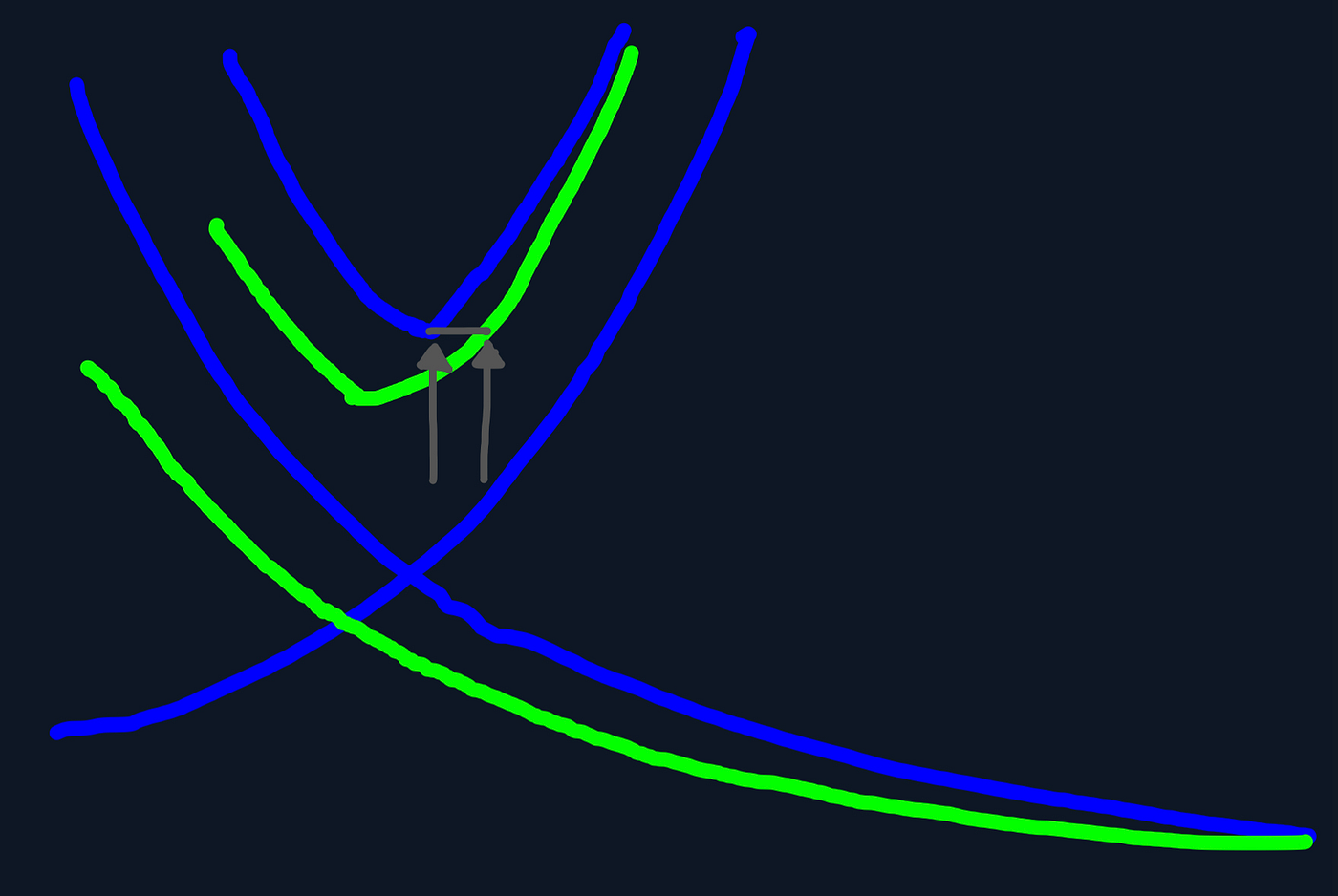
Consider that in ground effect we reduce our induced drag. But we still have full parasitic. We may even have a slight increase in parasitic due to interference drag of our craft and the surface being in close proximity. This means we have savings opportunity when induced drag would be dominant but such is limited by the parasitic toward the fast end of things. We could dive into ground effect to reduce our bleed rate but only to the extent at which we don’t increase our bleed rate even more.
Notice that as the induced drag reduces while generally the parasitic curve remains the same, our intersection of induced and parasitic shifts down and left. In fact our total curve also shifts down and left though there is a bit of a stretch quality to it pulling from the in ground effect L/Dmax.

https://www.faa.gov/sites/faa.gov/files/07_phak_ch5_0.pdf
If we assume a normal glide, we aren’t in ground effect during the glide. We’re only in ground effect during the round out and flare. And in this we’re only really into it in the flare. This means we can take our minimum drag out of ground effect and cut horizontally across until we reach the same value of drag going rightward upon the in ground effect drag curve.

Were we to also go left horizontally, we could find the area of energy not bled in ground effect that we lose by gliding out of ground effect. But I don’t math, so I reduce to simplifications. I think we’re ok with this as really all we need is a good starting notion from which we can go out and experiment iteratively. A more robust mathematical solution here isn’t going to get you much better in this sense. There are other factors we have to consider.
How much energy will we lose in an increased angles of load in the round out and flare? Will our round out and flare be at a higher g? How much will our temporarily reduced load in bunting into dive compensate for this increased round out and flare loading? How much does the increased down pitch of the dive reduce lift demand reducing induced drag? What about parasitic drag rise prior to ground effect? While we increase our float in ground effect, how much of this do we lose for sake of aiming shorter? Do terrain and obstacles even permit aiming shorter? In these we would have more math taking into account the rate and radius equations typically used in turn discussions, though we need to adapt values for Earth’s g. And we need to look at the energy differences, subtract the integrals of the two curves above. I’m not doing that. I’ve long since forgotten how to do this sort of thing. Besides, technique is going to make all of these vary and this variance will be away from the math.
Instead, I’m going to make a simple approximation to find targets for experimenting. Let’s consider L/Dmax, aka minimum drag, while out of ground effect as two units of drag. One for the induced and one for the parasitic. I don’t know the value of these units, I don’t particularly care. What I do know is that at minimum drag, induced and parasite are equal to each other. Now all I need do is find roughly where the in ground effect curve equals two units while on its fast side. This becomes my initial target speed for a mini dive. If in ground effect, any flying speed less than this speed bleeds less energy than optimum dive. This means I have more energy to go further than optimum dive. But this needs to be balanced with the costs seen in the questions above. At L/Dmax Di = Dp while Dp is proportional to V^2 and Di to 1/V^2. For our purposes, we’ll treat proportional as equal to. Then we can get ratios to apply to best glide speed for target speed.
With these we do need to know how much energy bleed reduction we gain by getting into ground effect. H.H. Hurt in Aerodynamics for Naval Aviators shows us

As the question as to the value of diving for ground effect as posed to me by a person flying Warriors, we’re going to look at the case of a PA-28.
Yes, I am copying and pasting much of this article from texts and emails back and forth. Other bits are adapted from these. If there are moments when the discussion gets choppy, it is because I’m lazy and not bothering with editing and rewrites as choppy or not, the discussion is functional.
https://www.youtube.com/@FalconImagery
With the Warrior, we figure the wings sit ~ 2.5 ft off the ground while parked. And we can fly it down to two to three feet off the ground for our ground effect run. Wingspan is thirty-five feet so we’re looking at about a ninth of a span is our in ground effect. So, we’re looking at roughly a forty-five percent reduction in induced drag making twenty-two and a half percent off the total drag while at the out of ground effect best glide speed by being in ground effect.
Out of ground effect we have 2 units = Dp + Di = VOGE^2 + 1/VOGE^2
In ground effect, we shift down to the other total drag curve seeking the faster point where the curve is the same 2 units.
2 = VIGE^2 + (1-.45)/VIGE^2
dropping “IGE” to make my typing easier
V^4–2V^2 + .55 = 0
into the solver
V multipliers = (0.574, 1.293)
1.293 * 73 kts PA-28 best glide = 94 kts target
Shooting for 94 kts in a dive for ground effect isn’t pilot friendly. We know we’ll be gliding at 73 kts but it would be much easier to have a height reference from which to dive in seeking 94 kts. We know we won’t be exact in this either, but we can figure the height equivalent energy of the 94 kts or 21 kts excess. Such would give us a good starting altitude tripwire to which we could add more height in subsequent runs for losses in the trade and for technique inhibiting complete trades. We also know that while not optimized, any dive below this threshold bleeds less energy than best glide hence is winning.
Es = h + V^2/2g
We’re striving to kill all h, so
Es = V^2/2g which means height equivalent
H = V^2/2g
H94 = (94 * 6076 ft/nm / 3600 sec/hr)^2 / 2 (32.2 fps)
H94 = 391 ft
Similarly, H73 = 236 ft
We should start our dive 391–236 = 155 feet above landing.
How would we test? Choose a long runway for testing. Don’t aim at the arrival end initially. Make your initial aimpoint sufficiently far down the runway to accommodate the shifts shorter. Have enough runway to accommodate floats. Do multiple runs alternating between L/Dmax all the way to round out and flare and with mini-dive comparing touchdown points; do note winds each run as well as weight changes if significant, height of dive initiation, speed actually obtained in dive, and shift of aimpoint.
Testing needs to also test points between to account for un-calculated losses, and needs to test speeds faster to verify that while they may float longer, the shortened aimpoints in their respective dives make for shorter actual touchdown points. We need to test both sides of the target, not just the target.
For the PA-28, we need to reference target heights above landing to which we think a mini-dive will give us targeted speeds and these speeds to test need to include 80, 85, 94, 95, 100, 105. Correlating heights are

After we get the results of these we can pick additional points either expanding the test range or tightening to more precise height-speed pairs. Note we need to vary the order of points and refuel often so as to keep consistent weight such that lower weight doesn’t skew L/Dmax slower. We also want to avoid windy conditions and temperature shifts, hence early morning is a better time to test. Ideally we do these at maximum gross weight and forward cg, but as packing the plane to such can be a pain, we can instead adjust test speeds from target speeds. Use the rule of thumb from the target speeds of minus a knot for every hundred pounds below max gross weight. Or, as we’re planning the points while still on the ground, use the same calculations we would use to adjust Va maneuvering speed for lighter weights applied to the test speeds.

https://safepilots.org/documents/SAIB_Maneuvering_Speed.pdf
or
Vtest = Vtarget * SQRT (Wtest / max gross weight)
You should calculate new heights pairing for any slower test speeds due to being lighter. Having said that, I wouldn’t bother. Use the original target trips heights. Round them to the nearest ten. You’re going to iterate anyway. Take good notes and select subsequent runs based on and around best outcome in terms of furthest forward touchdown point as compared to the straight glide down to round out and flare.
The goal is to eventually have one height-speed pair so as to know at what height above landing a mini-dive for ground effect becomes beneficial. Such becomes a trip wire that if you’re looking like you’re going to land short, you know to dive to stretch.
Should you need to apply this idea in extremis, consider configuration. Gear, leave it up and belly it in. Don’t add the parasitic drag and don’t add the down pitch moment. Flaps. Generally leave them up. But as you get in close, you’re floating, but you’re running out of steam, go ahead and throw them down. They may give you easier lift increase than can your elevator. Yes, generally such hurts your glide but it helps first. Take the help in the last second as you’ll be on the ground before the hurt of this particular bill comes due. And your touchdown speed will have less kinetic energy with which to deal, less kinetic to potentially flip you over.

— — — — — — — — — — — —
An aside, I don’t actually like the claims that Va gets slower as you get lighter. Such is only conditionally true. Your Va gets slower as you get lighter when something other than your lifting structure is your critical factor. The heavier you are the more likely your lift structure is the critical piece. Accelerations don’t break things, forces do. But I understand why the FAA writes this topic as they do. They need to write broadly to all and they don’t know your specifics. Therefore they assume something other than the lifting structure be critical, but they fail to tell you they’re making this presumption. It is a reasonable one though it makes the circular read a little silly as they treat accelerations as forces.
— — — — — — — — — — — —
Who benefits the most for a mini-dive into ground effect? Those with long wings, those with wings that sit low on the frame, those with slick profiles hence less parasitic drag, those with slower L/Dmax. What does more facial area, being less slick, do to L/Dmax? Shifts it up and left.
You’d think low aspect ratio high wing loading craft like fighters would do well for ground effect as they have large induced drag numbers, but their wings are short and stubby hence why they get low aspect so while they have large numbers for which percentages would be good reductions, they can’t get down deep into ground effect. While these sorts of jets do tend to float pretty far on a round out and flare, this is because their approach speeds are so high. Consider these are the sorts of jets which can use aero braking as better than wheel brake braking; aero braking is induced drag at the lowest most deep into ground effect these jets can get. High aspect ratio low wing loaded gliders, however, get really deep into ground effect while they have little by way of parasitic drag hence they have very little total drag in the flare.
But ground effect vehicles tend to have shorter wings? Yes, and these are generally placed low so as to get into more ground effect depth relative to span while they have a competing interest of not actually being able to fly out of ground effect. Such is a bit like taking a Viper, moving the wings down on the fuselage, and severely reducing the thrust so as to not be able to go faster than 120 mph. May want to make that propulsion propeller too so as to have quicker response and to be able to use the propeller as a brake.
Why would slower L/Dmax be beneficial? Es lines on the fast end are more vertical meaning you need more altitude to trade per knot gained. Then those large knots bleed quickly as parasitic is high as velocity is high. On the low end of Es, little altitude is traded per knot gained.

on the slow end, you gain many more knots for the cost of little height — https://www.faa.gov/sites/faa.gov/files/regulations_policies/handbooks_manuals/aviation/airplane_handbook/05_afh_ch4.pdf
— — — — — — — — — — — —
Imagine a glider, typically pretty slick, with a fifty feet wingspan able to fly with the wings a foot off the ground. Best glide out of ground effect might be fifty mph. Let’s dive from just out of ground effect just a little above a wingspan high.
Es = h + V^2/2g
Es = 60 ft + (50 mph)^2 / 2 (32.2 fps^2)
Es = 60 ft + (50 mph * 5280 ft/mi / 3600 s/h)^2 / 64.4 fps^2
Es = 60 ft + (73.3 fps)^2 / 64.4 fps^2
Es = 60 ft + 83.5 ft = 143.5 ft
143.5 ft = 1 ft + V^2 / 64.4 fps^2
142.5 ft * 64.4 fps^2 = V^2
Sqrt(9177 f^2ps^2) = V = 95.8 fps = 65 mph
So the ideal craft for the mini-dive into ground effect gained fifteen mph doing so with a higher just above ground effect dive in entry altitude. I buy this in a glider as the glider gets much further into ground effect. It looks worth it to me. I am surprised by how much. I have dove at about a wingspan above in the past, just didn’t realize how much it can give. Probably because I get toward where I want and go full spoiler so never really see the extent of the float I was buying.
— — — — — — — — — — — —
There are other glide considerations that, funny enough, gliders can teach us. Powered planes don’t investigate glide sufficiently and many powered pilots have significant gaps in what constitutes optimum. We should look at these, but first, we should also recognize George Patton, “A good plan violently executed now is better than a perfect plan executed next week.”
Why do I bring this up? Academically understanding optimum gliding can help us but practically, we’re better off with good enough. Do and accept what we get rather than delay while trying to optimize. After initial doings, as we think about tweaks, we can make tweaks toward optimum if needed though typically if we do large order of magnitude movements first, we won’t need to optimize. Instead we may find ourselves needing forward slips possibly S-turns to bleed energy. In all this, I do recommend aiming beyond the beginning of the runway or opening of the field so as to have margin if short of energy. If the field be short, lose the excess as you get close shifting the aim to the edge only after you’re sure you have enough. Personally I want to have to forward slip a bit. Strive to not need the tools of this article. If you’re using this article, you didn’t have enough margin.
Turns — when it comes to gliding turns, we don’t care about maximizing distance. In fact maximizing distance hurts our turning glide. What we care about is getting through the most angles of turn for the least altitude loss. Let straight away be the time for maximum distance. How do we optimize the turn? Two things, forty-five degrees angle of bank and minimum power required angle of attack. As minimum power required AOA is close to stall, the Fly Onspeed organization recommends using onspeed AOA in lieu of it. If you lack an AOA indicator, go no slower than 1.3 times your no flap stall speed. Without an AOA, this may actually be a good time to apply DMMS with 1.414 no flap stall. The loaded stall speed for forty-five degrees is just under 1.2 straight ahead stall speed.

Russell Holtz, Glider Pilot’s Handbook of Aeronautical Knowledge — https://www.ssa.org/product/glider-pilots-handbook-of-aeronautical-knowledge/
A word of warning. Most GA planes have glides on the order of 1.4 to 1.5 times no flap stall Vs. This is not true for all planes. Some have best glides significantly closer to no flap stall. Some are even gliding at speeds slower than an expected 1.3 Vs or anticipated no flap Vref. They get away with this as no flaps is not considered a normal landing configuration. This means you may be very close to stall limits at best glide and if you use constant airspeed turns, you may push into the limits. Check your best glide speed compared to no flap stall speed. Is it less than 1.3 times Vs? Less than 1.2 times? Less than 1.189 times? Watch out! If you have AOA, use AOA!! If you lack AOA, you either need to push your speed up or limit your bank angle. If you use constant AOA turns, you can maintain a constant best glide straight ahead L/Dmax AOA and let this be your margin. If you do so, you will see the speed naturally click up as you turn. To do these, don’t pull any longitudinal stick, just roll into the bank and let the trimmed setting do the turning. If you have AOA indication, you can switch between the optimum AOA conditions straight and turning. If you’re already low, don’t worry about optimizing, such becomes distracting.
L/Dmax AOA or best glide AOA is the best straight ahead you can do through an air mass. But we care about translating over the ground. We need to account for winds. To do this, we need to shift our origin right by the magnitude of the wind for headwinds and can shift left for tail winds before drawing our tangent to the power required curve or drag polar. Similarly we need to shift up for sinking air and can down for rising air. But the reference from which to shift is the horizontal to minimum sink or the value of the VVI at minimum sink. Push faster to get through headwinds and/or sink. Otherwise you won’t go as far over the ground.


— — — — — — — — — — — —
Here we can see several examples of gliders diving to stretch:
Mostly low scrub in this one, mostly not significant obstacles, long low wings much deeper into the effect, but note the tree to the left side and one to the right just before the airfield cutout:
https://www.youtube.com/watch?v=dsgrI74jJek
And another glider again much deeper into effect:
https://www.youtube.com/watch?v=xTUkwP4noGY
Watch out for glassy water: https://www.youtube.com/watch?v=s8xglwbRfW8
In the second video note he had to zoom in order to slow down. Typically more a back side of drag curve concern, back of power required curve for propeller aircraft with functioning engines, you need to push to extend range and pulling pulls you up short. The reason is induced drag. Here, in ground effect, while not on the back side, the reason is still induced drag. In the first video, while most the scrub is low, note there was a tree that went by the left side. The dive to ground effect to stretch can be useful, but perhaps better to aim long so as to have the margin to simply accept landing short of target as you’ve ensured an area exists to do so. Note the transition point front side to back side shifts left in ground effect. There is not much of a back side in ground effect. On the ground starting at zero, you add power to go faster not to enable being slower.
These stories put three thoughts to use: faster into headwind gets you further, getting lower likely reduces wind intensity, ground effect gets you further due to slower energy depletion but he definitely was flirting with obstacles — https://airfactsjournal.com/2021/11/dont-stretch-the-glide-easier-said-than-done/
— — — — — — — — — — — —
Note: this is different than Langeweische’s dive to stretch as his is predicated on flying a glide speed slower than best glide so as to have the option to push to stretch. This means Langeweische is deliberately targeting less than maximum. If you have the energy for it, it is a good idea so as to have margins in both directions. It is also different than pushing into a headwind. Yes, optimum glide into the wind needs to be faster than L/Dmax AOA. With such you shift forward from the origin by the wind speed then draw your tangent to the drag polar from there.
“There is no particular reason to glide an airplane at its most efficient airspeed — the flatness of the glide is a liability, not an asset. Some extremely clean airplanes have so shallow a ‘normal’ glide that an approach in that condition is just about impossible to judge and may be actually dangerous because the ship would have to be brought close across obstructions in the vicinity of the airport. But the most important advantage of the slower approach glide is that it gives you a chance to stretch the glide. Consider: you have an airplane whose ‘normal’ most efficient glide, resulting in shallowest path of descent, is 75 mph. You fly that airplane at 65 mph. Any time then that you are afraid of undershooting, you merely need to drop your nose and inch or two, and the airplane will presently become more efficient and its descent shallow out. That’s why it is true that in practice you can stretch your glide. That’s why one can put it as a rule — one of the most important rules in flying — that in a glide, if you want to get down more steeply you must point your nose down less steeply. And if you want to get down less steeply you must point your nose down more steeply. In practice, it goes against one’s grain to push the stick forward when one is too low anyway. The student may find it a little easier if he remembers that our controls are wrongly labeled. The ‘elevator’ is not the airplane’s up-and-down control, but its Angle of Attack control, or, if you will, its speed control. Thus the apparent nonsense of getting the stick forward in order to shallow out one’s descent turns out to be pretty good sense: you simply put your speed control in the (imaginary) notch that will result in the most efficient gliding speed… there is no other means of stretching a glide.” — Stick and Rudder, Wolfgang Langewiesche

https://www.goodreads.com/en/book/show/680115.Stick_and_Rudder
Note: Clmax in ground effect suggests it might be easier to stall in ground effect. This is a false and misleading indication. It is harder to reach this lower AOA and indeed some craft cannot reach it in ground effect. Three concepts are at play here. The first is that the aerodynamic center shifts aft the further into ground effect that we go. The typical ac out of ground effect is about a quarter chord line aft of the leading edge. Fully in ground effect it is about a half chord. This means the wing’s nose down moment arm is longer stronger hence as you get into ground effect, your plane tends to reduce its AOA and its trim position shifts to a lower faster position. In this, yes, your empennage is also in ground effect, but as it is of smaller length, it is much less in ground effect. Its moment arm does not gain the comparable strength increase. While increasing AOA becomes harder as if your cg had shifted forward, feels like your nose got heavier, you also have an increase in vertical component of lift hence need less total lift. You do in fact gain a cushion of air in ground effect. That isn’t merely a feel and we are wrong to dismiss such. Granted this is more a replacement of a lumpy old out of ground effect cushion with a new more evenly distributed in ground effect cushion not simply an addition of a cushion. But you do gain it. (In this we can also see how we get a little bit of interference drag adding to parasite drag.) Together these things make it hard to get to Clmax and stall. Further, as the relative wind cannot come from an angle below you once set in ground effect, some craft simply don’t have means to sufficiently pitch up so as to reach Clmax. Their tails would hit the ground prior to reaching Clmax. Established in ground effect, pitch is AOA. Consider not all “conventional” (tail dragger) craft land stalled in the point attitude. This inability to stall for some and harder to reach stall for others while in ground effect carries consequence to us. We should refer again to Aerodynamics for Naval Aviators:
“Any given airplane will have some fixed angle of attack (and Cl) which produces the best takeoff performance and this angle of attack will not vary with weight, density altitude, or temperature. An excessive angle of attack produces additional induced drag and may have an undesirable effect on takeoff performance. Takeoff acceleration may be seriously reduced and a large increase in takeoff distance may occur. Also, the initial climb performance may be marginal at an excessively low airspeed. There are modern configurations of airplanes of very low aspect ratio (plus sweepback) which if over-rotated during a high altitude, high gross weight takeoff-cannot fly out of ground effect. With the more conventional airplane configuration, an excess angle of attack produces a well defined stall. However, the modern airplane configuration at an excessive angle of attack has no sharply defined stall but develops an excessive amount of induced drag.”
“a deficiency of airspeed at takeoff may permit the airplane to become airborne but be incapable of flying out of ground effect.”
“Due to the reduced drag in ground effect the airplane may seem capable of takeoff below the recommended speed. However, as the airplane rises out of ground effect with a deficiency of speed, the greater induced drag may produce marginal initial climb performance. In the extreme conditions such as high gross weight, high density altitude, and high temperature, a deficiency of airspeed at takeoff may permit the airplane to become airborne but be incapable of flying out of ground effect. In this case, the airplane may become airborne initially with a deficiency of speed, but later settle back to the runway. It is imperative that no attempt be made to force the airplane to become airborne with a deficiency of speed; the recommended takeoff speed is necessary to provide adequate initial climb performance. In fact, ground effect can be used to advantage if no obstacles exist by using the reduced drag to improve initial acceleration.”
“the airplane leaving ground effect encounters just the reverse of the airplane entering ground effect, i.e., the airplane leaving ground effect will (1) require an increase in angle of attack to maintain the same lift coefficient, (2) experience an increase in induced drag and thrust required, (3) experience a decrease in stability and a nose-up change in moment, and (4) usually a reduction in static source pressure and increase in indicated airspeed.”
— — — —

https://dn790003.ca.archive.org/0/items/DTIC_ADA361836/DTIC_ADA361836_text.pdf

https://dn790003.ca.archive.org/0/items/DTIC_ADA361836/DTIC_ADA361836_text.pdf
“Ground effect alters the pitching moment generated by a wing. The altered flow about the wing moves the aerodynamic centre of the wing and therefore the pitching moment generated by the wing. The effect is the result of the pressure distribution changes over the lower surface of the wing. The ram pressure in extreme ground effect causes a near uniform pressure distribution over the under surface of the wing, while not significantly altering the upper surface pressure distribution.
“Wings generally create a nose down pitching moment in cruise flight. Ground effect causes an increase in this moment, resulting in a greater stabilising force being required to balance the pitching moment. To remain stable, a craft in ground effect will generally require a larger tailplane or canard. This larger surface creates greater drag and therefore reduces the efficiency of the craft as a whole. It also creates structural and weight penalties that reduce the efficiency of the craft.
“An additional complication of pitching moment in ground effect is that the pitching moment changes with height above the boundary. In freestream flight, the aerodynamic centre is generally considered to be approximately one quarter of the chord back from the leading edge. Flight in extreme ground effect may move the aerodynamic centre to the half chord position. This movement of the aerodynamic centre with the height of the wing above the boundary may cause considerable configuration design difficulties. In addition, the need to be able to control the craft over a large pitching moment range increases the drag, structural and weight penalties discussed earlier.” — Wing in Ground Effect Craft Review, Michael Halloran and Sean O’Meara, Contract Report CR-9802, Royal Melbourne Institute of Technology https://dn790003.ca.archive.org/0/items/DTIC_ADA361836/DTIC_ADA361836_text.pdf
While they got their figures flip-flopped in terms of labels IGE OGE, the Helicopter Flying Handbook gives us a good view to in ground effect vs out of ground effect lift vector orientation, IGE more up less aft less induced drag less total lift demand. Such applies equally well to fixed wings.
“In Ground Effect (IGE) Ground effect is the increased efficiency of the rotor disk caused by interference of the airflow when near the ground. The air pressure or density is increased, which acts to decrease the downward velocity of air. Ground effect permits relative wind to be more horizontal, lift vector to be more vertical, and induced drag to be reduced. These conditions allow the rotor disk to be more efficient. Maximum ground effect is achieved when hovering over smooth hard surfaces. When hovering over surfaces as tall grass, trees, bushes, rough terrain, and water, maximum ground effect is reduced. Rotor efficiency is increased by ground effect to a height of about one rotor diameter (measured from the ground to the rotor disk) for most helicopters. Since the induced flow velocities are decreased, the AOA is increased, which requires a reduced blade pitch angle and a reduction in induced drag. This reduces the power required to hover IGE.
“Out of Ground Effect (OGE) The benefit of placing the helicopter near the ground is lost above IGE altitude. Above this altitude, the power required to hover remains nearly constant, given similar conditions (such as wind). Induced flow velocity is increased, resulting in a decrease in AOA and a decrease in lift. Under the correct circumstances, this downward flow can become so localized that the helicopter and locally disturbed air will sink at alarming rates. This effect is called vortex ring state (formerly referenced as settling-with-power) … A higher blade pitch angle is required to maintain the same AOA as in IGE hover. The increased pitch angle also creates more drag. This increased pitch angle and drag requires more power to hover OGE than IGE.”


“A comment I recently read from an advocate that stick position equates AOA is that therefore your practiced stall stick position is the same for your stalled flared landing. First off, you don’t necessarily land stalled. So, no, even were such true, it would not be correct. Second, such isn’t true. Your aerodynamic center is typically about a quarter chord while out of ground effect. In ground effect it shifts aft reaching half chord once fully in ground effect. As the wing’s chord is longer than the horizontal stabilizer’s, the balance in moment arms has just changed. Additionally, downwash from the wing is reduced in ground effect and this changes the flow pattern at the empennage. Some planes can’t stall in ground effect. Rather instead they mush along unable to accelerated and unable to climb till they settle and crash, find terrain in front and crash, or fly off a cliff hence lose the ground effect then stall.”
https://medium.com/@jamesmcclaranallen/stick-position-does-not-indicate-aoa-853056b8fcd8
“To say a ‘conventional gear’ plane must have sitting angle near stall AOA to be designed well, however, is to misunderstand engineering. Design typically involves trades for what features to optimize. Vans appreciates more forward visibility, less drag from long main struts, and easier access to load and board the plane. Imagine how tall one would sit to have a near twenty degree sitting angle. Imagine also how difficult such would be to tie down and susceptible to winds while parked.”
— — — — — — — — — — — —
메타데이터
- post_id
- 53da07f6a1f6
- slug
- dive-to-stretch-the-value-of-a-mini-dive-for-ground-effect-53da07f6a1f6
- url
- https://medium.com/@jamesmcclaranallen/dive-to-stretch-the-value-of-a-mini-dive-for-ground-effect-53da07f6a1f6
- canonical_url
- https://medium.com/@jamesmcclaranallen/dive-to-stretch-the-value-of-a-mini-dive-for-ground-effect-53da07f6a1f6
- author_url
- https://medium.com/@jamesmcclaranallen
- status
- ok
- fetched_at
- 2026-06-16 19:09:56