The Body Keeps the Score: How Nervous System Healing Transforms Your Relationship Patterns
Learn to self-soothe by anchoring in your body. Nervous system regulation for anxious attachment and overthinking.
The Body Keeps the Score: How Nervous System Healing Transforms Your Relationship Patterns
Learn to self-soothe by anchoring in your body. Nervous system regulation for anxious attachment and overthinking.
The Body Keeps the Score: How Nervous System Healing Transforms Your Relationship Patterns
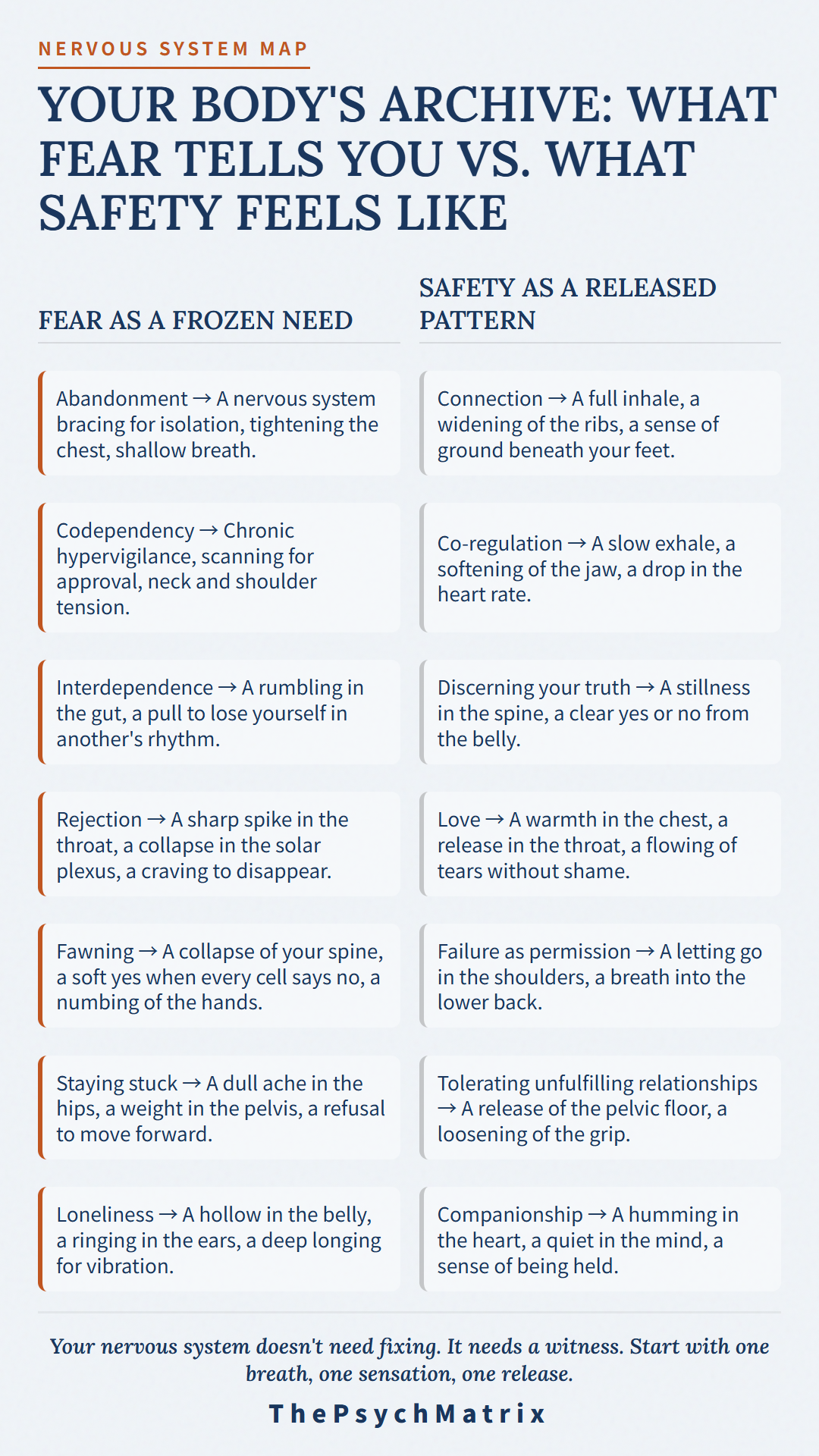
You may think your anxiety about a partner pulling away is just a thought pattern. But long before your mind crafts the narrative of abandonment, your body has already sounded the alarm. Your shoulders tighten, your stomach knots, your breath becomes shallow. This is your nervous system — specifically the sympathetic branch — activating a survival response to what it perceives as a threat to connection.
For those with anxious attachment, this response is often hyper-vigilant. Your body has learned that emotional distance equals danger, and it prepares you to fight for reassurance, flee into people-pleasing, or freeze into self-silencing. The problem is not your thoughts; it is your nervous system’s conditioned reaction. Healing attachment wounds requires a somatic approach — one that teaches your body, not just your mind, that you are safe.
Step One: Recognize the Somatic Signature of Activation
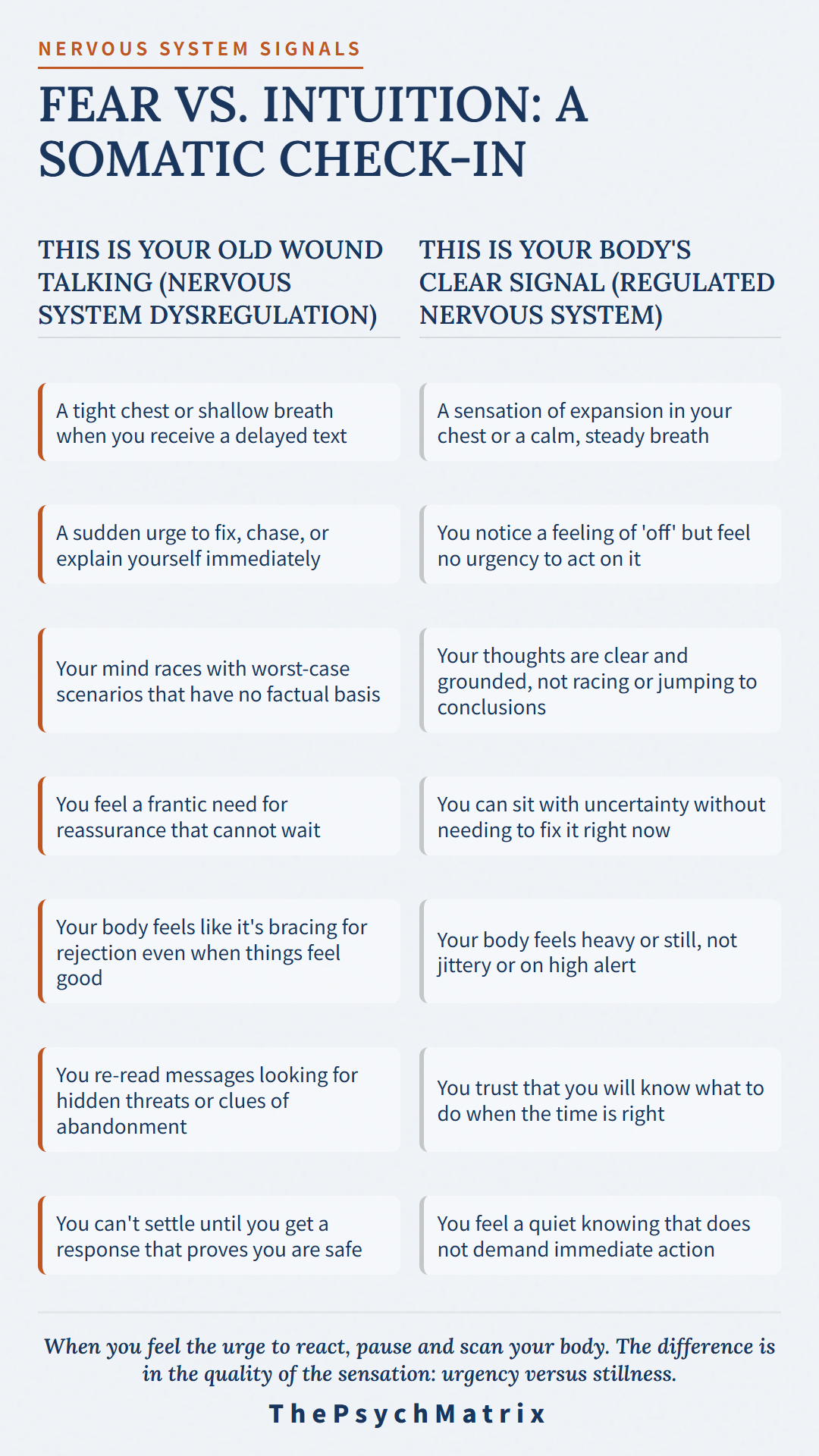
Before you can self-soothe, you must know what ‘unsafe’ feels like in your body. Common markers include: a racing heart, shallow chest breathing, tension in the jaw or shoulders, a hollow feeling in the stomach, or a sense of restlessness. When you notice these signals in response to your partner’s behavior, pause. Do not text, do not demand reassurance, do not abandon yourself by minimizing your feelings. Instead, name the sensation: ‘My chest is tight. I am in a stress response.’
Step Two: Use Grounding to Return to Ventral Vagal Safety
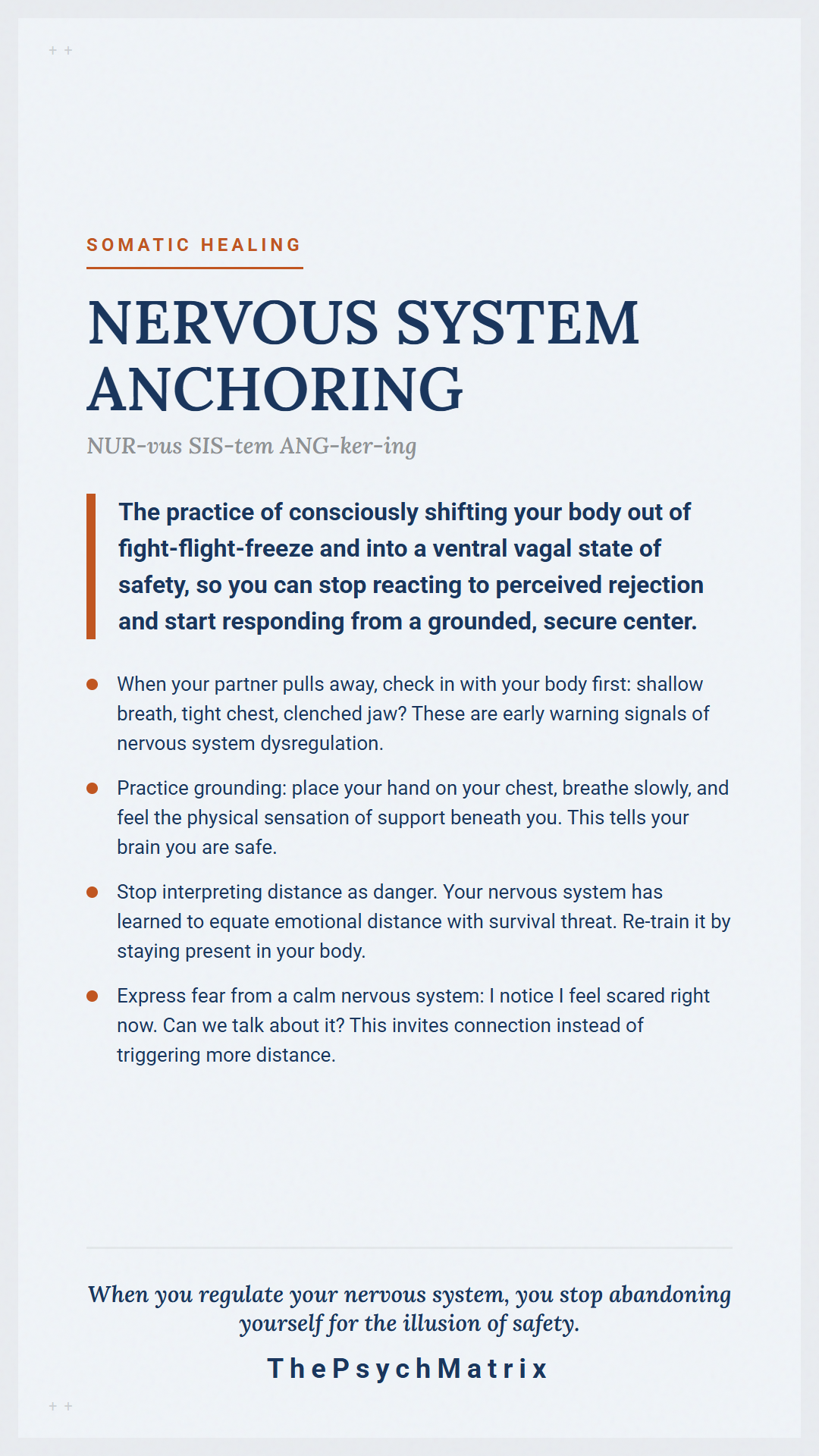
The ventral vagal complex is the branch of your parasympathetic nervous system responsible for social engagement and calm connection. To activate it, you need to send safety signals to your body. Place a hand over your heart and breathe slowly for six counts in, six counts out. Feel your feet on the floor. Look around the room and name three things you can see. This is not a distraction; it is a neural reset. You are teaching your nervous system that you can be present without fixing the external situation.
Step Three: Express from Regulation, Not Reactivity
Once your body has settled, you can communicate your needs without triggering further distance. Instead of a blame-laden accusation like ‘You always pull away,’ try a vulnerable, regulated statement: ‘I notice I feel scared when there’s space between us. Can we talk about what’s happening for you?’ This invites connection rather than demanding it. Your partner’s nervous system will pick up on your calm and be more likely to respond with openness rather than defensiveness.
Step Four: Practice Discernment Between Danger and Discomfort
Not every uncomfortable feeling is a sign of real threat. Your nervous system may be reacting to a pattern from childhood — a parent who was inconsistently available — rather than to the actual behavior of your partner. By staying in your body and noticing the difference between a trauma response and a present-moment reality, you begin to stop equating normal relational space with abandonment. Rejection, when it does occur, becomes a neutral misalignment of energies rather than a confirmation of your worst fears.
Step Five: Build a Somatic Practice Outside of Relationship Triggers
Nervous system regulation is not just for crisis moments. Daily practices like yoga, breathwork, cold exposure, or even a slow walk while noticing your surroundings can train your body to stay in a ventral vagal state. The more you practice, the more your baseline shifts from hyper-vigilance to calm. You stop abandoning yourself because your body knows it can handle discomfort without needing to cling, control, or collapse.
When you heal at the level of the nervous system, you no longer need to put partners on pedestals or equate the adrenaline of push-pull with love. You become a person who can feel fear and still stay present. You become someone who chooses emotionally available partners because your body no longer mistakes chaos for connection. This is not about thinking your way out of anxiety. It is about letting your body lead you back to safety.
💡 Ready to take the next step? Explore the worksheets and guided practices in the **Trauma Bond Recovery Kit** to start rewiring your nervous system today.
메타데이터
- post_id
- 53ed3a7cd9f2
- slug
- the-body-keeps-the-score-how-nervous-system-healing-transforms-your-relationship-patterns-53ed3a7cd9f2
- url
- https://medium.com/@haorucanghai432432/the-body-keeps-the-score-how-nervous-system-healing-transforms-your-relationship-patterns-53ed3a7cd9f2
- canonical_url
- https://medium.com/@haorucanghai432432/the-body-keeps-the-score-how-nervous-system-healing-transforms-your-relationship-patterns-53ed3a7cd9f2
- author_url
- https://medium.com/@haorucanghai432432
- status
- ok
- fetched_at
- 2026-06-25 07:00:49