Admin convenience is not the enemy. Unreviewed convenience is.
Admin shortcuts help under pressure, but shared accounts, MFA exceptions and SSH keys need owners, expiry, regular review and evidence.
Admin convenience is not the enemy. Unreviewed convenience is.
Admin shortcuts help under pressure, but shared accounts, MFA exceptions and SSH keys need owners, expiry, regular review and evidence.
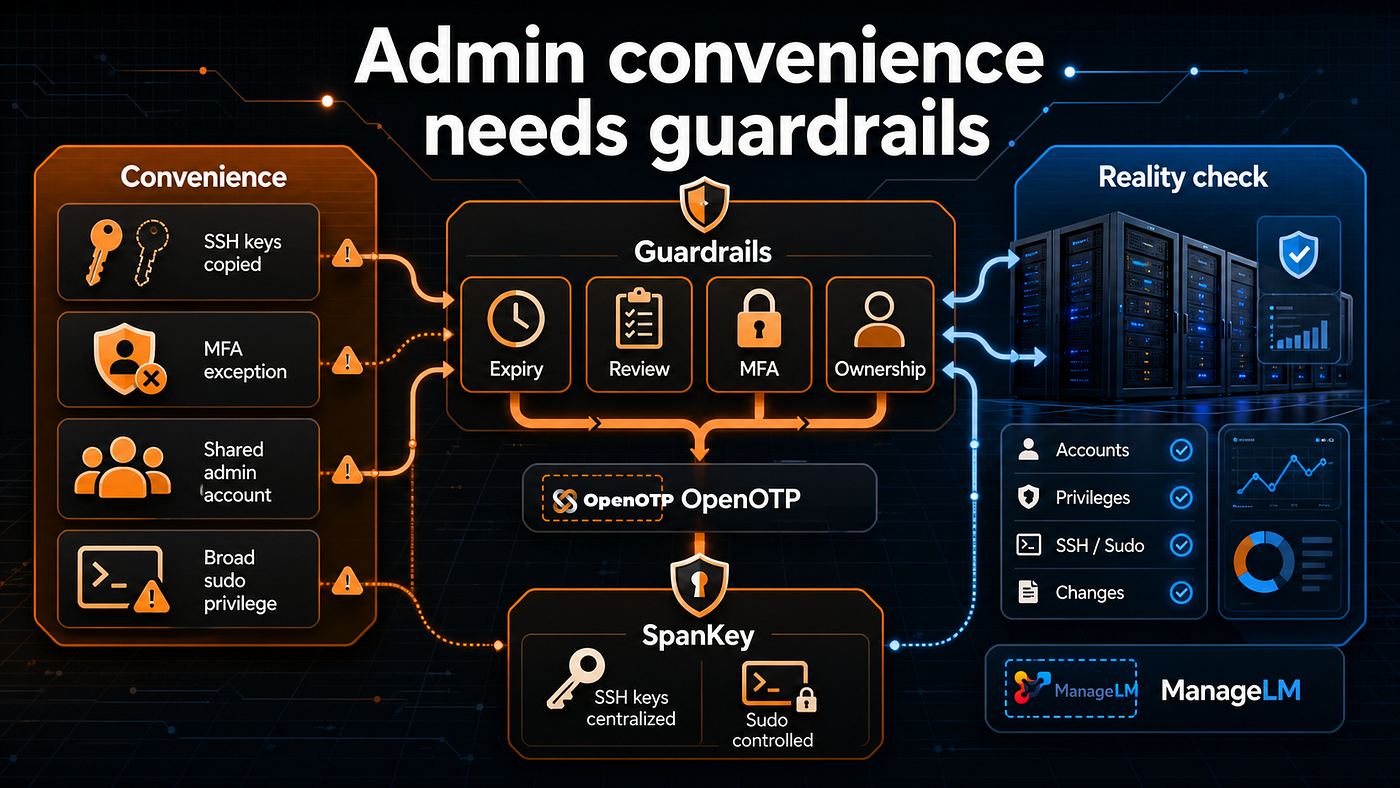
Every infrastructure has shortcuts. A shared admin account helps during an emergency. A temporary MFA exception keeps a migration moving. A copied SSH key avoids waiting for a formal access request. A broad sudo rule makes a script easier to run. None of these decisions necessarily starts as negligence. Most of the time, they start as practical answers to pressure.
The problem begins when convenience becomes permanent.
The shortcut that saves time today can become the access path nobody owns tomorrow. A team may remember why an exception was created for a few days. Six months later, the context has disappeared. The account still exists. The key still works. The privilege still applies. The access path is no longer a conscious decision. It is just part of the environment.
This is where administrative comfort turns into security debt.
OpenOTP and WebADM help on the access control side. They make it easier to centralize authentication decisions, enforce MFA and apply policies through groups and real access paths. The useful question is not only whether an admin can log in. It is whether that access still matches a rule, a role and a current operational need.
SpanKey is relevant when SSH becomes the quiet admin highway. SSH keys are powerful because they are efficient. They are risky when they are copied, forgotten or managed host by host. Centralizing SSH key management and sudo control helps reduce that spread. It also helps teams move away from permanent local habits that are difficult to review.
ManageLM adds the server-side reality check. It can help teams observe accounts, privileges, SSH/Sudo exposure, system state and operational changes. That matters because identity policy and server reality are often maintained by different people. If the access layer says a privilege was removed, the server layer should not quietly keep a local equivalent alive.
The goal is not to make administrators slower. Security that ignores operational pressure usually creates workarounds. The goal is to keep speed under control. Exceptions need owners. Privileges need review. Shortcuts need expiry. Access paths need evidence.
For audits, cyber insurance reviews and incident response, this is not a minor detail. After a problem, teams are rarely asked whether a shortcut felt convenient. They are asked who had access, why it existed, when it was used and whether it was still justified.
Operational speed needs guardrails, not blind spots.
메타데이터
- post_id
- 53f1c8b19cbb
- slug
- admin-convenience-is-not-the-enemy-unreviewed-convenience-is-53f1c8b19cbb
- url
- https://medium.com/@eric.james_36772/admin-convenience-is-not-the-enemy-unreviewed-convenience-is-53f1c8b19cbb
- canonical_url
- https://medium.com/@eric.james_36772/admin-convenience-is-not-the-enemy-unreviewed-convenience-is-53f1c8b19cbb
- author_url
- https://medium.com/@eric.james_36772
- status
- ok
- fetched_at
- 2026-07-13 10:48:08