When We Stop Noticing
Why Justice Begins with Attention
When We Stop Noticing
Why Justice Begins with Attention
The greatest threat to a civilization is rarely what it believes.
It is what it no longer notices.
History is filled with societies that celebrated freedom while overlooking oppression, admired prosperity while ignoring poverty, and defended order while quietly accepting injustice. Their decline did not begin the moment they rejected their highest ideals. It began when those ideals slowly disappeared from view. The crisis was not simply moral failure. It was moral blindness.
We often assume that information changes people. If citizens knew more, we tell ourselves, they would make better decisions. Yet we have never lived in a more informed age. Knowledge travels across the globe in seconds. Every crisis is documented. Every opinion is amplified. Every injustice can be recorded, shared, and debated almost instantly.
Still, our public life grows more fractured.
The problem is not information.
The problem is attention.
Information tells us what exists.
Attention determines what matters.
Every society develops habits of attention. It notices certain voices while overlooking others. It remembers particular histories while forgetting others. It celebrates some achievements while quietly accepting the costs paid by those left behind. These habits eventually become more than cultural preferences. They become moral instincts.
What a people consistently notices eventually becomes what it consistently protects.
What it repeatedly overlooks eventually becomes ordinary.
That may be one of the least discussed truths about justice.
Injustice rarely arrives with dramatic fanfare. It becomes familiar. We adapt. We explain away what once disturbed our conscience. We learn to live alongside realities that earlier generations might have confronted. Public injustice is often the visible consequence of private inattention.
This pattern extends far beyond politics.
Families stop noticing loneliness.
Schools stop noticing curiosity.
Churches stop noticing the weary.
Communities stop noticing neighbors.
Organizations stop noticing the purpose that first inspired their work.
Long before collapse becomes visible, attention has already begun to drift.
Every institution, in a sense, is built twice.
It is first built within the moral imagination of a people who believe certain truths are worth protecting. Only afterward is it built in policies, budgets, buildings, and procedures. The visible institution may remain impressive long after the invisible one has begun to erode. Institutions rarely fail because their walls weaken first. They fail because the convictions that gave those walls meaning have quietly disappeared.
Perhaps this is where the ancient wisdom of Proverbs speaks with surprising relevance.
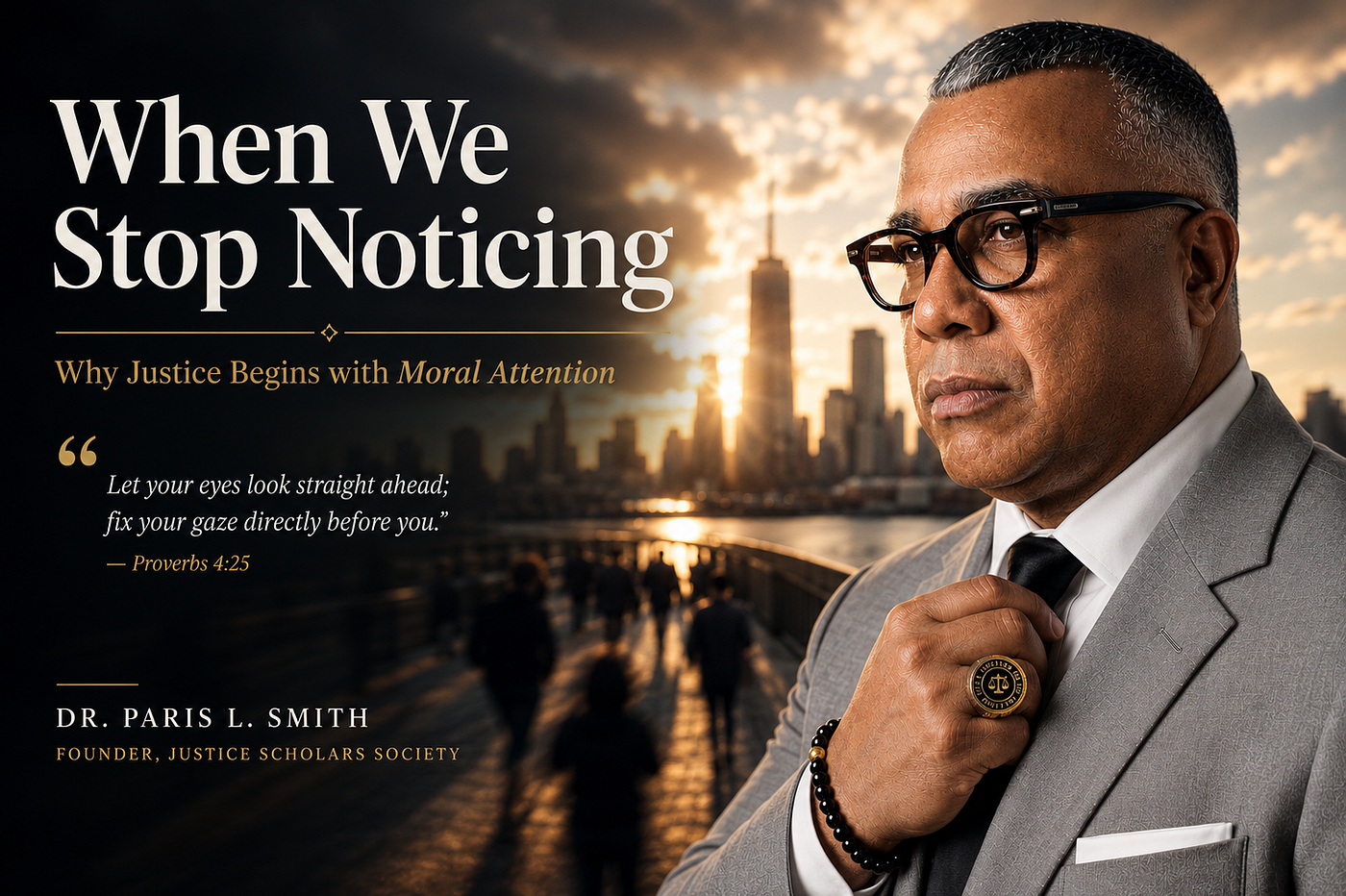
"Let your eyes look straight ahead; fix your gaze directly before you. Give careful thought to the paths for your feet…” (Proverbs 4:25–27).
These verses are often read as practical advice for personal living. They are certainly that. But they are also an education in perception.
Wisdom does not simply teach us what to think.
Wisdom teaches us what deserves our attention.
Before we choose what is right, we must first recognize what is worthy of our concern.
Before justice becomes legislation, it is recognition.
Before justice becomes public policy, it is perception.
Before justice transforms institutions, it transforms the people who inhabit them.
I have come to think of this discipline as moral attention — the cultivated ability to recognize what truth, love of neighbor, and human dignity require before convenience, distraction, or ideology persuade us to look away. Every healthy democracy depends upon laws and institutions. But every healthy democracy also depends upon citizens whose attention has been formed by wisdom rather than spectacle.
Perhaps we have been asking the wrong question.
We often ask why societies lose justice.
A deeper question is this:
What did they stop noticing?
Every generation answers that question — not only through the laws it passes or the leaders it elects, but through the lives it chooses to see, the truths it refuses to forget, and the neighbors it refuses to ignore.
The future will belong to societies that recover the discipline of moral attention.
Everything else begins there.
메타데이터
- post_id
- 540b00a96972
- slug
- when-we-stop-noticing-540b00a96972
- url
- https://medium.com/@revdrparissmith/when-we-stop-noticing-540b00a96972
- canonical_url
- https://medium.com/@revdrparissmith/when-we-stop-noticing-540b00a96972
- author_url
- https://medium.com/@revdrparissmith
- status
- ok
- fetched_at
- 2026-08-06 05:09:12

