The Art of Dissolution and Coagulation
Solve et Coagula
The Art of Dissolution and Coagulation
Solve et Coagula
There is a phrase inscribed on the arms of Baphomet — the goat-headed figure drawn by the 19th-century occultist Eliphas Levi — that captures one of the oldest and most mysterious principles in the Western esoteric tradition: Solve et Coagula. Dissolve and Coagulate.
Break apart and bring together. It is a phrase that belongs to alchemy, that ancient proto-science and spiritual discipline that obsessed some of the greatest minds of the pre-modern world for over two thousand years. And while many think of alchemy merely as a failed precursor to chemistry (a fumbling attempt to turn lead into gold) this reading misses almost everything that made alchemy profound. Alchemy can be looked at, at its deepest level, as a philosophy of transformation: of matter, yes, but also of consciousness, of the soul.
The Origins: Fire, Sulfur, and the Philosopher’s Stone
Alchemy emerged from a confluence of Egyptian metallurgy, Greek natural philosophy, and Mesopotamian cosmology, crystallizing in Alexandria around the 1st to 3rd centuries CE. The word itself likely derives from the Arabic al-kimiya, which in turn may trace back to the Greek Chemia — possibly related to the Egyptian khem, meaning “black earth,” referring to the rich dark soil of the Nile delta and the Egyptian art of working metals.
From these roots, alchemy spread through the Islamic Golden Age, where scholars like Jabir ibn Hayyan (known in the West as Geber) systematized its operations, introduced laboratory apparatus still used today, and began to articulate the sulfur-mercury theory of metals.
This theory held that all metals were formed from two principles: sulfur (the active, fiery, masculine principle) and mercury (the passive, fluid, feminine principle), combined in varying degrees and purities. Gold was considered the most perfect combination of these two principles, and the alchemist’s task was to accelerate nature’s own slow perfective work — to purify and recombine base matter until it achieved that golden perfection.
When alchemy passed into medieval Europe via Latin translations from Arabic, it gained a new dimension. The Church both tolerated and was suspicious of it. Some theologians found in it a rich vein of metaphor — the transformation of base metals into gold mirrored the transformation of the sinful soul through grace. Others condemned it as sorcery.
But the alchemists themselves were often both devout and wildly speculative, reading Scripture through alchemical eyes and vice versa. For them, the Philosopher’s Stone — the mysterious catalyst said to transmute metals and grant immortality through the elixir of life — was not merely a physical substance but a spiritual archetype, a symbol of perfected being. Figures like Paracelsus in the 16th century pushed this spiritual dimension even further, insisting that the true alchemical work was performed as much within the practitioner as without.
The great alchemists (Zosimos of Panopolis, Albertus Magnus, Roger Bacon, George Ripley, Paracelsus, Michael Maier, and later figures like Robert Fludd) produced an enormous corpus of texts, many of them deliberately obscure, encoded in symbolic imagery and cryptic language called the “Hermetic art.” Their illustrations, known as emblems or engravings, depicted dragons devouring their own tails (the Ouroboros), hermaphroditic kings and queens, black suns, white moons, and a procession of symbolic operations from calcination through conjunction to the final rubedo, the reddening, the achieved perfection.
This symbolic language was not merely decorative: it was a code designed to transmit the alchemical process to initiates while concealing it from the uninitiated.
The Literal Process: Solve et Coagula in the Laboratory
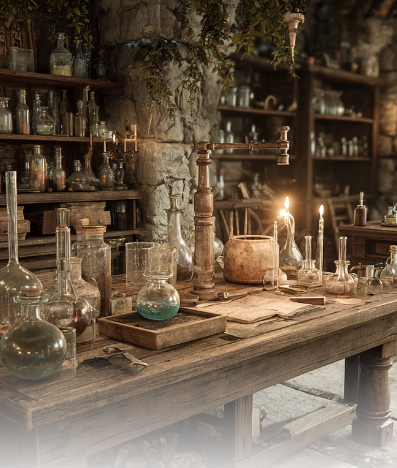
In its most literal, physical sense, Solve et Coagula described two fundamental and complementary operations in the alchemical laboratory. To solve (from the Latin solvere, to loosen, release, dissolve) meant to break a substance down: to reduce it to its most fundamental, formless state.
This could be accomplished through calcination (burning a substance to ash), putrefaction (allowing it to rot and blacken), dissolution in acid or water, or distillation. The goal was to strip away all that was impure, accidental, and compounded in the substance and return it to a prima materia, a first matter, a state of pure potential.
To coagulate (from coagulare, to curdle, thicken, solidify) meant the opposite: to bring the purified elements back together in a new, higher, and more perfect configuration.
Having dissolved away all that was base and impure, the alchemist would reconstitute, crystallize, fix, or sublimate the material into a new and more refined form. The repeated alternation of these two operations — dissolving and re-solidifying, breaking down and rebuilding — was considered essential to the Great Work. Each cycle of solve and coagula was thought to strip away more impurity and elevate the substance to a higher grade of perfection. The number seven was traditionally significant: the work was often described as seven stages, and the process might be repeated seven or more times.
The physical operations themselves were real and often produced genuine chemical discoveries — acids, alcohols, salts, and pigments that found their way into medicine, metallurgy, and the arts.
But even when alchemists were handling literal sulfur and mercury, literal acids dissolving literal metals, the symbolic dimension was never absent. The operations were performed with attention, with prayer, with ritual timing. The furnace, the athanor, was tended like a sacred hearth. The alchemist’s inner state was considered as important as the external conditions.
This inseparability of the outer and inner work is perhaps the most important thing to grasp about alchemy — and it is precisely what makes Solve et Coagula such a powerful lens for understanding psychological transformation.
The Hermetic Axiom: As Above, So Below
Underlying all of alchemy is the great Hermetic axiom from the Emerald Tablet, attributed to the mythical figure Hermes Trismegistus:
“As above, so below; as below, so above; as within, so without.”
This principle of correspondence between levels of reality — the cosmic and the terrestrial, the macrocosm and the microcosm, the outer world and the inner world — meant that any process observable in nature had its analog in the human soul, and vice versa.
The dissolution and reformation of metals in the crucible was the same process, operating at a different level, as the dissolution and reformation of fixed, habitual patterns of the psyche.
This is why alchemy was never merely chemistry, and why it still speaks so powerfully to depth psychologists, Jungians, and anyone engaged in serious inner work. The language of alchemy is a language for transformation at every scale.
Dissolve and Rebuild: Solve et Coagula as a Psychology of Transformation
Shadow Work, Dreams, and the Inner Alchemical Process
When Carl Gustav Jung, the Swiss psychiatrist who broke from Freud to develop his own depth psychology, began reading the great alchemical texts of the Middle Ages and Renaissance in the 1920s and 30s, he had what he described as a revelation.
Here, in these strange, symbolic, extravagantly illustrated manuscripts, he found something extraordinary: a complete imaginative map of the individuation process — his term for the lifelong psychological journey toward wholeness.
The alchemists, he concluded, had been projecting their own psychological contents onto matter. Their work with metals and acids and furnaces was also, and perhaps more essentially, a work with the unconscious mind. What they called the prima materia (the raw, chaotic, blackened first matter) was the same as what he called the shadow: the rejected, repressed, unacknowledged parts of the personality.
This insight opens a door. If we follow it through, Solve et Coagula ceases to be merely a laboratory instruction and becomes a profound map for working with the mind — a map that is arguably more sophisticated than many modern psychological frameworks, precisely because it does not separate the rational and the symbolic, the cognitive and the embodied, the conscious and the unconscious.
The Prima Materia: Beginning with Shadow
Every alchemical Work begins with the prima materia — the first matter, the raw material that will be transformed. The alchemists were notably ambiguous about what this substance actually was. They described it in contradictory terms: it was everywhere and nowhere, worthless and priceless, hidden in plain sight, despised by the ignorant.
One key quality, though, was consistent: the prima materia was dark, chaotic, undifferentiated. It was often symbolized by the nigredo — the blackening, the first stage of the Great Work, associated with putrefaction, death, and the dissolution of all fixed forms.
Psychologically, the prima materia can be looked at as the shadow — in Jung’s sense, the repository of everything in us that has been denied, rejected, projected outward, or simply left unconscious. This includes obvious darkness: rage, envy, lust, cruelty, selfishness. But it also includes unlived life: the creative potential we were told was impractical, the sensitivity we learned to armour, the wildness we domesticated out of ourselves in order to be acceptable.
The shadow is not evil — it is simply unprocessed. It is the raw, unrefined ore of the psyche, containing both poisons and precious metals in an undifferentiated mass.
The alchemists said the Work must begin here, with the most despised and overlooked material. You cannot perform alchemy on what you refuse to acknowledge. The first movement of inner Solve et Coagula is therefore an act of attention: turning toward what has been turned away from. This is often where people find the process most confronting, because the prima materia in ourselves tends to appear precisely in the places we most resist looking — in our compulsions, our projections onto others, our most charged emotional reactions, our recurring patterns of failure or self-sabotage.
Solve: The Psychology of Dissolution
The solve operation in psychological terms is the deliberate loosening of fixed structures: beliefs, identities, defenses, and habitual patterns of thought and feeling that have become rigid and are no longer serving life.
Psychologically speaking, we all carry what could be called psychic crystallizations — calcified ways of understanding ourselves and the world that formed, often in childhood or under trauma, as adaptive responses but have become prisons.
The person who was humiliated in childhood and decided they were fundamentally defective.
The person who survived chaos by controlling everything around them.
The person who learned that vulnerability meant annihilation and built an impenetrable competence.
These are not character flaws — they are crystallizations, fixed forms that once protected life and now constrain it.
To solve these structures is not to destroy them violently, but to loosen them through careful, sustained attention — the psychic equivalent of acid dissolving metal. The great solvents of inner alchemy include: honest inquiry (simply questioning whether a belief is true, or whether a response belongs to the present moment or to a memory), sustained emotional awareness (allowing oneself to feel what has been avoided, without acting on it or suppressing it), creative work (which breaks up fixed categories by generating new combinations), the felt experience of the body (which holds what the mind has dissociated), and perhaps most powerfully, the dream.
The Dream World as Alchemical Vessel
The alchemists worked in a vessel they called the vas hermeticum — the sealed container in which transformation occurred.
The vessel had to be strong enough to contain the volatile, chaotic energies released by dissolution without shattering. Psychologically, the vessel is the therapeutic relationship, the contemplative practice, the consistent ritual container within which the inner work is held safely. But there is another vessel, one that the alchemists knew intimately and that modern depth psychology has rediscovered: the dream.
Dreams are, in the most direct sense imaginable, the nightly Solve of the psyche. During sleep, the fixed structures of waking consciousness — the persona, the defended ego, the carefully maintained self-image — are dissolved.
The unconscious reorganizes, recombines, processes, and surfaces material that waking awareness keeps suppressed or at the margins. The language of dreams is not the language of rational discourse; it is the language of image and symbol, of condensation and displacement, of emotional logic rather than linear logic. It is, in short, the language of the alchemical tradition itself.
Shadow material surfaces in dreams with particular insistence.
The figures we dream of whom we find threatening, disgusting, or deeply fascinating are often shadow projections — parts of ourselves we have not integrated.
The recurring nightmare, the chase dream, the dream of falling: these are the psyche’s way of forcing attention toward what has been dissolved but not yet reconstituted, toward the prima materia that wants to be refined.
When we begin to work consciously with our dreams — recording them, sitting with their imagery, entering into dialogue with their figures — we are doing inner alchemy. We are taking the dissolved material of the unconscious and beginning the work of coagulation: bringing it up into the light of awareness, finding its meaning, integrating its energy into the conscious personality.
Lucid Dreaming: The Conscious Alchemist in the Solve
Lucid dreaming (the state in which the dreamer becomes aware that they are dreaming while remaining within the dream) introduces a remarkable possibility: the conscious mind entering directly into the dissolved, fluid state of the unconscious without losing itself.
This is alchemically significant. In ordinary dreaming, the solve operates without our participation: we are dissolved along with everything else, swept through the dream by its currents without choice or awareness.
In lucid dreaming, however, the witnessing awareness — the aspect of mind that in alchemy corresponds to the purified, skilled alchemist working at the furnace — enters the vas hermeticum of the dream fully present and intentional.
The implications for shadow work are profound. In a lucid dream, rather than fleeing the pursuing shadow figure, the dreamer can turn and face it, engage it, ask its name and nature. Rather than being overwhelmed by a terrifying dreamscape, the lucid dreamer can move through it with curiosity, altering the dream in ways that serve integration rather than avoidance.
Tibetan Buddhist practitioners have long used lucid dreaming in this way within the practice of Dream Yoga — understanding the dream state as an opportunity to work with the most subtle layers of mind, to observe the way consciousness itself creates its reality.
Shamanic traditions across the world similarly use dream states as a literal other world where healing, learning, and transformation occur.
What lucid dreaming offers, in alchemical terms, is the ability to be present for the solve. Instead of blacking out during the dissolution — losing consciousness as the fixed structures of the day-mind are broken down — the practitioner maintains awareness in the fluid, imaginal state of dream reality.
This corresponds in alchemy to the moment when the adept watches the blackening, the putrefaction, without fleeing, without trying to force premature coagulation. The ability to tolerate dissolution — to remain present within formlessness, uncertainty, and the surfacing of raw unconscious material — is, according to every tradition that has worked with the inner life seriously, the essential skill of transformation.
Coagula: The Psychology of Integration
If solve is the work of dissolution — loosening, breaking open, allowing the shadow material to surface — then coagula is the work of integration: taking what has been dissolved and forming it into a new structure, a higher synthesis.
In psychological terms, this is what happens when we genuinely integrate shadow material rather than merely acknowledging it intellectually. Acknowledgment alone is not coagulation.
I can know, abstractly, that I carry deep anger, and remain unchanged. Coagulation occurs when the energy of that anger is transmuted: when its raw force is taken up into courage, assertion, the capacity to hold one’s ground, the ability to name injustice clearly. The prima materia has been refined; the lead has become gold.
This is not a linear process. The alchemists emphasized repetition — the same operation performed again and again, each cycle refining the substance further.
Psychologically, this maps onto the reality of inner work: we do not resolve a shadow complex once and move on. We encounter it, dissolve it a little, integrate a little, and then encounter it again at a deeper level, in a new form, in a different relationship or circumstance.
Each encounter is a new cycle of solve et coagula. This can feel discouraging to those who expect transformation to be a single decisive event. But the alchemical model suggests it is more accurately understood as a gradual, ongoing refinement — the repeated heating and cooling, dissolving and crystallizing, each pass through the furnace removing another layer of impurity and revealing more of the gold within.
The Stages of the Work: Nigredo, Albedo, Citrinitas, Rubedo
The alchemical Great Work was classically described in four stages, each marked by a color and a quality of transformation. Understanding these stages psychologically gives the practice of Solve et Coagula its full shape.
The Nigredo (the blackening) is the beginning, the encounter with dissolution and shadow. Psychologically it is the dark night of the soul, the period of depression, confusion, and the collapse of the old self-structure. It is the necessary death that precedes transformation. To experience nigredo is to face the prima materia in oneself: the grief, the rage, the shame, the calcified beliefs that have been running the show from the darkness. Modern culture has an enormous difficulty with the nigredo because it looks and feels like failure, pathology, crisis. But in the alchemical framework it is the first sign that the Work has truly begun.
The Albedo (the whitening) follows the nigredo. It is the stage of purification, clarification, and the emergence of reflection. The prima materia has been dissolved and begins to be washed clean. Psychologically, this corresponds to the development of the witness consciousness: the capacity to observe one’s own inner processes without being entirely identified with them. The albedo is the phase of insight, of understanding, of the therapeutic breakthrough when something previously dark and compulsive becomes visible and knowable. Dreams during the albedo often shift from dark, threatening imagery to lunar, silvery, reflective landscapes.
The Citrinitas (the yellowing) represents the dawning of a new light, the first warm gold emerging from the purified white. Psychologically it is the phase of emerging vitality and new direction, when the integrated shadow material begins to express itself as new energy, creativity, and purpose. It is tentative, not yet complete — the gold is not yet fully refined — but it is unmistakably different from what came before.
The Rubedo (the reddening) is the completion of the Work: the full coagulation of the transformed substance, the achievement of the Philosopher’s Stone, the attainment of wholeness. Psychologically Jung associated this with individuation — not the perfection of the personality in any moralistic sense, but the integration of the full range of one’s humanity: the achievement of a self that is large enough to contain and work with one’s contradictions, wounds, gifts, and darkness without being destroyed by any of them. The rubedo is the image of the integrated human being, the person who has done the full cycle of solve et coagula and emerged not as something pure and separate from the human condition, but as something fully, richly, and consciously human.
Practicing Inner Alchemy: Working with Solve et Coagula
How does one actually practice this? The inner alchemical process is not a technique so much as an orientation — a way of relating to one’s own psychological material. But there are practices that enact it.
Dream work is perhaps the most natural and direct form of inner alchemy. Keeping a dream journal — writing down dreams immediately on waking, before the waking mind reasserts itself and dissolves the dream images — is the essential first step.
The aim is not interpretation in the reductive sense (this symbol means that), but a sustained imaginative engagement with the dream figures and landscapes: sitting with the images, amplifying them through art or writing, entering into dialogue with them, noticing what they evoke emotionally in the body. This is the psychic equivalent of the alchemist sitting with the material in the vessel, observing patiently, allowing the transformation to proceed at its own pace.
Active imagination — extends this process into waking life. In active imagination, one deliberately enters into a semi-trance state and engages directly with inner figures and images, allowing them to move and speak and act, maintaining a witnessing presence rather than directing the imagery. This is a powerful form of coagula: taking the dissolved, fluid material of the dream or fantasy and consciously engaging with it until its meaning and energy begin to crystallize into a form the conscious mind can work with.
Meditation practices of various kinds enact the solve in a different register. Practices that develop witnessing awareness — the capacity to observe thoughts, emotions, and sensations without identifying with them — perform a kind of daily solve on the ego-structures, loosening their grip and creating space for something new. Somatic practices — breathwork, body-centered therapies, practices like Yoga or Qi Gong — address the solve et coagula at the level of the body, where so much of the shadow and the prima materia is literally held as tension, constriction, numbness, or chronic activation.
Creative work of all kinds )painting, writing, music, dance) is alchemical in a direct sense. Creation is the bringing of something from the unconscious (the prima materia, the formless potential) into form (the coagulated work). Every artist knows the phase of solve — the confrontation with the blank page, the descent into uncertainty, the dissolution of previous certainties about what the work should be. And the phase of coagula — the sudden crystallization of form, the emergence of the work from chaos into coherent being. The creative process is a natural container for the alchemical work, which is perhaps why creative individuals have so often been drawn to alchemical imagery and why Jung himself insisted that the capacity for creative symbolization was essential to the health of the psyche.
The One Thing That Runs Through Everything
What ultimately unifies the literal and the psychological, the laboratory and the inner life, the dream and the waking practice, is the principle at the heart of the Hermetic tradition: that all of reality is continuous, that what happens at one level of being is reflected at every other level, and that transformation — genuine transformation, not mere change — always requires both dissolution and reconstitution.
You cannot build the new without first loosening the old. You cannot integrate what you refuse to dissolve. You cannot reach the rubedo without passing through the nigredo.
Solve et Coagula is not a formula to be applied mechanically. It is an orientation toward transformation that respects both the necessity of dissolution and the necessity of form — that understands destruction and creation not as opposites but as complementary movements in a single continuous process.
The alchemists knew, in whatever symbolic and confused and sometimes literal way they expressed it, that the gold they sought was always already present in the lead — that the transformation was not the addition of something foreign but the revelation of what was there all along, refined from impurity, brought from potential to actuality.
This remains, perhaps, the most important thing alchemy has to teach: not how to escape the darkness, but how to work with it until the gold within it shines.
Alchemy #CarlJung #Consciousness #DreamWork #Hermeticism #InnerAlchemy #LucidDreaming #Mysticism #OccultWisdom #PhilosophersStone #SelfDiscovery #ShadowWork #spiritualawakening #SpiritualTransformation
메타데이터
- post_id
- 540f9b8a41a4
- slug
- the-art-of-dissolution-and-coagulation-540f9b8a41a4
- url
- https://medium.com/@nishaconsults/the-art-of-dissolution-and-coagulation-540f9b8a41a4
- canonical_url
- https://medium.com/@nishaconsults/the-art-of-dissolution-and-coagulation-540f9b8a41a4
- author_url
- https://medium.com/@nishaconsults
- status
- ok
- fetched_at
- 2026-06-11 21:11:36