America just put $54 billion on the table for autonomous drones — and quietly opened a door for 3D…
DAWG, SAWC, Replicator’s heir, and why the next defense supply chain might be additive by necessity, not by choice.
America just put $54 billion on the table for autonomous drones — and quietly opened a door for 3D printing
DAWG, SAWC, Replicator’s heir, and why the next defense supply chain might be additive by necessity, not by choice.
Buried inside the U.S. Department of War’s 2027 budget request — yes, that’s what the Department of Defense is now officially called in budget documents — is a number that should make every executive in the additive manufacturing industry sit up straight.
$54.6 billion for autonomous systems and drone dominance in a single fiscal year. $1 billion in the base budget, $53.6 billion more from the mandatory reconciliation side. Within that, $39.2 billion for multi-year investments in autonomous systems and domestic production capacity, and $14.4 billion for counter-drone capabilities. Add in the broader counter-UAS line and you’re looking at roughly $20.6 billion for stopping enemy drones alone.
For context, the entire global additive manufacturing market in 2025 was around $20 billion. A single American budget line for drone defense is now bigger than the worldwide AM industry.
This isn’t just a defense story. It’s a manufacturing story. And it’s worth understanding why.
The two acronyms you need to know
The plan has two structural pieces, and both have catchy names that the Pentagon does not usually go for.
DAWG — Defense Autonomous Warfare Group — is the institutional heir to Replicator, the program launched in 2023 with a stated goal of fielding “multiple thousands” of attritable autonomous systems in 18 to 24 months. Attritable is Pentagon-speak for cheap enough to lose. The original Replicator pitch was a direct response to Chinese industrial mass: instead of countering it with a handful of exquisite, expensive platforms, counter it with lots of smaller, upgradeable, expendable ones.
DAWG keeps that logic and embeds it in a much larger budget envelope. Breaking Defense reports that Pentagon officials are describing DAWG as a “pathfinder” — a structure tasked with finding technologies, testing them with industry, and working through integration.
SAWC — SOUTHCOM Autonomous Warfare Command — is the new operational command set up by U.S. Southern Command under Marine General Francis L. Donovan. Its mission: use autonomous, semi-autonomous and uncrewed platforms across the SOUTHCOM area of responsibility. That means counter-narcoterrorism and cartel networks, but also disaster response in Latin America and the Caribbean.
This matters because it shifts autonomous warfare out of the China-Pacific frame everyone has been using since 2023. SAWC explicitly bolts these capabilities onto missions in the Americas, where the work is surveillance, maritime patrol, distributed sensing, surface vessels, aerial drones and underwater systems.
In other words: this isn’t a China bet anymore. It’s a permanent structural shift.
What “autonomous systems” actually means here
The budget doesn’t only fund quadcopters and small UAVs. The documents talk about autonomous and remotely operated systems across multiple domains: air, ground, surface naval, and underwater.
That domain breadth matters more than people realize, because each domain stresses manufacturing differently.
An aerial drone needs weight reduction, aerodynamics, and fast iteration. An uncrewed surface vessel needs saltwater resistance, sealing, protected electronics, energy autonomy. A ground system has to survive impacts, dust, vibration, and a maintenance cycle in the field. An underwater platform has its own pressure, corrosion and acoustic constraints.
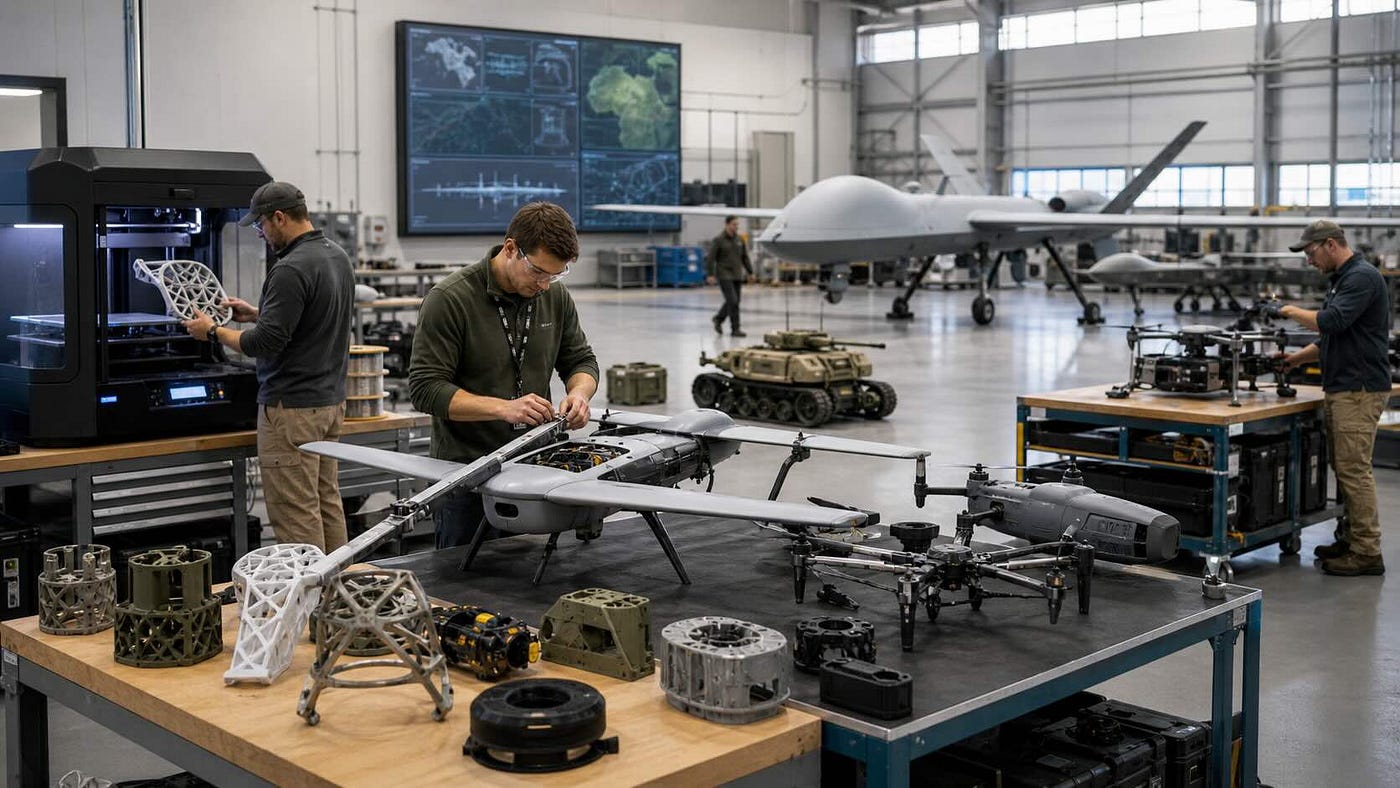
For 3D printing, this variety isn’t a footnote — it’s the entire opportunity. Different domains pull in different materials and processes. Reinforced polymers and composites for lightweight aerial parts. Printed metals for brackets, heat exchangers, thermal components, or parts with internal channels. Powder-bed systems, industrial extrusion, photopolymerization all find roles, from prototyping through tooling through limited-run production.
The companies already positioned
A handful of names dominate any honest conversation about who’s ready for this wave.
Anduril Industries built its entire identity around software-defined defense, sensors, autonomous platforms and scalable production. The company has announced Arsenal-1, a manufacturing facility in Ohio designed to produce tens of thousands of autonomous defense systems per year. Anduril has also invested in facilities with dedicated additive manufacturing and 3D printing labs — the Atlanta site being the most visible example.
Skydio, the American autonomous drone maker, just landed a U.S. Army order worth more than $52 million for over 2,500 X10D drones — described as the largest single-vendor small UAS purchase in U.S. Army history. The shape of that order tells you everything about market direction: small systems, high quantities, supply chains compliant with American security requirements.
Firestorm Labs, the California company specialized in modular UAS produced with additive manufacturing, is the cleanest example of where the AM industry meets the drone procurement story. According to 3D Printing Industry, Firestorm received a five-year, $100 million IDIQ contract from the U.S. Air Force for additively manufactured UAS. This is one of the most direct cases of 3D printing and military drones living inside the same industrial model.
Add in AeroVironment (Switchblade and other loitering munitions), Red Cat, Skyways, and other Blue UAS-compliant manufacturers and you have a market with real shape. Not every name above will be a direct DAWG fund recipient — and “budget approved” is not the same as “contract awarded” — but the gravitational pull is clear.
Where additive manufacturing actually fits
There are three honest places where 3D printing earns its seat at this table.
Speed of iteration. When a drone needs a new sensor, antenna, battery mount, or air-intake geometry, AM lets you cycle variants in days rather than months. It doesn’t replace qualification — it shortens the loop between design and test. In a program built around rapid evolution, that’s not a luxury, it’s the model.
Reduced tooling dependence. For high-volume, stable products, traditional molding still wins on cost. For variable batches, multiple configurations, and frequent updates — exactly what attritable autonomous systems demand — additive becomes more attractive. The math changes when the design is moving.
Production closer to use. This is the most delicate one. Military components need to meet technical requirements, quality controls, and cybersecurity standards. But for non-critical or already-qualified parts, distributed production can lighten logistics. When your operational concept depends on thousands of small platforms spread across a theater, the maintenance footprint can outweigh the original production volume.
The honest caveat: quantity isn’t capability
A program at this scale carries a specific risk: confusing volume with effectiveness. Producing thousands of drones doesn’t automatically produce a working system. You need operators, doctrine, data links, electronic protection, maintenance pipelines, batteries, payloads, software, simulation, training, and reliable supply chains.
3D printing doesn’t escape this either. A printed part has to be designed for the process, qualified, tracked, verified, and embedded in a larger system. On military platforms, every variation in material, machine, print orientation, or post-processing can shift final performance. The “factory anywhere” idea only works if there are controlled files, robust procedures, and adequate inspection behind it.
If the AM industry pitches itself as “we can print everything” without confronting qualification, traceability and process control, it will lose this market to traditional suppliers who handle those things better. The opportunity is real. The bar is also real.
The counter-drone side is just as interesting
Most coverage focuses on the offensive autonomous systems. The counter-UAS side may be where additive manufacturing has the cleaner near-term opportunity.
That $14.4 billion counter-drone allocation funds radar mounts, sensor enclosures, components for mobile systems, custom containers, lightweight parts for portable turrets, transportable modules. These are exactly the kinds of variable, site-specific, rapidly-iterated components where additive shines and where qualification bars are often lower than for parts that fly.
Counter-drone is the less photogenic side of this war. It may also be the side where 3D printing genuinely matures into defense-grade industrial infrastructure.
The wider context: it’s not just about drones
The 2027 War Department budget request totals $1.45 trillion, with heavy emphasis on industrial base, domestic production, autonomous tech, AI, and the capacity to sustain higher production rhythms. The document references over $100 billion in Defense Industrial Base investment, targeting supply chains, strategic materials, microelectronics, batteries, castings and forgings.
For additive manufacturing, the implication is precise: AM companies shouldn’t only look at the finished drone. They should look at everything that allows the drone to be built and sustained. Machines, materials, qualification software, simulation, inspection, digital thread, distributed production, spares and tooling can all enter a supply chain far broader than any single platform.
The whole industrial logic of defense procurement is being rebuilt around speed, flexibility, and domestic production. AM happens to be one of the few manufacturing categories aligned with all three.
The part nobody can dodge: the ethics
A budget surge of this size for autonomous systems brings questions that don’t disappear because the numbers are large. Human control. Algorithm reliability. Jamming vulnerability. Cybersecurity. Use-of-force accountability. Escalation management. The Guardian and others have reported significant concerns from AI and security experts about military integration of autonomous platforms, particularly as advanced software gets embedded into operational systems.
A 3D printing publication isn’t the right venue to settle military doctrine. But it would be dishonest to write a piece about $54 billion in autonomous warfare funding and pretend the conversation is purely industrial.
The faster a supply chain becomes, the more controls, traceability and accountability matter. Additive manufacturing can make design faster, production more flexible, maintenance more distributed. Every one of those gains raises the bar for governance — for whoever holds the printer, holds the files, and approves the parts.
This is true for defense. It will become true for civilian critical infrastructure too. The defense build-out is just the most visible early case.
What this means for the AM industry
DAWG and SAWC together signal that the autonomous systems market isn’t moving on software alone anymore. There needs to be a production base capable of building bodies, mounts, structures, components, spares and accessories quickly. This is where 3D printing can become concrete industrial infrastructure — especially when batches vary and configurations shift fast.
The opportunities aren’t only for big drone makers. They extend to technical material suppliers, certified service bureaus, industrial printer manufacturers, quality-control software developers, post-processing companies, and operators specialized in distributed production. The AM industry will have to demonstrate repeatability, data security, process qualification and reliable delivery — not just print capability.
The message is straightforward. American defense wants to shorten the distance between idea, test, production, and field use. 3D printing can help in exactly that direction — but only if it moves past the prototype mentality and presents itself as part of a verifiable production chain.
In that sense, Replicator’s rebirth as DAWG and the creation of SAWC aren’t only military news. They’re signals of an industrial demand pattern where speed, flexibility, and local production are becoming structural requirements. The companies that figure out how to deliver all three — with the quality controls that defense procurement actually demands — will define the next decade of additive manufacturing.
Even those of us who would prefer the market drivers were something other than autonomous warfare have to look at this honestly.
Originally published in Italian on Stampare in 3D.
메타데이터
- post_id
- 540fffe7f0bf
- slug
- america-just-put-54-billion-on-the-table-for-autonomous-drones-and-quietly-opened-a-door-for-3d-540fffe7f0bf
- url
- https://medium.com/@pippopipposky/america-just-put-54-billion-on-the-table-for-autonomous-drones-and-quietly-opened-a-door-for-3d-540fffe7f0bf
- canonical_url
- https://medium.com/@pippopipposky/america-just-put-54-billion-on-the-table-for-autonomous-drones-and-quietly-opened-a-door-for-3d-540fffe7f0bf
- author_url
- https://medium.com/@pippopipposky
- status
- ok
- fetched_at
- 2026-06-09 14:34:10