Optimizing Matrix Multiplication with Sparse Representations in Python
Matrices serve as fundamental data structures in various computational tasks, often encountered in machine learning, data analysis, and…
Optimizing Matrix Multiplication with Sparse Representations in Python
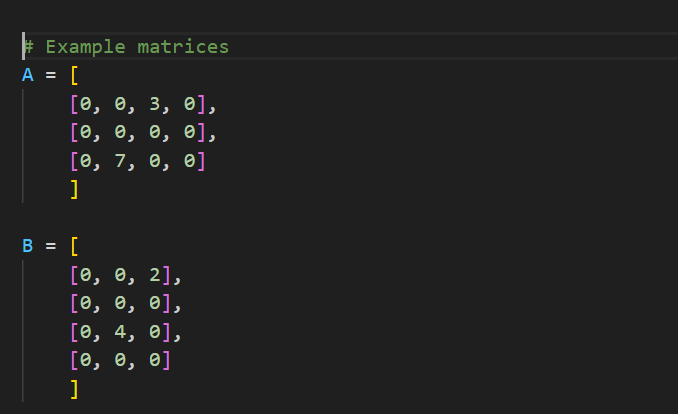
Sparse Matrices Example
Matrices serve as fundamental data structures in various computational tasks, often encountered in machine learning, data analysis, and scientific computing. However, when dealing with large matrices dominated by zero values, memory consumption becomes a significant concern. In such cases, employing sparse representations proves to be a game-changer.
Let’s explore how Python code handles sparse matrix multiplication using a sparse representation approach.
Sparse Matrix Representation
The implementation of a “sparse_representation(matrix)” function plays a pivotal role in efficiently representing matrices with predominantly zero values. This function meticulously constructs a sparse representation by capturing only the non-zero elements along with their positions:
def sparse_representation(matrix) :
        """This sparse representation is a dictionary where each key represents
        the position (i, j) of a non-zero element in the matrix, and the
        corresponding value is the non-zero element itself."""

        output = []
        for i in range(len(matrix)) :
            for j in range(len(matrix[0])) :
                if matrix[i][j] != 0 :
                    output.append({(i, j) : matrix[i][j]})
        return output
This approach cleverly captures the essence of the matrix by storing solely the non-zero values and their corresponding positions, drastically reducing memory usage for sparse matrices.
Sparse Matrix Multiplication
The following “sparse_matrix_multiplication(matrix_a,matrix_b)” showcases a performant method for matrix multiplication, leveraging the previously crafted sparse representations:
def sparse_matrix_multiplication(matrix_a, matrix_b):
    #Let's now construct a list of lists (multiplication) with the number of A_Rows and B_columns, filled with zeros.
    multiplication = [[0 for _ in range(len(matrix_b[0]))] for _ in range(len(matrix_a))]

    if len(matrix_a[0]) !=  len(matrix_b) :
        return [[]]
    else :
        rep_A = sparse_representation(matrix_a)
        rep_B = sparse_representation(matrix_b)
        for A_dict in rep_A :
             A_row, A_col = list(A_dict.keys())[0]
             A_value = list(A_dict.values())[0]
             for B_dict in rep_B :
                B_row, B_col = list(B_dict.keys())[0]
                B_value = list(B_dict.values())[0]

                # Now if The column index of the sparse representation of A is equal to the row index of the sparse representation of B
                # Then we do a dot product
                if A_col == B_row :
                    multiplication[A_row][B_col] += A_value * B_value
        return multiplication
This implementation orchestrates matrix multiplication through the sparse representations of matrices ‘A’ and ‘B’. It selectively processes non-zero elements, computing dot products only when the column index of ‘A’ matches the row index of ‘B’ , resulting in a memory-efficient and swift matrix multiplication process.
Application
They are used in various domains, including their role in managing sparse data and their wide-ranging applications in machine learning models.
Text and NLP: Sparse matrices are extensively used in tasks like text classification, sentiment analysis, and document clustering, where text data is represented using techniques like TF-IDF or Bag-of-Words.
Recommender Systems: In collaborative filtering-based recommendation systems, user-item interaction data is often represented as sparse matrices, enabling efficient computation.
Conclusion
In scenarios involving matrices with sparse distributions of non-zero elements, these Python implementations shine. This approach of handling sparse matrices and matrix multiplication not only optimizes memory usage but also enhances computational efficiency, paving the way for smoother execution of data-intensive tasks in diverse fields.
Would you like further expansion on any particular aspect or additional examples demonstrating the applications of sparse matrices?
메타데이터
- post_id
- 541b0ee9a1a3
- slug
- optimizing-matrix-multiplication-with-sparse-representations-in-python-541b0ee9a1a3
- url
- https://medium.com/@mahachakir/optimizing-matrix-multiplication-with-sparse-representations-in-python-541b0ee9a1a3
- canonical_url
- https://medium.com/@mahachakir/optimizing-matrix-multiplication-with-sparse-representations-in-python-541b0ee9a1a3
- author_url
- https://medium.com/@mahachakir
- status
- ok
- fetched_at
- 2026-07-07 09:05:48




