Dominion, Subjugation And Dispossession (Part 1 of 2).
The Holy Writ’s Blueprint of Conquest And Subjugation Echoed From Beresheit (Genesis) As The Penultimate Manifest Destiny Through The Lens…
Dominion, Subjugation And Dispossession (Part 1 of 2).
The Holy Writ’s Blueprint of Conquest And Subjugation Echoed From Beresheit (Genesis) As The Penultimate Manifest Destiny Through The Lens of The Two Kingdoms Framework Essay Series.
(Written By Rohan Palmer).

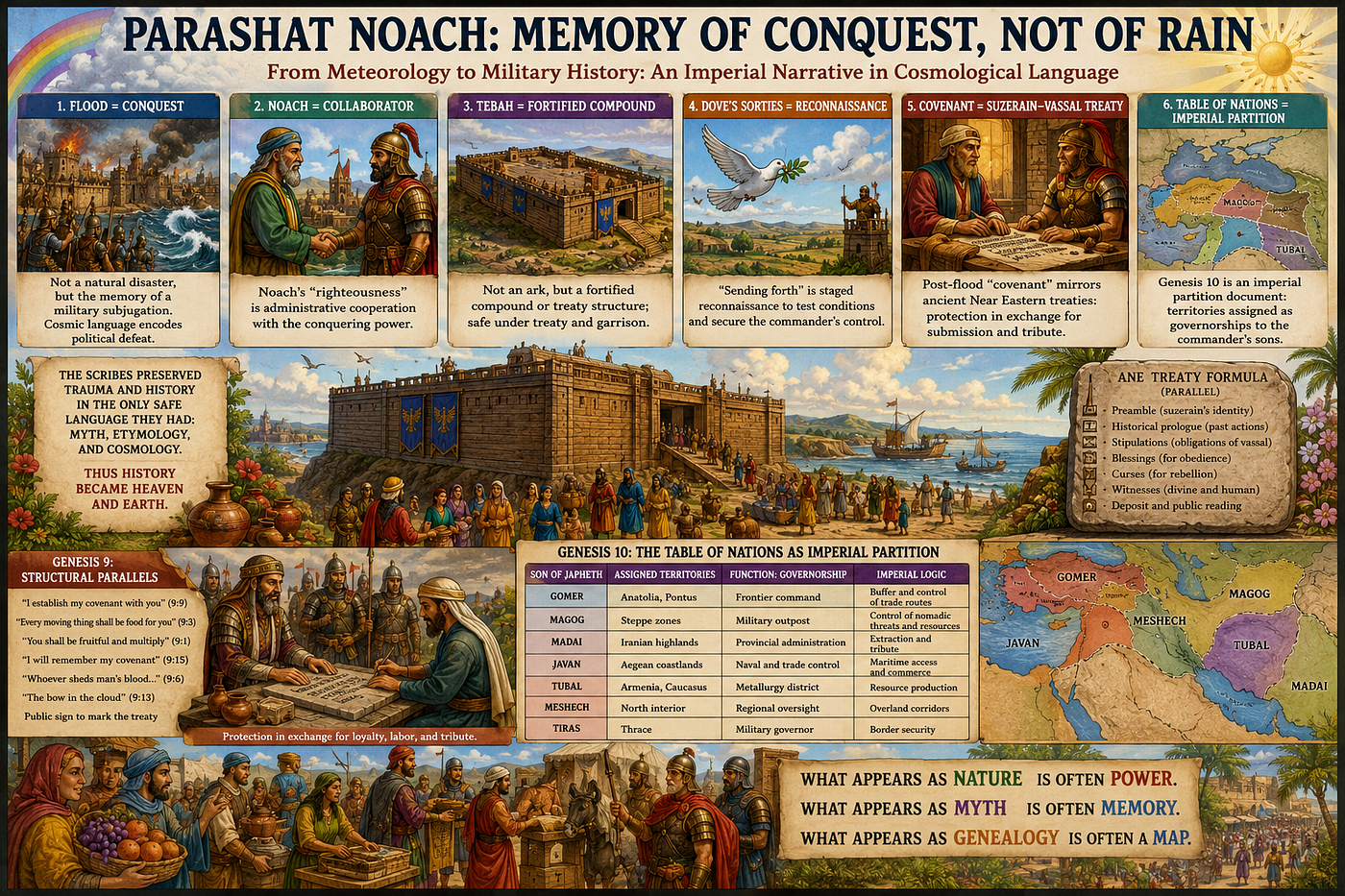
Image By Ai.
“…Once more, the Adversary took him up into the summit of a very high mountain, showed him all the kingdoms of the world in all brilliance and splendor, and said to him, “All this I will give you if you will bow down and worship me.” “Away with you, Satan!” Yeshua (Jesus) told him, “For the Tanakh says, Worship Adonai your Elohim, and serve Him only…” (MattitYahu/Matthew 4:8–10).
This is the twenty-third essay in the Two Kingdoms Framework series.
Note to the reader: The subject here is dominion’s propaganda of named imperial powers to legitimize conquest and domination, not race or racism itself, especially as we know it today. The essay explores the darker meaning of the word penultimate. Going forward…
A Note on What This Essay Is.
This essay did not begin as an argument. It began as a juxtaposition someone noticed and could not stop noticing, a command in the book of Bimidbar (Numbers) sitting uncomfortably close to Columbus, to the conquistadors, to the men in Berlin in 1884 who drew lines across a continent none of them had walked. The juxtaposition asked a question the Two Kingdoms Framework is built to answer honestly rather than explain away. The question is this, when Beresheit (Genesis) 1:26 says let them have dominion, whose dominion is that — and what happens when a different governing power picks up the same word and uses it for something the first Speaker never intended?
This essay follows that question from Eden to the Berlin Conference. It uses the same three-tier method as the two volumes (The forthcoming, Two Kingdoms Framework book.) that precede it. Textual observation is marked as such. Interpretive reading is marked as such. Speculative theological proposal — the territory this essay spends the most time in — is marked clearly and left open for the reader to test, not accepted as settled. One further note on terms. Where earlier conversation used a name for the figure this essay calls the Serpent Elohim, that name is retired here. The being under discussion is not Elohim of Bereseit (Genesis) 1 — the Creator who speaks light into existence and gives freely. It is the governing power installed at the tree, operating afterward under the covenant name, administering the world that covenant produced. Serpent Elohim is the more precise term, and the one this essay uses throughout.
I. Think And Read Slowly— The Word Before the Wound.
Slow down at Genesis 1:26, “And Elohim (G-d) said, Let us make man in our image, after our likeness. And let them have dominion over the fish of the sea and over the birds of the heavens and over the livestock and over all the earth and over every creeping thing that creeps on the earth. This is Elohim’s dominion — issued in the same breath as the free provision of Beresheit (Genesis) 1:29, in the same world where zakhar u’nekevah bara otam, male and female, are created together, equally, with nothing standing between them and what has been given. Dominion here is not conquest. It is stewardship handed to a species that has not yet been told it is missing anything. There is no rival claimant in Account One’s world. There is no land already occupied by someone else, no border to draw, no population to dispossess. Dominion is total precisely because it costs nothing and takes nothing from anyone.
[TEXTUAL NOTE: The reading of Beresheit (Genesis) 1:26–28 as unconditional, co-equal, and non-acquisitive follows directly from the grammar of the passage — the simultaneous creation formula, the absence of hierarchy, the total-provision language of 1:29. This is textual observation, not interpretation; the words say what they say.]
Hold that word — dominion — in your hand as you turn the page, because it does not stay in Elohim’s world for long. It is picked up again, centuries later in the narrative’s own internal chronology, in a very different mouth, applied to a very different kind of taking.
II. The Tree Where Dominion Changed Hands.
Book One of this framework has already made the case, carefully and with its own bracketed cautions, that the eating at the tree was not a dietary infraction but a covenant ratification — the physical, bodily acceptance of a new governing authority’s terms. What matters for this essay is what happened to dominion the moment that covenant took effect.
[SPECULATIVE NOTE: This is the essay’s central proposal, and it is offered exactly as speculative — not as a conclusion the text states outright. If the tree was a covenant transfer, then the dominion mandate did not disappear at the Fall. It was inherited — by the Serpent Elohim, the governing power whose terms were accepted — and it began, from that point forward, to operate under new rules. Where Elohim’s dominion was stewardship over an uncontested world, the Serpent Elohim’s dominion, born at a moment of rupture rather than free gift, would from its first exercise carry the mark of that rupture: dominion as acquisition, dominion exercised over what must first be taken from someone else.]
This is not a small distinction. It is, on this framework’s own terms, the hinge on which the rest of the biblical narrative — and everything this essay traces afterward — turns.
III. Bamidbar (Numbers) — The Mandate Applied to Contested Ground.
By the time we reach Bamidbar (Numbers) 33:50–56, we are no longer in Eden’s uncontested world. Canaan is inhabited. The land the text calls a divine grant is someone else’s home. You shall dispossess the inhabitants of the land and dwell in it, for I have given you the land to possess it… And if you do not drive out the inhabitants of the land from before you, then those whom you let remain shall be as barbs in your eyes and thorns in your sides. Bamidbar (Numbers) 34:1–29 follows immediately with the borders drawn and the land allotted by tribe — the paperwork of conquest completed before the conquest itself.
[TEXTUAL NOTE: That Bamidbar (Numbers) 33–34 describes dispossession, destruction of existing cult objects, and pre-conquest territorial allotment is not in dispute among any reader of the passage regardless of theological commitment. This is what the text says.]
[INTERPRETIVE NOTE: Whether this mandate reflects Elohim’s original dominion or the Serpent Elohim’s acquisitive inheritance of it is where interpretation begins. The Two Kingdoms Framework’s proposal — consistent with its reading of the divine names throughout (Beresheit) Genesis 2 onward — is that the conquest and allotment language belongs to the covenant-system world, not Eden’s. The governing voice that says “I have given you the land” in Bamidbar is transacting in exactly the currency the Serpent Elohim’s system runs on: territory as something granted by decree from above, overriding whoever already stands on it.]

Image By Ai.
The child-sacrifice justification offered for this dispossession deserves the same scrutiny this framework applies everywhere else. If the underlying claim is that Canaanite practice was morally intolerable, the commanded response — the killing of Canaanite children in the taking of the land — does not resolve that claim. It reproduces the very harm it names as cause. A system that eliminates child sacrifice by killing children is not applying a moral principle. It is applying a pretext to a taking that was already underway on other grounds — precisely the mechanism this essay now follows forward.
IV. The Apologetics, and Where They Fail.
Traditional readings have not left the contradiction in Bamidbar (Numbers) unaddressed. Four defenses recur, and each is worth taking seriously before it is set down. The first argues that the killing of Canaanite children was not punishment for their own guilt but removal of a corrupting influence — the culture, not the child, being the target. This does not survive contact with what a child actually is. A child is not yet the bearer of a culture in any morally meaningful sense; removing “the corruption” by removing the person who has not yet had time to be corrupted is not a defense of the act, it is a redescription of it.
The second retreats further, these are God’s to give and take, sovereignty over life itself, and no human moral calculus applies. This is the point at which the argument stops being a moral argument at all. It no longer claims the killing was right because child sacrifice was wrong; it claims the killing was right because the one commanding it cannot be questioned. That is not ethics. That is authority substituting for ethics — the same substitution every conquest ideology eventually makes, including the colonial ones this essay has already named. Might, dressed as command, becomes right.
[INTERPRETIVE NOTE: Within the Two Kingdoms Framework, this second defense is the clearest place the mask slips. Elohim’s provision in Beresheit (Genesis) 1 never required this move — nothing there needed defending by appeal to unquestionable authority, because nothing there took anything from anyone. A governing power whose dominion is acquisitive, by contrast, eventually has no argument left but its own supremacy. “Sovereignty over life” is not a description of Elohim’s world. It is the Serpent Elohim’s system explaining itself in its own native language — command in place of covenant, authority in place of care — the same language every empire uses once its stated justification has run out.]
The third defense narrows the command rather than defending it outright, Ibn Ezra and later interpreters read herem as bound to one historical moment, not a standing policy for Israel or anyone else to reapply. This limits the damage. It does not remove the contradiction for the moment it concedes actually happened — and it raises its own question worth sitting with: if the command was bounded and non-repeatable, why has its language and logic proven so exportable to every empire that has since claimed a similar mandate? A precedent that was supposed to stay closed has, historically, stayed remarkably open. The fourth defense stops defending and simply names the wound, Susan Niditch and John Collins, among others, treat the herem texts as an unresolved ethical rupture in scripture itself, not a puzzle scripture solves. This is the most honest of the four, and it is where this essay’s own method — textual, interpretive, speculative, each marked as such — finds the most agreement. A rupture acknowledged is not a rupture healed, but it is at least a rupture no longer being talked around.
[SPECULATIVE NOTE: Read together, these four defenses trace a retreat — from moral reasoning (corrupting influence), to bare authority (sovereignty over life), to containment (Ibn Ezra’s bounding), to admission (Niditch and Collins). That retreat is itself instructive. If Bamidbar’s (Numbers) conquest belonged to Elohim’s world of free, non-acquisitive provision, it would not need four successive lines of defense, each weaker than the last. A dominion that requires this much defending is confessing, in its own apologetic history, that something at its foundation does not sit easily — which is exactly what this framework proposes the tree, and the covenant transfer that followed it, put there in the first place.]
Next: Dominion, Subjugation And Dispossession (Part 2 of 2).
Dear reader, please applaud, share and subscribe. Looking forward to your continued support.
메타데이터
- post_id
- 54205dac87d2
- slug
- dominion-subjugation-and-dispossession-part-1-of-2-54205dac87d2
- url
- https://medium.com/@rpalmerusa19/dominion-subjugation-and-dispossession-part-1-of-2-54205dac87d2
- canonical_url
- https://medium.com/@rpalmerusa19/dominion-subjugation-and-dispossession-part-1-of-2-54205dac87d2
- author_url
- https://medium.com/@rpalmerusa19
- status
- ok
- fetched_at
- 2026-07-10 14:51:46