How the Ultra-Fast EV Charging Stations will change the Power Grid
Power systems are expected to become increasingly complex over the coming decades as renewable generation, distributed energy resources…
How the Ultra-Fast EV Charging Stations will change the Power Grid
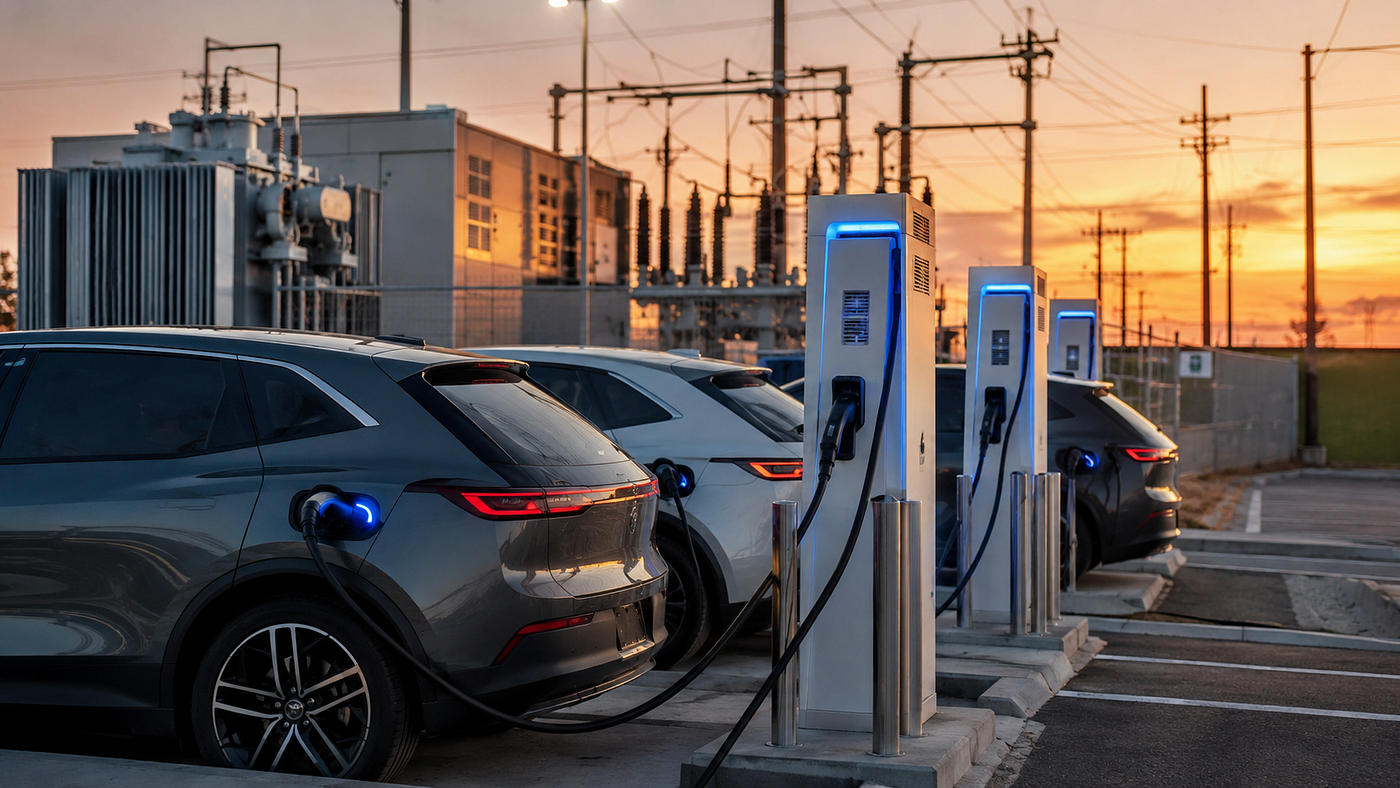
Power systems are expected to become increasingly complex over the coming decades as renewable generation, distributed energy resources (DERs), microgrids, and electrified transportation are integrated into a single interconnected grid. Among these developments, the widespread adoption of electric vehicles (EVs) is expected to significantly reshape electricity demand, particularly at the distribution level, through the rapid deployment of high-power charging infrastructure.
Conventional Level 2 EV chargers typically operate between 3.8 and 19.2 kW, requiring several hours to fully recharge a typical passenger EV depending on the battery capacity and charging rate. In contrast, DC fast chargers operate at 50 to 350 kW, enabling many EVs to recharge to approximately 80% state of charge in as little as 20–40 minutes under suitable conditions (U.S. Department of Energy — Electric Vehicle Supply Equipment Infrastructure).
Although a fast-charging session is often only a partial recharge, the instantaneous power demand created when multiple vehicles simultaneously draw hundreds of kilowatts is substantial. A single 350 kW charger draws more than 18 times the power of a 19.2 kW Level 2 charger. This dramatic increase in peak demand shifts charging from a relatively gradual residential load to a highly concentrated commercial load, creating new operational challenges for distribution networks.
One of the primary constraints is the distribution transformer. Transformers designed for conventional residential or commercial demand may become overloaded when serving clusters of ultra-fast chargers unless they are appropriately sized. Consequently, EV charging hubs often require significantly larger transformers, upgraded feeders, and in many cases dedicated substations to accommodate the concentrated power demand.
At the system level, the cumulative impact of widespread ultra-fast charging can be considerable. Simulation results published by researchers at Peking University indicate that deploying 2,000 ultra-fast charging stations within a single city could increase the daily peak-to-valley charging load difference by approximately 31.6%. The study further projects that, under an unregulated large-scale deployment scenario, peak charging loads could increase by more than 70–85% by 2030 and by up to 7.5 times by 2050, highlighting the need for coordinated charging strategies, grid planning, and operational control rather than unmanaged charging expansion (Peking University summary; Nature Communications paper).
These trends are expected to increase investment in electricity generation, transmission and distribution infrastructure, including transformers, substations, distribution feeders, protection systems, and advanced grid management technologies.
메타데이터
- post_id
- 5433ffc5ed06
- slug
- how-the-ultra-fast-ev-charging-stations-will-change-the-power-grid-5433ffc5ed06
- url
- https://medium.com/@omerahmedsiddiqui786/how-the-ultra-fast-ev-charging-stations-will-change-the-power-grid-5433ffc5ed06
- canonical_url
- https://medium.com/@omerahmedsiddiqui786/how-the-ultra-fast-ev-charging-stations-will-change-the-power-grid-5433ffc5ed06
- author_url
- https://medium.com/@omerahmedsiddiqui786
- status
- ok
- fetched_at
- 2026-08-11 17:20:30