Linear Algebra for Machine Learning
Machine learning is about turning events into numbers and visualising them to find meaning and build prediction based on the meaning.
Linear Algebra for Machine Learning
Machine learning is about turning events into numbers and visualising them to find meaning and build prediction based on the meaning.
Everything can be represented with numbers because math is a universal language. In machine learning, we can represent groups of numbers as vectors. The dimensions of the space change based on these numbers. Once we convert information into numbers, we can use vectors to organize it. After that, it’s all about manipulating the numbers, which is known as linear transformation.
vector
vector transformation ( linear transformation, matrix multiplication )
determinant
dot product
these concepts hels extracting the meaning out of the information rendered as vector.
Knowing these ideas is important for anyone who wants to get started in machine learning.
Vector: A vector is a key building block in machine learning. Information is essentially represented as vectors. We convert information into numbers and then express those numbers as vectors. Ultimately, this visual representation provides insights.
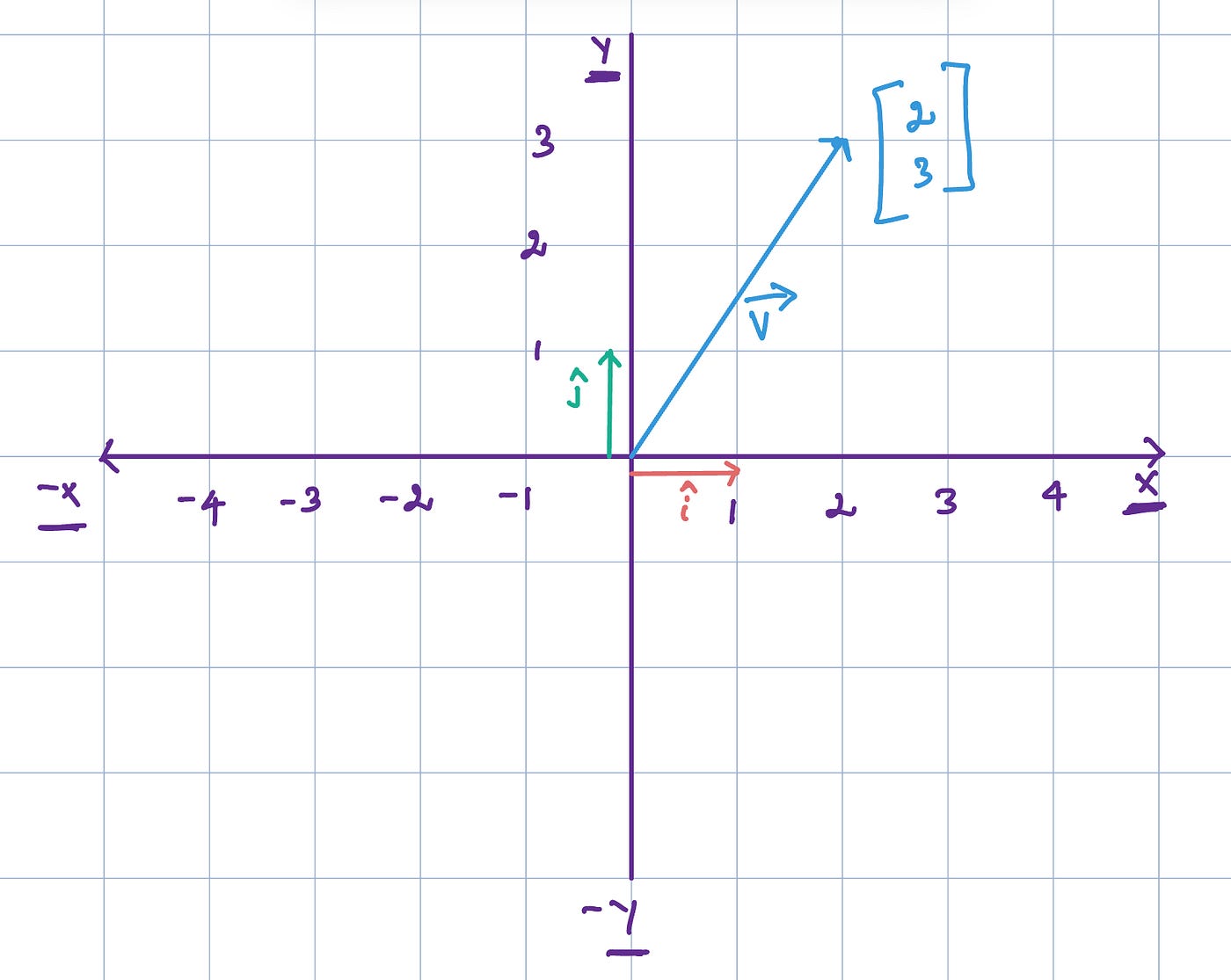
Matrices ( Linear Transformation ): After we have the vectors, we can manipulate them to uncover patterns or group them based on their characteristics. To do this, we need to apply transformations, specifically linear transformations, which serve as the tools for extracting meaning from the data.

Determinants: Determinants help us understand how a transformation affects the scale and volume of vectors in a space

Dot Products: The dot product does measure the similarity between vectors. A positive dot product indicates that the vectors point in the same direction, while a negative dot product indicates that they point in opposite directions. A dot product of zero indicates that the vectors are orthogonal (perpendicular) to each other. This information is indeed useful for understanding how similar or related vectors are, which can help in grouping or clustering them effectively.
- If the dot product of two vectors is positive, it indicates that the vectors point in the same direction. This suggests that the two vectors share common properties or are similar in nature. As a result, we can group these vectors together, as they exhibit similarity.

-
If the dot product is zero, the vectors are perpendicular to each other, indicating that they are independent.
-
If the dot product is negative, the vectors are pointing in opposite directions.
The four concepts mentioned above are fundamental for building a strong foundation in machine learning
메타데이터
- post_id
- 543a4ae8752e
- slug
- linear-algebra-for-machine-learning-543a4ae8752e
- url
- https://medium.com/@stalee.subramani/linear-algebra-for-machine-learning-543a4ae8752e
- canonical_url
- https://medium.com/@stalee.subramani/linear-algebra-for-machine-learning-543a4ae8752e
- author_url
- https://medium.com/@stalee.subramani
- status
- ok
- fetched_at
- 2026-06-29 01:02:39





