Through an Iced-Over Hospital Window, Darkly
Instead of Walking Through the Southern Snow, I’m Learning How to Walk Past the Nurses’ Station
Through an Iced-Over Hospital Window, Darkly
Instead of Walking Through the Southern Snow, I’m Learning How to Walk Past the Nurses’ Station
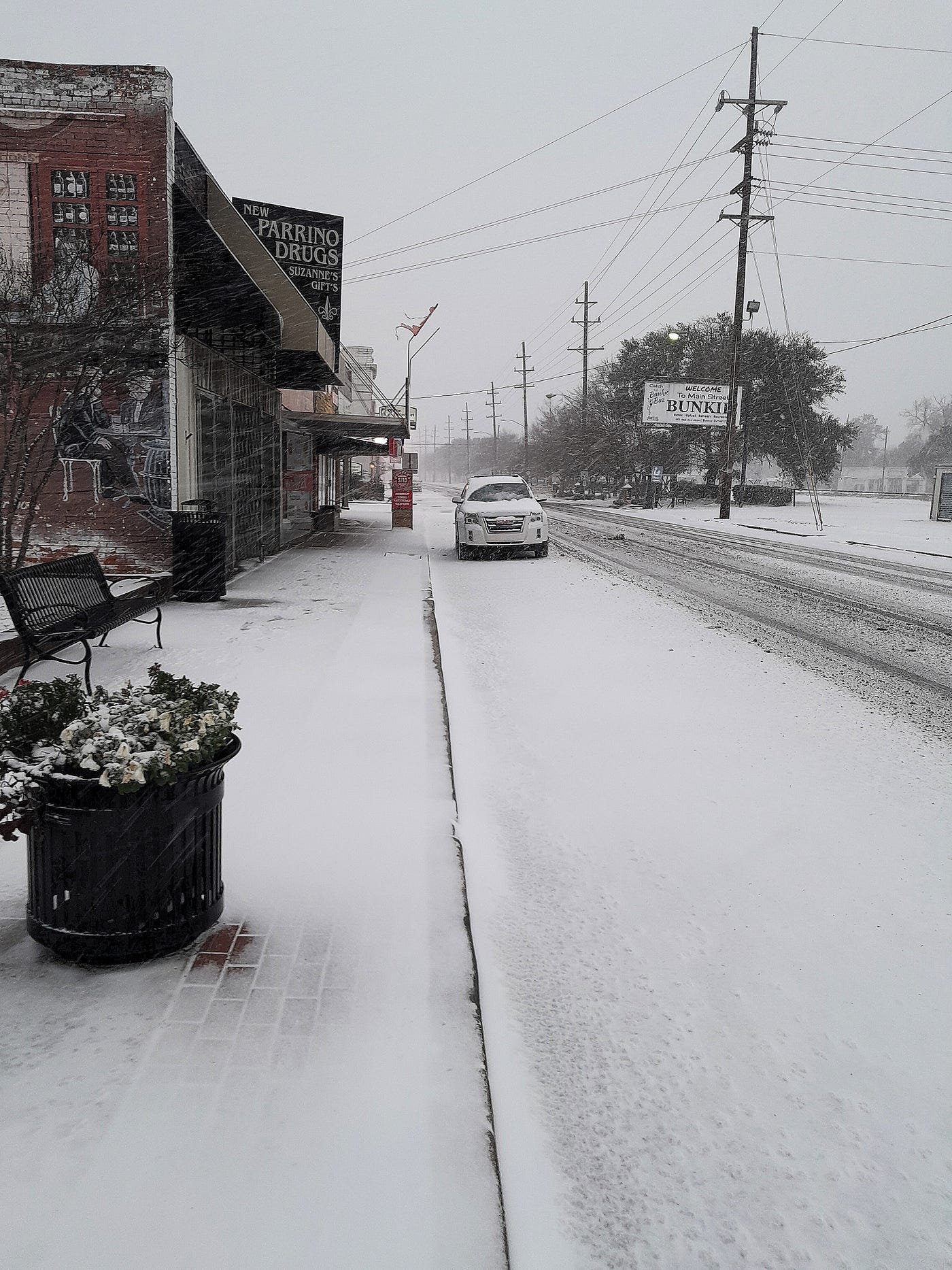
My Louisiana Hometown; Courtesy of Author
Biopsies aren’t like lottery tickets, though the concept is the same.
You choose whether or not to pay for a ticket. Someone else orders your biopsies. On both accounts, the odds are never in your favor, and you’ll be paying for those biopsies for the rest of your life.
For a while, I was engrossed in Wilkie Collins’s The Moonstone, hoping it would cement my attention throughout the three-hour New Year’s Eve ride to New Orleans, but I overestimated my own mettle as all it managed to cement was a legion of brain cells martyred by boredom. After an hour or so I set the book down and re-acclimated myself to the modern world. I stared out the window, marvelling at the clumps of white still scattered about the outskirts of Baton Rouge.
“That can’t be snow still on the ground?” I ask my father, who taps the steering wheel to the beat of another godawful song bouncing off the airwaves of Sirius XM ‘60’s.
“Sure is,” he says. Thus completes one of a handful of conversations we’ll exchange throughout the coming days, even though he leaves my side only when he has no choice. I can’t wrap my mind around the residual clods of slush still lingering from the previous week’s arctic blast.
Silence resumes. It is our connection, the language in which we’ve invested since I was a child. No one seems to understand this.
They told me to shower the night before with a hibiscus rinse. When I woke at 4AM the next morning in the hotel, a single room connected to my father’s adjacent room via a mutual door, I stare at myself in the mirror. I hadn’t slept, but that’s what anesthesia is for. The dizzying swirls of this godawful carpet pattern, infused with the nagging hint of cigarette smoke, bleeds through to my father’s room, from whence I hear the most uncertain of clicks from the first of the two conjoining doors.
I stared one last time at my reflection, the muscles of my shirtless torso in the mirror above the dresser. I was still skinny — 20 years of Crohn’s Disease saw to that, but whereas before I boasted the shape of a child’s stick figure, now I could pass for what Calvin Klein would classify as a plus-sized model.
Granted, I was no Schwarzenegger or Stallone, nor did I aspire to be. But I’d exercised faithfully for years, even after the diagnosis of Crohn’s, even through every prescription cycle of muscle-deflating catabolic steroids and the diagnosis just two years earlier of end stage renal disease. I was still young-ish, and every curve, every contour, the definition of my shoulders and chest — well, my discipline spoke for itself. I’d worked my ass off. I’d driven the tar-black, often foggy 4AM interstate three times a week to Planet Fitness. Even my face had matured, come into its own — better late than never. I replayed the voices of everyone who had belittled me throughout my youth, the silence of everyone who had ignored and dismissed me, the bullies for whom my existence sparked such devastating trauma that they’d no option but to hurt me, the ones who grew up to cower behind the registers of convenient stores glued to their phones, discretely scrolling through photos on Grindr (verified fact). What if they witnessed me standing there, out of context, suffused with the beauty I’d coveted and strived for my whole life? What could they say or do now that could possibly hurt me?
Would they gloat if they knew that I was scheduled to lose all of it in a matter of hours?
“No one’s getting cancer on my watch,” the surgeon said just weeks before. Did I care? I should have told her to accept that there’s a first time for everything, and I’d sooner die than agree to this ritualistic mutilation. And that she could go to hell.
Every day for twenty years I was besieged by a disease that my closest friends, like me, had never heard of. Unable to fit into my shoes, much less walk a mile in them, they couldn’t understand or relate, which is natural and normal. Some of them accepted me, some dismissed me. Sometimes the ones I trusted most outright ridiculed me.
Whatever the case, they all moved forward, into the future, without me.
The hotel was a tediously enormous structure conjoined to Ochsner’s Hospital in New Orleans. The windows afforded a view of the sprawling, gardened courtyard below, an indoor tropic complete with fountains and jungle vegetation, sofas and leather chairs and writing tables. Over the next ten years I would become very fond of its secret nooks, its winding brick paths, its exciting horror movie silence at three in the morning when not a single person — criminal maniac nor kindred spirit — was also wandering through the stillness.
I heard another click of the door and my father stepped into my room. Without uttering a word, he embraced me. Ours was never a physically affectionate family; if it weren’t for the comings and goings at airports, this very well could have been the first time I remember my father ever hugging me.
I woke in a mass recovery warehouse, something akin to a hastily erected tent out of MASH. The nurse assigned to watch over my bedside informed me that eight hours had passed since they’d wheeled me into the O.R. “My best friend had this exact same procedure,” she said. “Best thing that ever happened to him.” She pumped me with a merciful dose of super-morphine before I regained the presence of mind to respond accordingly.
“He’s been an exemplary patient,” one of the doctors remarked at the hour of my discharge, five days later. He was inexplicably young — maybe this was his first gig — and inexplicably sexy, Insanely beautiful. I’d have plunged to the floor just to shine his shoes, pain be damned.
This was my life from now on. Forever.
I wanted to curl up, double over, but every night my father forced me out of the hospital bed, offering his arm as leverage by which to lift myself, and after throwing on a robe I grasped the grip bar along the wall as we walked, slowly, out of my room and down the hall, and, down another hall to the empty TV room where the local meteorologist warned of more arctic weather on the way.
New Orleans had frozen over.
“Do you think it will snow?” I asked.
“Doubtful.”
And the silence resumed as we drove north, into an early darkness whose horizon shed just enough light for me to witness my world inside-out. The slushy, scattered puffs had morphed into blankets and glaciers, and when we got home my cat, an outdoor stray who bunked atop an electric heating pad inside a tiny green house on the back deck, burst into hysterics, rowring and meowing, trying to tell us, “Look! Look at the back yard! What’s happening? Do you understand what’s happening?”
메타데이터
- post_id
- 543cc303edbb
- slug
- through-an-iced-over-hospital-window-darkly-543cc303edbb
- url
- https://medium.com/storyflow-network/through-an-iced-over-hospital-window-darkly-543cc303edbb
- canonical_url
- https://medium.com/storyflow-network/through-an-iced-over-hospital-window-darkly-543cc303edbb
- author_url
- https://medium.com/@ariadnus
- status
- ok
- fetched_at
- 2026-07-11 23:22:18