The AI Layoff Trap: Why Cutting People Too Fast Can Hurt Long-Term Growth
Artificial Intelligence (AI) is transforming industries at an unprecedented pace. From automating repetitive tasks to improving…
The AI Layoff Trap: Why Cutting People Too Fast Can Hurt Long-Term Growth
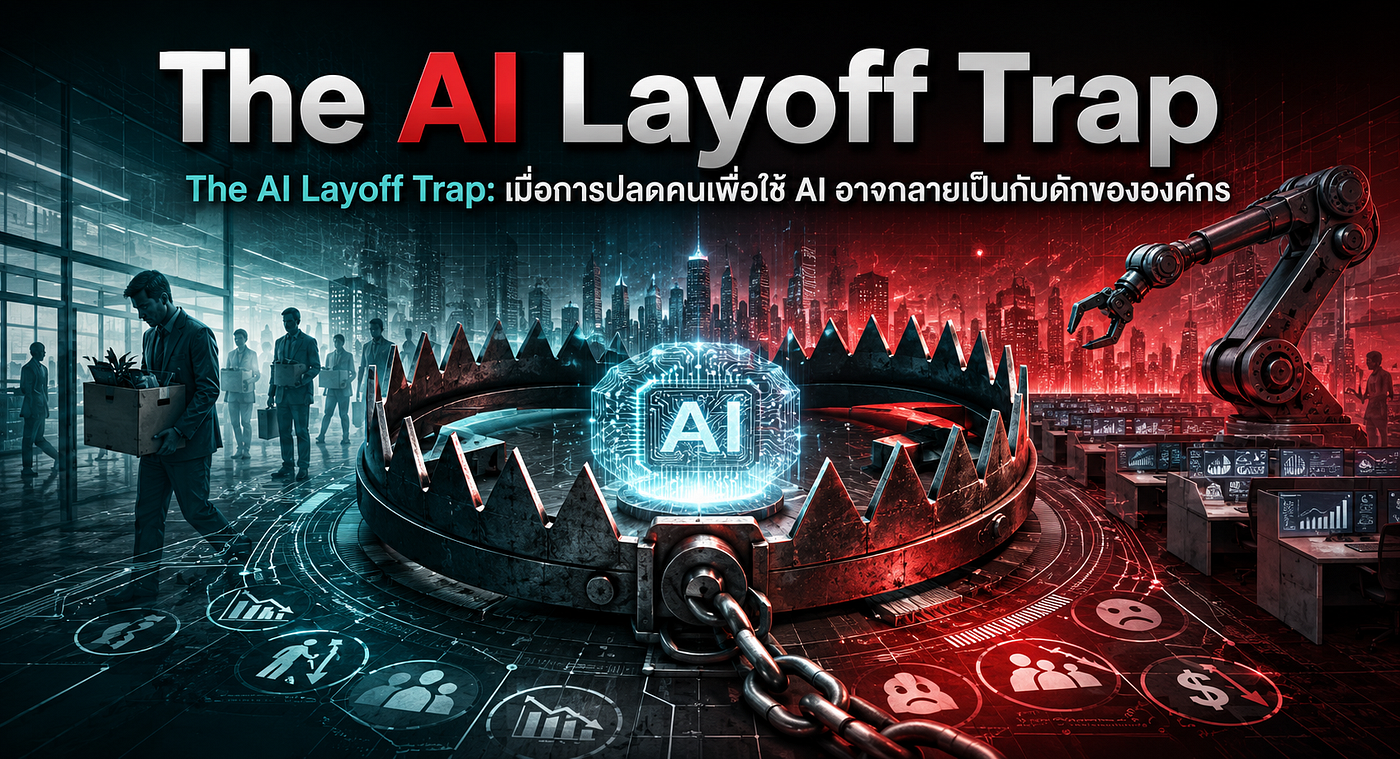
The AI Layoff Trap
Artificial Intelligence (AI) is transforming industries at an unprecedented pace. From automating repetitive tasks to improving decision-making, AI promises higher productivity, lower costs, and faster business growth. As a result, many organizations have rushed to integrate AI into their operations. However, an emerging trend is creating concern across industries: the belief that AI can immediately replace large portions of the workforce. This phenomenon is increasingly referred to as the AI Layoff Trap.
The AI Layoff Trap occurs when companies reduce headcount too aggressively after adopting AI, expecting technology to fully replace human capabilities. While short-term cost savings may look attractive, the long-term consequences can damage innovation, customer experience, organizational knowledge, and overall business resilience.
At first glance, layoffs driven by AI appear logical. Automation can handle data entry, content generation, customer support inquiries, scheduling, and many other routine tasks. Executives often see an opportunity to reduce labor costs and improve efficiency. Shareholders may also reward organizations that demonstrate lower operational expenses.
However, the reality is more complex. AI excels at processing information, identifying patterns, and performing structured tasks. Yet many business functions still require human judgment, creativity, emotional intelligence, ethical reasoning, and strategic thinking. When companies eliminate employees too quickly, they risk losing expertise that cannot be easily replicated by algorithms.
One of the biggest risks is the loss of institutional knowledge. Experienced employees understand company culture, customer behavior, operational challenges, and industry nuances. This knowledge is often undocumented and developed through years of experience. Once these employees leave, valuable insights disappear with them. AI systems can analyze data, but they cannot fully replace context accumulated through human experience.
Customer relationships are another area where excessive reliance on AI can create problems. Many consumers appreciate speed and convenience, but they still value human interaction when facing complex issues or important decisions. Businesses that replace too many customer-facing roles with AI may find that customer satisfaction declines over time. Trust, empathy, and relationship-building remain uniquely human strengths.
Innovation can also suffer. Breakthrough ideas often emerge from collaboration, debate, experimentation, and diverse perspectives. While AI can assist with brainstorming and analysis, it does not possess genuine curiosity or the ability to challenge assumptions in the same way humans do. Organizations that significantly reduce their workforce may unintentionally weaken their capacity for innovation and long-term competitiveness.
Another overlooked challenge is AI management itself. AI systems require training, monitoring, governance, and continuous improvement. They can produce inaccurate information, demonstrate bias, or make recommendations that conflict with business objectives. Skilled employees are needed to oversee these systems, validate outputs, and ensure responsible implementation. Ironically, companies that reduce staff too aggressively may struggle to manage the very AI tools they invested in.
The AI Layoff Trap is particularly dangerous because the financial benefits often appear before the negative consequences become visible. Cost reductions can improve quarterly earnings, but the impact on culture, innovation, and customer loyalty may take months or years to emerge. By the time performance begins to decline, rebuilding lost talent can be expensive and difficult.
Forward-thinking organizations are taking a different approach. Instead of viewing AI as a replacement for people, they see it as a tool that augments human capabilities. Employees are trained to work alongside AI, allowing them to focus on higher-value activities such as strategy, creativity, relationship management, and problem-solving. This human-AI collaboration model often delivers better results than workforce reduction alone.
Reskilling and upskilling are becoming critical strategies. As AI automates routine work, employees can transition into roles that require critical thinking, digital literacy, and specialized expertise. Companies that invest in workforce development are more likely to capture AI’s benefits while maintaining organizational strength.
The future of work will not be defined by AI versus humans. Instead, it will be shaped by how effectively humans and AI work together. Businesses that treat AI solely as a cost-cutting tool may fall into the AI Layoff Trap, sacrificing long-term growth for short-term gains. Those that balance technology adoption with talent development will be better positioned to adapt, innovate, and compete in an increasingly AI-driven economy.
Ultimately, AI is not simply a workforce replacement technology. It is a productivity multiplier. The organizations that thrive will be those that understand a fundamental truth: technology creates value when it enhances human potential, not when it eliminates it indiscriminately.

The AI Layoff Trap
FAQ: The AI Layoff Trap
What is the AI Layoff Trap?
The AI Layoff Trap refers to a situation where companies reduce their workforce too quickly after adopting AI technologies, assuming automation can fully replace human employees. This often leads to hidden long-term costs such as reduced innovation, lower customer satisfaction, and loss of institutional knowledge.
Will AI replace all jobs?
No. While AI can automate many repetitive and predictable tasks, most jobs involve human skills such as creativity, empathy, leadership, critical thinking, and complex decision-making. AI is more likely to transform jobs than eliminate all of them.
Which industries are most affected by AI-driven layoffs?
Industries with highly repetitive workflows, including customer service, administration, data processing, content production, and some manufacturing sectors, are experiencing the greatest impact. However, nearly every industry is being influenced by AI adoption.
How can companies avoid the AI Layoff Trap?
Organizations can avoid the trap by using AI to augment employees rather than replace them, investing in reskilling programs, maintaining human oversight, and focusing on long-term business value instead of short-term cost reductions.
What is the future of human workers in an AI-driven economy?
Human workers will remain essential. The most valuable professionals will be those who can effectively collaborate with AI, leverage technology to increase productivity, and contribute uniquely human capabilities that machines cannot replicate.
In-Depth Analysis Sources Widely Shared Within the AI Community
Although these are not major global mainstream media outlets, they are frequently referenced and discussed across tech and AI communities.
- Border Cyber Group: Their article “The AI Layoff Trap” provides a detailed summary of the research and explores its broader economic implications. https://bordercybergroup.com/the-ai-layoff-trap/
- AI Changing Work: Examines the paper through the lens of game theory, focusing on how competitive pressures between companies can drive excessive AI adoption and workforce reductions. https://aichanging.work/en/blog/ai-layoff-trap-automation-arms-race-wharton-2026
- Nahornyi AI Lab: Explains why market incentives may push organizations toward adopting AI beyond the economically optimal level, potentially creating unintended negative consequences for both businesses and consumers. https://nahornyi.ai/en/news/ai-layoff-trap-over-automation-market-failure
메타데이터
- post_id
- 5487e4c249b3
- slug
- the-ai-layoff-trap-why-cutting-people-too-fast-can-hurt-long-term-growth-5487e4c249b3
- url
- https://medium.com/@AAZZ01/the-ai-layoff-trap-why-cutting-people-too-fast-can-hurt-long-term-growth-5487e4c249b3
- canonical_url
- https://medium.com/@AAZZ01/the-ai-layoff-trap-why-cutting-people-too-fast-can-hurt-long-term-growth-5487e4c249b3
- author_url
- https://medium.com/@AAZZ01
- status
- ok
- fetched_at
- 2026-06-10 10:12:36