From Prototype to Production — Developer Abstractions that Accelerate (Part 7)
By this stage, the system has all the necessary layers in place. Requests are validated before they leave, routed intelligently, executed…
From Prototype to Production — Developer Abstractions that Accelerate (Part 7)
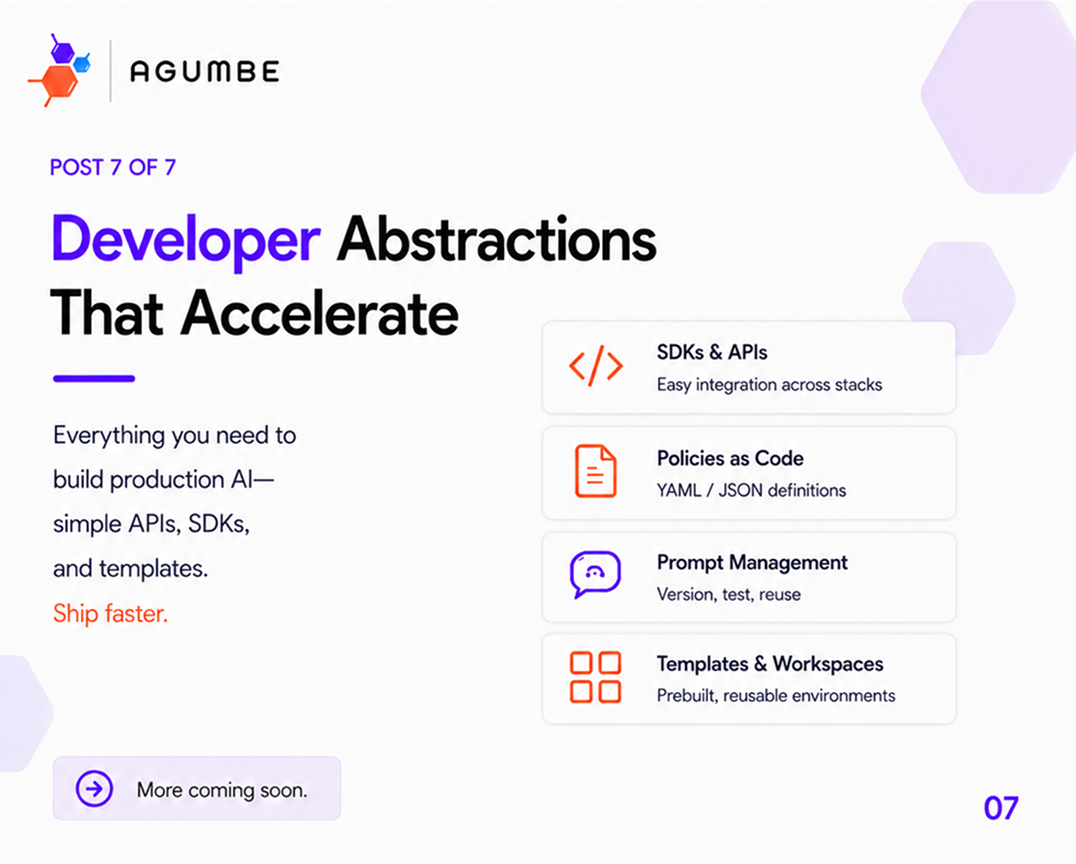
By this stage, the system has all the necessary layers in place. Requests are validated before they leave, routed intelligently, executed within defined cost boundaries, adapted across environments, and fully observable. Each of these capabilities addresses a specific aspect of running AI systems in production, but together they introduce a level of complexity that can be difficult for teams to work with directly.
Why do developers need abstractions?
The challenge shifts from building the system to making it usable. Without clear abstractions, developers are required to understand and manage multiple concerns simultaneously — policies, routing logic, cost constraints, and environment configurations. This often leads to duplication of effort, inconsistencies across services, and an increasing reliance on implicit knowledge rather than shared structure. It’s a cognitive overload.
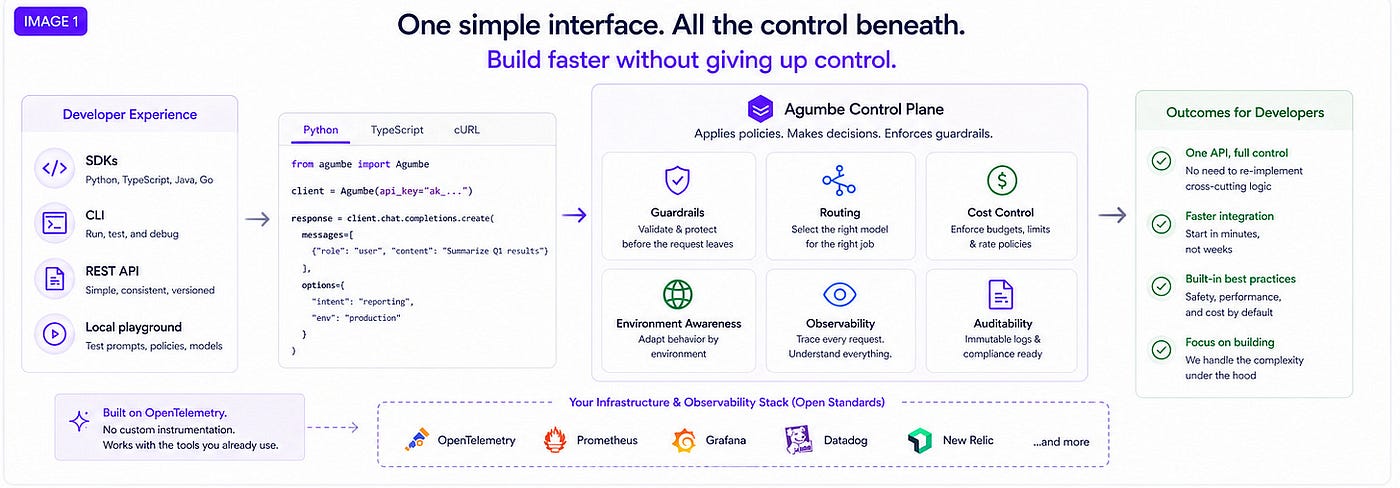
Abstractions address this by introducing a unified interface through which developers interact with the system. Instead of handling each layer independently, requests flow through a single entry point that applies guardrails, selects models, enforces limits, and captures observability by default. This simplifies integration while preserving control, allowing teams to focus on building features rather than orchestrating infrastructure.
Over time, these abstractions extend beyond APIs into structured configurations, reusable templates, and shared workflows. Policies become explicit and versioned, routing strategies can be defined once and applied consistently, and common patterns are reused across teams. This reduces fragmentation and makes system behaviour predictable, even as complexity increases.

What emerges is a set of tools, and a platform that balances flexibility with consistency. Developers can move quickly without bypassing safeguards, and teams can scale systems without introducing instability.
The Need for an AI Control Plane
The control plane enforces rules, enabling a way of building that remains reliable as systems evolve.
Looking across the layers — guardrails, routing, cost control, environment awareness, and observability — it becomes clear that the real value lies in how these capabilities are brought together and made accessible. This is what allows AI systems to transition from isolated prototypes to structured, production-ready systems that can be trusted to operate at scale.
Shared Platform Capabilities
Over time, the control plane becomes more than a gateway. It evolves into a shared platform capability used across teams and products.
New applications inherit observability automatically. Environment-aware policies are applied consistently. Routing strategies become reusable. Audit trails exist by default. Instead of each team solving operational concerns independently, the platform provides these capabilities as standardized building blocks.
This creates a significant shift in how AI systems are developed. Teams spend less time assembling infrastructure layers and more time focusing on product behaviour, user workflows, and business logic.
Reducing Operational Fragmentation
One of the less visible challenges in production AI systems is operational fragmentation. Different teams often introduce different SDKs, different routing strategies, different observability tools, and different governance models. Over time, this creates systems that behave inconsistently despite serving similar purposes.
Developer abstractions reduce this fragmentation by creating a common operational language. Requests follow similar patterns regardless of the application. Policies are enforced consistently. Observability data becomes comparable across teams and environments.
Consistency at this layer is what allows organizations to scale AI adoption without losing operational control.

The Shift from Integrations to Systems
Early AI adoption focused on integrating models into applications. Production AI shifts the focus toward operating systems of behaviour — where governance, routing, observability, and cost management become shared infrastructure concerns rather than isolated implementation details.
Series Summary
This series explored the operational layers required to move AI systems from isolated prototypes to reliable production infrastructure.
We examined how guardrails define what is allowed, how routing determines where requests should go, how cost control keeps systems sustainable at scale, how environment-aware behaviour introduces operational context, and how observability and auditability make AI systems understandable over time.
The final layer focused on developer abstractions and the emergence of the AI Control Plane — a shared operational layer that brings governance, routing, cost management, environment policies, and observability together into a consistent system that teams can build on reliably.
Together, these layers represent a shift from simply integrating models into applications toward building structured, governable, and scalable AI systems.
메타데이터
- post_id
- 548fed473201
- slug
- from-prototype-to-production-developer-abstractions-that-accelerate-part-7-548fed473201
- url
- https://itnext.io/from-prototype-to-production-developer-abstractions-that-accelerate-part-7-548fed473201
- canonical_url
- https://itnext.io/from-prototype-to-production-developer-abstractions-that-accelerate-part-7-548fed473201
- author_url
- https://medium.com/@santoshpai
- status
- ok
- fetched_at
- 2026-06-09 15:37:30