The Trump Phenomenon
Leadership, Illusion, and the Crisis of Modern Democracy
The Trump Phenomenon
Leadership, Illusion, and the Crisis of Modern Democracy
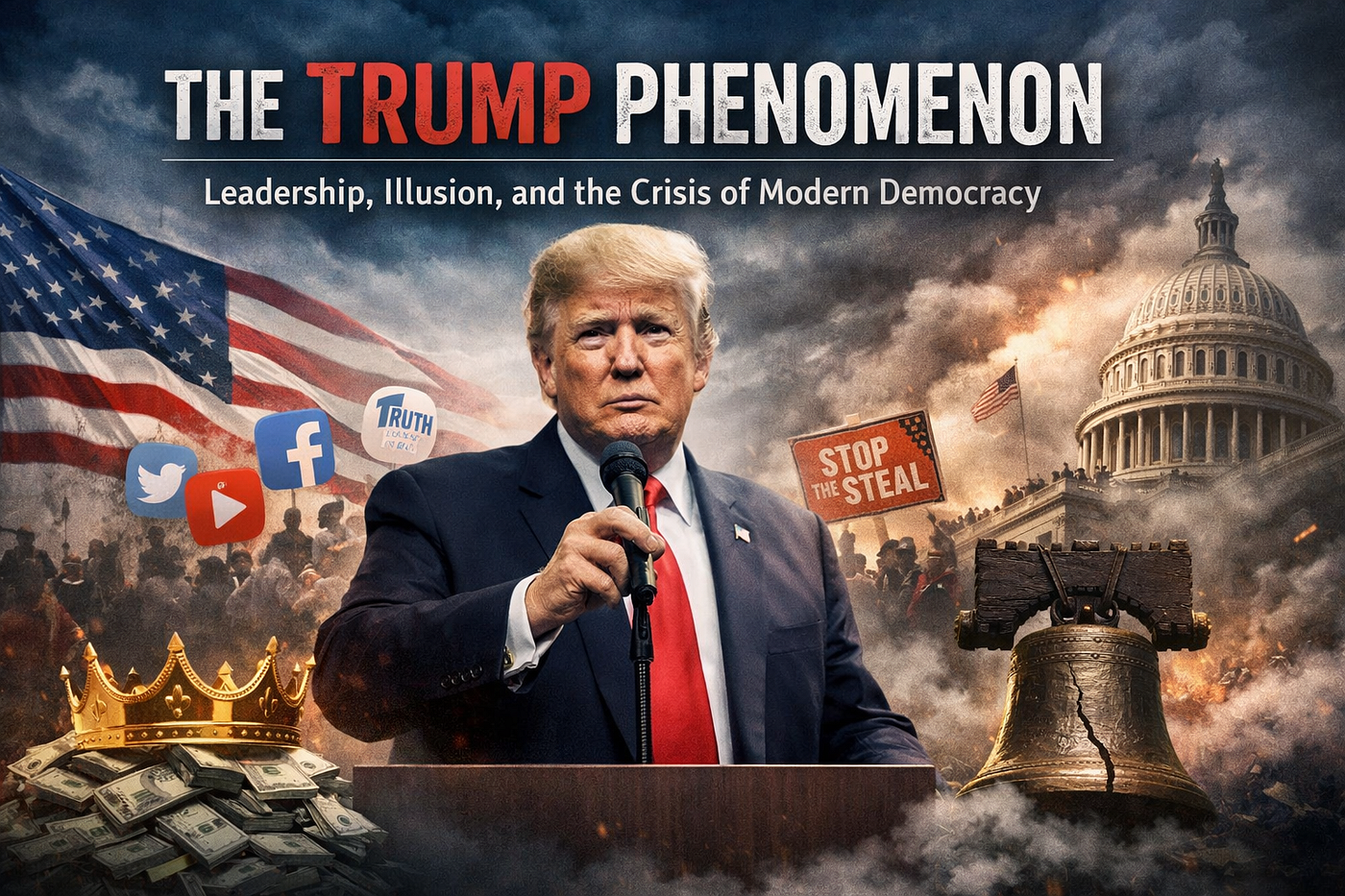
How one man reflects not just personal contradictions but systemic cracks in global politics
A Leader or a Projection?
In the 21st century, leadership is no longer defined solely by governance. It is shaped, amplified, and sometimes distorted by perception.
A leader today can be controversial, inconsistent, and deeply polarizing — and yet still be seen as decisive, powerful, even heroic. Few figures embody this paradox as vividly as Donald Trump.
This raises a deeper and more uncomfortable question: Is Donald Trump an outlier in modern politics or is he a product of a system that increasingly rewards spectacle over substance?
A Life That Invites Both Admiration and Doubt
Donald Trump’s story is often told as one of success of business dominance and political victory. But beneath that narrative lies a far more complex and turbulent reality.
His life has been marked by controversy, legal battles, and a constant presence in the public eye. While certain personal choices suggest discipline, his public conduct has often raised questions about consistency, temperament, and judgment.
This duality success on one hand, instability on the other is what makes him both compelling and deeply polarizing.
The Age of Amplification
To understand Trump’s rise, one must understand the age he rose in.
The 2016 U.S. election was not just a political contest; it was a demonstration of how powerful narratives can become when amplified through modern media ecosystems. The FBI’s investigation into Hillary Clinton’s use of a private email server became a defining issue, shaping public perception at a critical moment and influencing the trajectory of the election.
In this new environment, perception did not just influence reality it began to override it.
When Crisis Reveals Leadership
Every leader is eventually tested by circumstances beyond their control.
For Trump, that test came in the form of the COVID-19 pandemic. As the United States crossed the grim milestone of over one million deaths, questions around leadership, communication, and preparedness became unavoidable. Public health experts pointed to inconsistent messaging and delayed responses as factors that complicated the national response.
Moments of crisis tend to reveal more than they conceal. And in this case, they reshaped how leadership itself was being evaluated.
A Democracy Under Strain
If the pandemic tested leadership, the 2020 election tested democracy.
The events of January 6, 2021, when a mob stormed the U.S. Capitol, marked a moment of profound institutional stress. The attack followed weeks of claims that the election had been stolen claims that were repeatedly rejected by courts and election officials.
This was not just a political dispute. It was a moment that forced a nation to confront the resilience of its democratic foundations.
Reality Check: Stepping Back from the Narrative
At this point, it becomes necessary to step away from rhetoric and examine what can be verified.
Donald Trump first rose to the presidency in 2016, lost the election in 2020, and returned again in 2024 an arc that reflects deep and persistent political polarization in the United States. The FBI’s investigation into Hillary Clinton’s emails undeniably influenced voter sentiment during the 2016 election, while the claims surrounding the 2020 election were dismissed across multiple legal and institutional channels.
The United States’ experience during COVID-19, with over one million deaths, brought leadership decisions under intense scrutiny. Similarly, bold claims regarding economic transformation and rapid geopolitical resolutions have often struggled to find validation in measurable outcomes.
At the same time, the high turnover within administrative roles points toward a leadership style that appears to prioritize personal loyalty over institutional continuity.
The Gap Between Promise and Reality
Campaigns thrive on certainty. Governance operates within constraints.
Trump’s political messaging has often relied on bold, sweeping promises — on trade, global negotiations, and conflict resolution. Yet the realities of global interdependence and institutional limitations tend to resist such simplification.
Over time, the gap between what is promised and what is delivered becomes increasingly visible.
Leadership and Loyalty
One of the defining patterns of Trump’s leadership has been the frequency with which key officials have been replaced. While leadership changes are not unusual in any administration, the scale and speed of turnover raise important questions about stability.
When leadership becomes closely tied to personal allegiance, institutions themselves risk becoming fragile.
A Larger Question About Democracy
It would be easy to view Donald Trump as an exception. But doing so may overlook the more important truth.
His rise reflects deeper shifts toward a politics shaped by perception, driven by amplification, and sustained by polarization.
If a system allows such a figure to rise, thrive, and return, the issue cannot be reduced to the individual alone. It must also include the structures, incentives, and vulnerabilities within the system itself.
A Personal Reflection and a Concern
There is one thought that lingers beyond analysis.
I sincerely hope that the youth of the United States and across the world do not come to idolize Donald Trump.
Not because he is controversial, or unconventional. But because he reflects very little of the enduring values that define meaningful leadership integrity, humility, accountability, and responsibility.
The real concern is not about one leader. It is about what future generations begin to admire and emulate.
Closing Thought
Leadership shapes societies. But societies also shape their leaders.
If we begin to celebrate spectacle over substance, power over principle, and noise over nuance, we risk redefining leadership itself.
And that shift, once it takes hold, may be far more lasting than any one political figure.
References
- FBI (2016): Statement on Hillary Clinton Email Investigation
- CDC: COVID-19 Data Tracker
- U.S. House Select Committee (2022): January 6 Report
- UNCTAD: World Investment Report
- Brookings Institution: Trump Administration Turnover Analysis
메타데이터
- post_id
- 54f2cba6c2c5
- slug
- the-trump-phenomenon-54f2cba6c2c5
- url
- https://medium.com/@spmishrais/the-trump-phenomenon-54f2cba6c2c5
- canonical_url
- https://medium.com/@spmishrais/the-trump-phenomenon-54f2cba6c2c5
- author_url
- https://medium.com/@spmishrais
- status
- ok
- fetched_at
- 2026-06-28 14:26:31