The Inner Architecture of Courage
How do ideas form personality and the purpose of life?
The Inner Architecture of Courage
One statement.
This one statement, made by one of the most influential people in my life, has been etched in my mind for a very long time. He said, “Every human psyche is a living psychology textbook.” Such a profound thought. As they say, learning can come from any angle when the receiving end is prepared enough to get illuminated. On this basis, I am attempting a small experiment in my writing today.
Truth be told, it may not be a novel idea, but I felt compelled to take you through the psyche of a single personality over his lifetime, sneaking through the inner workings of human evolution, its struggles, and ultimately finding direction. Yes, you heard me right. I am going to walk you through this one person’s thoughts, documented from his days as a high school student to his emergence as a grown man. This could be relatively longer writing, but you HAVE to feel this, my friend. “FEEL” is the keyword here. In doing so, we will see how personality is shaped by strong inner conviction and how a meaningful life begins to take form, if at all, when you listen to your calling.
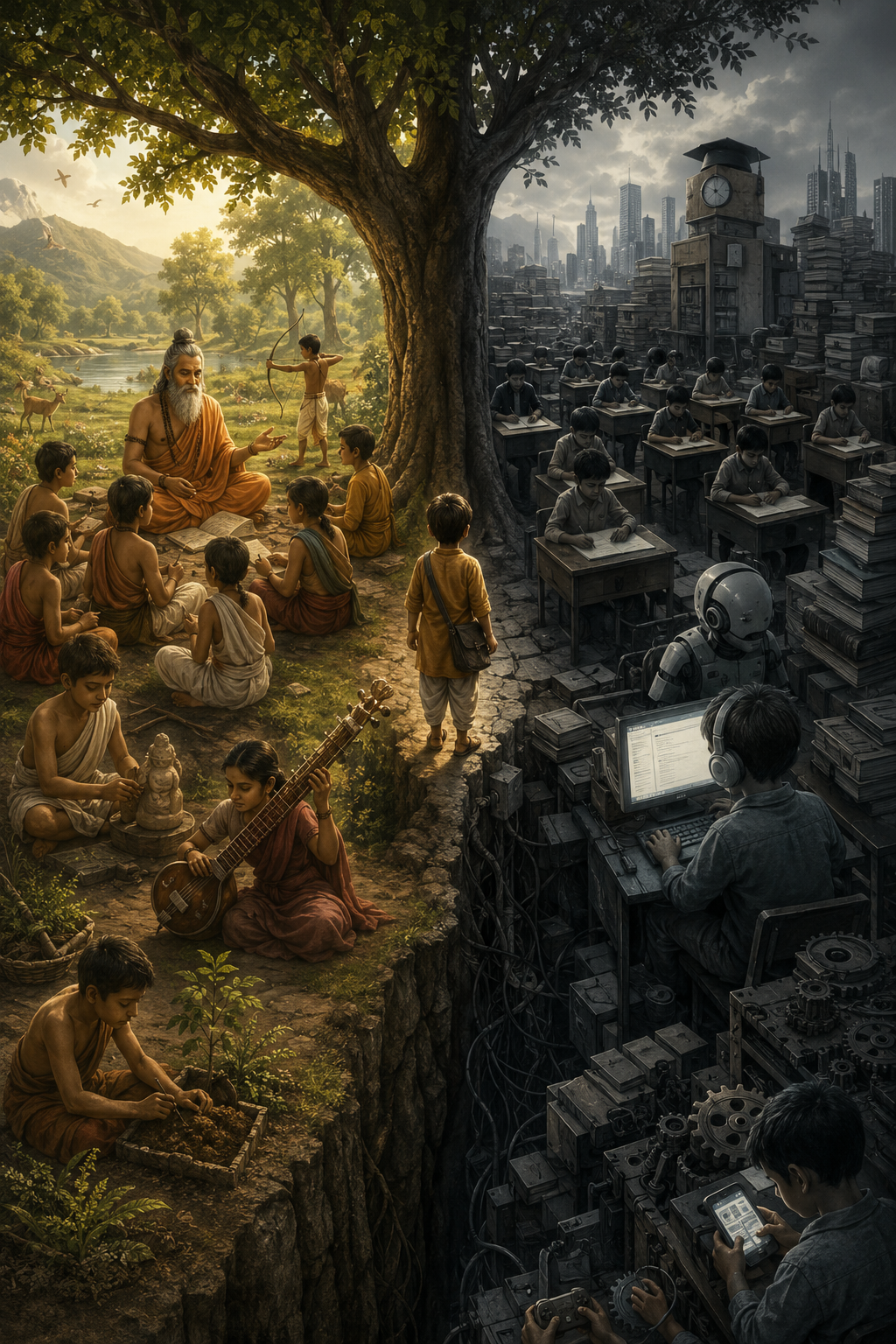
To set the context, imagine zooming out on the life of a high school boy who had just begun studying great works such as The Mahabharata, the poems of Wordsworth, and the verses of Kalidasa, all due to his headmaster’s insistence.
Reflecting on that influence, he later wrote:
“My headmaster had roused my aesthetic and moral sense — had given a new impetus to my life, but he had not given me an ideal to which I could give my whole being.” No doubt these works deeply influenced him. Yet, as his mind matured, he entered into a kind of mental state, as he puts it, ‘one of the stormiest periods of my psychological life’. Mental health, you ask? Let us hear his own description of the inner turmoil that did not leave him for almost six years. He writes:
“It was a period of acute mental conflict causing untold suffering and agony, which could not be shared by any friends and was not visible to any outsider…. After a long-term crisis of adolescence, I had in some respects a touch of the abnormal in my mental makeup. Not only was I too much of an introvert, but I was in some respects precocious. The result was that at an age when I should have been tiring myself out on the football field, I was brooding over problems which should rather have been left to a more mature age. The mental conflict, as I view it from this distance, was a two-fold one. Firstly, there was the natural attraction of a worldly life and of worldly pursuits in general, against which my higher self was beginning to revolt. Secondly, there was the growth of sex-consciousness, quite natural at that age, but which I considered unnatural and immoral, and which I was struggling to suppress or transcend.”
This was the early twentieth century. Yet these struggles feel strikingly familiar even today. Almost everyone, at some point in adolescence, is exposed to the real world, its desires, expectations, temptations, and moral ambiguities. What stands out here is one phrase: “I was struggling to suppress or transcend.” That tendency to feel this as a struggle itself demands immense inner strength and moral resolve.
Skipping several parts for brevity, anyway, one is bound to see light after passing through a tunnel, we next encounter a transformed voice. The same individual, once tormented by inner conflict and searching for a foundational principle to build his life upon, writes to his mother years later:
“Let suffering remain my constant companion, then alone will I be able to remember you (God) from the bottom of my heart. Amidst happiness and prosperity, I may forget you, therefore I have no need of pleasures of life…. Oh! How much we weep for the trifles of the world, but we don’t shed any tears for want of God. Mother we are more disloyal and stone-headed than animals. Fie on the education, in which there is no name of God and worthless is the life of that man who does not repeat the name God!”
Can you believe it? I’m sure you won’t be surprised now, but by the end of this read, you are bound to get surprised. Let’s get ahead.
He repeats with even greater intensity:
“Fie on the education, in which there is no name of God, and worthless is the life of that man who does not repeat the name of God!”
Later still, he reflects:
“The Lord has befooled us with the toys of temptation and has kept us entangled in His Maya. Our Divine Mother is also playing with us in a similar way. God cannot be realized unless we give Him the whole of our mind.”
And then, in a letter to his brother, his concern expands beyond the self to the nation:
“How wonderful was the condition of India and what it has become now! What a pathetic change! …. Everything is gone… But still we have some hope; to remove darkness from our hearts and to illumine it with infinite light, the messenger of hope has arrived. It is Vivekananda… A brighter future is India’s destiny.”
You now know the reason for such a tremendous transformation. It dawned on him from two majestic personalities: Swami Vivekananda and Bhagavan Sri Ramakrishna.
You focus on his words now more than mine :)
“I was barely fifteen when Vivekananda entered my life. Then there followed a revolution within and everything was turned upside down. It was, of course, a long time before I could appreciate the full significance of his teachings or the greatness of his personality, but certain impressions were stamped indelibly on my mind from the outset. Both from his portraits as well as from his teachings, Vivekananda appeared before me as a full-blown personality. Many of the questions which vaguely stirred my mind, and of which I was to become conscious later on, found in him a satisfactory solution. My headmaster’s personality ceased to be big enough to serve as my ideal. I had previously thought of studying philosophy as he had done and of emulating him. Now I thought of the path which Vivekananda had indicated. From this study, I emerged with a vivid idea of the essence of his teachings.”
The influence deepened further:
*“Atmano Mokshartham Jagaddhitaya” *— for your own salvation and for the service of humanity — that was to be life’s goal… Talking of the future, he had remarked that the Brahman (religious caste), the Kshatriya (warrior caste), and the Vaisya (trader caste) each had had their day and now came the turn of the Sudras, the downtrodden masses. To the ancient scriptures, he had given a modern interpretation. Strength, strength, is what the Upanishads say, he had often declared; have faith (shraddha) in yourselves as Nachiketa of old had.”
Just feel the energy in his thoughts:
“I had a new ideal before me now, which had inflamed my soul — to effect my own salvation and to serve humanity by abandoning all worldly desires and breaking away from all undue restraints. I no longer recited Sanskrit verses inculcating obedience to one’s parents; on the contrary, I took to verses which preached defiance. Ramakrishna’s example of renunciation and purity entailed a battle royal with all the forces of the lower self. And Vivekananda’s ideal brought me into conflict with the existing family and social order.”
Gradually, clarity emerged:
“It slowly dawned on me that for spiritual development, social service was necessary… to serve the poor is to worship God.”
By the end of his college life, he arrived at firm resolutions:
He became deeply engaged in his spiritual quest and selfless service, but still he wanted to realize his mission in this lifetime. He came to a conclusion by the end of his college life. Thus: “I had by then made certain definite decisions for myself — I was not going to follow the beaten track, come what may; I was going to lead a life conducive to my spiritual welfare and the uplift of humanity; I was going to make a profound study of philosophy so that I could solve the fundamental problems of life; in practical life I was going to emulate Ramakrishna and Vivekananda as far as possible and, in any case, I was not going in for a worldly career.”
Emulate Swami Vivekananda and Sri Ramakrishna?!
Practically, he notes:
“I had stood up with courage and composure in a crisis… I had developed self-confidence as well as initiative… In short, I had acquired character and could face the future with equanimity.”
With this in mind, he went on to attend a foreign school for his higher studies, and when we came back to India, he was still not sure as to what to do in his life.
“I have not been able to decide yet what I shall do. Sometimes I feel like the Ramakrishna Mission. At others time I feel like going to Bolpur. And then again, I have a desire to become a journalist. Let us see what happens.”
After finding himself in a philosophical mixture of conflicts and with a deep passion for his guru, Swami Vivekananda, he says in one of his letters to his friend,
“Of what you have written about Sri Aurobindo, I agree with most…. but I have a profound reverence for Vivekananda… I think, for the majority of the people, the performance of duty and work in the spirit of service should be the main plank of their Sadhana. For a variety of reasons, our nation has been incessantly deviating from the sphere of action; therefore, today we badly need a ‘double dose ‘ of Rajas — the spirit of action.”
“I cannot write about Vivekananda without going into ruptures. Few indeed could comprehend or fathom him.”
“And his love for his downtrodden people! That was ocean like. Do you remember that message of his, “Say brothers! “The naked Indian, the illiterate Indian, the pariah Indian is my brother.”… Say brothers at the top of your voice! — “India’s Gods and Goddesses are my Gods. India’s good is my good”- and pray day and night, “Oh, Thou Lord of Gauri, Oh Thou mother of strength! — take away my weakness, take away my unmanliness and make me a man!” ‘
Thus, Subhas Chandra Bose initiated the struggle for the freedom of the motherland in the spirit of ‘Karma Yoga’.
The rest is history!
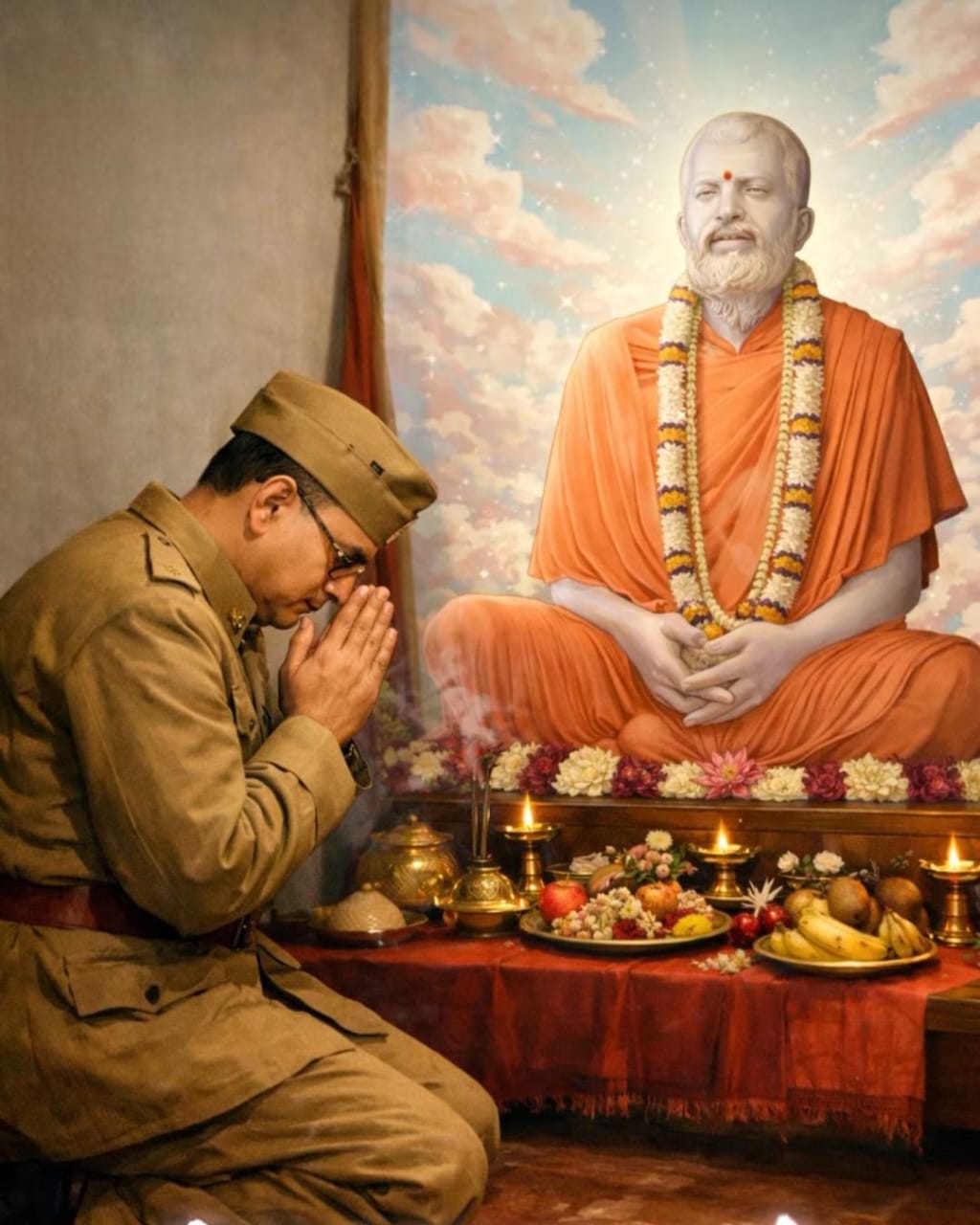
Happy Parakram Divas
— Avyakt
메타데이터
- post_id
- 54f338ddb00a
- slug
- the-inner-architecture-of-courage-54f338ddb00a
- url
- https://medium.com/@suvyakta/the-inner-architecture-of-courage-54f338ddb00a
- canonical_url
- https://medium.com/@suvyakta/the-inner-architecture-of-courage-54f338ddb00a
- author_url
- https://medium.com/@suvyakta
- status
- ok
- fetched_at
- 2026-06-21 19:25:17