The Post-Production Building Is Already Empty
A practical framework for deciding what stays in the room and what moves to the cloud
The Post-Production Building Is Already Empty
A practical framework for deciding what stays in the room and what moves to the cloud
Not yet a Medium Member? Read this article for free here.
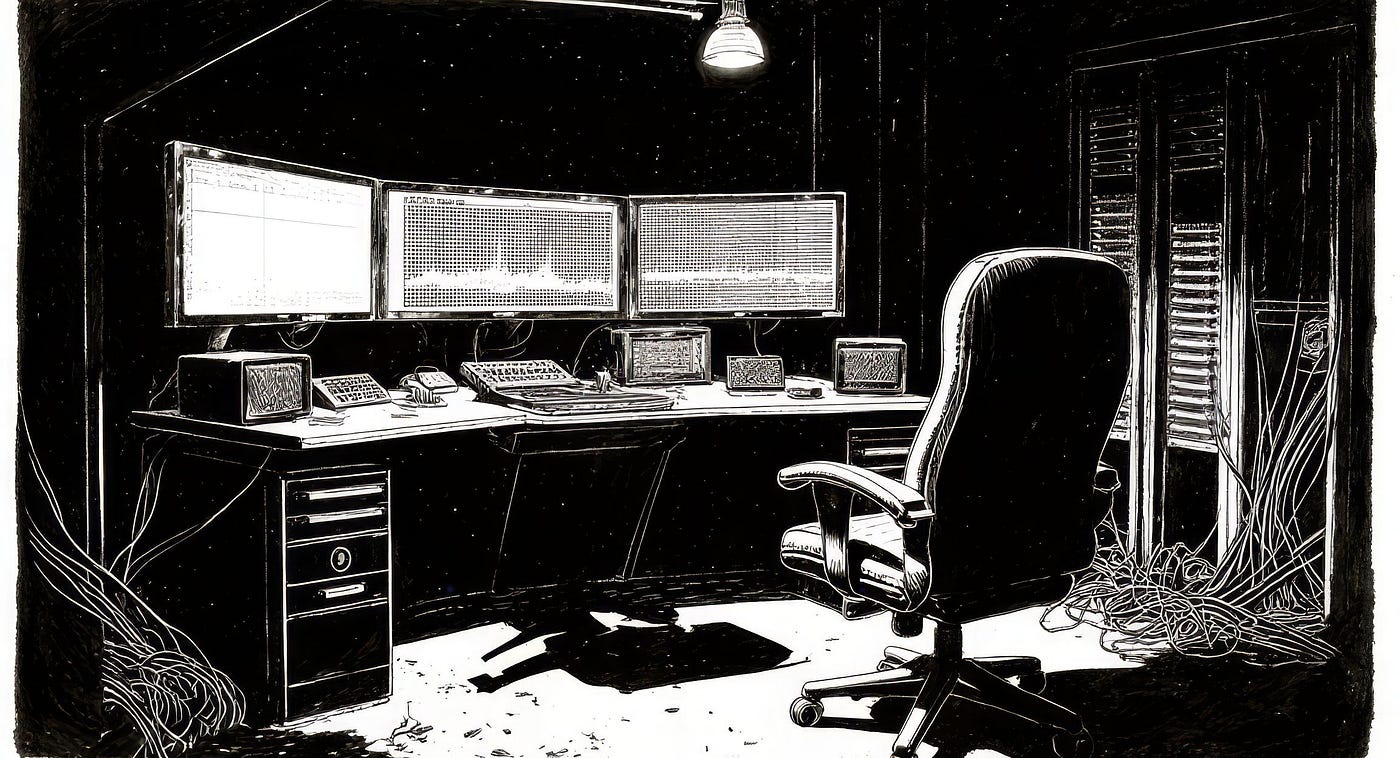
Walk through a few post-production buildings these days and you’ll notice something. Half the suites are dark. Not closed, just empty most days, because the artist assigned to that bay is working from a spare room in Manila, or a converted garage in Wellington, logged into a cloud session instead of sitting in the chair. The building is still there. The work has mostly moved out.
That image is a good place to start, because it sits at the center of a debate that comes up at almost every industry panel right now. Shared roof versus cloud distributed. Which one is the future of post. Both sides make a real case. Both sides are also missing the more useful question, so let’s back up and look at how we got here.
How Post-Production Used to Work
For most of the digital era, post-production ran on one model, and it wasn’t really a choice. A facility owned or leased a building. That building held the storage servers, the color suites, the mix stages, the render farm, and the staff who ran all of it. If a studio needed a grade, an edit, or a finish, the work happened in that building, on that hardware, because the footage lived there too.
Moving footage anywhere else meant physical media: hard drives, LTO tapes, couriers. An 8K camera package was heavy in every sense, and shipping it across town, let alone across an ocean, cost time and carried real risk. So facilities built everything they needed under one roof, and “the building” and “the company” were basically the same thing. Decisions and execution happened in the same rooms, because there was nowhere else for either one to happen.
Two Roads Out of the Old Model
Two pressures broke that model apart, and they pulled in different directions.
The first pressure was cost. Running a building full of suites, servers, and staff is expensive whether those suites are full or empty. Independent artists and small studios started sharing buildings, splitting the lease, the gear, and the overhead, while each unit kept its own clients and identity. Call this shared roof. The address is shared. The companies inside it are not.
The second pressure was the cloud. As bandwidth improved and remote display technology got good enough for color-critical work, facilities realized the footage didn’t need to sit in their building at all. It could sit in a secure cloud environment, and artists could connect to virtual workstations from wherever they happened to be, seeing the same frame, in close to real time, as if they were at the desk next to the server. Call this cloud distributed.

The Cloud Distributed (Zero-Egress Architecture) Workflow of Love Hurts. All departments and vendors work with and sync to one central set of master data. (Source “Learning to Love End-to End Cloud Production in Love Hurts”, Movielabs.)
At the high end, this cloud model has a more formal name worth knowing, because you’ll start hearing it from vendors: Zero-Egress Architecture. The idea is simple even though the engineering underneath isn’t. The footage never leaves the secure cloud environment. Artists don’t download copies to work on. They connect to the data, work on it remotely, and the only thing that travels back to their screen is a video stream, not the file itself. Nothing gets exported, copied, or emailed around, which is the entire point. Every exported file is a copy that can be lost, leaked, or fall out of sync with the master, and Zero-Egress is designed to remove that risk from the workflow.
This isn’t theoretical. Universal’s Love Hurts production, working with Company 3, Pixelogic, and AWS, ran a real end-to-end version of this model. One central cloud store, 325 terabytes of data, with dailies, VFX plate pulls, conform, color grading, and digital cinema mastering all running against that single source. The result was a 75% time savings in marketing editorial and a 50 to 60% reduction in the time it took to produce digital cinema packages.
[embed]
The Collapsed Variable
Here’s where the debate tends to go sideways. Shared roof and cloud distributed (or Zero-Egress at the high end) get treated as two ends of one spectrum, like a dial you turn from “old way” to “new way.” They’re not. They describe two different things.
Shared roof is about who owns the address. Cloud distributed is about where the footage and the labor actually sit. Those can mix in ways the spectrum picture doesn’t allow for. A shared-roof building in Burbank can have every desk connected to a Zero-Egress cloud environment, with artists logging in from Manila, Lagos, or Wellington. A fully cloud-distributed company can also have every employee living in the same city, working from home, never sharing a roof at all.

Treating these as one axis makes for a tidy chart. It just doesn’t describe how any of this actually works.
The Strongest Case for Shared Roof
Before going further, it’s worth taking the shared-roof side seriously, because the argument holds up.
Trust gets built in rooms. A VP of Post can walk into a building, sit next to the colorist, and watch a reel on a calibrated monitor. In twenty minutes, she gets a read on the team that no deck or call replicates, and that read often decides whether a season’s work goes to this vendor or another one.
There’s also the apprenticeship case. A junior colorist learns by watching a senior’s hands move across the panel, catching the pause before a node gets added, the small adjustments that never make it into a written note. That kind of learning happens through proximity.
And there’s security. TPN compliance and the MPA’s Content Security Best Practices were written with controlled physical spaces in mind. When unreleased footage, a lead actor’s likeness before clearance, or biometric data is involved, having that material inside an audited building with a known address answers a lot of jurisdiction questions before they get asked.
The Strongest Case for Cloud Distributed (and Zero-Egress)
Now the other side, because it’s just as strong.
Start with the talent pool. A senior colorist in Manila can deliver the same grade as a colorist in Los Angeles, for a fraction of the day rate, and that gap keeps widening as LA costs rise and remote talent pools deepen.
This also isn’t new. Distributed post on episodic television has been the quiet default for over a decade. Conform, paint, roto, and render have been farmed out across time zones since the outsourcing wave of the 2000s, long before anyone called it “the future.”
What Zero-Egress changes is the security and version-control argument that used to favor shared roof. In the old model, sending footage to a remote artist meant sending a copy, a “liability packet” that could be lost, leaked, or fall out of sync with the master. In a Zero-Egress model, nothing leaves. The remote artist works on the same single source of truth as everyone else, which is exactly what Universal’s S3-based setup did on Love Hurts, with thirteen external teams onboarded onto one bucket under role-based access.
And there’s the cost structure. The facility tax was never really the rent. It was the cost of the next seat, the next workstation, the next license. Cloud infrastructure pushes that number close to zero, and once it’s close to zero, the case for the building as the thing that justifies cost gets a lot harder to make.
The Real Line: Front Room and Engine Room
Here’s a more useful way to look at all of this. The line that actually matters doesn’t run between shared roof and cloud distributed. It runs between decisions and execution. Think of them as the front room and the engine room.
The engine room is where execution happens: conform, paint, roto, render, QC, mastering. As the Love Hurts case shows, this work can run entirely in the cloud, against one shared dataset, with people in Vancouver, Los Angeles, and New York all touching the same files. None of that requires anyone to be in the same building, or even the same country.
The front room is different. It’s wherever an irreversible decision gets made, by the people who own the risk, looking at the same frame at the same moment. That can be a physical screening room. It can also be a virtual session where a director, a DP, and a colorist watch the same render live, even if they’re three time zones apart. A front room isn’t defined by its address. It’s defined by the decision: synchronous, high-trust, hard to undo.

A comparison from outside post-production might help here. An oil company doesn’t run its rigs from headquarters. Drilling happens in remote fields, with crews and equipment that move to wherever the geology points. But the decision to greenlight a well, the one that puts real money at risk, happens in a boardroom, with a small group of people in the same chairs. Nobody calls that boardroom outdated because the rigs sit somewhere else. They’re different functions, sized for different reasons.
Seen this way, a shared-roof collective plays a different role than a cloud-distributed engine room. Think of it as the boardroom. It’s where the people who carry the risk on a project gather, because the stakes justify the cost of the room. The independent units sharing that space are sharing something more valuable than rent: proximity to the people who make the calls.
This also explains why things go wrong when the wrong work ends up in the wrong room. The Love Hurts team learned this with their trailer workflow. Trailer graphics stayed on-prem, so having the trailer’s conform live in the cloud created friction, since the team didn’t have a fast way to move data between the two. Execution work ended up needing a front-room setup it wasn’t built for. Run the mistake the other way, and you get an irreversible sign-off, like a final color approval, handled through an async review link instead of a live session. The director’s read of the room doesn’t match what the thread implied, and the cost of that mismatch shows up later as an expensive redo.
A Reference Framework: When to Choose Which
Here’s a framework worth keeping on hand for the next budget conversation or vendor decision. It works by asking two questions about any given stage of a project, then checking two factors that can override the answer.
Question 1: Is this stage a decision, or is it execution?
A decision is anything where someone has to look at the work and accept the risk of moving forward: a color grade getting locked, a mix getting approved, a final cut getting signed off. Execution is anything that can be checked against a spec: did the conform match the EDL, does the render match the LUT, does the deliverable meet the technical spec for the platform it’s going to.
If it’s a decision, lean toward a front room, physical or virtual. If it’s execution, lean toward the engine room, which today usually means cloud distributed or Zero-Egress.
Question 2: Does someone need to be in the room to own the risk?
Some decisions can be made asynchronously, with a written sign-off. Others can’t, because the read of the room matters as much as what’s on screen. A junior team member learning the craft by watching, or a director making a call that’s hard to walk back once locked, both fall into this category. If the answer is yes, build that moment around a front room, even a virtual one, with everyone watching the same live stream.
Override 1: Security and IP tier
Some material carries its own requirements regardless of where the decision sits. Unreleased footage, masters, biometric or likeness data, and anything tied to TPN or MPA Content Security Best Practices compliance needs an audited environment. That can be a physical facility or a Zero-Egress cloud setup with the right access controls and a security audit behind it. What it can’t be is an ungoverned mix of personal laptops and email attachments.
Override 2: Cost and scale
Watch for two specific costs. The first is the facility tax, the marginal cost of adding the next seat, workstation, or license in a physical building. The second is the egress cost, the fee some cloud providers charge to move large volumes of data back out of their environment, which can run into six figures on a single petabyte-scale project. Stages that need to flex hard and fast, like a VFX crunch week or an episodic delivery wave, generally favor cloud-distributed setups, because they can scale up and back down without either of these costs piling up.

Putting it together
For most productions, the practical answer is one small, fixed front room, rarely more than four or five seats, for the handful of irreversible calls a project actually needs, paired with an engine room sized to flex with the workload, wherever in the world that workload happens to sit.
The front room stays constant. The engine room breathes.
That’s the framework on its own. The next question is what it looks like inside a real organization. Not a diagram on a whiteboard, but actual pipelines, actual vendors, actual teams making these calls every week, across pre-production, production, and post. That’s where the next piece picks up.
Key Takeaways
- Post-production used to require one building because the footage, the gear, and the decisions all had to live in the same place. That requirement is gone.
- Shared roof describes who owns the address. Cloud distributed, or Zero-Egress at the high end, describes where the footage and the labor sit. Different questions, not two ends of one spectrum.
- Zero-Egress means the footage never leaves a secure cloud environment. Artists connect to it remotely, and nothing gets copied, exported, or emailed around.
- Universal’s Love Hurts production proved this works at feature scale: one central cloud store, 325TB of data, a 75% time savings in marketing editorial, and a 50 to 60% cut in digital cinema package production time.
- The real divide is between decisions and execution. Call them the front room and the engine room. Execution can run anywhere. Decisions need a front room, physical or virtual, with the people who own the risk in the same moment.
- Build a small, fixed front room for the irreversible calls a project needs, and let the engine room flex with the work, using the two-question framework above to sort any given stage.
Before You Go…
If this gave you a clearer way to think about where your next project’s work should actually happen:
- Clap 50 times.👏 Medium’s algorithm reads volume as a signal, and more claps help other serious creators and studio teams find practical, field-tested insights.
- Connect on LinkedIn: Let’s discuss creative craft and new technology.
- Follow for More: Get grounded, actionable insights on AI, film production, and workflow efficiency.
- Buy Me a Coffee ☕ — a small gesture that keeps the ideas and caffeine flowing.
Your Next Step: Take your next project’s schedule and sort each stage into front room or engine room using the two questions above. You might find your next budget conversation gets a lot shorter.
메타데이터
- post_id
- 5501f2e1f453
- slug
- the-post-production-building-is-already-empty-5501f2e1f453
- url
- https://medium.com/@jdcruel/the-post-production-building-is-already-empty-5501f2e1f453
- canonical_url
- https://medium.com/@jdcruel/the-post-production-building-is-already-empty-5501f2e1f453
- author_url
- https://medium.com/@jdcruel
- status
- ok
- fetched_at
- 2026-07-13 14:54:43






