Facebook Account Generator Bot: Navigating Antifraud Systems via Mobile Proxies
The digital advertising ecosystem has become a fortress. If you’ve ever tried to scale Facebook account creation, you know the cycle: you…
Facebook Account Generator Bot: Navigating Antifraud Systems via Mobile Proxies
The digital advertising ecosystem has become a fortress. If you’ve ever tried to scale Facebook account creation, you know the cycle: you script a flawless automation sequence, deploy it, and within minutes, you’re staring at a “Checkpiont” or an “Account Disabled” notification. It’s a frustrating game of cat and mouse where the “mouse” (the developer) often feels like they are running on a treadmill.
The fundamental issue is that Facebook’s AI doesn’t just look at what you are doing; it looks at where you are coming from and how your digital footprint behaves. To bypass these defenses, we must move beyond simple automation and into the realm of behavioral mimicry and infrastructure obfuscation.
Why Does Standard Automation Fail Against Modern Antifraud?
The era of “set and forget” Selenium scripts is over. Facebook’s antifraud engine — often referred to as the “Ad Integrity” system — utilizes multi-layered analysis to distinguish between a genuine user and a bot.
Most developers fail because they focus on the logic of the script while ignoring the environment it lives in. Standard data center proxies or even residential IPs often carry a “trust score” that is too low for account registration. When a thousand accounts originate from the same subnet, even if the browser fingerprints are unique, the pattern is glaringly obvious.
To win, you must understand that Facebook treats your IP address as a reputation anchor. If that anchor is fixed, static, or associated with a known server provider, you are flagged before the first “Click” event is even fired.
The Power of the Mobile Proxy: Why It’s the Gold Standard
If IP addresses are reputation anchors, mobile proxies are the ultimate camouflage. Why? Because of how mobile carriers manage IP distribution.
- CGNAT (Carrier Grade NAT): Mobile operators assign the same public IP address to thousands of legitimate users simultaneously. If Facebook were to ban a single mobile IP, they would potentially lock out thousands of paying customers. This creates a “herd immunity” for your bot.
- Natural Rotation: Mobile IPs are dynamic by nature. As devices move between towers or toggle airplane mode, their IP changes. This erratic behavior is exactly what the antifraud system expects from a human user.
- Trust Signals: Mobile IPs carry specific headers and metadata that signal “real hardware” to a server.
Using a mobile proxy doesn’t just hide your location; it force-feeds the antifraud system the exact signals it is programmed to trust.
The Framework: The “Four Pillars” of Stealth Account Generation
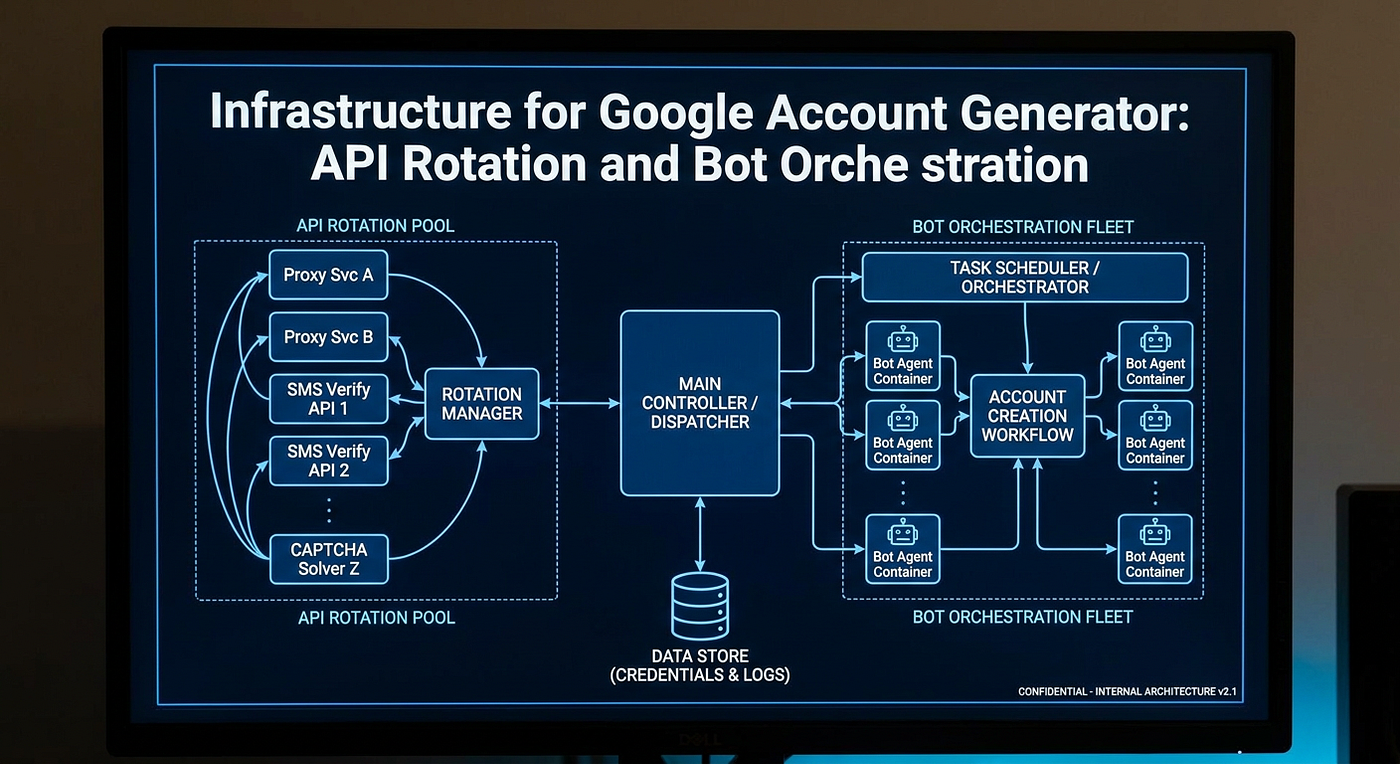
To build a generator that actually works, you need to align four distinct layers of your stack. If one pillar crumbles, the whole account expires.
1. Hardware Fingerprint Decoupling
Your bot must not look like a headless Chrome instance. You need to emulate Canvas, AudioContext, WebGL, and font lists. However, the trick isn’t just changing these values — it’s making sure they are consistent. A browser that claims to be an iPhone 13 but uses a desktop-grade GPU renderer is an immediate red flag.
2. Network Integrity (Mobile Proxies)
This is the core of our discussion. You need a rotating mobile proxy (4G/5G) with a high-speed backconnect. The ability to trigger an IP change via a “rotation link” (resetting the connection through the carrier) is vital during the registration phase.
3. Humanized Behavioral Heuristics
Static delays (e.g., wait 5 seconds) are a death sentence. Bots need "jitter." This means variable typing speeds, mouse movements that follow Bézier curves rather than straight lines, and pauses that mimic a human reading a "Terms of Service" page (even if we know no one actually reads them).
4. The Warm-up Cycle (Farming)
An account created and immediately used for ads is an account that will be banned. The final pillar is the “resting” phase, where the bot interacts with the platform like a lurker — scrolling the feed and liking a few posts — without performing high-risk actions.
Step-by-Step Guide: Configuring Your Generator for Success
If you are ready to move from theory to implementation, follow this checklist to ensure your infrastructure is robust enough to handle the current Facebook environment.
Phase 1: Infrastructure Setup
- Procure Mobile Proxies: Avoid provider aggregators that sell “shared” mobile proxies. You need a dedicated 4G/5G dongle or a private proxy service that provides a dedicated physical device.
- Choose Your Automation Framework: While Selenium is common, Playwright or Puppeteer (with the
stealthplugin) provides better control over low-level browser primitives. - Integrate an Anti-Detect Browser API: Use tools like AdsPower, Multilogin, or Dolphin{anty} via their APIs. These tools handle the heavy lifting of fingerprint spoofing so your script can focus on logic.
Phase 2: The Registration Logic
- IP Validation: Before starting the registration, call an API (like
ip-api.com) to ensure your proxy is actually showing a mobile carrier and not a data center. - SMS Verification: Integrate an SMS activate service via API. Use numbers that match the country of your proxy. A US IP with a Vietnamese phone number is an instant “Checkpiont.”
- The “Cool-Down” Variable: Implement a logic where the bot performs a 5-minute “pre-scroll” on the landing page before clicking “Sign Up.”
Phase 3: Post-Registration Stability
- Cookie Exporting: Save all session cookies and LocalStorage data immediately. This allows you to re-log without triggering a new login alert.
- 2FA Implementation: Immediately enable Two-Factor Authentication (2FA) using a TOTP (Time-based One-Time Password) generator. This significantly boosts the account’s trust score.
Quantifying Success: The Math of Antifraud
In the world of account generation, we often talk about “Trust Scores.” While Facebook doesn’t show you this number, you can estimate it using a simple heuristic. Let T be the total trust score, where:
T=(Ip×Wn)+(Bh×Wb)−(Df×Wd)
Where:
- Ip: IP Reputation (Mobile = 1.0, Residential = 0.7, Data Center = 0.1)
- Wn: Weight of Network integrity
- Bh: Behavioral Heuristics (human-like patterns)
- Wb: Weight of Behavior
- Df: Fingerprint Discrepancies (the “mismatch” factor)
- Wd: Penalty weight for inconsistencies
Your goal is to maximize T. If your Df is high because your WebGL doesn’t match your User-Agent, even a perfect mobile proxy (Ip) won’t save you.
Why “Clean” IPs Aren’t Enough
The most common mistake is thinking that a “clean” mobile IP is a silver bullet. You could have the freshest IP in the world, but if your bot performs “teleportation” — logging in from London and then two minutes later from New York — the system will flag you.
You must maintain Geographical Persistence. If you start an account on a proxy based in Paris, that account should “live” in Paris for its entire lifecycle. This requires your bot to map specific accounts to specific proxy ports or rotation patterns.
The Infinite Game
Building a Facebook Account Generator is not a “once and done” project. It is a continuous process of observation and adaptation. Facebook’s engineers are constantly updating their detection vectors, moving from simple IP blacklists to advanced machine learning models that analyze the rhythm of your interactions.
To succeed at a senior level, you must stop thinking like a coder and start thinking like a social engineer. Your goal is to blend into the noise of millions of mobile users. Use mobile proxies not just as a tool, but as the foundation of a broader strategy of “digital camouflage.”
The question isn’t whether the accounts will be flagged — eventually, everything is. The question is: can you make the cost of detection higher for Facebook than the value the account provides to you? If the answer is yes, you’ve already won.
메타데이터
- post_id
- 551809620430
- slug
- facebook-account-generator-bot-navigating-antifraud-systems-via-mobile-proxies-551809620430
- url
- https://medium.com/@onlineproxypmm/facebook-account-generator-bot-navigating-antifraud-systems-via-mobile-proxies-551809620430
- canonical_url
- https://medium.com/@onlineproxypmm/facebook-account-generator-bot-navigating-antifraud-systems-via-mobile-proxies-551809620430
- author_url
- https://medium.com/@onlineproxypmm
- status
- ok
- fetched_at
- 2026-06-28 14:26:31