Butterfly Kisses
Mary Posada was tired. She had been camped out at the mouth of Becker’s Cave for almost eleven hours. All night, she and her undergraduate…
Butterfly Kisses
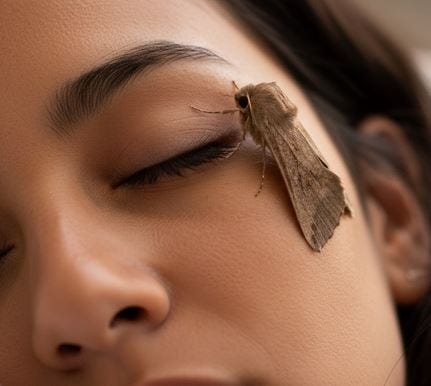
AI-generated image — courtesy of NoteGTP
Mary Posada was tired. She had been camped out at the mouth of Becker’s Cave for almost eleven hours. All night, she and her undergraduate assistant, Wes Wheatfield, had been collecting information on a subspecies of Myotis grisescens, or gray bat. The two had collected eight specimens in mist nets outside the cave. All were measured, sexed, and set free. Two of the eight had yellowish fuzzy fungal growths and dried blood about their noses and ears. The infected specimens appeared healthy otherwise. Mary had scraped some yellowish fuzz into a vial for later evaluation.
The sun had come up, and its beams felt good against the doctor’s face and arms. She was drowsy from the all-night Gray Bat vigil. She sat down in her folding field chair and dozed off. She had been asleep perhaps half an hour when she was awakened by a pricking sensation near the corner of her left eye. She opened her eyes to find that the vision in her left eye was obscured by something. The something was moving; it was a winged insect of some sort. She reflexively swiped at the thing and saw that the unwanted visitor was a butterfly or moth; she wasn’t sure which.
Mary instinctively rubbed her left eye. She felt something wet and sticky. She withdrew her hand from her face to find a smear of blood across her knuckles. She examined the smear, confused. She had read that moths of the genus Calyptra were known to feed on human blood, but there was no record of the genus living anywhere near Becker’s Cave, or anywhere else in the USA, for that matter. She noted the incident in her field journal. She had a good friend back at the university who was an entomologist and planned to mention the encounter to her when she was back on campus.
Wes Wheatfield had not been accosted by moths, though he had seen a half dozen fluttering just above the stream that issued from the cave’s mouth. He was surprised when Mary told him that she had been attacked by one. The expression on his face at the revelation showed that he doubted that such a thing was possible.
The rest of the time at Becker’s cave was uneventful.
Three days after the Becker’s Cave study, Dr. Mary Posada became ill. The symptoms of the illness were not unique to any specific pathogen, so she figured it was a garden-variety virus, one that would run its course in a week or two. She felt tired and achy and was running a slight fever. She was not so sick that she wanted to stay in bed, but she was not up to her daily routine.
As Mary expected, the virus — or whatever it was — ran its course in a week. By the weekend, Mary was feeling like her old self again, perhaps better.
Strangely, the Doctor’s general constitution continued to improve with each passing day. Not only that, her cognitive abilities were on the upswing. Seemingly overnight, she was able to see patterns in her mammalogical studies she had not noticed before. Complex relationships were made manifest to her as if revealed by a divine source. The sudden clarity frightened and excited her. What had happened to her brain?
The moth that had pierced Dr. Posada with its proboscis was a vector of a microscopic fungus-bacteria organism, a hybrid that science had not yet described. The tiny invader entered Dr. Posada’s bloodstream and migrated to her brain, where it embedded itself. Once anchored, the organism began to feed on blood cells. It used the energy derived from its repaste to clone itself. It kept eating and cloning — five red blood cells per clone produced.
Early in its development, each clone sprouted a flagellum; the clone used this hair-like structure to swim off, making its way to some other part of the brain. When the conditions were right (whatever that meant), the clone, like its parent, would embed itself in its host’s tissue. In three days, Dr. Mary Posada’s brain had become thoroughly infested with clones.
The infestation did not result in any obvious illness, however, at least not at first.
A chemical signal from the parent organism lodged within Dr. Mary Posada’s gray matter triggered a transformation in its clone children. The clones became what could be termed “pseudoneurons,” and each began sprouting filaments. The filaments, which were axon analogs, began to intersect each other, creating a network. Dr. Mary Posada had, in the span of seventy-two hours, acquired what amounted to a second brain.
What does one do with twice the brains of a normal human? For Dr. Mary Posada, the answer was simple: write scientific papers! This she did, and very prolifically, too. Six months after the Becker’s Cave study, Dr. Posada had written over thirty papers, each bearing the hallmarks of genius.
The doctor’s papers found their way into all the world’s notable scientific journals and in the latest editions of zoology textbooks. Her standing within academic circles soared, and she soon discovered that her thoughts and opinions were in great demand among social media content creators who dealt with scientific matters.
But not all was right in the doctor’s world. Having a second brain hadn’t helped her relay what she had experienced at Becker’s Cave to anyone of influence. For some reason, the memory of the fuzzy yellowish fungus and dried blood around the mouths and ears of the gray bat specimens she and Wes Wheatfield had collected existed only in her field journal. She had no recollection of observing a fungus on any bat at any time. Each time she read the entry, the words seemed foreign to her, as if they had been penned by a forger. The harder she tried to attach memory to the script, the less she would recall. The blockage was even more pronounced when she reviewed the notes she had made on the incident with the blood-sucking moth.
Within the doctor’s skull, the recently established colony of hybrid organisms made sure that certain memories remained suppressed. The colony had tapped into Mary Posada’s synapses and was reading her thoughts. Only those thoughts that benefited the colony would be allowed to persist. The colony had a goal, and that goal had not yet been achieved.
Dr. Mary Posada’s family and friends began noticing changes in the doctor’s work habits a few weeks after the Becker’s Cave study. For one, the doctor began writing like a woman on a mission. She’d skip meals and work through the night to get a paper done. When she did eat, she ate things that she had previously shown little to no interest in, like beef liver, sashimi, and chicken gizzards. She also took to visiting bat colony sites (always unaccompanied) between writing papers. It was as if she were looking for something in those dark, dank guano-filled recesses in the earth.
The other change that garnered the attention of her friends and family was her adoption of antisocial behaviors. Before the Becker’s Cave study, Dr. Mary Pasado had been approachable and gregarious, but after commencing her academic writing spree, her demeanor changed. She became insufferably arrogant and withdrawn. Her patience with people diminished precipitously; any perceived offense could (and usually would) arouse her wrath.
Notwithstanding all of Dr. Posada’s newly acquired–and undesirable–quirks, her family and friends were immensely proud of her and would brag about her to anyone who would listen. After all, Mary had risen out of obscurity and — as far as her admirers were concerned — had skyrocketed to her prominent position in the scientific community through extraordinary effort, top-notch brains, and an iron will.
Eventually, colleagues at the university convinced Dr. Posada to participate in speaking tours promoting the ideas and conclusions she had so eruditely outlined in her papers. It had been a herculean task to coax the unsociable woman into the public arena. An appeal to her now flagrantly displayed self-importance had tipped the scales, but just.
Dr. Posada’s first speaking engagement was at a conference at the Smithsonian in Washington, D.C., on the diversity of Pleistocene bats. Her presentation was by far the best of the conference and netted her fifty thousand dollars.
Her next speaking opportunity came a mere week later in Chicago. This time, the topic centered on the importance of bats in Western and Eastern cultures. She walked away from the engagement with fifty-five thousand dollars.
Dr. Posada’s achievements had certainly justified the confidence her colleagues had placed in her, but they also had a magnifying effect on her already enormous ego. Moreover, unbeknownst to the doctor and her fan base, the dopamine produced at the realization of each victory had turned her cranial symbiote into a pleasure junkie.
The speaking opportunities afforded to Dr. Mary Posada snowballed after a particularly outstanding presentation on the maternal habits of Mexican free-tailed bats in Phoenix. After that showstopper, the doctor could not be had for any sum less than a hundred thousand dollars. Mary became known as “Dr. Bat.” Never before had a specialist in mammalogy achieved the celebrity status Dr. Mary Posada enjoyed. And, never before had a bat specialist become a multimillionaire.
Dr. Posada had a huge, cave-themed mansion built northeast of Louisville, Kentucky. The main house had thirty rooms, five of which were windowless and lacked artificial lighting. The grounds of the main residence featured extensive housing for bats and a large, elaborate butterfly garden. The whole project cost six million dollars and took over a year to complete.
Upon moving into her estate, Bat ally, and mammalogy superstar Dr. Mary Posada adopted the life of a hermit, only allowing family and friends to visit by appointment. Housekeeping and groundskeeping tasks were handled by contracted staff who were instructed to avoid contact with the mistress of the house and leave the premises before nightfall.
Almost exactly three years after theBecker’s Cave study, Dr. Posada began experiencing hallucinatory episodes wherein she imagined herself a bat. While hallucinating, she would run around the halls of her mansion half-clothed, flapping her arms and emitting loud squeaks and clicks.
The doctor’s reclusive nature meant that her bizarre activities were not discovered for weeks. It was only after the morning housekeeping staff observed Dr. Posada hanging upside down from a horizontal rod mounted in one of the mansion’s dark rooms and wrapped in a black bed sheet that the extent of the doctor’s condition was revealed.
A psychologist was called in, of course, but more was going on in Dr. Mary Posada’s head than anyone could have guessed. The colony of hybrid organisms that had granted her superhuman IQ was dying. The next phase of the organisms’ life cycle was at hand, and the colony needed new, more fertile environs.
Dr. Posada awoke from a fitful sleep. She had been recuperating from a particularly disturbing hallucinatory episode in which she had attacked the psychologist hired to evaluate her. According to eyewitnesses, she had tackled the psychologist to the ground and bit him over his right zygomatic bone. Fortunately, her teeth had not penetrated the man’s eye (he had closed his eyes reflexively), though the bite had drawn blood.
The dangerous bat-obsessed patient was lying in her bed in a hospital gown, soaked in a cold sweat. It was half past midnight. Her arms had been pinned to her sides with fabric straps. Her legs were also bound with the same. She was not alone. Three other people were in the room with her: the injured psychologist (now wearing an eye patch), a burly police officer, and a large, blonde male nurse. The threesome stood close to one another to the doctor’s left.
Dr. Mary Posada slowly turned her head toward the small group, her eyes wide and glaring. She clinched her teeth and clicked her tongue against the roof of her mouth loudly. Anyone familiar with bat calls would know the click was an approximation of a bat call. It was clear to the recently assaulted psychologist that the start of another hallucinatory episode was imminent.
The group of three watched horrified as Dr. Posada writhed in her bands, clicking away. The colony of hybrid organisms in her head was desperate; it targeted the doctor’s adrenal glands, causing them to flood her system with adrenaline. The injection did exactly what the colony wanted it to do. Mary Posada burst her bands and leapt off her bed to the surprise of her observers.
A red-faced Dr. Posada pushed aside the police officer and the male nurse like a roid-raging linebacker and dashed through the bedroom door. The door had not been secured. The bat-obsessed celebrity speaker threw the door aside and made her way into the hallway outside, clicking her tongue against the roof of her mouth as she went.
The officer and the male nurse pursued the doctor, intending to capture and restrain her. The psychologist, on the other hand, took his smartphone out of a vest pocket and began recording the scene. He would follow his patient, but at a safe distance.
Mary Posada ran to the nearest exit, barely eluding her pursuers. She knew the property better than any of her “guests,” and that gave her an advantage. After a mere five minutes, the chase was over. The police officer had tripped on a pair of rubber garden overshoes in the estate’s backyard and landed face-first on a sprinkler head hidden in crabgrass; the nurse had twisted an ankle in a small gutter lining a path in the butterfly garden, and the psychologist had simply run out of steam.
An all-points bulletin was put out as soon as the police officer lying on the lawn regained consciousness. It was to no avail. Dr. Posada had metamorphosed into a giant bat and flew away into the night–at least, it seemed that way. In reality, the doctor was hiding in a manhole-equipped storm drain on the edge of her property. She was determined to stay put until she was sure that the coast was clear.
One of the three cars Dr. Posada had bought since becoming a lecturing sensation came up missing a day after the manhunt on her property had been abandoned. A new search was initiated.
A disheveled Mary Posada traveled by night. She was headed to Becker’s Cave. Voices in her head, most linked to the ghosts of dead relatives, were telling her that her destiny lay within that waterlogged cavity. She was convinced the voices were speaking the truth.
The colony of cranial invaders drove the doctor forward. She ascended the path to Becker’s Cave in a trance. She entered the cave at five o’clock in the morning.
Richly embroidered couches upholstered in purple velvet lined the walls of the cave’s main chamber, where Myotis grisescens dwelt. The smell of jasmine and citrus filled the air, and flower petals showered down–fluttering delicately–from the ceiling. Dr. Mary Posada was tired, so tired. She fell onto the nearest couch. It was soft. She closed her eyes as she sank into its down-soft cushions. She could feel the flower petals making contact with her skin. It was divine. She was in ecstasy.
Wes Wheatfield came to the front door of his residence on the third floor of the 3000 block of the Hickory Grove Luxury Apartments complex. It was 8 AM, and his doorbell had been ringing intermittently for a full two minutes. It was annoying.
Wes opened the door to find two police officers, from the city of Louisville by their livery, standing on his welcome mat.
“Hello, sir. Are you Wes Wheatfield?” the junior officer, a corporal, asked.
“Yes, I’m Wheatfield,” Wes replied. “What’s this about?”
The senior officer, a sergeant based on the chevrons on his shoulder, spoke.
“I’m Sergeant Mayhew, and this is Corporal Pope. We are from the Louisville Metro Police Department. We’d like to ask you a few questions. Can we come inside?”
“Sure thing. But what is this about?”
“A missing person,” the sergeant replied.
Wes invited them inside and led them to his small living room off the entry.
“Please, take a seat. Would you like a drink or something?” Wes asked, nonplussed by having the police in his home. He was the straightest arrow the community had in its checkered quiver, and he knew it.
“Thanks, we’ll sit, but no refreshments,” the old sergeant responded. “I’ll cut to the chase. Do you know the whereabouts of Dr. Mary Posada?”
Wes Wheatfield’s facial expression instantly revealed that he did not. “No, officer. I didn’t know she was missing.”
“Let me show you something,” the corporal chimed in. The corporal produced a smartphone and proceeded to show Wes Wheatfield a video of Dr. Posada running from her home, pursued by a police officer and a large, blonde man dressed in scrubs. Loud clicking could be heard in the playback.
“The video is recent, only a few days ago,” said the sergeant. She is not in trouble with the law or anything; we just need to find her. She could be a danger to herself.”
“I don’t know where she is.” Wes’ mind was reeling from the video. “That clicking noise sounds familiar, though. It sounds like the call of a gray bat, only slowed down and downshifted in frequency. I wonder . . .” Wes voice trailed off.
“What do you wonder, Mr. Wheatfield?” queried Sergeant Mayhew.
“It’s just a hunch. I wonder if she is headed for Becker’s Cave. We did a study there three or so years ago. That is the only place I’ve seen a significant population of gray bats.”
“Would you show us where this cave is?”
“Sure thing.”
“You wouldn’t mind riding in our patrol car, would you?” asked Corporal Pope.
“Not at all. I’ll be ready to go in two shakes. Let me get my field bag.”
An hour later, Wes Wheatfield, Sergeant Mayhew, and Corporal Pope were ascending a hill covered in shagbark hickory and eastern redbud. The slope was shallow and forgiving, so the climb was easy. It helped that the weather was hospitable.
As they approached the cave site, all the hikers noticed a train of moths zigzagging its way through the tops of the hardwoods towards the lowlands below. The rear of the train appeared to be leading, like a trail of airborne breadcrumbs, to Becker’s Cave.
Fifteen minutes later, the three were standing on the alluvium beside the small stream that gurgled out of the mouth of Becker’s Cave. A few moths fluttered out of the gaping darkness before them and lighted upon smooth egg-shaped stones opposite the party. Wes dropped his field bag with a thud onto the gravel bank and unzipped a large side compartment. From this, he produced three headlamps.
I always keep spares,” he told the officers, grinning. The experienced field researcher had always prided himself on his preparedness.
The party donned their lamps and headed into the cave.
Roughly thirty yards in, the cave, which had been too narrow for them to walk abreast, opened up to a large dome-like chamber. Inside the chamber, the air was thick and smelled of ammonia and mold.
The party scanned the floor for any sign that Dr. Posada had wandered into the place. The search lasted less than a second. Corporal Pope saw the doctor’s corpse first.
Near the chamber wall to the party’s right lay a body, rigid and manikin-like. Sergeant Mayhew advanced towards it, followed by the corporal. Wes Wheatfield took up the rear. The procession stopped about five feet from the doctor’s remains and, as if on cue, directed their headlamps at the corpse.
Before the party lay a grisly sight: Dr. Mary Posada’s corpse lay half buried in centuries of detritus — that is to say, mostly bat guano. Flies, cockroaches, beetles, and a host of other arthropods moved freely about her remains. Several moths were perched on the dead woman’s face. Sergeant Mayhew crouched down to take a closer look at the face’s features. He beckoned his companions to join him at the lower, more intimate, vantage point.
What the party saw would haunt their dreams for the rest of their lives. The moths were stabbing the corpse’s blood-encrusted eyes with their wiry proboscises, apparently feeding on congealing fluids. Fuzzy yellowish ribbons of fungus carpeted a substrate of dried blood that had recently emanated from Dr. Posada’s ears and nostrils. Finally, there was the expression on Dr. Posadas’s face — it was rapturous. She had died in apparent ecstasy (the symbiotic colony in the doctor’s skull had flooded its host’s system with endorphins as a reward for transporting it to Becker Cave’s guano deposits).
Wes Wheatfield drew a loupe from his shirt pocket and examined the fuzzy fungal ribbons. They appeared to be comprised of the same fungus that had adorned the ears and noses of the gray bats he and Dr. Posada had collected during their study of the cave. What’s more, the magnification afforded by the loupe showed that the fuzz sported fruiting bodies, sporocarps, that appeared to have burst open and expended themselves.
The fungus-bacteria hybrid organism had succeeded. A new generation of hybrid organisms was already incubating in the fermenting mass around Dr. Mary Posada’s dead body. Over the past three years or so, the celebrated speaker, academic, and symbiote host had been the vehicle through which the colony surveyed additional habitats to exploit. The blood-sucking moths of Becker’s Cave had already been dispatched to seek these habitats. It was a biological coup, a masterstroke in species proliferation.
Of course, the party in Becker’s Cave knew nothing of the organism’s victory. They just knew that a prominent and popular scientist had died under mysterious circumstances. There would be lots of documentation that would have to be done before the body of Dr. Mary Posada could be interred. Sergeant Mayhew was not thrilled about the prospect of more paperwork.
“Okay, I guess we gotta tell all responsible parties about our find. It’s a real shame,” Sergeant Mayhew lamented. “This case report is goin’ to be a doozy! I’ll be leaning heavily on you, Pope!” The sergeant took a hard, sharp glance at the corporal at his side. The young officer nodded obediently.
Just as the sergeant stood up from a squat that had lasted too long for his aging knees, he felt a pinch at the back of his neck. He clapped a hand over the affected area and felt something delicate crumple in his palm. He cupped his hand and brought the something forward. Spreading his palm, he saw the crushed form of a moth. “Well, damn!” he said.
메타데이터
- post_id
- 551d7fdc073f
- slug
- butterfly-kisses-551d7fdc073f
- url
- https://medium.com/@garbagecan909090/butterfly-kisses-551d7fdc073f
- canonical_url
- https://medium.com/@garbagecan909090/butterfly-kisses-551d7fdc073f
- author_url
- https://medium.com/@garbagecan909090
- status
- ok
- fetched_at
- 2026-06-26 06:47:43


