Securitize Tokenized Its Own Public Stock On Listing Day. What Does That Really Change?
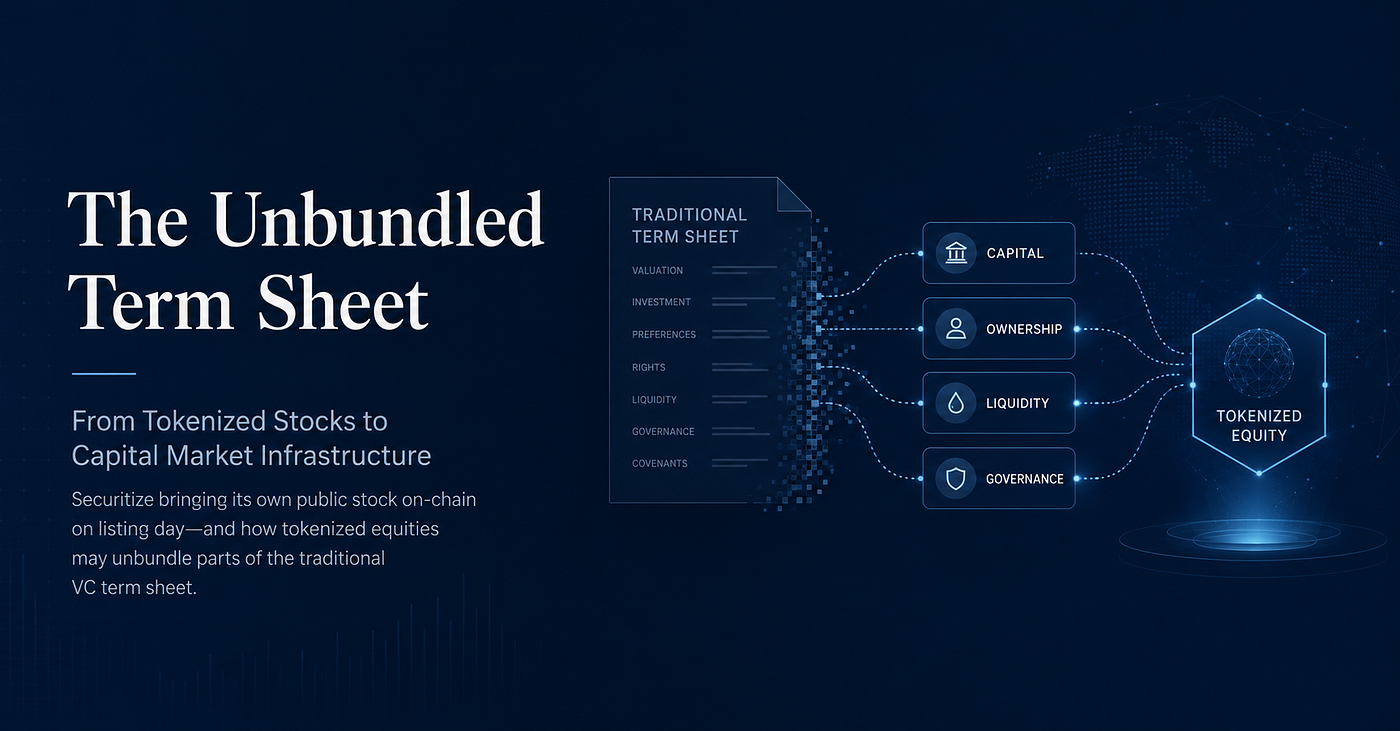
From Tokenized Stocks To The Unbundled Term Sheet
Securitize Tokenized Its Own Public Stock On Listing Day. What Does That Really Change?
From Tokenized Stocks To The Unbundled Term Sheet
Over the past few weeks, the market has been talking a lot about tokenized stocks.
Robinhood, Kraken, Bybit, KuCoin, Bitget, Ondo, xStocks, Hyperliquid and others are all approaching tokenized equities from different angles.
But in my view, the most important case is not simply another platform offering exposure to U.S. stock prices.
It is Securitize.
Because Securitize did something symbolically important:
On the same day it listed on the NYSE, it also brought its own public stock on-chain.
This was not an offshore wrapper.
It was not synthetic exposure.
It was not just a contract tracking a stock price.
It was Securitize’s own common stock, appearing in tokenized form on listing day through regulated infrastructure for eligible investors.
The significance is not simply:
“Another company tokenized its stock.”
The bigger question is this:
If a public company can list on a traditional exchange and have its equity exist in tokenized form on the same day, what happens next to fundraising, ownership records, investor relations, secondary liquidity and even the traditional VC term sheet?
What Did Securitize Do?
Securitize is a company focused on tokenized securities and real-world asset infrastructure.
This is not a company suddenly chasing a market trend.
Its entire business is built around helping companies, funds and asset managers bring securities and financial assets on-chain.
So when Securitize listed publicly and tokenized its own shares, it was sending a very direct market signal:
If you sell tokenization infrastructure, you should probably use it yourself.
Securitize completed its public listing through a SPAC merger with Cantor Equity Partners II and began trading on the NYSE under the ticker SECZ.
On the same day, Securitize announced that its own common stock would also be available in tokenized form.
According to the company’s statement, tokenized SECZ is not a separate share class.
It represents the same common stock trading on the NYSE, but with ownership reflected through tokenized infrastructure.
That detail matters.
Because this is very different from many tokenized stock products in the market today.
Many tokenized stocks are wrappers, SPV claims, synthetic exposures or derivative contracts.
Securitize emphasized that SECZ tokenized shares are not synthetic tokens.
They are not offshore wrappers.
They are issuer-sponsored tokenization of the same common stock trading on the NYSE.
That is what makes this case worth studying.
Three Different Paths For Tokenized Stocks
To understand why Securitize matters, we need to understand that tokenized stocks are not a single product category.
There are at least three different structures.

1. Issuer-Backed Ownership
This is the version closest to real stock ownership on-chain.
In this model, the company itself, or its regulated infrastructure provider, records ownership in tokenized form.
The token is not simply tracking the stock price.
It represents actual equity ownership.
SECZ is moving in this direction.
Securitize brought its own common stock on-chain through its own regulated platform, initially on Solana and Avalanche.
This is different from xStocks or Robinhood stock tokens.
It is not someone else wrapping Securitize’s stock.
It is Securitize itself sponsoring the tokenization of its own equity.
That means the issuer is at the center.
Not the exchange.
Not an offshore SPV.
Not a perpetual market.
This is why I think the Securitize case is more important than most tokenized stock launches.
It is not asking:
“Can investors get exposure to U.S. stock prices?”
It is asking:
“Can a company’s own equity ownership, transfer and recordkeeping become tokenized?”
That is a much deeper market structure question.
2. Wrapper Or SPV-Backed Tokens
The second model is where an SPV, custodian or issuing entity holds the underlying stock and issues a corresponding token on-chain.
This type of product may give investors exposure to Apple, Tesla, Nvidia or ETFs.
But the token holder may not be the registered shareholder of the underlying company.
Typical examples include:
- xStocks by Backed
- Ondo Global Markets
- Robinhood stock tokens
This model is easier to scale.
It can quickly package many public stocks or ETFs into tokenized products and distribute them through exchanges, wallets or DeFi ecosystems.
But the core question is:
What exactly does the investor own?
A share?
A claim against an SPV?
Economic exposure?
A derivative contract?
These are very different things.
This model can be useful for expanding access and liquidity, but it does not always mean true equity ownership has moved on-chain.
3. Synthetic Exposure
The third model is synthetic exposure without holding the underlying shares.
This includes perpetual futures, pre-IPO perps and oracle-based synthetic markets.
These products usually do not hold the underlying stock.
Instead, they use price oracles, funding rates, margin systems and trading mechanics to let users trade exposure to an asset’s price movement.
Hyperliquid’s HIP-3 framework and platforms such as TradeXYZ are closer to this model.
The advantage is speed and flexibility.
You do not need a full SPV, broker-dealer, custodian or proof-of-reserves structure to create a perp market.
But this is not ownership.
There is no underlying share.
No voting rights.
No dividends.
No shareholder status.
It is price exposure.
This structure is better suited for traders than long-term equity investors.
Why The Securitize Case Matters
Securitize is not primarily demonstrating the second or third model.
It is pointing toward the first:
A company’s own stock existing in tokenized form from the first day of public trading.
This shifts the discussion from:
“Can exchanges offer stock exposure?”
to:
“Can companies themselves bring their equity structure on-chain?”
That difference is important.
If tokenized stocks are wrappers or synthetic exposures, the trading platform is the main actor.
But if tokenized stocks are issuer-sponsored, the company becomes the main actor.
That has implications for:
- shareholder records
- secondary transfers
- investor relations
- corporate actions
- dividend processing
- voting rights
- transfer restrictions
- compliance workflows
- cap table management
In other words, tokenization is no longer just a trading feature.
It begins to touch the structure of corporate ownership itself.
The Term Sheet Was Originally A Bundled Product
The Token Dispatch article made a very useful point:
A VC term sheet is not just money.
It is a bundled product.
A typical term sheet includes several things.
First, capital.
The investor provides funding for the company to grow.
Second, pricing.
The lead investor helps set the valuation and creates a signal for the market.
Third, curation.
Having a respected investor on the cap table is itself a form of market validation.
Fourth, network and resources.
VCs introduce customers, talent, follow-on investors and strategic partners.
Fifth, follow-on capital.
VCs may continue investing in future rounds, reducing uncertainty for the company.
Sixth, governance.
Investors often receive board seats, information rights, protective provisions and transfer restrictions.
Traditionally, these elements have been bundled together.
When a founder accepts a VC term sheet, they are not only accepting capital.
They are also accepting valuation, governance, signaling, network and future financing expectations.
That is the traditional term sheet as a packaged product.
What Can Tokenization Unbundle?
Tokenized stocks will not replace everything a VC does.
But they may start unbundling some of the more mechanical parts of the term sheet.
For example:
- ownership records
- transfer restrictions
- secondary liquidity
- vesting schedules
- price discovery
- investor access
- cap table automation
Historically, these functions required lawyers, funds, custodians, transfer agents, brokers and intermediaries to coordinate.
But if equity itself can be recorded, transferred and partially governed through tokenized infrastructure, some of these functions may be redistributed across software, smart contracts, regulated transfer agents, market venues and legal infrastructure.
That is what “the unbundled term sheet” means.
It does not mean VC disappears.
It means some of the services previously bundled inside the VC financing package may be separated into modular infrastructure.

What Gets Unbundled First?
I think three parts will likely be unbundled first.
1. Ownership Records
The most important part of Securitize’s move is that ownership itself can be represented in tokenized form.
This means tokenization is not only about trading.
It is about recordkeeping.
If company equity can be represented through blockchain-native ownership records, the role of the transfer agent becomes much more important.
This is why the NYSE and Securitize relationship is worth watching.
NYSE is not only experimenting with crypto.
It is exploring what next-generation tokenized securities market infrastructure might look like.
Securitize’s role is not simply to issue tokens.
It is part of a digital transfer agent infrastructure layer.
2. Secondary Liquidity
One of the biggest problems in private markets is the lack of liquidity.
Employees, angels and early shareholders often have to wait years before they can sell.
If legally compliant tokenized equity transfer infrastructure matures, secondary liquidity may become easier to create.
This does not mean every early-stage startup will become freely tradable.
But for mature private companies, pre-IPO companies or public companies with strong disclosure, a more continuous market may become possible.
That could reduce the monopoly that lead investors currently have over price discovery.
Historically, company valuation has often been set by a lead investor in a financing round.
In the future, some assets may have more continuous market-based pricing.
3. Governance And Execution
Term sheets contain many governance provisions.
Vesting, transfer restrictions, voting rights, information rights, liquidation preferences and protective provisions are often enforced through legal documents and manual processes.
In the future, some mechanical rules may be assisted by tokenized infrastructure or smart contracts.
Examples include:
- vesting releases
- transfer lockups
- investor eligibility
- whitelists
- dividend distribution
- proxy voting
- corporate action tracking
This does not mean law disappears.
Actually, law becomes more important.
But the execution of legal rights may become more software-driven.
But VC Will Not Disappear
I would not be overly optimistic here.
Tokenization can unbundle mechanics.
But it cannot fully replace judgment.
The biggest challenge for early-stage companies is not the lack of a token.
It is the lack of reliable valuation.
Securitize can tokenize its own public stock because it is a mature company.
It has financial statements.
It has disclosure.
It has a business history.
It has a track record in tokenized assets.
The market has information to evaluate it.
A Series A startup is different.
An early-stage company often has only:
- founders
- team
- vision
- technical assumptions
- early traction
- unproven market demand
Tokenization does not automatically solve pricing.
The market still needs someone to make judgment calls.
Someone needs to curate.
Someone needs to put their reputation behind a company and tell the market:
“This is worth backing.”
That is why VC will still exist.
Tokenization Will Change The Role Of VC
My view is that tokenization will not kill VC.
But it will change what VCs do.
Historically, VCs sold a full package:
capital + pricing + curation + governance + network + follow-on capital.
In the future, this bundle may be broken apart.
Capital may come from broader markets.
Pricing may be partially informed by secondary liquidity.
Cap table management may be handled by platforms.
Vesting and transfer restrictions may be supported by software.
Secondary liquidity may be provided by regulated tokenized venues.
But curation, judgment, reputation, network and governance wisdom will remain scarce.
So VC will not disappear.
But VCs who only rely on capital access may become less valuable.
The most valuable investors will look more like:
- curators
- market signal providers
- strategic advisors
- talent connectors
- governance partners
- next-round catalysts
This is similar to what happened in music.
Streaming unbundled the distribution monopoly of record labels.
But it did not eliminate labels that are good at discovering, packaging, promoting and scaling artists.
Tokenization may do something similar to venture capital.
What This Means For Founders
If this trend continues, founders may have more choices in how they raise capital and manage ownership.
In the past, the founder’s main question was:
“Which fund should lead the round?”
In the future, the question may become:
“Which functions do I actually need from investors?”
For example:
Who should provide pricing?
Who should provide governance?
Who should bring customers?
Who should provide follow-on capital?
Who should support secondary liquidity?
Who should design tokenized equity infrastructure?
Who should handle compliance and shareholder records?
Founders may not need the same investor to provide every function.
That is the real meaning of the unbundled term sheet.
Founders may begin to separate:
What should be handled by the market?
What should be handled by platforms?
What should be handled by lawyers and regulated intermediaries?
What still requires human judgment and trust?
Why This Matters For RWA
Many people talk about RWA only in terms of asset categories:
- tokenized treasuries
- tokenized funds
- tokenized stocks
- tokenized real estate
- tokenized private credit
But I think the more important question is:
What happens to the market structure behind those assets?
If we only wrap stocks into tokens, the product changes.
But if ownership records, secondary markets, investor rights, transfer restrictions, voting, dividends, governance and fundraising processes begin to change, then the market structure changes.
That is much more significant.
Securitize’s decision to tokenize its own stock on listing day is important because it moves tokenized securities from an exchange product into corporate finance infrastructure.
That is a bigger shift.
My Take
Securitize’s SECZ tokenization is not just another tokenized stock headline.
It asks a more important question:
If a public company can bring its own stock on-chain from day one, will future fundraising still depend entirely on the traditional term sheet?
My answer is:
Not entirely.
But it will not fully replace it either.
Tokenization will likely unbundle the most mechanical parts of the term sheet first:
- ownership records
- transfers
- vesting
- secondary liquidity
- investor eligibility
- corporate action execution
But it will not immediately replace the scarcest parts:
- judgment
- trust
- reputation
- network
- governance wisdom
So the future is not:
VC versus tokenization.
It is more likely:
VC plus tokenization.
Good investors will use tokenization to enhance what they do.
Weak intermediaries may be replaced by software and market infrastructure.
The Securitize case is a reminder that the next phase of RWA is not only about assets moving on-chain.
It is about capital market infrastructure being unbundled, rebuilt and repackaged.
That is the real story.
When stocks can become tokens, the term sheet may no longer be just a PDF.
It may become a financial infrastructure layer executed by markets, software, law and people together.
References
- Token Dispatch — The Unbundled Term Sheet
- Securitize — Tokenizing SECZ: Securitize Brings Its Own Public Stock Onchain At Listing Day
- NYSE / ICE — New York Stock Exchange and Securitize Memorandum of Understanding
- WSJ — Securitize Partners With Computershare To Tokenize U.S. Stocks
- Securitize / Cantor Equity Partners II — Business combination and NYSE listing announcement
메타데이터
- post_id
- 554647d7e5e1
- slug
- securitize-tokenized-its-own-public-stock-on-listing-day-what-does-that-really-change-554647d7e5e1
- url
- https://medium.com/defi-singapore-decentralized-finance/securitize-tokenized-its-own-public-stock-on-listing-day-what-does-that-really-change-554647d7e5e1
- canonical_url
- https://medium.com/defi-singapore-decentralized-finance/securitize-tokenized-its-own-public-stock-on-listing-day-what-does-that-really-change-554647d7e5e1
- author_url
- https://medium.com/@hukenneth
- status
- ok
- fetched_at
- 2026-08-03 18:51:10


