Tatsuki Fujimoto, the New Genius of Manga?
For some time now, readers have been hearing more and more about Fujimoto. In fact, many have started to say “Fujimoto is a genius.” Just…
Tatsuki Fujimoto, the New Genius of Manga?
For some time now, readers have been hearing more and more about Fujimoto. In fact, many have started to say “Fujimoto is a genius.” Just look at the titles of YouTube videos and specialized shows about manga: *1*7–21 | TATSUKI FUJIMOTO est un GIGANTESQUE GÉNIE ! of Spatule Force, and Qui peut stopper Fujimoto (pas nous) feat Bytell — POPIN X CRUNCHYROLL #3 by Marie Palot, among others. These highlight the widespread sentiment: Fujimoto **is considered the new genius of manga. But why is that? And is it really true?
First of all, who is Tatsuki Fujimoto?
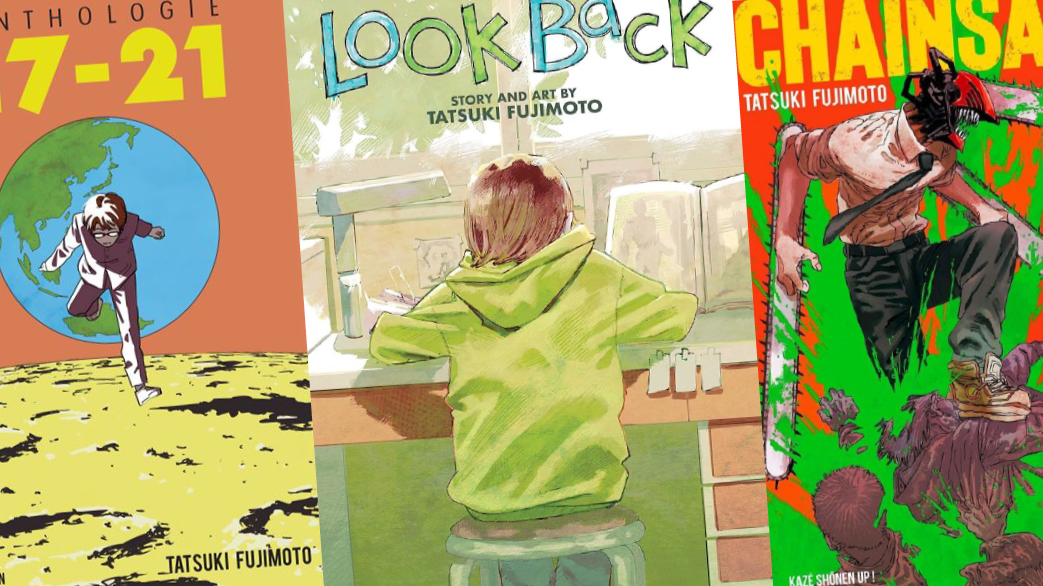
Tatsuki Fujimoto is a mangaka from Akita Prefecture, born in late 1992. He is the author of two manga series, Fire Punch and Chainsaw Man, and has also released four volumes of One-shots: Look Back, 17–21 Anthology, 22–25 Anthology, and Goodbye, Eri. All of these were published by Shūeisha, Japan’s largest manga publishing company. Shūeisha publishes major magazines like Shonen Jump+ and the iconic Weekly Shonen Jump, which currently serializes Chainsaw Man, a demonstration of the publisher’s trust in Fujimoto.
While Fire Punch certainly left a mark in his career, it’s with Chainsaw Man that Fujimoto truly became well-known, and with Look Back and 17–21 Anthology, he earned his status as a new icon and genius of the medium.
As a sort of manga version of Hideo Kojima or Yoko Taro, Fujimoto builds “blockbuster” universes full of superpowers, devils, and action, all handled in a disturbing and uncompromising way.
At first glance, one might assume that his status as a new genius stems from his offbeat approach to storytelling. Writing a superpower story set during an apocalypse wasn’t so unusual back in 2016. The same goes for the idea of demon hunters working within an institutionalized structure in a modern world, but Fujimoto takes these “classic” tropes and subverts them.
- The man responsible for slaughtering the protagonist’s loved ones and leaving him in a state of eternal burning and pain? He’s now seeking redemption and haunted by his past crimes.
- The overpowered hero, whose only dream is to touch breasts and kiss, is used as a weapon, forced to kill and watch his friends die one after another.
We enjoy seeing familiar stories twisted, especially when those twists allow us to take some distance with our art. Add to that our tendency to praise and idolize the media we cherish, and you get a seemingly simple answer.
But that’s not it. There’s something deeper than that. I’m not sure if Fujimoto is a genius, but I do believe I understand why he’s such a highly regarded mangaka.
Tatsuki Fujimoto understands manga.
That may sound like a basic statement, but it’s arguably one of the most important aspects of Fujimoto’s career. In his comment on Love is Blind from the 17–21 Anthology, he writes:
“You stretched a sixteen-page story into thirty-one,” “You should condense the narrative” […] Thinking about it now, I feel like in all my manga, even today, I tell a story in thirty-one pages that I could draw in sixteen.”
And yet, this is exactly what proves to me that Fujimoto truly understands what manga is.
Manga isn’t just telling a story through drawings. Manga is a composition of panels. Every panel expresses intent; a double-page spread can elevate, horrify, glorify the scene… Choosing to draw one panel and not another, deciding on the size and layout of panels… These are not trivial decisions.
This is manga. And Fujimoto understands that deeply.
To illustrate, let’s look at three examples.
1. Love is Blind (17–21 Anthology) A story built around the very simple idea that the student council president wants to confess his feelings to his vice president — but of course, things become increasingly absurd and chaotic. What critics reproach Fujimoto for isn’t so much that the character keeps getting interrupted as he tries to confess, but rather that Fujimoto is supposedly unable to tell a story succinctly. The real criticism lies in his paneling. Fujimoto shows everything he believes needs to be shown, and at the size he deems appropriate. The interruptions to the president’s confession are depicted with increasingly large panels, escalating in intensity until the final interruption is delivered across a double-page spread. This shift disrupts the initial sense of urgency and instead sets the stage for a new rhythm. The protagonist’s determined responses to each obstacle are framed in panels that vary in size, sometimes even taking up entire page, to emphasize his resolve and the emotional weight behind his confession. Where many other mangaka might have opted for efficiency, trimming down scenes to save pages, Fujimoto understands that paneling is a meaningful and essential component of storytelling and pacing in manga.
2. Look Back There are also the many wordless panels in Look Back, where we see the two protagonists working together, shown from behind, as time and the seasons quietly pass. It’s an extremely simple device in the world of manga, but when executed well, it can be incredibly powerful. This approach clearly echoes the well-known cinematic principle: “Show, don’t tell.” We don’t need dialogue or narration to understand that these characters are practicing relentlessly, working side by side, and gradually growing closer. These few panels, which let time slip by almost unnoticed, convey more than any line of dialogue ever could.
3. The action sequence in Volume 7 of Chainsaw Man Here, we witness Quanxi’s incredible physical prowess in what I consider one of manga’s finest action scenes. It unfolds in two phases:
- Setup: Quanxi launches her attack — we see her slicing through the pages, dashing effortlessly through enemies with remarkable agility. Then she pauses on a staircase, gazing at her blade, catching the reflection of her own eyes in its chipped, cracked, and worn surface.
- Payoff: Heads begin to fly. With each turn of the page, the damage becomes more intense. Panels previously seen reappear from new angles, revealing the devastating results. The heads of every enemy fall simultaneously. It all builds to a final double-page spread that condenses the entire second phase into a sublime, almost painterly composition.
This eight-page sequence is a true marvel, using the static nature of manga to give depth and meaning to Quanxi’s speed and power. The rhythm suspended yet swift is a real challenge in terms of pacing and paneling, and it’s something Fujimoto manages to replicate later in the series, notably during the Gun Devil sequence. It’s a true achievement that showcases Fujimoto’s mastery of his medium.
That’s also what makes Fujimoto so highly regarded, even if it’s sometimes hard to pinpoint exactly why, we instinctively understand and feel that Tatsuki Fujimoto has an exceptional command of the form we hold dear. While the techniques I’ve mentioned might seem trivial or derivative at first glance, Fujimoto is among the few who have used them to such powerful effect, and arguably the one who wields them best today.
Tatsuki Fujimoto understands manga.
Are Fujimoto’s manga edgy?
It’s a fair question at first glance.
Fire Punch tells the story of a man who feeds his village by cutting off his regenerating limbs, has an incestuous relationship with his sister, and burns in eternal agony.
Chainsaw Man follows a young man saddled with his dead father’s debts, forced to kill devils, sell organs, and eat cigarettes for cashonly to watch every friend he makes die violently.
Some might say I’m exaggerating, but while Fujimoto’s stories are undeniably violent and dark, I don’t consider them edgy. Why? Because the darkness, horror, and extremity serve a purpose: they convey helplessness.
In the postface to 17–21 Anthology, Fujimoto reflects on volunteering after the 2011 Tōhoku earthquake:
“At 17, I enrolled at Yamagata University of Art. The great earthquake had just struck Tōhoku… I felt that drawing had no meaning. Wanting to be of use, I volunteered to help reconstruct Ishinomaki… Thirty of us worked all day and couldn’t finish. I felt powerless.”
“Since then, I’ve been haunted by a deep sense of powerlessness. Every time a tragedy occurs, the feeling that my work is useless grows.”
This excerpt from the afterword of Anthology 17–21, written by Tatsuki Fujimoto, explains that the darkness, the strangeness, the horror, the despair, the extremity inherent in his work all serve a single purpose: to make us experience helplessness.
- What can we do when faced with a demon capable of wiping out an entire country?
- What can we do when faced with a world almost already destroyed by a man-eating alien race that can transform into titans?
- What can we do once our best friendwhom we had rejected has been brutally murdered?
- What can we do?
Nothing. We can do nothing. We can no longer do anything.
One of the best representations of this is in Volume 6 of Chainsaw Man, during the Bomb Devil’s attack. Two characters try to fight back. One briefly holds her off; the other strikes from behind. But the attack fails. A few pages later, the Bomb Devil stops a car holding their severed heads. What else could they have done? Nothing.
Nothing, we are profoundly helplessness in the face of horrors of such magnitude.
Fujimoto is one of the few mangaka who can evoke this deeply unsettling feeling of helplessness. That’s why I don’t call his work edgy. The horror has meaning. It’s a theme that affects him personally, and he makes all his characters confront it. His heroes are never spared.
There’s an urgency in his manga — just like the urgency people saw in early Scorsese films. Fujimoto needs to talk about this:
“Recently, overwhelmed by the need to scream this feeling to the world, I drew a story called Look Back.”
Yet he finds a bittersweet response to helplessness:
“I wasn’t drawing only out of despair, but also with an empty stomach; through it all, I practiced with friends… and happy memories came back — making me wonder why I only remembered the dark ones.”
At the end of Chainsaw Man Part 1, Denji lives peacefully with a little devil girl. In Two Chickens in the Garden, aliens sacrifice themselves to save a child. And in Look Back, the heroine draws again, honoring the friend who always believed in her.
We may be helplessness. We may face inevitable tragedy. But we keep moving forward. Always.
So, is Fujimoto the new genius of manga?
Let me close with a blunt and entirely subjective opinion.
Fujimoto faces a challenge that, if he cannot overcome, may see him become just another artist who fades into temporal relevance — his style and persona turned into a marketing tool, remembered more as a caricature of his prime.
Fujimoto, as I’ve said, is aware, perhaps too aware of the language of manga. His works often struggle to separate from his identity as a creator. There’s a tendency to reflect on his own craft, to remind readers that he’s a mangaka in existential reflection. Just look at the end of Goodbye, Eri, where the protagonist seems to be a simulacrum of Fujimoto himself, with absurdity and strangeness defining his style. I believe we’re at a pivotal moment in his career. He must now show that the absurdity and violence in his stories aren’t just stylistic or eye-catching flourishes, but rather expressions of maturity and deeply felt emotion.
— Quentin “Gecko” Thoral, (Correction and help by MrClemzer and Tona)
메타데이터
- post_id
- 558b8370fc69
- slug
- tatsuki-fujimoto-the-new-genius-of-manga-558b8370fc69
- url
- https://medium.com/@quentinthoralpro/tatsuki-fujimoto-the-new-genius-of-manga-558b8370fc69
- canonical_url
- https://medium.com/@quentinthoralpro/tatsuki-fujimoto-the-new-genius-of-manga-558b8370fc69
- author_url
- https://medium.com/@quentinthoralpro
- status
- ok
- fetched_at
- 2026-06-29 22:44:20