The Writer’s Life
What I actually do all day (and why it never feels like enough)
WRITING
The Writer’s Life
What I actually do all day (and why it never feels like enough)
Not my dog. Photo by Cookie the Pom on Unsplash
I was probably the only kid in the state with a subscription to Writer’s Digest.
I was also the only child I’ve ever known who wanted to read a book in her room but was made to watch TV instead because that was family time.
In other words, my love of reading and writing came early and I have always been weird.
The Myth of the Easy Writing Life
So what do writers do all day? If you’ve watched enough movies or TV shows, you might think you know, because writers are always writing about writing — plus they love to make writers the characters in their novels and screenplays.
And those fictional writers tend to have a pretty good life with plenty of money, flexible schedules and a charming level of eccentricity.
There’s a persistent belief that making a living as a writer is, if not easy, at least manageable. You write a book, maybe a few articles, and somehow that turns into a comfortable existence. See also: Carrie Bradshaw, who in reality would have been living in a dumpster and wearing shoes from Payless.
The reality is less glamorous and far more chaotic.
The Financial Reality of Being a Writer
Most writers are either poor, have a day job, or both. Some have the benefit of inherited wealth or a well-paid spouse. I did not marry or inherit money, but my husband’s job provides our health insurance. That alone makes this life possible.
Beyond that, I have a thrifty lifestyle and a persistent sense that I should be working harder.

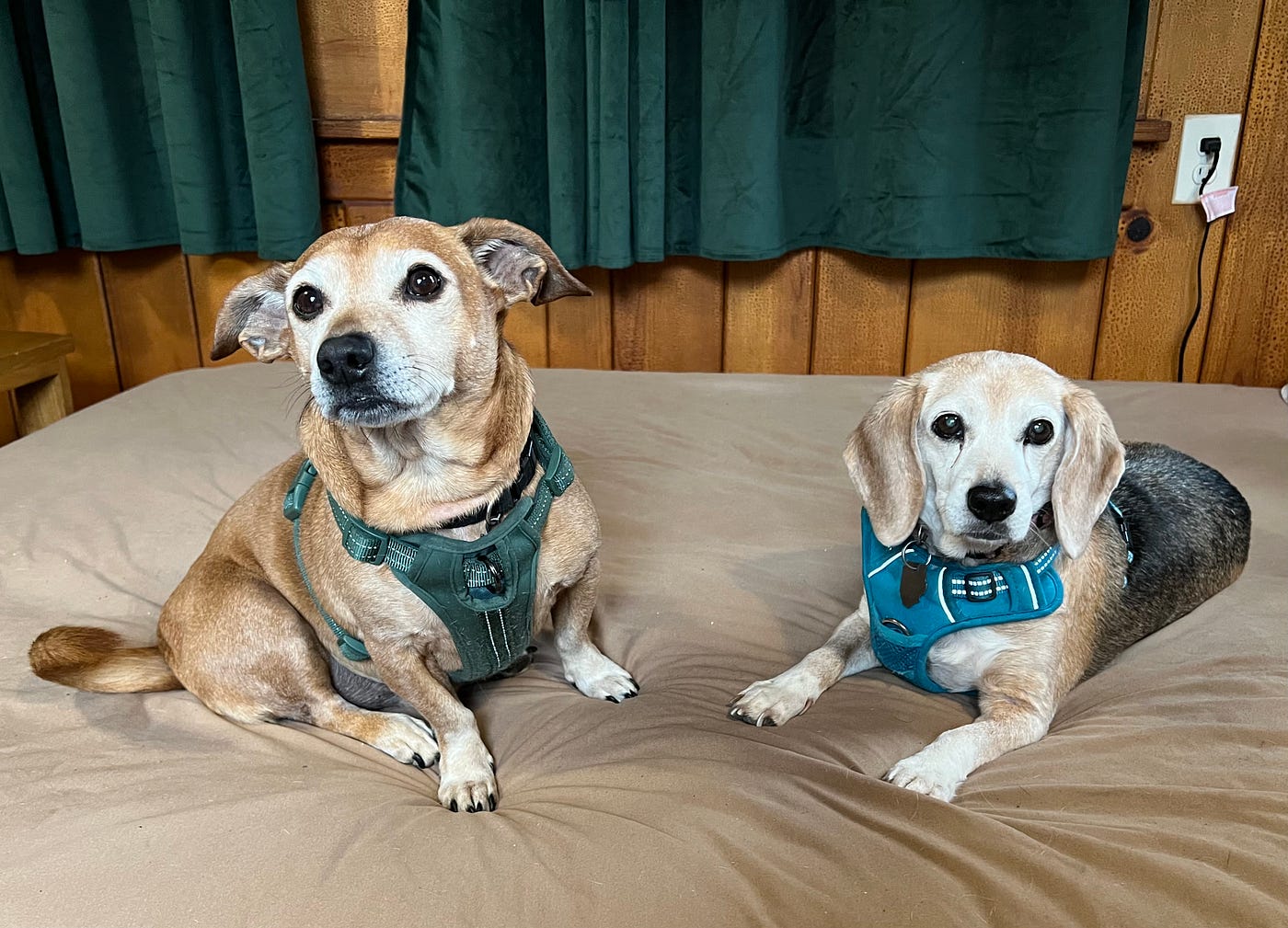
That’s Mr. Joe, left, and Cashew, aka The Little Woofette, resting on the futon in my office. I know they are judging me. (Photo by Michelle Teheux)
A Real Writer’s Daily Routine
Here is an accurate account of a day in the life of one writer.
I begin every morning drinking coffee in the dark while reading The New York Times on my phone. My husband delivers a cup of coffee to my bedside table before he leaves for work, and honestly, I’d keep him around just for that even if he weren’t a good husband in a thousand other ways.
After checking to see what wars the U.S. is involved in that day, I open various platforms and start reading. How long do I spend reading on my phone in the dark?
Long enough to begin feeling a low, creeping anxiety about getting my day started, while also trying to reassure myself that, for me, reading is actually part of the work.
Writing Routine vs. Real Life Interruptions
In practice, the reading ends when my older dog, Cashew, begins to stir around sunrise.
It’s a Code Red the moment she lifts her head. I have to pick her up, rush downstairs and get her outside immediately. She’s an elderly tripod beagle mix who needs a little help getting going in the morning, and it is very much in my best interest to move quickly.
My other dog, Mr. Joe, remains in bed until he hears the specific sound of a knife scraping the inside of a can of dog food. Kibble doesn’t interest him. But that sound? He comes running from upstairs every time. I’ve tested this. There is no sneaking canned food past him.
Joe finishes eating in about seven seconds. Cashew takes her time, or sometimes refuses entirely. I sit with her and read a bit more while she decides. I can’t leave the food unattended — Joe would happily eat both portions and then look for more.
The Constant Pressure to Be Writing
Around this time, the anxiety sharpens.
I should be writing already. I also need a shower. I should probably exercise before I shower. The house is a mess. There’s paperwork I’ve been putting off. There are at least five other things I could (and probably should) be doing.
I have not yet figured out which thing I’m supposed to do first.
Some days I shower, rushing through it so I can get to my desk. Other days I go straight to my office in a bathrobe, promising myself I’ll just get started quickly, but those are the days I end up sitting there for hours, unshowered, feeling vaguely gross and questioning my life choices.
No one is monitoring me. No one is going to criticize me. No one but my dogs even knows what’s going on.
And yet, the pressure is constant.
My two dogs stare at me continuously. They say nothing, but I feel their judgment.
Why Writers Struggle With Productivity
Throughout the morning, I keep getting pulled away. Cashew needs to go out again. And again. Each trip downstairs turns into something else.
Today, I carried her downstairs and while she was taking care of business, I ended up moving all the citrus and coffee trees and potted herbs around so they could catch better sunlight. Then I noticed everything needed watering. So I dipped water from the goldfish pond. Then I realized the pond’s pump needed adjusting.
At some point, I found myself standing pond-side thinking, Why are you not writing right now?
Today I made a turkey wrap for lunch, and I’m eating it at my desk, trying to make up for lost time.
It’s not that I’m not being productive.
It’s that I am never productive enough. And writing only pays enough to even halfway survive when you’re quite productive.
The Hidden Workload of a Full-Time Writer
Almost every day is a publication day. I publish here and on Substack multiple times a week. I’m working on a long-running series. I take on freelance work when I can get it.
And I have four books in progress, which is at least three too many.
This is the part that’s hard to explain: The pressure isn’t coming from outside. It’s entirely self-imposed. But that doesn’t make it any less real.
If anything, it makes it worse.
Comparing Yourself to More Productive Writers
I know there are writers out there doing more than I am under far more difficult circumstances.
They’re raising young children. They’re working full-time jobs. They’re caregiving, commuting, juggling entire households and still managing to publish consistently. Sometimes prolifically.
My kids are grown and writing is my only job.
I am not writing enough. I am not writing well enough.
That’s where the shame creeps in.
It doesn’t matter how much I actually produce. I know there’s always someone writing more. And it’s very hard not to measure myself against that.
So the pressure builds, day after day, entirely inside my own head.
The Best (and Worst) Part of the Writing Day
The best moment of the day is when I finally hit publish.
I close my computer, settle into a comfortable spot and read the piece on my phone like any other reader.
And then I spot a typo or a clumsy sentence, and I go back to fix it.
The Writing Cycle Never Ends
After that, it’s making and serving dinner. A walk with my husband and the dogs. More reading. Some laundry, some dishes, some cleaning. Some household paperwork.
My husband does plenty of housework, yard work and fixing up our fixer-upper, but in addition to his full-time job, he has a recording studio in our attic and works up there several evenings per week. It’s cool that there’s often live music in my house. It’s not necessarily conducive to deep writing, though.
I tell myself I’ll write more later in the evening, and sometimes I do. But often, I’m out of juice by then.
So I make the same promise I made the day before.
Tomorrow, I’ll get more writing done.
And then tomorrow comes, and the whole process begins again.
About Michelle Teheux
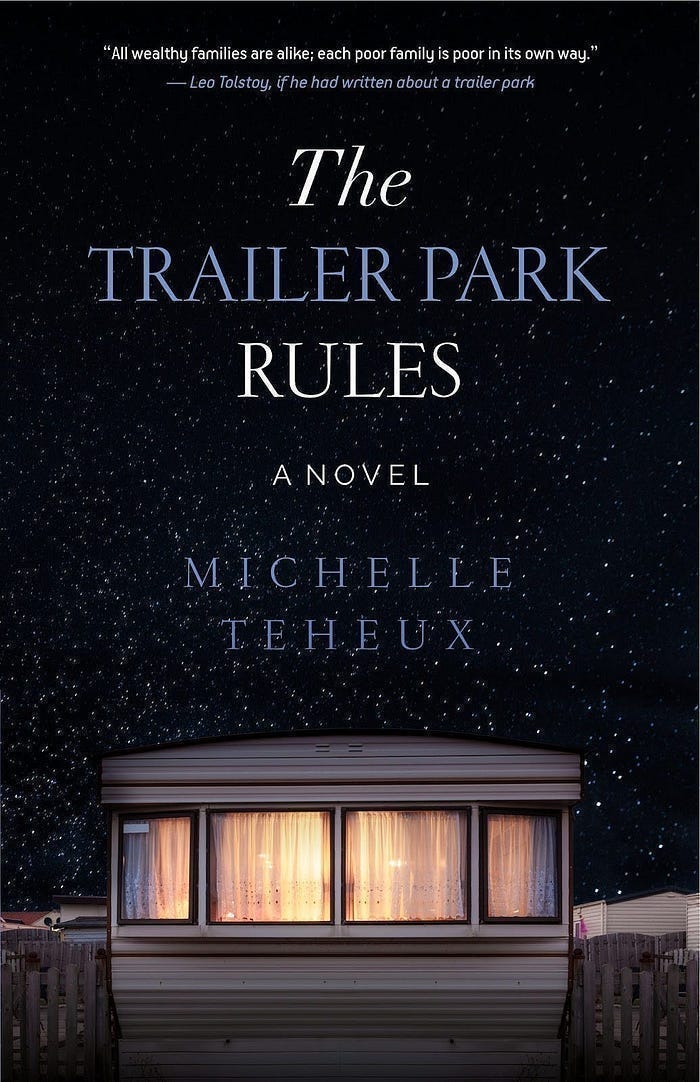
I’m a writer in central Illinois. If you like my work, subscribe! I also have a Substack about economic inequality called *Untrickled and another aimed at authors who want to self-publish books called[ The Indie Author](https://selfpublishingbookauthors.substack.com/). My new book is[ Strapped: Fighting for the soul of the American working class](https://www.amazon.com/dp/B0DJNRCQSJ). And yes, those are my husband’s actual boots on the cover! My most recent novel is[ The Trailer Park Rules](https://www.amazon.com/dp/B0CTHT43L9).* Tips joyfully accepted via Ko-fi: https://ko-fi.com/michelleteheux
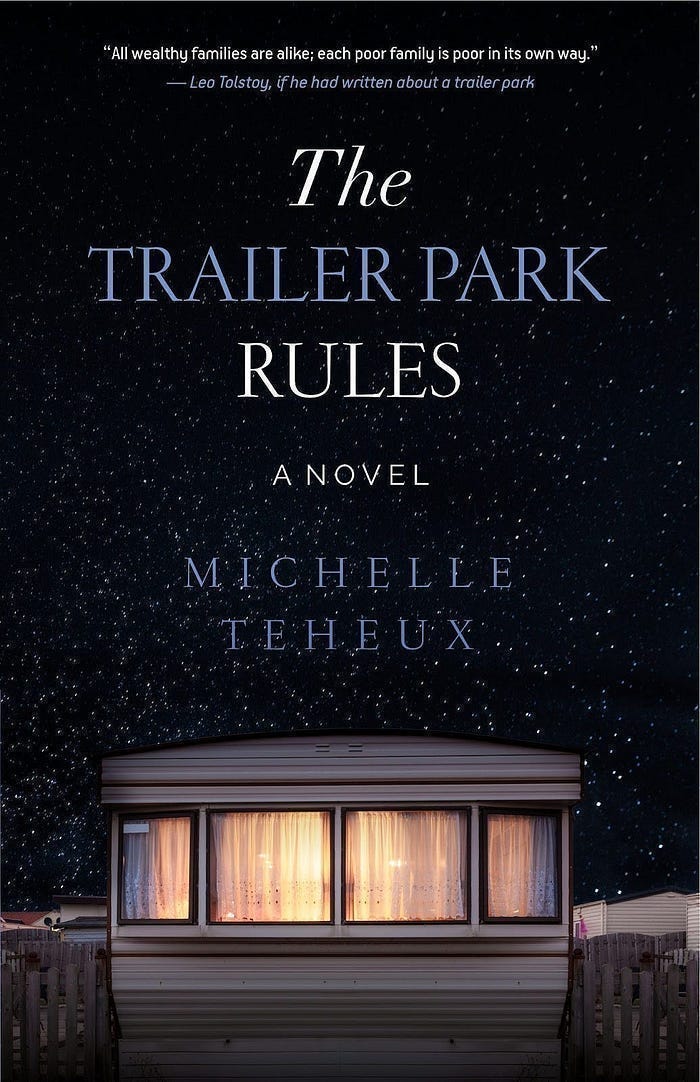
**All wealthy families are alike; each poor family is poor in its own way. ** — Leo Tolstoy, if he had written about a trailer park
For residents of the Loire Mobile Home Park, surviving means understanding which rules to follow and which to break. Each has landed in the trailer park for wildly different reasons.
Jonesy is a failed journalist with one dream left. Angel is the kind of irresponsible single mother society just shakes its head about, and her daughter Maya is the kid everybody overlooks. Jimmy and Janiece Jackson wanted to be the first in their families to achieve the American dream, but all the positive attitude in the world can’t solve their predicament. Darren is a disabled man trying to enjoy his life despite a dark past. Kaitlin is a former stripper with a sugar daddy, while Shirley is an older lady who has come down in the world and lives in denial. Nancy runs the park like a tyrant but finds out when a larger corporation takes over that she’s not different from the residents.
When the new owners jack up the lot rent, the lives of everyone in the park shift dramatically and in some cases tragically.
Welcome to the Loire Mobile Home Park! Please observe all rules.
메타데이터
- post_id
- 559f644e6814
- slug
- the-writers-life-559f644e6814
- url
- https://medium.com/minds-without-borders/the-writers-life-559f644e6814
- canonical_url
- https://medium.com/minds-without-borders/the-writers-life-559f644e6814
- author_url
- https://medium.com/@michelleteheux
- status
- ok
- fetched_at
- 2026-07-08 22:53:05