The Mormon Church’s $20 Billion Farmland Empire: What They’re Really Preparing For
While you were paying rent this month, the Mormon Church was buying another thousand acres of prime American farmland.
The Mormon Church’s $20 Billion Farmland Empire: What They’re Really Preparing For
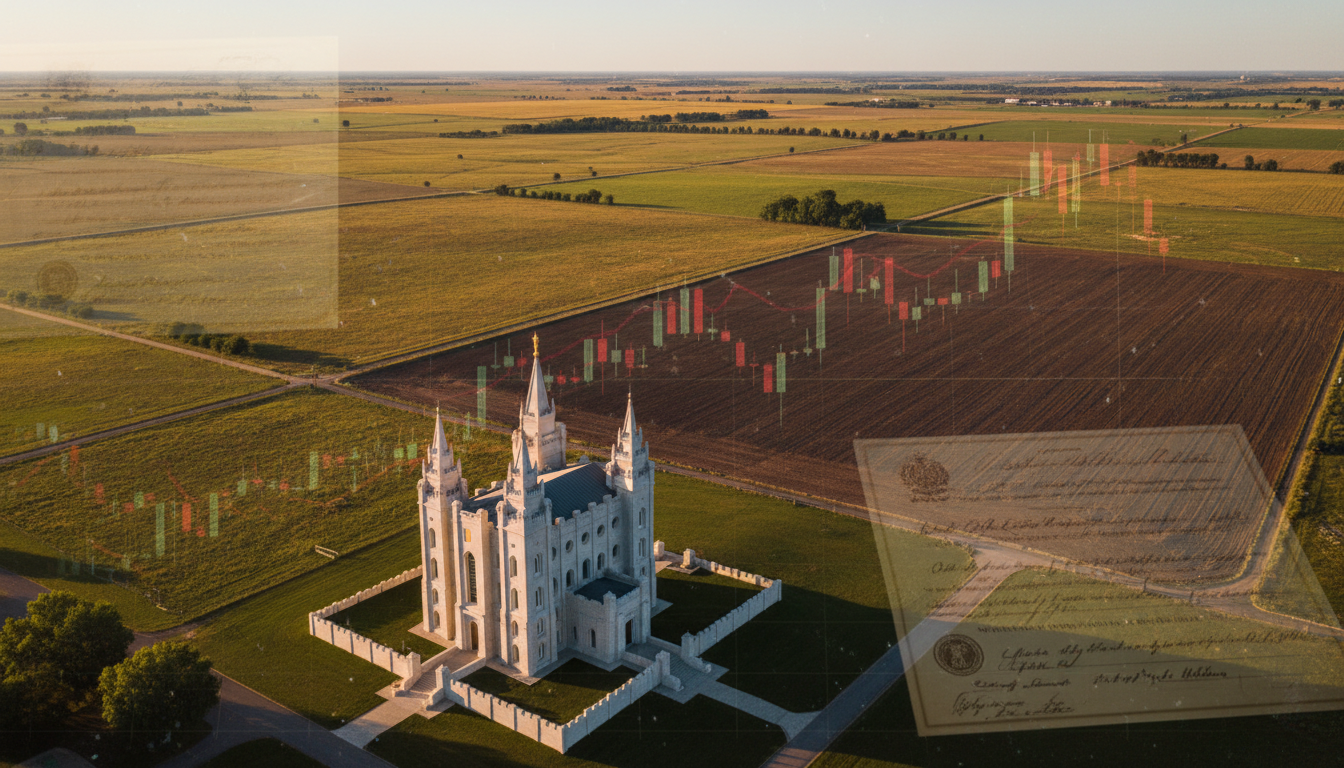
While you were paying rent this month, the Mormon Church was buying another thousand acres of prime American farmland.
And they’ve been doing this for decades.
Right now, in 2026, the Church of Jesus Christ of Latter-day Saints owns more agricultural land than almost any private entity in America. We’re talking about 1 million acres — cattle ranches in Florida, wheat farms across the Midwest, citrus groves in California, and timberlands in the Pacific Northwest.
That’s bigger than the entire state of Rhode Island.
And it’s all tax-exempt.
But here’s what makes this genuinely disturbing: This isn’t about feeding the poor. This isn’t about humanitarian aid. These farms operate as profitable businesses — selling beef commercially, leasing land, and generating millions in revenue.
All while sitting on a $100 billion investment fund.
All while asking members living paycheck to paycheck to pay 10% of their income in tithing.
[embed]@MormonDeepDive
The Scale of the Mormon Agricultural Empire
The Church operates one of the largest agricultural empires in America through several corporate entities that most members have never heard of:
- Deseret Ranches (Florida)
- Farmland Reserve, Inc.
- AgReserves, Inc.
- Dozens of subsidiary corporations designed to obscure the full scale of ownership
Deseret Ranches: A Case Study
Deseret Ranches in Florida alone covers nearly 300,000 acres — one of the largest cattle operations in the entire United States.
It produces beef sold commercially under brands that don’t advertise their connection to the Mormon Church. It also operates citrus groves and sod farms that generate tens of millions in annual revenue.
Then there are:
- Wheat farms across Nebraska, Kansas, and the Dakotas
- Timberland operations in the Pacific Northwest
- Orchards in California
- Ranches across the Western United States
Financial analysts estimate the total value of the Church’s agricultural holdings at somewhere between $15 and $20 billion. And that’s a conservative estimate because the Church doesn’t disclose full financial information.
The Uncomfortable Truth
Here’s what makes this truly extraordinary: Almost none of this land is used to feed the poor or support the Church’s welfare system.
The vast majority operates as for-profit commercial agriculture:
- The beef is sold to grocery stores and restaurants
- The wheat goes to commodity markets
- The timber is sold to lumber companies
This is not a charity. This is a business. A tax-exempt business.
Your local farmer pays taxes on every acre, every cow, every bushel of wheat. But the Mormon Church, sitting on $100 billion in investments, pays nothing.
The Doctrinal Justification
The Mormon Church teaches something called the “Law of Consecration and Stewardship.” The idea is that in the end times, before the Second Coming of Jesus, there will be tribulation, economic collapse, food shortages, and chaos.
Faithful members are supposed to prepare by storing a year’s supply of food and essentials. The Church itself operates grain silos, canneries, and distribution centers to support this preparation.
But here’s where it gets interesting: While the Church tells individual members to store food in their basements, Church leadership took the concept to an entirely different level.
Why store food when you can own the farms that produce it?
Why depend on supply chains when you can control the entire production process from field to distribution?
This isn’t about helping members prepare. This is about institutional survival.
Strategic Resource Consolidation
Think about what they’re actually doing:
- Acquiring water rights in regions with scarce water
- Buying timberland that will be valuable as construction materials become expensive
- Securing cattle ranches that provide protein independent of global supply chains
- Purchasing land in regions less vulnerable to climate change — northern states, higher elevations, areas with natural water sources
This is not religious preparation. This is strategic resource consolidation.
And it’s all funded by tithing from members who think their donations are going to build temples and support missionary work.
The Financial Structure: A Tax-Exempt Loophole
The Church operates these agricultural businesses through corporate entities that are technically separate from the religious organization. This gives them legal protection and financial opacity.
Deseret Ranches, for example, is a for-profit corporation. It sells products. It generates revenue. It operates like any other agribusiness.
But because it’s owned by the Church, it benefits from the Church’s tax-exempt status. The profits flow back into the broader Church financial ecosystem without being taxed.
The Tax Question
Should this be allowed? Is this what tax exemption was designed for?
Religious organizations in the United States enjoy tax-exempt status under the assumption that they operate for charitable, educational, or religious purposes — not for profit.
But the Mormon Church operates massive for-profit agricultural businesses under the umbrella of religious tax exemption. They generate revenue. They compete with commercial farmers. They sell products on the open market.
The only difference is they don’t pay taxes.
Some legal scholars argue that the Church’s agricultural operations have crossed the line from religious mission to commercial enterprise. That entities like Deseret Ranches should be taxed as the for-profit corporations they functionally are.
But the Church has powerful lawyers and political influence. So far, nobody has successfully challenged their tax status.
The Human Cost
Let me show you what this looks like in human terms.
A Mormon family in Idaho earns $50,000 a year. They pay $5,000 in tithing — 10% of their gross income before they pay rent, before they buy groceries, before they cover medical expenses.
The Church takes that $5,000, along with billions from millions of other members, and uses it to buy another thousand acres of farmland that will generate profit for the institution.
That family struggles to make ends meet. The Church sits on $100 billion and buys more land.
That family is told to have faith and trust God. The Church builds a financial empire that could survive any economic collapse.
The institution tells members to sacrifice and trust. While the institution sacrifices nothing and trusts only its own resource consolidation.
This is not spiritual leadership. This is exploitation dressed up as stewardship.
What Are They Really Preparing For?
Based on the pattern of acquisitions, the strategic focus on water and food, and the scale of their operations, the Church is preparing for one of three scenarios:
Scenario 1: Economic Collapse and Food Insecurity
If supply chains break down, if inflation makes food unaffordable, if global trade disrupts, the Church will control domestic food production. They will have leverage. They will have power.
Scenario 2: Climate-Driven Resource Scarcity
As water becomes scarce in the Western United States, as droughts intensify, as agricultural land becomes less productive, the Church will own the land with water rights and the infrastructure to produce food.
Scenario 3: Social and Political Instability
If American society fragments, if government authority weakens, if regional power structures emerge, the Church will be positioned as a quasi-governmental entity controlling essential resources in its sphere of influence.
Any of these scenarios would make the Church’s agricultural empire extraordinarily valuable — not just financially, but politically.
The Real Endgame
This is not about charity. This is not about feeding the hungry.
This is about power.
The Mormon Church is not preparing to serve. They are preparing to survive. And they’re doing it by consolidating control over the resources everyone else will desperately need.
The message to members is spiritual: “Trust God. Pay your tithing even if you can’t afford rent. Have faith.”
But the message revealed by their actions is entirely different: “Secure resources. Control production. Prepare for collapse.”
So which message is true? The one they preach, or the one they live?
The Questions We Should Be Asking
- Should religious organizations be allowed to own billions of dollars in for-profit farmland while paying zero taxes?
- If the Church believes collapse is coming, why aren’t they telling members? Why hoard resources in secret while asking struggling families to pay tithing?
- Does knowing that tithing funds for-profit farms change how you see the Church?
These aren’t rhetorical questions. They’re fundamental questions about transparency, institutional honesty, and the relationship between religious organizations and the state.
Conclusion: Following the Money
The Mormon Church’s agricultural empire reveals an institution that says one thing publicly while doing another privately.
They preach faith and sacrifice to members. They practice strategic resource consolidation and wealth accumulation behind closed doors.
They claim to be preparing for the Lord’s return. But their actions suggest they’re preparing for something much more earthly: institutional survival in a world of economic and environmental collapse.
And they’re doing it all with your money — tax-free.
This is not conspiracy theory. This is documented fact, observable in public records, corporate filings, and investigative journalism.
The question is: What are we going to do about it?
Watch the full investigation:
[embed]
Follow Mormon Deep Dive for more investigations into the hidden financial empire, institutional power, and real agenda behind the carefully managed public image.
메타데이터
- post_id
- 55c926fbb8d9
- slug
- mormon-church-farmland-empire-20-billion-tax-free-55c926fbb8d9
- url
- https://medium.com/@Mindvero/mormon-church-farmland-empire-20-billion-tax-free-55c926fbb8d9
- canonical_url
- https://medium.com/@Mindvero/mormon-church-farmland-empire-20-billion-tax-free-55c926fbb8d9
- author_url
- https://medium.com/@Mindvero
- status
- ok
- fetched_at
- 2026-06-23 03:48:11