Depreciation Recapture Explained for Real Estate Investors
I regularly review tax strategies with real estate investors and their CPAs, and depreciation is almost always part of the conversation…
Depreciation Recapture Explained for Real Estate Investors
I regularly review tax strategies with real estate investors and their CPAs, and depreciation is almost always part of the conversation. One topic that often surprises investors is depreciation recapture, especially when they sell a property and see how it affects the final tax calculation.

A Question That Often Comes Up at Sale Time
Most investors understand that depreciation provides valuable tax deductions while they own a property.
For residential rental real estate, the IRS allows investors to depreciate the building over 27.5 years. That annual deduction can significantly reduce taxable income from rental activity.
But what many investors don’t fully anticipate is what happens when the property is eventually sold.
At that point, the IRS requires part of the gain to be treated as depreciation recapture, which is taxed differently than long-term capital gains.
Understanding how that works ahead of time helps investors evaluate both short-term tax savings and long-term tax outcomes.
The Common Misunderstanding
A common misconception is that depreciation deductions are simply permanent tax savings.
In reality, depreciation often creates tax deferral rather than permanent tax elimination.
When a property is sold, the IRS “recaptures” the depreciation that reduced the property’s tax basis over time.
This means that the portion of gain attributable to depreciation is taxed separately from the rest of the capital gain.
For residential rental property, depreciation recapture is generally taxed at a maximum federal rate of 25%.
That rate sits between ordinary income tax rates and long-term capital gains rates.
The remaining gain on the property typically qualifies for long-term capital gains treatment, depending on holding period and other factors.
How Depreciation Recapture Actually Works
Depreciation recapture is calculated based on the difference between the property’s adjusted basis and the sale price.
The process works like this:
- The investor purchases a property.
- The building portion is depreciated each year.
- Depreciation reduces the property’s tax basis.
- When the property is sold, the IRS calculates gain relative to the reduced basis.
The portion of gain tied to prior depreciation becomes the recapture amount.
Real-World Factors That Affect Recapture
Several practical factors influence how depreciation recapture affects a sale.
Amount of Depreciation Claimed
The more depreciation taken during ownership, the larger the potential recapture amount.
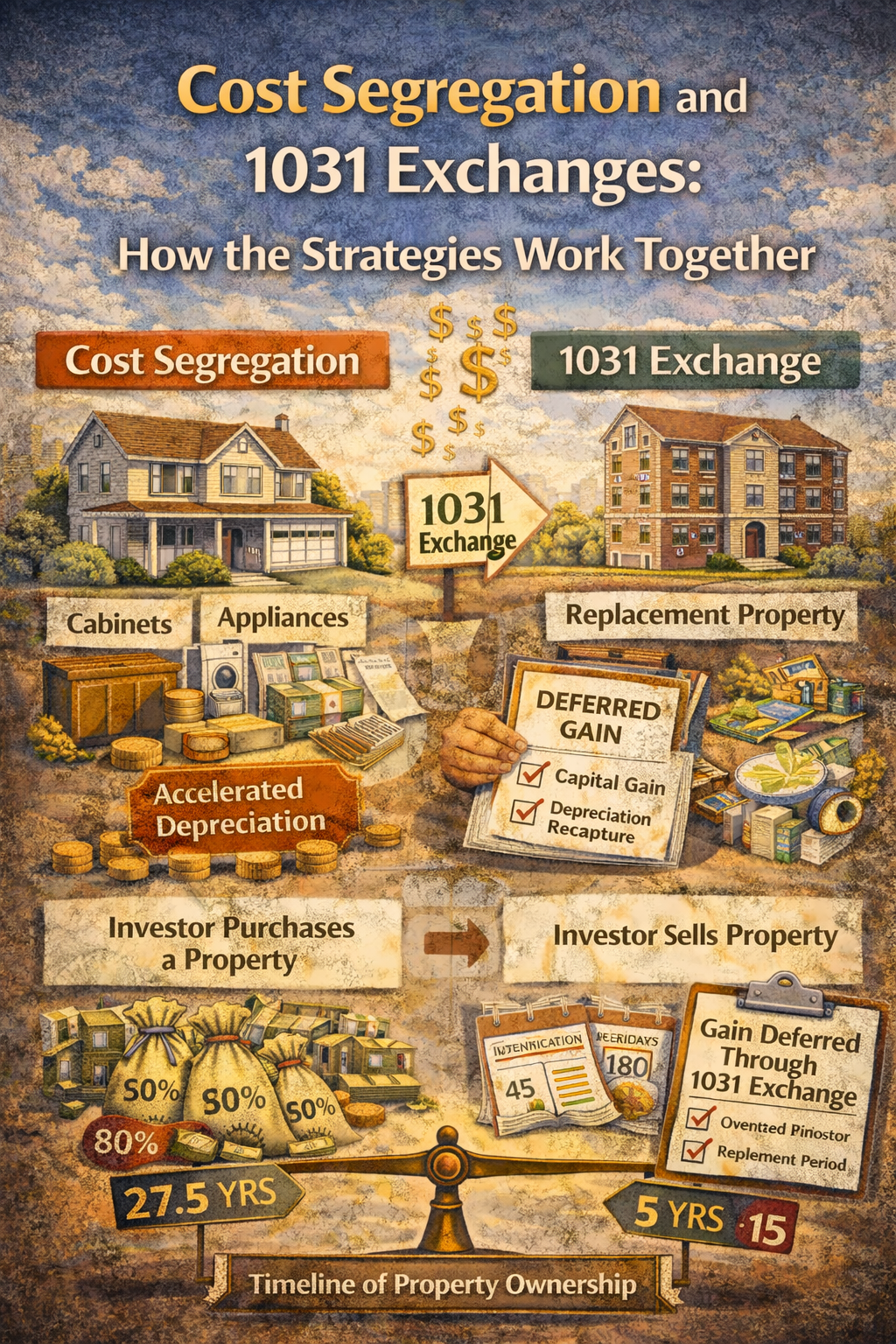
Strategies such as cost segregation can accelerate depreciation, which increases early deductions but may increase recapture when the property is sold.
Length of Ownership
Longer holding periods spread depreciation deductions over many years.
Shorter holding periods combined with accelerated depreciation can concentrate deductions early, which may influence the recapture calculation at sale.
Property Appreciation
If the property appreciates significantly, a large portion of the gain may still qualify for long-term capital gains treatment.
In many cases, the recapture portion represents only part of the total gain.
Tax Planning Before Sale
Investors sometimes structure sales or exchanges in ways that defer or manage recapture.
One example is a 1031 exchange, which can defer both capital gains and depreciation recapture when proceeds are reinvested into qualifying replacement property.
These strategies require careful planning and coordination with tax professionals.
Situations Where Recapture Becomes Especially Relevant
Depreciation recapture tends to become a central planning issue in several scenarios:
- Investors selling long-held rental properties
- Properties that have used cost segregation strategies
- Properties that have experienced significant appreciation
- Portfolio sales involving multiple rental properties
- Investors considering 1031 exchanges or portfolio restructuring
In these situations, understanding how recapture works helps investors evaluate the full tax picture before a transaction occurs.
Final Perspective
Depreciation is one of the most valuable tax benefits available to real estate investors.
At the same time, those deductions affect the property’s tax basis and influence the tax calculation when the property is sold.
Depreciation recapture is simply the mechanism the tax code uses to account for those earlier deductions.
When investors understand this relationship ahead of time, they can evaluate strategies like cost segregation, long-term holding, or 1031 exchanges more clearly as part of their broader investment planning.
Michael Feldman Owner, No Tax Compromise
No Tax Compromise focuses on tax strategy and cost segregation analysis for real estate investors.
More resources and detailed guides are available at https://www.NoTaxCompromise.com
Connect with Michael on LinkedIn https://www.linkedin.com/in/michael-feldman-2a21093b2/
메타데이터
- post_id
- 55cd4029175d
- slug
- depreciation-recapture-explained-for-real-estate-investors-55cd4029175d
- url
- https://medium.com/@notaxcompromise/depreciation-recapture-explained-for-real-estate-investors-55cd4029175d
- canonical_url
- https://medium.com/@notaxcompromise/depreciation-recapture-explained-for-real-estate-investors-55cd4029175d
- author_url
- https://medium.com/@notaxcompromise
- status
- ok
- fetched_at
- 2026-06-09 15:37:30