Mexico’s Genius Workarounds: How Ordinary People Stay Free in a Digital World
When one system becomes compulsory, Mexicans often keep another one alive
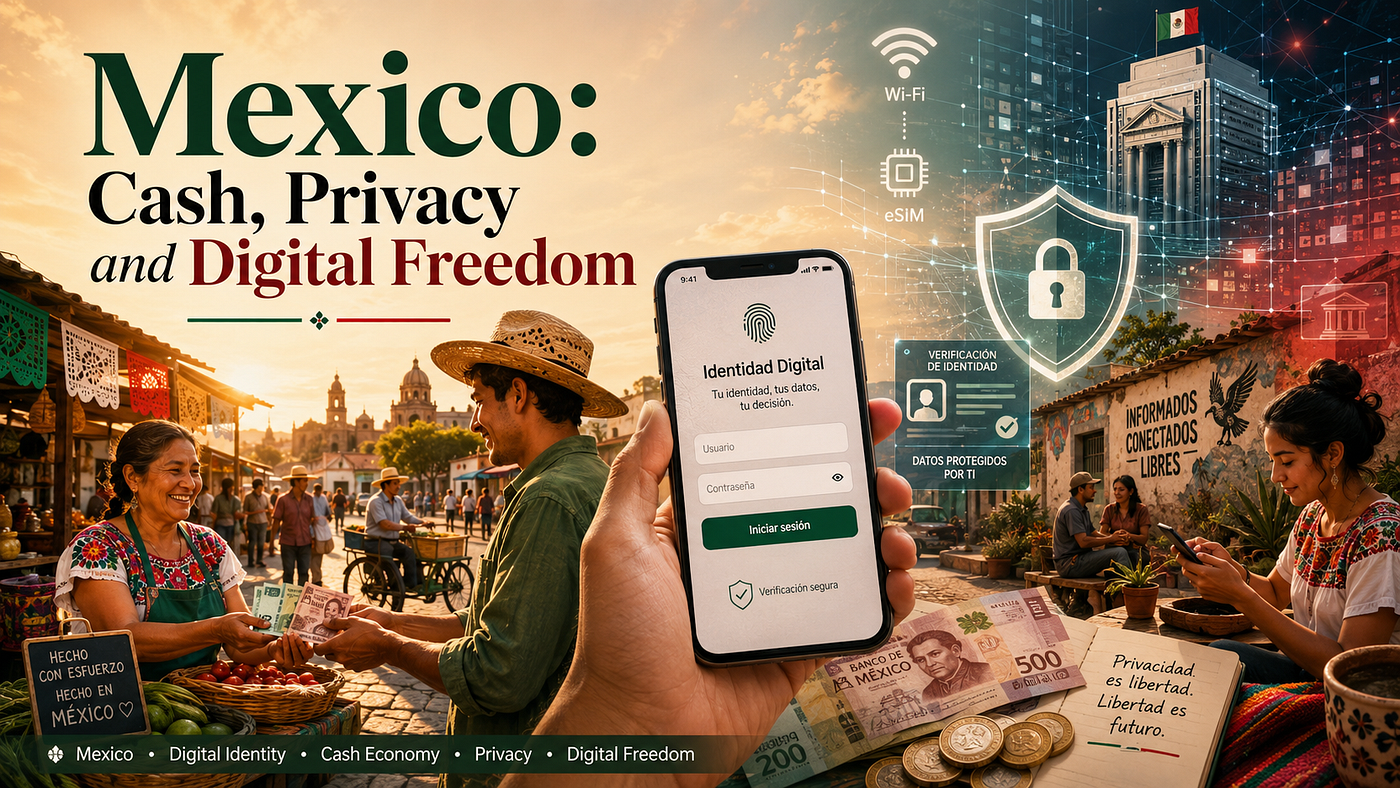
Mexico’s Genius Workarounds: How Ordinary People Stay Free in a Digital World
When one system becomes compulsory, Mexicans often keep another one alive
Let me ask you something.
Have you ever had that moment where your phone dies, your banking app won’t load, or a payment gets declined for no clear reason — and suddenly you feel stuck? Like the world has quietly locked a door you didn’t even realise you depended on?
That feeling is becoming more common.
Across the world, governments and companies are building systems where almost everything depends on a verified digital identity.
Your phone number identifies you. Your banking app tracks your spending. Your government account unlocks services. Your face or fingerprints may soon tie it all together.
Mexico is moving in that direction too.
New rules now require mobile phone lines to be linked to a verified person or business. Unregistered lines can be suspended. At the same time, biometric identity systems are being developed, raising real concerns about privacy and control.
But here’s what struck me when looking at Mexico more closely.
Despite all of this…
Life doesn’t completely fall apart when the official system stops working.
People have alternatives.
They have backup plans.
And honestly, some of them are quietly brilliant.
The first workaround: cash keeps the real economy breathing
In Britain, we’re constantly nudged to see cash as outdated or inconvenient.
But in Mexico, cash is still very much alive — and not just out of habit.
It’s part of how people stay afloat.
Most everyday purchases are still made with cash, especially for smaller amounts. And that creates something we’ve slowly lost elsewhere: a safety net.
If the card machine breaks, the shop still trades.
If the power goes out, the market stall stays open.
If someone doesn’t have a bank account — or their phone isn’t working — they can still buy what they need.
Cash doesn’t ask for a password.
It doesn’t freeze your account.
It doesn’t suddenly decide you need to “verify your identity” before you can eat.
You hand it over. You get what you came for.
Simple.
And that simplicity isn’t backward.
It’s freedom in its most practical form.
The second workaround: the neighbourhood becomes the platform
Think about the last time you needed help with something small.
Did you turn to a neighbour… or did you open an app?
In Mexico, the answer is often still the neighbour.
The corner shopkeeper knows who you are.
Someone nearby knows a person who can fix your washing machine.
A family member can pick something up for you without needing a digital authorisation code.
Sometimes, a small business will even trust you to pay later — because they recognise you.
No database.
No facial scan.
No algorithm deciding whether you’re “trusted.”
Just human relationships doing what they’ve always done.
The neighbourhood becomes the network.
And there’s something deeply reassuring about that.
The third workaround: Wi-Fi can matter more than a telephone number
At first glance, losing your mobile line sounds like a disaster.
But here’s the thing — your phone doesn’t suddenly become useless.
With Wi-Fi, people can still message, call, and stay connected.
WhatsApp, public Wi-Fi, a friend’s hotspot, even a small portable router — there are multiple ways to stay online without relying on a traditional mobile line.
It’s not perfect.
It doesn’t make anyone invisible.
But it does show something important:
There’s rarely just one way into the system anymore.
And when one door closes, people often find another.
The fourth workaround: prepaid thinking
This one is less about technology and more about mindset.
In many parts of Mexico, people avoid tying themselves into long-term commitments wherever possible.
They pay for what they need.
When they need it.
And they keep their options open.
That might mean switching phone services, working multiple small jobs, or buying things in smaller amounts instead of relying on credit.
It’s not as neat as the subscription model we’re used to.
But it gives people something valuable:
Control over when and how they engage.
Instead of being locked into a system, they can step in and out of it.
The fifth workaround: small businesses can bend without breaking
We often hear about the informal economy as a weakness.
And yes, it has real downsides — especially when it comes to worker protections.
But there’s another side to it.
Flexibility.
A small family business doesn’t need layers of software, contracts, or approvals to keep going.
If something breaks, they adapt.
If prices change, they adjust.
If the system goes down, they carry on.
A big chain might grind to a halt because of a technical issue.
A street vendor just picks up a pen and changes the price on a sign.
It’s not flashy.
But it works.
And it keeps working when things go wrong.
The sixth workaround: people repair, reuse and improvise
There’s something I really admire here.
In Mexico, things don’t get thrown away at the first sign of trouble.
They get fixed.
Adapted.
Reused.
People find ways to make things last.
And that mindset matters more than we often realise.
Because modern systems tend to push us toward dependency.
Devices that can’t be opened.
Services that stop working if the company changes its terms.
Features that disappear overnight.
The repair culture quietly pushes back against that.
It asks a simple question:
What can we do with what we already have?
And sometimes, that question is more powerful than any new technology.
The seventh workaround: the formal and informal worlds overlap
One of the most interesting things is how people blend digital and non-digital life.
It’s not one or the other.
It’s both.
Someone might advertise on Facebook but take cash.
Arrange a sale on WhatsApp but complete it in person.
Use digital tools — but not depend on them entirely.
That balance is incredibly important.
Because it means technology stays useful…
without becoming the gatekeeper.
The eighth workaround: scepticism creates friction
Here’s something we don’t talk about enough.
Systems don’t just work because they’re introduced.
People have to accept them.
And in Mexico, there’s often a healthy level of scepticism.
Questions get asked.
Concerns get raised.
Legal challenges happen.
That doesn’t always stop a policy.
But it slows things down.
It forces a conversation.
And it makes it harder for sweeping changes to happen quietly.
That friction matters.
Because once a system is fully embedded, it’s much harder to question.
This is not about romanticising poverty
Let’s be clear.
None of this means things are perfect.
Power cuts aren’t good.
Limited access to banking isn’t freedom.
People shouldn’t have to rely on workarounds because systems fail them.
But here’s the uncomfortable truth.
Those workarounds — once they exist — create a kind of independence that highly digitised societies are starting to lose.
Because a perfectly efficient system can also be incredibly fragile.
Take away the power.
Lose the signal.
Freeze the account.
Reject the login.
And suddenly, everything stops.
Mexico’s system might look messy from the outside.
But underneath that mess…
there’s resilience.
There’s always another way.
What Britain could learn from Mexico
This isn’t about rejecting technology.
It’s about not putting all our eggs in one basket.
We need to keep alternatives alive.
Cash.
Face-to-face services.
Simple ways to prove who we are without handing over everything.
We need systems that still work when things go wrong.
Because they will go wrong.
And when they do, the real question isn’t how advanced the system is.
It’s this:
Can you still function without it?
Can you still pay?
Can you still communicate?
Can you still live your life?
Mexico’s strength isn’t one clever trick.
It’s the fact that there are always options.
Cash alongside cards.
People alongside platforms.
Flexibility alongside structure.
And maybe that’s the lesson we need to hold onto.
Not everything should depend on one system.
Because when it does…
we all become a little more fragile.
Reader’s note: This article reflects on everyday resilience and the importance of keeping alternatives alive. It is not about avoiding lawful identification requirements, but about ensuring people always have practical, human-centred ways to participate in society.
메타데이터
- post_id
- 55d009bd5b05
- slug
- mexicos-genius-workarounds-how-ordinary-people-stay-free-in-a-digital-world-55d009bd5b05
- url
- https://medium.com/@dragonflameace007/mexicos-genius-workarounds-how-ordinary-people-stay-free-in-a-digital-world-55d009bd5b05
- canonical_url
- https://medium.com/@dragonflameace007/mexicos-genius-workarounds-how-ordinary-people-stay-free-in-a-digital-world-55d009bd5b05
- author_url
- https://medium.com/@dragonflameace007
- status
- ok
- fetched_at
- 2026-07-13 06:23:13



