The Wheel That Launched a Thousand Ships
What was the invention that remade world commerce, warfare, and global expansion?
The Wheel That Launched a Thousand Ships
What was the invention that remade world commerce, warfare, and global expansion?
Photo by David Dibert on Unsplash
It was the spinning wheel.
It was the ability to make sails more quickly.
Making cord and string has been around since the time of the Neanderthals. Modern humans probably learned this skill, along with sewing with a needle and thread, from them or the Denisovans hundreds of thousands of years ago. The first fibers were plant based and twined rather than spun, but it wasn’t relatively long before someone figured out how to spin fiber into thread using a stick, and then if a weight is added, the stick will spin faster and longer. As a creative species, we were on our way.
In order to keep a village in clothes, blankets, rugs, and everything else needed that was made out of fabric, people must have been spinning at every available moment. We assume that women were doing this, but there’s no reason that men weren’t also spinning. It was a vital activity and needed by the entire community.
Evenings would have been spent doing tasks that could be done by fire or lamp light. Tasks like spinning, sewing, and mending continued through the day and into the evening. There was no spare time. Spare time is a very modern concept.
Spinning sails
When we think of early ships, we naturally think of the woodwork that goes into building them. We rarely consider the sails that are needed to sail, rather than row, the ship.
That means months of spinning and weaving, not to mention preparing the fiber for spinning beforehand. Wool must be sorted, washed, and either carded or combed. Plant fibers need even more processing.
Early sails were made from the wool of primitive breeds of sheep. These sheep were double coated, meaning they had a coarse outer coat and a fluffier inner coat. Rather than being shorn, these sheep shed their coats in the early summer.
They were also much smaller than modern sheep breeds. A primitive breed weighs 27–32 kg or 60–70 lb, while a modern merino sheep weighs 56–107 kg or 125 to 235 lb. A single sail of 9×10 meters needed the wool from over 150 sheep.
This means that the process of making a sail began in the early summer when the wool was gathered, washed, and prepared for spinning. Then thousands of hours of spinning were required to make the thread that would be woven to make the sail.
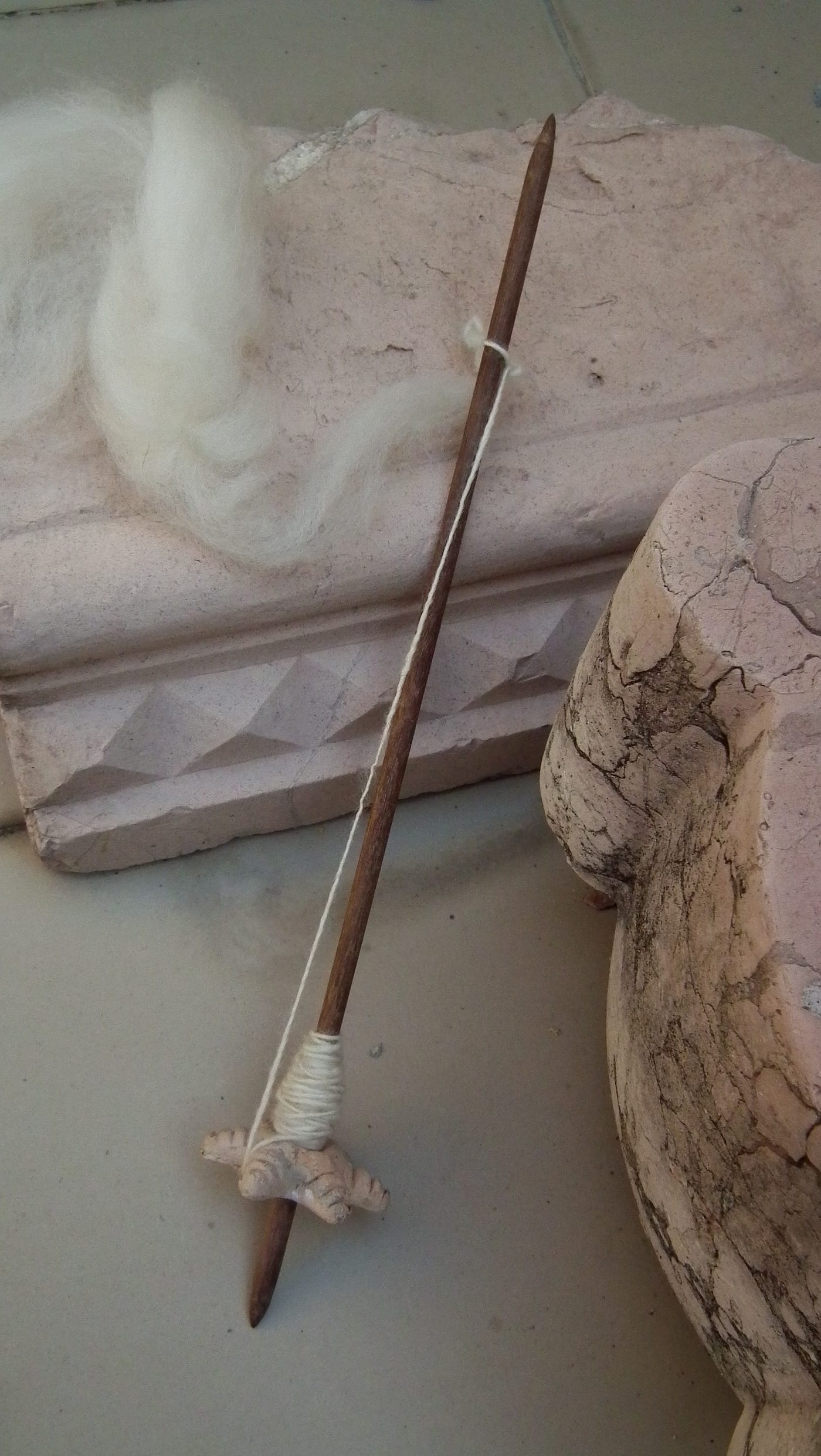
Drop spindle (Photo by author)
The spinning was done using drop spindles. Drop spindles are made of a slender wooden shaft about 50 cm long with a round whorl, usually made of clay or bone that was attached near the bottom of the shaft. The wool is attached and the spindle whorl is spun, causing the wool to twist. After spinning several centimeters of yarn, it is wound onto the shaft of the spindle and another length of thread is spun.
A sail for a Viking ship took about 10,000 hours to make, including the time to process the wool, spin it, weave it, and waterproof the finished textile. The labor-intensive process of spinning the 154 kilometers (60 miles) of thread created a bottleneck in ship production.
And if something happens to the sail? If it can’t be mended or recovered from a sunken boat, a new one has to be made from scratch.
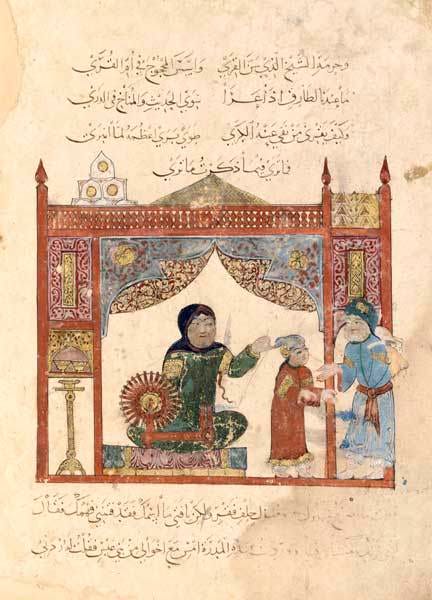
Woman spinning using a charkha type spinning wheel in a painting by al Hariri of Basra, dated 1237. (Image in public domain)
New Technology
In the early part of the 11th century, hand cranked spinning wheels called charkhas appeared in India, China, and the Middle East. These were small wheels that sat on a low table or on the ground. The spinner cranked a larger wheel that had a band that connected to a smaller wheel with a spindle coming out of the central shaft. The spinner then spun the fibre off the tip of the spindle while continuing to crank the wheel. The difference in the size of the wheels meant that the smaller wheel rotated much faster than the one being cranked. It sped up the process of spinning, but the spindles were still small, and the spinner had to stop spinning periodically to wind the thread onto the spindle. When the spindle was full, it was taken off and replaced by an empty one, and the process started again.

Painting of a woman spinning on a great wheel by Guillaume Fouace (Image in public domain)
This small hand cranked wheel was not adopted in Europe, however the same concept was used in the design of the great wheel. These came into use in the 14th century and sped up the spinning process considerably. These had a main wheel that was over a meter in diameter, meaning that the spindle can spin much faster and produce more thread in less time. The process was similar to the smaller hand cranked wheels. The spinner turned the wheel while spinning the thread off the end of the spindle.
Spinning was faster but still labour intensive. Ships usually still had a single mainsail.

Treadle spinning wheel with flyer (Photo by author)
The Technological Revolution
In 1533 the first treadle spinning wheels with flyer assemblies were invented. These are what most people imagine when they think of a spinning wheel. The spinner sits at the wheel and guides the wool in through a flyer system that simultaneously twists the thread and winds it onto a bobbin while the spinner rotates the wheel using a foot treadle. The process is extremely fast. The spinner no longer needed to stop to wind the thread onto the spindle, since the winding process was automatic. The bobbin was easily removed from the flyer assembly, and an empty one put in its place in seconds. Meanwhile, the bobbin of finished thread could be mounted on a rack to be made ready for weaving.
In her book The Fabric of Civilization, Virginia Postrel describes the estimated time needed to spin enough coarse thread (60 miles / 154 km) to make a sail. During the Viking period, using drop spindles, it would have taken 3,088 hours of continuous spinning. Using a spinning wheel, this was reduced to 1,692 hours.
Photo by Rafael Garcin on Unsplash
The development of more efficient spinning technology sped up the process considerably. Having more sails of different types enabled ship builders to make them larger and faster and to have more control when sailing. Simple square sails could be supplemented with triangular sails that helped in changing direction. By the sixteenth century, ships were able to have three or four masts that supported multiple sails.
While Viking ships did have the ability to travel long distances and carry cargo, they were limited in their size and maneuverability. The number of ships available was limited because of the amount of time and resources that went into making sails. As spinning technology advanced, ships could be designed to have multiple sails with different functions. This enabled the ships to travel faster and longer distances without needing to stop at ports. It also meant that the ships could be larger and carry more cargo with a smaller crew. Because of the multiple sails, ships could also maneuver more easily in maritime battles. By improving textile production, the shipping industry could advance to being able to circumnavigate the world.
References
Elizabeth Wayland Barber (1996) Women’s Work: The First 20,000 Years — Women, Cloth, and Society in Early Times. ISBN-13: 978–0393313482
Virginia Postrel (2021) The Fabric of Civilization. ISBN-13: 978–1541617629
Viking ships and sails https://www.hardraade.com/en/post/viking-ship-sail-traditions
Sailmaking https://www.heritagecrafts.org.uk/craft/sail-making/
메타데이터
- post_id
- 55e1f60e3489
- slug
- the-wheel-that-launched-a-thousand-ships-55e1f60e3489
- url
- https://thequantasticjournal.com/the-wheel-that-launched-a-thousand-ships-55e1f60e3489
- canonical_url
- https://thequantasticjournal.com/the-wheel-that-launched-a-thousand-ships-55e1f60e3489
- author_url
- https://medium.com/@gfregni
- status
- ok
- fetched_at
- 2026-06-13 16:00:06