ColdFusion Talent Shortage: How to Hire, Train, and Retain CFML Developers
The ColdFusion talent shortage is real and structural — the experienced CFML workforce is aging, few junior developers are learning the…
ColdFusion Talent Shortage: How to Hire, Train, and Retain CFML Developers
ColdFusion Talent Shortage: How to Hire, Train, and Retain CFML Developers
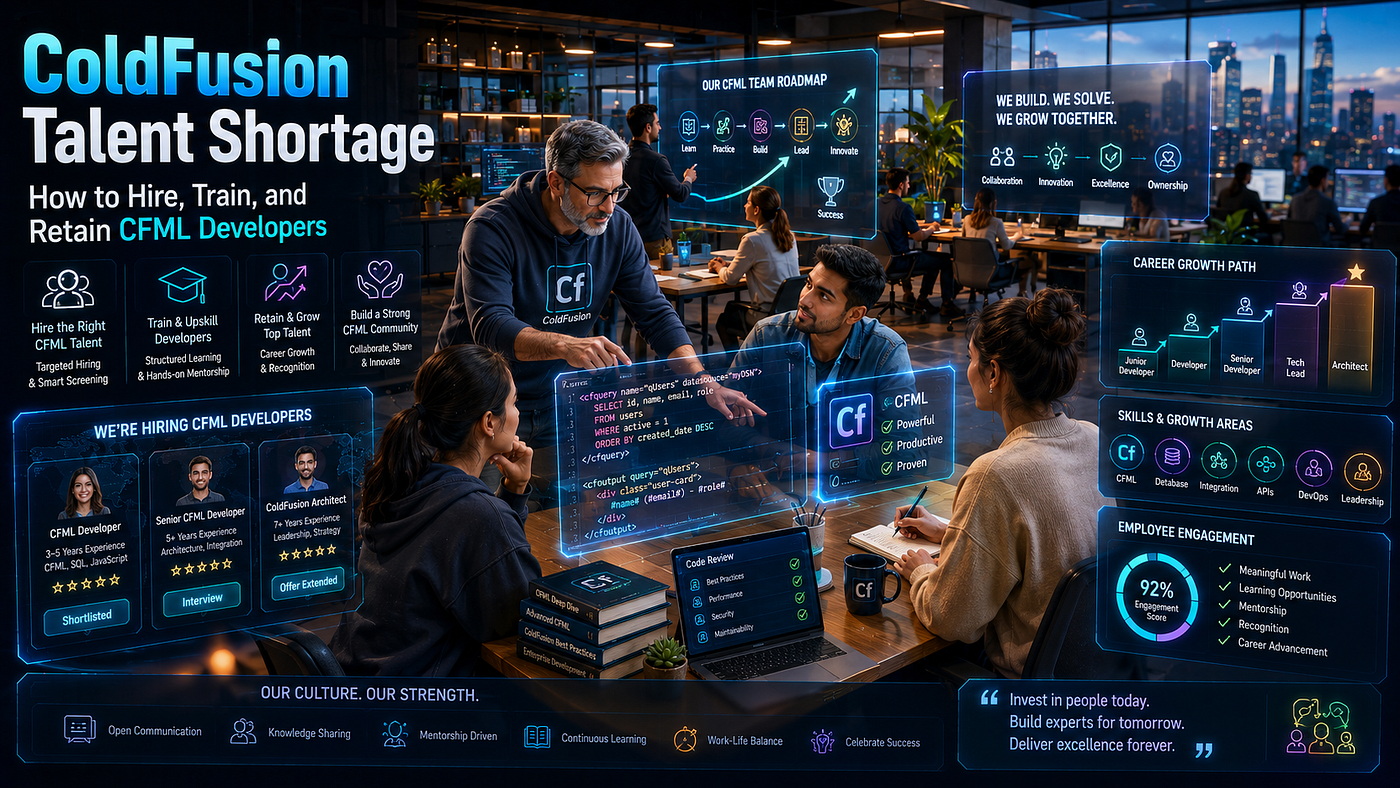
The ColdFusion talent shortage is real and structural — the experienced CFML workforce is aging, few junior developers are learning the language, and senior developers rarely change jobs, so an ad for a ColdFusion role often draws far fewer responses than one for a mainstream stack. The practical response has three parts. Hiring: stop fishing only for unicorns with 15 years of CFML; target the sectors where CFML talent concentrates (government, healthcare, higher ed, finance, insurance), use specialized CFML staffing/agencies, and consider a white-label or contractor partner to cover delivery gaps. Training: upskill your existing Java or JavaScript developers into CFML using proven resources like the open-source “Learn CF in a Week,” “Modern CFML in 100 Minutes,” and Ortus Solutions’ ColdBox/CommandBox/TestBox courses — CFML is approachable for anyone with backend experience. Retaining: the scarcity that makes hiring hard also gives you leverage to keep people — pay to the market, invest in modern CFML skills (frameworks, cloud, CI/CD) so the role doesn’t feel like a dead end, and treat your CFML developers as the specialized, hard-to-replace assets they are.
Why the Shortage Exists (and Why It’s Not the Same as “ColdFusion Is Dead”)
It’s important to separate two things that often get conflated. ColdFusion is not dead — Adobe ships regular releases (2021, 2023, 2025) with a roadmap of enterprise support extending well into the future, and a large installed base of mission-critical applications keeps running on Adobe ColdFusion and the open-source Lucee engine across government, healthcare, finance, higher education, and manufacturing. The platform is viable.
What is true is a demographic and pipeline problem. Adobe’s own community has acknowledged this for years — going back to a 2018 Adobe ColdFusion blog post that described a “population problem,” noting that an ad for a PHP developer might draw 30 responses in a day while a ColdFusion ad gets crickets. The dynamics behind it, as described across the CFML community:
- An aging workforce. Many CFML developers have been with the language for one to two decades; as they retire or move on, there isn’t an easy replacement pool.
- A thin junior pipeline. Few new developers learn CFML — bootcamps and universities teach JavaScript, Python, and Java, not ColdFusion — so teams “often age without easy replacement,” as community discussions put it.
- Low turnover among seniors. The experienced CFML developers who remain are usually employed, working on long-term systems, with little incentive to move — so when a role opens, qualified candidates are scarce and the market moves fast.
- Sustained demand. Enterprises still running business-critical CFML systems, plus well-funded modernization budgets that need both legacy knowledge and modern skills, keep demand high even as supply stays tight.
The result is a genuine squeeze. One CFML services firm noted that organizations seeking senior ColdFusion talent often search for months before finding the right fit. But — and this is the reframe enterprise teams should internalize — that same scarcity is leverage for the developers and teams who have these skills. Scarcity means pricing power and stability for those who position themselves well.
Part 1: How to Hire CFML Developers
Widen the definition of a qualified candidate
The single biggest hiring mistake is demanding a candidate who already has many years of exactly your stack. That person may not exist in your market. CFML is a JVM language, and a competent Java or JavaScript developer can become productive in CFML relatively quickly (more on training below). The modern CFML developer, as the community describes the role, is a full-stack professional fluent in both legacy and contemporary technology — comfortable with tag-based CFML and CFScript, modern frameworks (ColdBox, FW/1), tooling (CommandBox, TestBox), SQL, and integrations. Hire for that adaptable profile, not just for a CFML résumé keyword.
Target the sectors where CFML talent concentrates
CFML developers cluster around the industries that run CFML systems. If you’re hiring, recruit where they already are:
- Government (state/local) — licensing, permitting, tax, elections, case management systems.
- Healthcare — eligibility, claims, provider directories, secure forms (often with HIPAA requirements).
- Higher education — student portals, scheduling, intranet workflows.
- Finance, insurance, and credit unions — billing, claims, member portals.
- Manufacturing — asset tracking, maintenance scheduling, self-service portals.
Knowing this lets you write job postings with the right keywords (postings appear as “ColdFusion/Lucee developer,” “CFML engineer,” “Full-stack CFML,” “Web developer (ColdFusion)”) and recruit from adjacent organizations in the same vertical.
Use the community and specialized channels
Generic job boards underperform for CFML. The community is small and connected, so go where it lives: the CFML Slack, the Adobe ColdFusion Community forums, Ortus Solutions community channels (for ColdBox/CommandBox), Lucee mailing lists, and CF-focused conferences like Adobe ColdFusion Summit and Into the Box. Posting and engaging in these channels reaches active CFML developers that a LinkedIn keyword search misses.
Consider specialized agencies, contractors, and white-label partners
Because direct hiring is slow (community estimates of the recruiting cycle for senior CFML engineers often run to several months), many organizations supplement with specialized CFML staffing firms, contractors, or white-label delivery partners that maintain a bench of CFML developers. This trades some cost and control for speed and flexibility — useful when you have a deadline and an unstaffed project. Be aware of the trade-offs: contractors offer flexibility but require individual vetting, while a specialized partner offers a vetted team at a higher baseline cost.
Screen with a practical skills assessment, not trivia
Don’t quiz candidates on obscure tag syntax. Give them a small, realistic exercise that reveals how they actually write CFML — parameterized queries (security awareness), error handling, and clean structure. Here’s a representative screening artifact: ask the candidate to implement and explain a small, secure data-access function.
// Candidate exercise: "Write a function that safely fetches a user by ID
// and returns a clean struct. Explain your security choices."
//
// A strong candidate produces something like this and can articulate WHY:
component {
    public struct function getUser( required numeric userId ) {
        // cfqueryparam = SQL-injection protection (the key security signal)
        var qry = queryExecute(
            "SELECT id, name, email FROM users WHERE id = :id",
            { id = { value: arguments.userId, cfsqltype: "cf_sql_integer" } },
            { returntype: "array" }
        );
        // Graceful handling of the not-found case, not a raw error
        if ( arrayLen( qry ) == 0 ) {
            return { found: false, user: {} };
        }
        return { found: true, user: qry[ 1 ] };
    }
}
What you’re looking for: do they reach for cfqueryparam/bind parameters automatically (security instinct)? Do they handle the empty result cleanly? Can they explain their choices? This tells you far more than asking them to recite the attributes of a tag. Adjust difficulty to the seniority you're hiring.
Part 2: How to Train CFML Developers
The most reliable way to beat the shortage is to create CFML developers from the backend talent you can hire — Java, JavaScript, Python, or PHP developers who learn CFML on the job. The CFML community has built genuinely good, often free, resources to make this fast.
Proven learning resources (many free)
- Learn CF in a Week — a long-standing, open-source course designed to take a capable beginner to a professional working level in roughly a week (with practice). Ideal for onboarding a new-to-CFML backend developer.
- Modern CFML in 100 Minutes — a free online book from Ortus Solutions that focuses on modern CFML: best practices, object orientation, CFScript, and tooling. Perfect for developers who need to unlearn the “ColdFusion is stuck in 2002” mindset and write contemporary code.
- Ortus Solutions training and courses — the team behind ColdBox, CommandBox, and TestBox offers structured courses (e.g., “ColdBox: Zero to Hero,” Core ColdBox, CommandBox, TestBox) via live virtual, on-site, and on-demand (CFCasts) formats. Direct training from the framework authors compresses the learning curve dramatically.
- Adobe Certified Professional: ColdFusion — Adobe’s certification program validates CFML expertise; useful as a structured learning target and a marketability credential for your developers.
- CFdocs.org and Adobe ColdFusion docs — comprehensive references for nearly any CFML tag or function; CFdocs is open-source and covers all CFML engines.
- Conferences and community — Adobe ColdFusion Summit, Into the Box, CFCamp, plus the Adobe ColdFusion YouTube channel for recorded talks. The CFML community is famously welcoming to newcomers.
A practical onboarding path for a Java/JS developer
A sensible 4-to-8-week ramp for an experienced backend developer new to CFML:
- Week 1: Work through “Learn CF in a Week”; set up a local environment with CommandBox (
box server start). Get them writing and running CFML immediately. - Weeks 2–3: “Modern CFML in 100 Minutes”; emphasize CFScript (which reads much like JavaScript/Java and eases the transition), CFCs (components/OOP), and
queryExecutewith bind parameters. Pair them with a senior developer on real tickets. - Weeks 3–5: Introduce your framework. If you use ColdBox, the Ortus “Zero to Hero” material; teach the conventions, TestBox for testing, and your codebase’s patterns.
- Weeks 5–8: Increasing ownership of real features, with code review focused on security (parameterized queries, the Adobe Lockdown Guide) and your team’s standards.
The reason this works: experienced backend developers already understand the hard parts — databases, HTTP, architecture, security. CFML’s syntax and idioms are the easy part to add, especially modern CFScript. You’re teaching a dialect, not a discipline.
Reduce onboarding friction structurally
Make CFML easier to adopt by investing in the things that help any new developer: strong documentation of your codebase, consistent use of a framework and conventions (so the code is predictable), modern script-style CFML over sprawling legacy tags where practical, and good test coverage with TestBox. ColdFusion Central’s guidance on the talent challenge points exactly here — teams that simplify onboarding with frameworks, documentation, and script-style CFML have an easier time bringing people up to speed.
Part 3: How to Retain CFML Developers
Retention is where the shortage flips from problem to opportunity. The same scarcity that makes hiring hard makes keeping your people more valuable — and losing a senior CFML developer is far costlier and slower to fix than in a mainstream stack. Treat retention as a first-class priority.
Pay to the market — and recognize the scarcity premium
Compensation expectations for senior CFML developers have climbed in recent years, driven by exactly the supply/demand imbalance described above. Be realistic: underpaying a scarce specialist is an invitation for them to leave, and replacing them may take months. While public salary data for a niche role is imperfect and varies widely by region, sector, clearance, and contract vs. full-time, the consistent signal from the market is upward pressure on senior CFML compensation. Benchmark against current postings in your sector and pay accordingly — the cost of a vacancy usually dwarfs the cost of a fair raise. (Treat any single salary figure you find online with caution; niche-role estimates from aggregators are often algorithmic and inconsistent. Use multiple current sources and your own sector’s postings.)
Keep the work modern so the role isn’t a dead end
The fastest way to lose a good developer is to make them feel professionally stranded maintaining 2003-era code with no growth. Counter this deliberately:
- Invest in modern CFML. Frameworks (ColdBox), tooling (CommandBox, TestBox), CFScript, and current ColdFusion releases. Developers stay when the work feels current, not archaeological.
- Add adjacent, transferable skills. Support your CFML developers in learning REST/GraphQL, Docker/Kubernetes, CI/CD, and cloud (AWS/Azure/GCP) — all directly applicable to modernizing CFML apps. This keeps them engaged and makes them better at your modernization roadmap. The community’s career advice is explicit: treat CF as a specialization, not an island, and pair it with modern architecture skills.
- Give them modernization projects, not just maintenance. Strangler-fig migrations, API-first refactors, performance tuning, security hardening — meaningful engineering work, not just keeping the lights on.
Value institutional knowledge and reduce bus-factor risk
A senior CFML developer who knows your decades-old application’s quirks holds irreplaceable institutional knowledge. Protect against that being a single point of failure and signal that you value it: fund documentation time, encourage knowledge-sharing and pairing, and support conference attendance (CFSummit, Into the Box) and community involvement. Developers who feel their expertise is recognized — and who get to stay connected to the broader CFML community — are far more likely to stay.
Build a pipeline so you’re not perpetually in crisis
Retention and training reinforce each other. Pairing a new-to-CFML hire with a senior developer both onboards the junior and gives the senior mentorship responsibility and recognition. Over time this builds the internal pipeline that the broader market can’t supply — turning the shortage from a recurring emergency into a managed, ongoing capability.
A Realistic Combined Strategy
No single lever solves the shortage. The teams that handle it best combine all three:
- Hire pragmatically — adaptable backend developers, sector-targeted recruiting, community channels, and partners/contractors to cover gaps.
- Train systematically — convert Java/JS talent into CFML developers using the strong (often free) learning resources, with a structured onboarding path and a framework to standardize on.
- Retain deliberately — competitive pay that respects the scarcity premium, modern and meaningful work, investment in transferable skills, and genuine recognition of institutional knowledge.
And honestly assess the build-vs-borrow-vs-partner question for your situation: building internal capacity is the most durable but slowest; contractors are fast but need vetting; a specialized CFML partner can carry delivery while you build your bench.
Conclusion
The ColdFusion talent shortage is real, structural, and unlikely to resolve on its own — the workforce is aging, the junior pipeline is thin, and demand from the enormous installed base of business-critical CFML systems remains strong. But it is manageable, and for teams that approach it deliberately it’s even an advantage: the scarcity that frustrates careless hiring rewards organizations that hire adaptably, train their own, and retain their specialists well. Widen your candidate definition and recruit where CFML developers actually are; convert capable backend developers into CFML developers with the community’s proven resources; and keep your people by paying to the market, modernizing the work, and valuing the irreplaceable knowledge they hold. Do those three things together and the shortage stops being an existential threat and becomes a competitive moat — because your competitors who don’t do them will keep struggling to staff the same systems you’ve learned to run smoothly.
If your organization is feeling the CFML talent squeeze — struggling to hire, needing to upskill a team, planning modernization that requires both legacy and modern skills, or simply needing experienced CFML capacity now while you build your internal pipeline — **Lucid Outsourcing Solutions can bridge the gap. As a dedicated ColdFusion development partner, Lucid provides vetted CFML talent, helps train and ramp your team, and works with you to design a hiring-and-modernization roadmap that fits your sector and systems. The right first step is a conversation that scopes the work against your current team, applications, and roadmap — reach out to [Lucid Outsourcing Solutions](https://lucidoutsourcing.com/)** to get started.
Sources and Research Audit Trail
The talent shortage — existence, causes, dynamics (Tier 1/2 — Adobe + community + industry):
- Adobe ColdFusion blog (Mark Takata) — “The Delicate Balancing Act between the number of ColdFusion Jobs and the number of ColdFusion Developers” (Adobe’s own acknowledgment of the “population problem”; PHP ad gets 30 responses/day vs ColdFusion ad “crickets”; community needs more jobs AND more developers; Adobe roadmap extends well into the future): coldfusion.adobe.com/2018/10/the-delicate-balancing-act-between-the-number-of-coldfusion-jobs-and-the-number-of-coldfusion-developers/
- ColdFusion Central — “Is ColdFusion Still Used in 2025?” (hiring CFML devs is “harder than for mainstream stacks”; teams upskill Java/JS developers, rely on specialized agencies, simplify onboarding with frameworks/documentation/script-style CFML; CF viable niche, Adobe + Lucee, regular releases): coldfusioncentral.com/coldfusion-2025/
- ColdFusion Central — “What Companies Hire ColdFusion Developers in 2025?” (sectors: government/licensing/permitting/elections/case management, healthcare/claims/provider directories, higher ed/student portals, finance/credit unions, manufacturing/asset tracking, agencies/staff augmentation; posting keywords “ColdFusion/Lucee developer,” “CFML engineer,” “Full-stack CFML”; community channels: CFML Slack, Adobe forums, Ortus, Lucee, CFSummit/Into the Box; ForgeBox OSS modules): coldfusioncentral.com/companies-hiring-coldfusion-developers-2025/
- Evalogical Technologies — “Why Skilled ColdFusion Talent Remains in High Demand” (2026; senior CFML hiring difficult, candidates already employed, low senior turnover, compensation climbed significantly past two years, recruiting cycle often exceeds three months, modern CFML developer = full-stack fluent in ColdBox/FW/1/Model-Glue/CommandBox/TestBox; white-label partnership model). NOTE: CFML agency source with interest in emphasizing scarcity — figures attributed and caveated, not stated as neutral fact: evalogical.com/blog/why-coldfusion-development-companies-still-need-skilled-cfml-developers-in-2026
- Quora / community — ColdFusion career discussion (aging teams “without easy replacement”; fewer juniors learn CFML; “treat CF as a specialization, not an island”; pair with Java/Node/Python, REST/GraphQL, Docker/K8s, CI/CD, cloud; scarcity = pricing power for legacy maintenance/modernization): quora.com/Is-being-a-ColdFusion-developer-good-for-a-future-career
Training and upskilling resources (Tier 1/2 — Adobe + Ortus + training providers):
- Adobe ColdFusion blog — “Learning about CFML: Resources & Ideas” (Learn CF in a Week — open-source, beginner to professional level in ~a week; Modern CFML in 100 Minutes — free Ortus book on modern CFML; CFdocs & Adobe docs; Adobe ColdFusion YouTube): coldfusion.adobe.com/2022/02/learning-cfml-resources-ideas/
- Ortus Solutions — Courses & Training (ColdBox Zero to Hero 2-day, Core ColdBox 3-day flagship, ColdBox Modules, CommandBox, TestBox, RESTful APIs, Docker, ElasticSearch; live virtual/on-site/CFCasts on-demand; trained directly by ColdBox/CommandBox/TestBox creators): ortussolutions.com/learn/courses; ortussolutions.com/services/training; ortussolutions.com/blog/coldfusioncfml-training-everything-you-need-to-know
- Ortus — ColdBox Zero to Hero training detail (2-day intensive: ColdBox 7, HMVC, RESTful APIs, BDD/TestBox, builds a real micro-blogging app “SoapBox”; cbsecurity/cbauth, migrations): ortussolutions.com/blog/level-up-your-coldfusion-skills-with-our-virtual-live-training-coldbox-from-zero-to-hero
- Modern CFML in 100 Minutes (Ortus book — jump-start developers into CFML from a modern perspective: best practices, OO, tooling): modern-cfml.ortusbooks.com
- ColdBox HMVC docs (conventions-based HMVC framework for CFML/BoxLang; productivity, team standards, modular): coldbox.ortusbooks.com
- TeraTech — ColdFusion Training List (16+ resources: Ortus tools, Learn CF in a Week, Learn CFML, Adobe certification, Pluralsight, FusionReactor tutorials; on-site training options): teratech.com/comprehensive-coldfusion-training-list-16-resources
- itlandmark / Adobe — Adobe Certified Professional: ColdFusion certification program (validate CFML expertise, increase marketability, remote options); Pluralsight ColdFusion courses: itlandmark.com/blog/coldfusion-training-learn-cfml-quickly
Broader labor-market context (Tier 1 — for backdrop only, not CF-specific claims):
- World Economic Forum — Future of Jobs Report 2025 (structural labor-market churn, ageing working-age populations as a workforce-transformation driver): reports.weforum.org/docs/WEF_Future_of_Jobs_Report_2025.pdf
- Stack Overflow blog — AI vs Gen Z (entry-level tech hiring down 25% YoY in 2024; broader pressure on junior developer pipeline): stackoverflow.blog/2025/12/26/ai-vs-gen-z/
메타데이터
- post_id
- 560a1df77575
- slug
- coldfusion-talent-shortage-how-to-hire-train-and-retain-cfml-developers-560a1df77575
- url
- https://medium.com/@Coding-Algorithms/coldfusion-talent-shortage-how-to-hire-train-and-retain-cfml-developers-560a1df77575
- canonical_url
- https://medium.com/@Coding-Algorithms/coldfusion-talent-shortage-how-to-hire-train-and-retain-cfml-developers-560a1df77575
- author_url
- https://medium.com/@Coding-Algorithms
- status
- ok
- fetched_at
- 2026-07-23 11:12:48