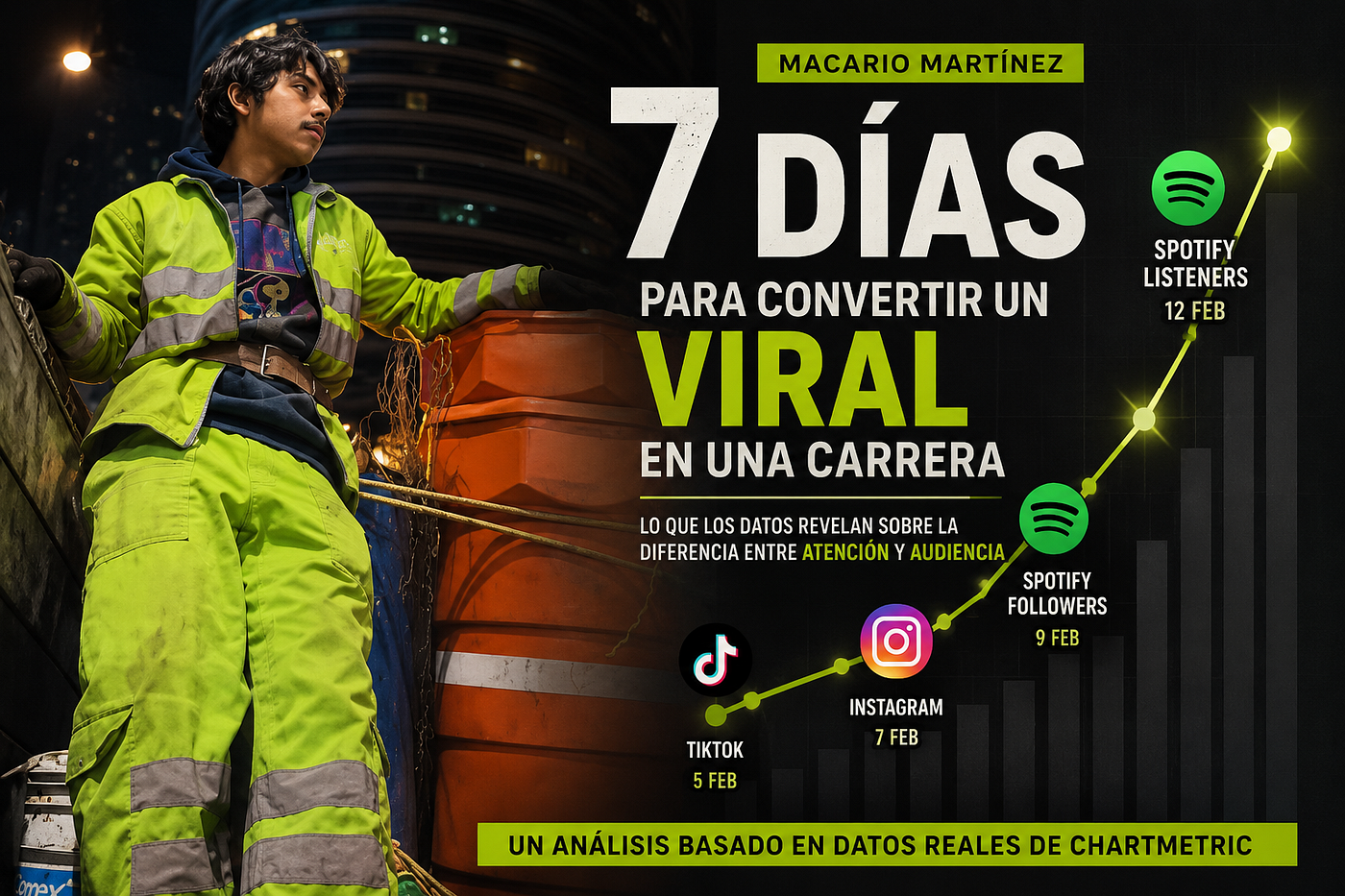
How RATA Turned an Explosion of Listeners into a Real Fan Base
What independent artists, managers, and labels can learn from one of the most compelling growth stories in Spain’s recent music scene.
How RATA Turned an Explosion of Listeners into a Real Fan Base
What independent artists, managers, and labels can learn from one of the most compelling growth stories in Spain’s recent music scene.
In today’s music industry, we are surrounded by stories of explosive growth. An artist suddenly appears on a major playlist, a song goes viral on TikTok, a strategic collaboration spikes the numbers for a few weeks, and overnight, a new star seems to be born. Dashboards fill up with upward curves, social media celebrates the success, and industry professionals start paying attention.
However, a few months later, many of those projects disappear as quickly as they arrived.
That is why the case of RATA especially caught my attention.

When I started analyzing their historical data on Chartmetric, I found something that went far beyond a simple audience explosion. Between mid-2025 and mid-2026, the project grew by 1,128% in monthly listeners and 711% in Spotify followers. These are the kind of numbers that would catch the attention of any A&R, manager, or record label executive. But what really sparked my curiosity was not the magnitude of the growth, but the way it occurred.
Because RATA’s real success was not reaching more than 150,000 monthly listeners.
The real success was getting a significant portion of them to decide to stay.
The Story Hidden in the Data
When we look only at the final result, it is easy to assume that we are looking at another case of growth driven by a successful collaboration or the backing of a major label. The numbers seem to point in that direction. However, the data tells a much richer story when viewed in context.

Summary of KPIs and Key Growth Indicators for RATA
At first glance, the growth seems extraordinary. But percentages alone rarely explain why something happens. To truly understand what occurred, it is necessary to analyze the complete evolution of the project and observe what happened before the numbers exploded.

Comparative Growth of Monthly Listeners and Followers on Spotify
This graph practically summarizes the entire thesis of this article. While the listener curve shows accelerations, corrections, and sharp peaks, the follower curve maintains a much more stable trajectory. The difference between the two metrics is fundamental to understanding the difference between capturing attention and building a community.
The interesting thing about RATA is not only that they gained more listeners. The interesting thing is that they also gained more followers.
And those two things rarely move at the same pace.
Building When No One is Watching
Every success story has a stage that almost no one remembers: the phase of the first followers, the first poorly attended shows, and releases that barely generate conversation outside the inner circle.
For RATA, that stage occurred during a good part of 2025.
During those months, they released songs like TUS MIERDAS, YA NO ME CUENTAS NADA, TENGO UNA COSA EN LA CARTERA, QUE SÍ QUE SÍ, and later the EP *NIÑATO*.
None of those releases triggered an audience explosion. There were no massive entries into editorial playlists, nor any viral phenomena capable of radically altering the project’s trajectory.
However, something much more important happened.
An identity began to take shape.
While many emerging artists desperately search for the big moment that will change their lives, projects that end up developing sustainable careers usually spend months or even years defining who they are, what they represent, and why they should matter to a specific audience.
RATA did precisely that.

RATA’s Catalog: Accumulated Streams by Song and Label
Looking at the performance of this first stage, it is obvious that we are not talking about spectacular numbers. But it is also clear that there was an artistic consistency that would later serve as the foundation for everything to come.
Often, the industry overvalues the moment an artist is discovered and undervalues the time they spent preparing to be discovered.
The Decline That Was Actually Good News
After the release of NIÑATO, RATA reached approximately 10,000 monthly listeners. Shortly after, a major correction occurred. The audience dropped considerably, and if we only looked at that metric, we might conclude that the project had lost momentum.
However, followers continued to grow.
This is one of the most interesting details of the entire analysis.
Listeners are a metric of reach. Followers are a metric of intent. Listeners can appear because a song entered a playlist. Followers appear when someone makes a conscious decision and says: “I want to listen to this artist again.”
Therefore, when a project loses listeners but continues to gain followers, it usually means it is building something more valuable than a simple accumulation of streams.
It is building a relationship.
And that difference ends up being decisive.
Sony Changes the Equation
At the end of 2025, one of the most important milestones in the project’s recent history arrived: signing with Sony Music.
There is a widespread narrative that major labels create artists. Personally, I believe the data usually shows something else.
Major labels do not create interest.
They amplify interest.
Sony did not magically turn RATA into an interesting band. What it did was provide tools capable of multiplying the reach of something that was already working. Marketing, editorial relations, promotional infrastructure, access to resources, and execution capability.

BMG vs Sony Comparison: Average Track Performance
The difference between both stages is clear. The catalog released during the previous phase built identity. Sony’s infrastructure multiplied the discoverability.
And that difference is important.
Because we often confuse amplification with creation.
The Hens Effect
If there is a moment that explains RATA’s audience explosion, it is the release of *Aquí estoy yo* together with Hens.
The numbers are extraordinary.
In just a few weeks, the project went from approximately 10,000 monthly listeners to exceeding 150,000. This is the most significant jump in the recent history of the band.

Release Timeline and Its Impact on Monthly Listeners
The magnitude of the effect is clear. However, when we analyze the evolution of followers at the same time, a fascinating conclusion emerges.
The audience exploded.
Conversion did not.
Thousands of people discovered RATA thanks to the collaboration. Far fewer decided to immediately become followers.
And here we find one of the most important lessons for independent artists.
Collaborations generate discovery.
They do not necessarily generate loyalty.
A collaboration can put a song in front of hundreds of thousands of people. What it cannot do is force them to develop an emotional connection with an artistic project.
That remains the responsibility of the songs.
The Moment RATA Stopped Relying on External Exposure
Between March and April 2026, RATA released *YO DE MAYOR QUIERO SER YO, TIPOS DUROS, and later NO ME QUIERO MORIR NUNCA*. It is during this stage that the story changes definitively.
Follower growth accelerated significantly.
The songs enter **Spotify Top 200 Spain**.
Audience levels remained stable.
Conversion improves.
Retention increases.

Evolution of Spotify Popularity Score
The stability observed after the initial peak is particularly interesting. If the growth had depended exclusively on a specific collaboration, we would expect a much more aggressive decline once the novelty effect wore off.
That was not what happened.
And that is precisely why this case is so relevant.
Because this is where RATA stops behaving like a project driven by external exposure and begins to behave like a project capable of generating its own demand.
The Daniel Sabater Variable
There is another element that constantly appears when studying RATA’s catalog: Daniel Sabater.
His name appears repeatedly in the credits of a large part of the band’s repertoire. For those who follow the Spanish alternative scene, Sabater is much more than a credited songwriter. He is an artist, producer, and creator with a highly recognizable artistic sensibility.
This raises an interesting question.
How much of the growth can be attributed to Sony?
How much to Hens?
And how much to the creative ecosystem behind the project?

Playlists vs. Reach vs. Streams per Song
Sony explains the amplification. Hens explains the discovery. However, none of these variables alone explains why thousands of people decided to stay after listening to RATA for the first time.
Campaigns can generate visibility.
Playlists can generate streams.
Collaborations can generate reach. But none of them can manufacture emotional connection.
That responsibility still lies with the songs.
And when we look at the project’s evolution, we find precisely that pattern. The listener explosion coincides with Hens. The consolidation of followers coincides with their own repertoire.
Perhaps one of the most interesting lessons from this case is precisely that: behind many successful careers, there is a solid creative ecosystem capable of producing songs that consistently connect with the audience.
Is This Growth Sustainable?
In my opinion, yes.
And the main reason is that the project’s behavior does not resemble that of a traditional viral phenomenon.

Follower/Listener Conversion Rate
During the peak generated by the collaboration with Hens, the conversion rate temporarily dropped, which is completely normal when a massive audience discovers a project for the first time. The interesting thing is what happened next.
Conversion improved again.
And that indicates that a significant portion of those new listeners decided to stay.

Weekly Follower Growth Velocity
The evolution of this metric reinforces the same conclusion. The subsequent growth does not seem to depend on a single isolated event, but on a combination of exposure, repertoire, and artistic identity.
What Artists and Labels Can Learn
The RATA case offers several valuable lessons. The first is that building an identity before reaching exposure remains a huge competitive advantage. The second is that followers are usually a much more useful metric than monthly listeners for evaluating the health of a career. The third is that collaborations work better as accelerators than as permanent solutions.
It also shows that major labels can amplify an existing signal, but cannot substitute the creative work necessary to build a relationship with the audience. And, above all, it shows that retention is usually much more important than any temporary spike in audience.
Conclusion

Estimated Attribution of RATA’s Growth Factors
It would be easy to explain RATA’s success by saying they signed with Sony Music and collaborated with Hens. Both factors were important and had an obvious impact on the evolution of the project. However, the data points to a much more comprehensive explanation.
Sony provided the infrastructure necessary to amplify the band’s reach. Hens acted as a gateway to a much larger audience. Daniel Sabater and the rest of the creative team helped build the repertoire. But it was the songs that convinced the audience to stay.
And in an industry obsessed with algorithms, playlists and metrics, perhaps that remains the most important lesson of all: Great songs still win.
Information Sources and Methodology
This analysis was prepared using data obtained through the Chartmetric API, including historical Spotify metrics, audience growth, follower evolution, song performance, playlist presence, popularity, catalog behavior, and the timeline of the project’s main indicators.
The research was complemented by active listening and qualitative analysis of RATA’s catalog, including their main releases during the analyzed period. Although the data allows the identification of growth patterns and audience behavior, the artistic, creative, and strategic evaluation reflects a subjective component based on my professional experience in music production, artist development, A&R, and data analysis applied to the music industry.
Limitations of the Analysis
It is important to note that no music analytics platform can explain the causes of a specific growth with total precision. The data allows for the identification of correlations, inflection points, and events associated with growth, but they do not always allow for the establishment of absolute causal relationships.
Factors such as specific marketing campaigns, advertising investment, live performance activity, media coverage, public relations, management strategy, or internal decisions by the artist’s team can significantly influence results without being fully reflected in the available metrics.
Likewise, some conclusions presented in this article, particularly those related to the relative impact of collaborators, songwriters, creative teams, or strategic partners, should be interpreted as reasoned hypotheses based on the observed data and not as definitive claims.
About Estimates and Attributions
Estimates of the contribution of factors such as collaborations, record label support, playlists, release strategy, or the involvement of certain creative collaborators represent analytical interpretations made by the author. They do not correspond to official data provided by Spotify, Chartmetric, Sony Music, RATA, Daniel Sabater, Hens, or any other mentioned participant.
Any attribution percentage included in the article should be understood as a conceptual tool to facilitate the understanding of the case study and not as an exact measurement of the individual impact of each variable.
Purpose of the Article
The objective of this analysis is not to determine a universal formula for musical success, nor to fully explain the growth of a specific artist. Its purpose is to identify patterns, decisions, and signals that may be useful for independent artists, managers, record labels, A&Rs, and industry professionals interested in better understanding how music careers are built in today’s digital environment.
Ultimately, data can help us understand what occurred. The songs, the artists, and the people behind them remain those who determine why it occurred.
메타데이터
- post_id
- 560dbabd2242
- slug
- how-rata-turned-an-explosion-of-listeners-into-a-real-fan-base-560dbabd2242
- url
- https://medium.com/@soyluisguinea/how-rata-turned-an-explosion-of-listeners-into-a-real-fan-base-560dbabd2242
- canonical_url
- https://medium.com/@soyluisguinea/how-rata-turned-an-explosion-of-listeners-into-a-real-fan-base-560dbabd2242
- author_url
- https://medium.com/@soyluisguinea
- status
- ok
- fetched_at
- 2026-06-10 08:17:25