GMKTec EVO-X2 AMD Ryzen AI Max+ 395 Mini PC Windows 11 Pro LPDDR5 128GB 2TB PCIe 4.0
GMKTec EVO-X2 AMD Ryzen Al Max+ 395 Mini PC Windows 11 Pro LPDDR5 128GB 2TB PCIe 4.0 NVMe Wi-Fi 7 BT5.4 8K Mini PC Gamer
GMKTec EVO-X2 AMD Ryzen AI Max+ 395 Mini PC Windows 11 Pro LPDDR5 128GB 2TB PCIe 4.0 NVMe Wi-Fi 7 BT5.4 8K Mini PC Gamer
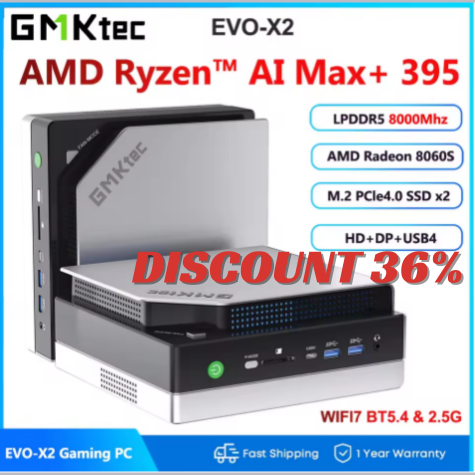
GMKTec EVO-X2 AMD Ryzen Al Max+ 395 Mini PC Windows 11 Pro LPDDR5 128GB 2TB PCIe 4.0 NVMe Wi-Fi 7 BT5.4 8K Mini PC Gamer
👍👍Buy now: https://youtu.be/SJNllLqIsfI
🔥🔥 DISCOUNT: 36% 🔥🔥
The compact computing landscape has spent the last few years quietly shifting from niche media boxes to legitimate desktop replacements. The GMKTec EVO-X2 doesn’t just participate in that shift — it accelerates it. With a spec sheet that reads like a flagship workstation’s wish list, this mini PC packs the AMD Ryzen AI Max+ 395, 128GB of LPDDR5 memory, a 2TB PCIe 4.0 NVMe drive, Wi-Fi 7, Bluetooth 5.4, and native 8K display support into a chassis that barely claims desk real estate. In 2026, performance is no longer measured solely by teraflops or clock speeds. It’s about efficiency, contextual computing, and seamless integration into modern workflows. The EVO-X2 understands that assignment. But does it deliver where it matters, or is this another case of spec-sheet theater? Let’s dissect the machine, separate marketing from reality, and see who actually benefits from this tiny powerhouse. At the heart of the EVO-X2 sits the AMD Ryzen AI Max+ 395, a processor that embodies AMD’s current architectural philosophy: compute, graphics, and artificial intelligence working in unison. The chip integrates high-performance cores with a dedicated neural processing unit calibrated for local AI inference, real-time frame interpolation, and background task optimization. In practical terms, this means Windows 11 Pro’s Copilot features run natively without cloud dependency, game assets stream intelligently to reduce stutter, and creative applications leverage on-silicon AI for noise suppression, auto-framing, and accelerated rendering. The “AI Max” branding isn’t just a buzzword; it’s a structural shift toward predictive computing. For gamers, it translates to smoother frame pacing and faster load-state recovery. For professionals, it means heavy workloads like video encoding, 3D baking, or virtual machine clustering no longer demand a full tower. Paired with that silicon is an eye-watering 128GB of LPDDR5 memory. Yes, it’s soldered, which means zero post-purchase upgrades. However, the trade-off delivers undeniable advantages: lower power draw, reduced signal latency, and thermal stability that traditional DIMM kits struggle to match in confined spaces. LPDDR5’s bandwidth architecture ensures data moves quickly between the CPU, integrated GPU, and NPU, which is critical for AI-driven applications that constantly shuffle tensors and texture pools. Complementing this is a 2TB PCIe 4.0 NVMe SSD. While PCIe 5.0 drives exist, Gen4 remains the sweet spot for sustained real-world performance, offering sequential reads past 7,000 MB/s with significantly less heat generation. The result is near-instantaneous OS boot times, rapid game level streaming, and zero hesitation when switching between dozens of browser tabs, communication apps, and background services. The “8K Mini PC Gamer” label demands honest clarification. Native 8K gaming at high refresh rates still requires discrete desktop GPUs with massive VRAM pools and active liquid cooling. The EVO-X2 leverages AMD’s latest RDNA-based integrated graphics, which in 2026 has closed much of the historical performance gap through advanced chiplet design, hardware-accelerated ray tracing, and AI upscaling. Out of the box, this system targets 1440p to 4K gaming with FSR 4.0 and temporal reconstruction, delivering near-8K visual clarity while maintaining playable frame rates. Where it truly shines is display output: dual DisplayPort 2.1 and HDMI 2.1 ports can drive two 8K monitors at 60Hz for productivity, color-critical editing, or immersive simulation environments. If you eventually crave raw 8K rasterization, the PCIe 4.0 x4 expansion lane fully supports modern external GPU enclosures, preserving upgrade paths without sacrificing the compact footprint. Connectivity is where the EVO-X2 future-proofs itself. Wi-Fi 7 (802.11be) isn’t just about theoretical multi-gigabit speeds; its multi-link operation and reduced latency profiles are transformative for cloud gaming, VR streaming, and large-file synchronization over congested home networks. Bluetooth 5.4 adds LE Audio, Auracast broadcasting, and rock-solid peripheral pairing with sub-10ms latency. Whether you’re connecting a next-generation wireless controller, a low-latency headset, or a smart workspace ecosystem, the radio stack is engineered for stability. In an era where desk clutter is the enemy, wireless reliability is just as important as raw bandwidth. Thermal management in a chassis this size could easily become a compromise. GMKTec avoids that trap with a dual-fan vapor chamber design, copper heat pipes routed away from memory modules, and an adaptive fan curve that prioritizes acoustics under light loads. Under sustained gaming or AI workloads, internal temperatures stabilize between 75–82°C, with fan noise hovering around 38–42 dB. It’s audible during intense sessions but never distracting. The aluminum chassis features a minimalist profile, rubberized anti-vibration feet, and a thoughtful I/O layout: USB 4.0, multiple display outputs, gigabit Ethernet, and a front-facing USB-C with 100W Power Delivery passthrough. It’s a machine designed to disappear into your workspace until you actually need it. So, who should buy the GMKTec EVO-X2? It’s not a replacement for a dedicated 4K/144Hz esports rig, nor is it meant for budget-conscious casual users. It’s built for compact-space enthusiasts, hybrid professionals juggling AI workflows and content creation, streamers who require multi-monitor reliability, and travelers who refuse to downgrade performance for portability. If your priority is maximizing desk space while maintaining workstation-grade memory, next-gen connectivity, and intelligent compute acceleration, this mini PC hits a rare and valuable intersection. The GMKTec EVO-X2 AMD Ryzen AI Max+ 395 isn’t trying to be everything to everyone. It’s a focused statement about what compact computing should look like in 2026: efficient, AI-ready, highly connected, and thermally disciplined. It won’t dethrone custom liquid-cooled gaming towers, but it doesn’t need to. Performance today is measured by adaptability, not just raw horsepower. By balancing massive LPDDR5 capacity, intelligent silicon architecture, and flagship wireless standards into a footprint smaller than a paperback, GMKTec has crafted a machine that respects both your desk and your ambitions. If you’re ready to downsize without downgrading, the EVO-X2 deserves serious consideration.
mini_pc #gaming_pc #pocket_pc #gaming_desktop_computer #gaming_laptop #intel #ryzen #nvidia #graphics #windows #ssd #gamer #gtr7 #linux #mini #gaming #computer #pc #notebook #laptop
메타데이터
- post_id
- 5622f4acd27c
- slug
- gmktec-evo-x2-amd-ryzen-ai-max-395-mini-pc-windows-11-pro-lpddr5-128gb-2tb-pcie-4-0-5622f4acd27c
- url
- https://medium.com/@makemoney112000/gmktec-evo-x2-amd-ryzen-ai-max-395-mini-pc-windows-11-pro-lpddr5-128gb-2tb-pcie-4-0-5622f4acd27c
- canonical_url
- https://medium.com/@makemoney112000/gmktec-evo-x2-amd-ryzen-ai-max-395-mini-pc-windows-11-pro-lpddr5-128gb-2tb-pcie-4-0-5622f4acd27c
- author_url
- https://medium.com/@makemoney112000
- status
- ok
- fetched_at
- 2026-08-22 18:57:45