Why I Kept Coming Back to RedRob AI During the India Runs Hackathon
I’ve tried a lot of “AI resume checker” tools over the last few months. If you’re job hunting right now, you probably have too, and you…
Why I Kept Coming Back to RedRob AI During the India Runs Hackathon
I’ve tried a lot of “AI resume checker” tools over the last few months. If you’re job hunting right now, you probably have too, and you probably know the drill. You upload your resume, wait a few seconds, and get back a big shiny number. 85%. 91%. Sometimes even 95%. It feels good for about ten seconds, and then you realize the tool never actually told you anything. It didn’t tell you if your resume matches the job you’re applying for. It just told you your resume looks like a resume.
That’s the exact problem RedRob AI’s Resume Ranker solved for me, and it’s the main reason I wanted to write this up as part of the India Runs Hackathon, co-hosted by RedRob AI and Hack2Skill.
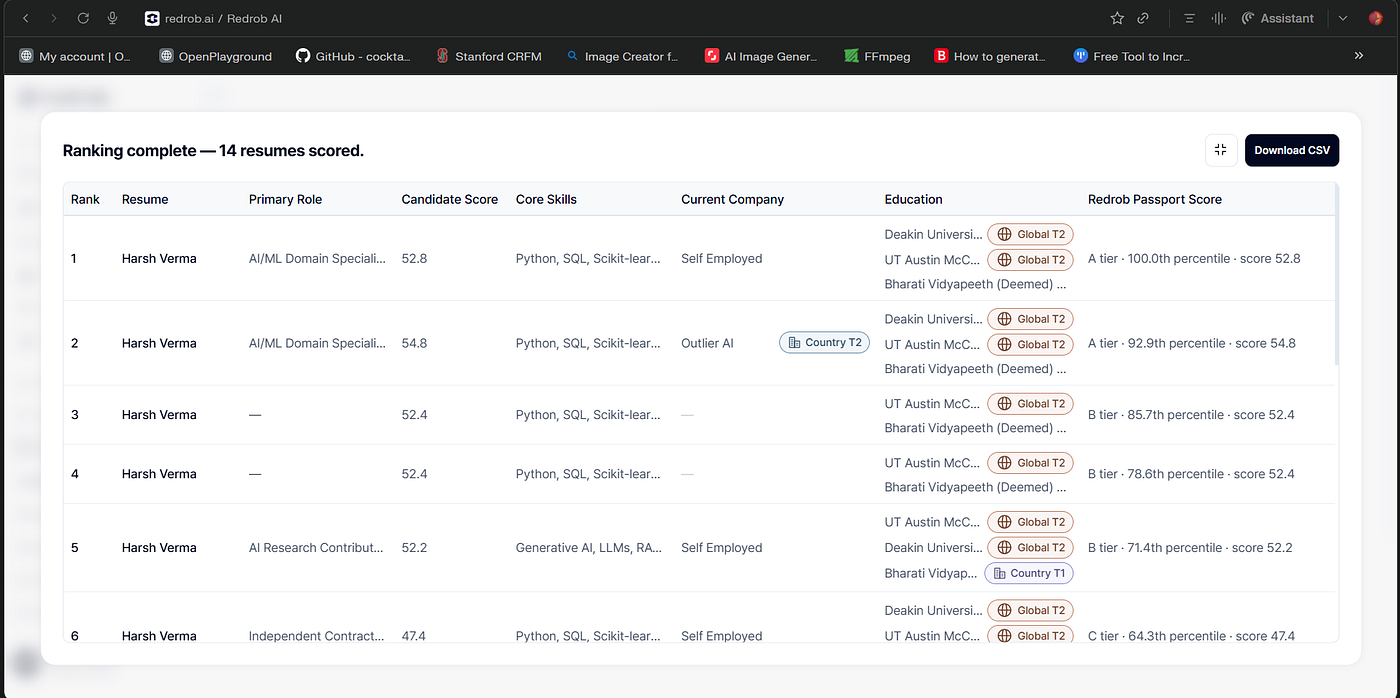
I ran it against a few different real job descriptions over the past week, not just once, because I wanted to see if the scoring logic held up across different kinds of roles. The first test was a Tesco Bengaluru posting for a six-month Business Transformation apprenticeship. I uploaded a batch of my resumes together, and instead of a flat score, I got back a full ranking table. Fourteen resumes scored in one pass, each one broken down by primary role, core skills, current company, education, and something they call a Redrob Passport Score, which combines a tier (A through D) with a percentile against the rest of the batch. My strongest version landed A tier at the 100th percentile with a candidate score of 52.8. A slightly different version of the same resume, one where I’d listed my most recent stint as an independent contractor, actually scored higher on raw points at 54.8, but landed at the 92.9th percentile instead, which tells me the tool isn’t just adding up keyword hits, it’s weighing how each version reads as a coherent package. My weaker drafts dropped all the way down to C tier by the sixth entry. Same person, same core background, different outcomes purely because of how each version was framed.
I ran a second real JD through it too, an internship listing from Fuld & Company for a Software Engineering Intern role on their FuldOne platform, based in Noida, looking for strong Python skills plus experience with FastAPI, Docker, and agentic frameworks like LangGraph. Same pattern held. The ranking table came back with the same kind of granular breakdown, not a generic score copy-pasted regardless of what JD I fed it.
What actually impressed me more than the ranking itself was what happened when I pushed further. I tested a third scenario, an Associate AI Product Manager JD, and instead of just accepting the score, I asked it directly what the top keyword and skill gaps were between my resume and that specific JD. It didn’t dodge the question. It pulled out the five actual requirements from the posting, product management fundamentals, AI/ML exposure, cross-functional communication, technical comfort, and responsible AI practices, then compared each one against what my resume actually showed and told me plainly where the gaps were.
I pushed it one step further and asked for concrete fixes. It came back with specific, usable suggestions instead of vague advice. It told me to quantify the business impact on my SuperKart project instead of just describing what it does, gave me an example of how that sentence should read with real percentage placeholders. It told me to build out a dedicated section for product management experience, and named the exact transferable skills to surface, things like PRD framing and roadmap thinking, which aren’t skills I would have thought to call out on my own even though the underlying experience was already there. That’s a genuinely different experience from a tool that just tells you to “add more keywords.”
I also uploaded my resume separately and asked for a general review against the same AI Product Manager target, no JD attached this time, just a role title. It gave me a structured strengths breakdown, technical skill depth, practical project experience through things like SuperKart and my Medical Assistant RAG pipeline, and flagged my education, the PGP in AI/ML from UT Austin McCombs through Great Learning, plus my incoming Master of Data Science at Deakin, as a real credential strength rather than just listing it back at me.
I also spent some time in their lead generation and people search feature, mostly out of curiosity since I’m still a student and don’t have an immediate use case for it. You can filter people by geography, down to whether you want candidates from tier one or tier two countries, by the field they’re hired into, by seniority or position level, and by education background. Even without a real use case right now, the granularity was obvious. If I were on the hiring side of the table or building out a team for one of my own projects down the line, this is the kind of filtering that actually saves time instead of just generating a longer list to sort through manually.
The one part of the platform that’s clearly still finding its feet is the image creation tool. It’s in beta, and it shows. I don’t think that’s a knock against the team, most AI image tools take a while to get consistent, and I’d rather a platform ship something early and iterate than hold back a feature that’s 80% there.
Overall, what stood out to me about RedRob AI wasn’t a single killer feature, it was that the Resume Ranker actually understood the relationship between a resume and a job description instead of scoring a resume in isolation, and it kept that same level of understanding when I pushed it further with follow-up questions. For anyone prepping applications right now, especially students stacking multiple versions of the same resume for different roles, that’s a genuinely useful thing to have.
This was written as part of the India Runs Hackathon, co-hosted by RedRob AI and Hack2Skill.


#redrobai #hack2skill #indiaruns
메타데이터
- post_id
- 5624c095fdec
- slug
- why-i-kept-coming-back-to-redrob-ai-during-the-india-runs-hackathon-5624c095fdec
- url
- https://medium.com/@vharsh26_10924/why-i-kept-coming-back-to-redrob-ai-during-the-india-runs-hackathon-5624c095fdec
- canonical_url
- https://medium.com/@vharsh26_10924/why-i-kept-coming-back-to-redrob-ai-during-the-india-runs-hackathon-5624c095fdec
- author_url
- https://medium.com/@vharsh26_10924
- status
- ok
- fetched_at
- 2026-07-14 19:39:34

